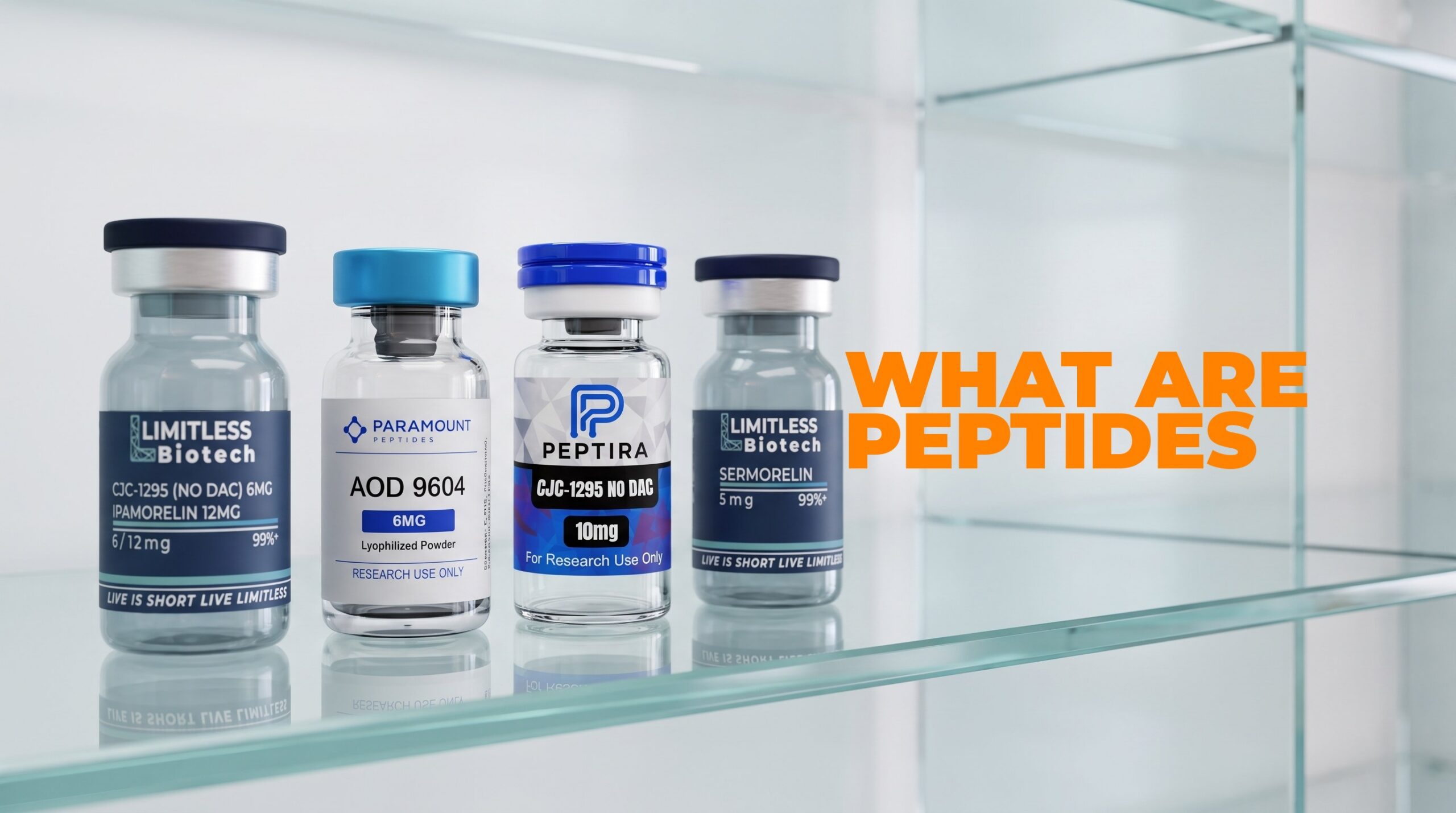
What Are Peptides? The Beginner Guide That Actually Makes Sense
Key Takeaways
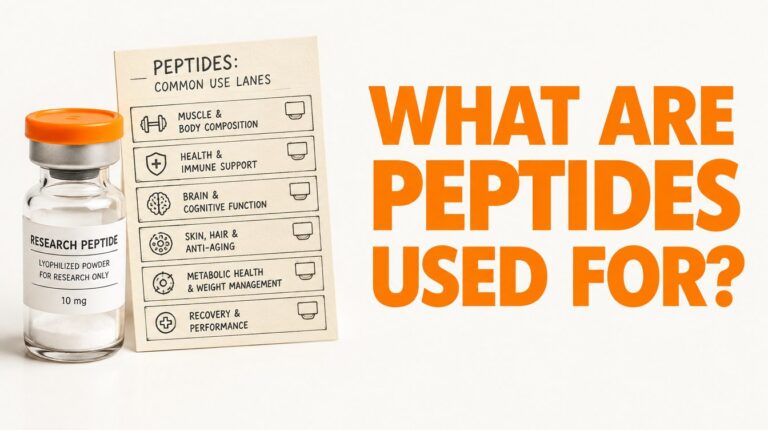
- What are peptides? Short chains of amino acids. Same bricks as proteins. Shorter. Most of the ones people argue about are signals, not construction lumber.
- A peptide is not automatically a hormone. Hormones can be peptides (insulin, GLP-1). Most research-catalog compounds are receptor notes, not a second endocrine axis in a vial.
- Three buying lanes: FDA-approved pharmacy drugs, compounding under a prescription, and research catalogs with a named sequence and a COA. Gray market is not one of those.
- Oral vs injectable is a route, not a personality. This page is education and research, not a protocol, a treatment, or a cure.
People hear “peptide” and paste three different molecules into one word. Insulin. A collagen scoop. A freeze-dried cake from a research catalog. A GLP-1 pen. A cream that says “peptide” on the box because marketing found a syllable that converts.
That is not a category. That is a pile.
This page answers what are peptides. Protocol depth, stacks, and classroom schedules live in Pro. I am not dumping a screenshot-friendly dose chart so a stranger can call it “Lee’s protocol.”
What are peptides actually — versus a protein?
Start with the chemistry, not the brand name.
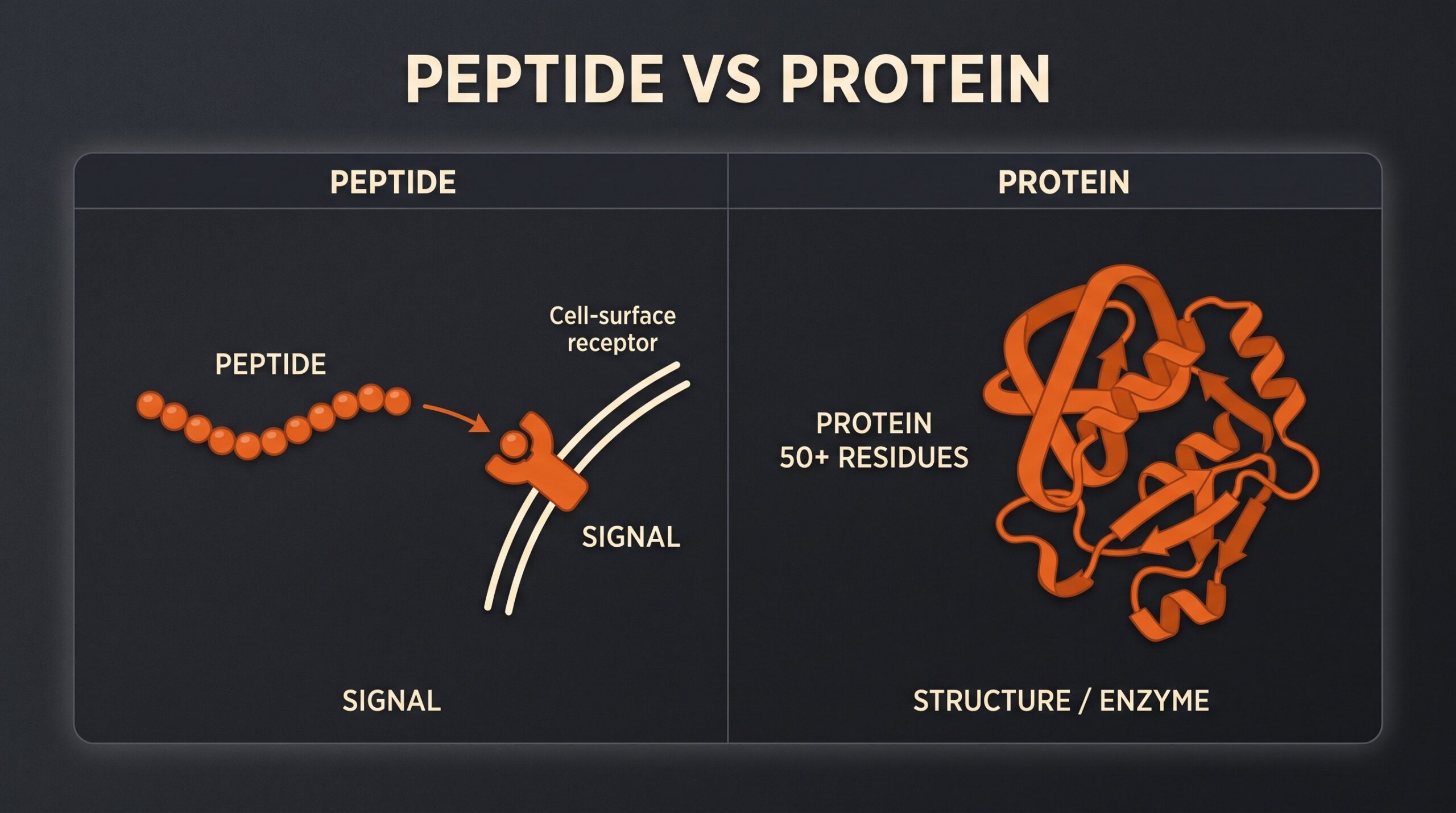
A peptide is a chain of amino acids joined by peptide bonds. Amino acids are the bricks. The bond is an amide. String enough bricks and chemists say polypeptide. String more, and they say protein. Same construction. Different length. Different folding. Different job.
The IUPAC-IUB nomenclature is blunt about the fuzzy cutoff. Oligopeptides: fewer than about 10 to 20 residues. Longer: polypeptides. Specific-sequence chains over about 50 residues are usually called proteins, “but authors differ greatly on where they start using this term.” Insulin sits on the line at 51 and gets called a protein hormone. GLP-1 is 30. Do not die on the number. Die on the function.
Proteins are the workforce. Enzymes. Collagen. Hemoglobin. They fold into shapes that do work. Peptides, in the conversation you clicked into, are closer to messages. Short enough to bind a receptor, flip a switch, and leave. Wang and colleagues, 2022, in Signal Transduction and Targeted Therapy, put therapeutic peptides in the gap between small-molecule drugs and big protein biologics (review). Small enough to be specific. Big enough to be a real signal.
Your body already makes them. Insulin. Oxytocin. GLP-1. Thymosin β4. Fragments of gastric juice. A research catalog sequence is usually a synthetic stand-in for a signal that already exists, or a close analog. That is not “giving your body more protein.” Whey is lumber. A 15-amino-acid gastric fragment is a note taped to a specific door.
Two examples. BPC-157 is a 15-amino-acid gastric fragment: cytoprotection, GI models, and a preclinical pile on rodent tendon and muscle. Chang, 2011, tied tendon-fibroblast outgrowth to the FAK-paxillin pathway (paper). Oral vs pin is a route: Is Oral BPC-157 Worth It?
TB-500, as careful vendors sell it, is synthetic thymosin β4: 43 amino acids. Day job is binding G-actin so a cell can move. Goldstein, Hannappel, and Kleinman, 2005, framed Tβ4 as the major actin-sequestering molecule in eukaryotic cells (paper). Some catalogs stamp TB-500 on a short fragment. A fragment is not “the same thing, cheaper.” Full filter: TB-500 vs BPC-157. If you cannot tell them apart, you are not ready to spend money.
Signals versus hormones — stop collapsing the two
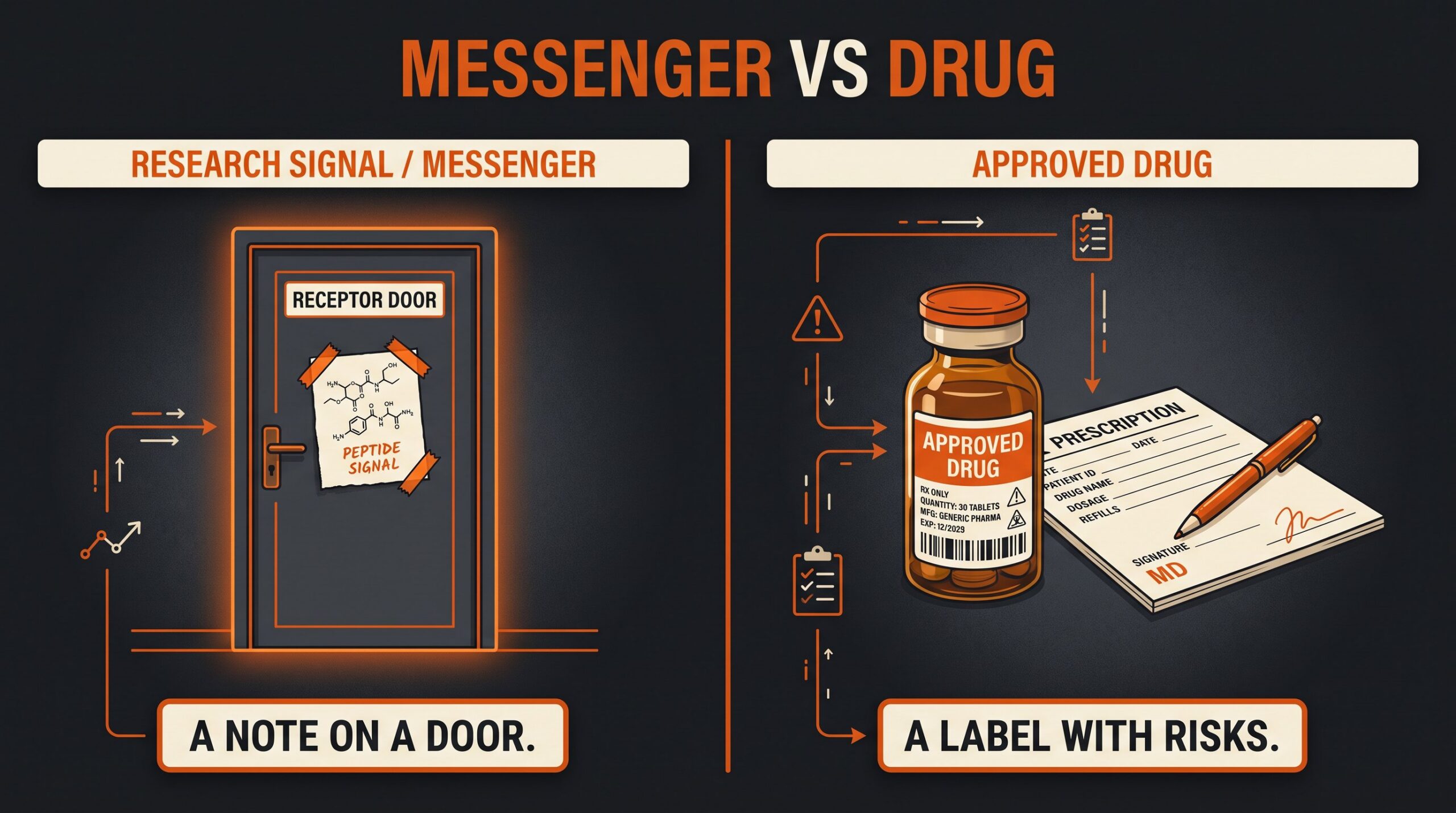
A hormone is a system-wide broadcast. Insulin is a peptide hormone. GLP-1 is a peptide hormone analog when it is a labeled drug. Oxytocin is a peptide hormone. Receptors, feedback loops, and, in the pharmacy lane, a label with risks attached.
Most of what people mean by “peptides” in a research catalog are not that. They are short sequences aimed at a receptor or a local process. A gastric fragment is not growth hormone. A thymosin analog is not testosterone. A copper tripeptide in a serum is not “HRT in a dropper.”
Some research compounds sit next to an axis on purpose. Growth-hormone secretagogues talk to the GH conversation without being GH in a vial. That still does not make every lyophilized cake “a hormone.” Signals get quieter with age. That psychology is real. It is not a coupon, and it is not a reason to treat ordinary aging as a disease you reverse with a research chemical. Research tools, and in a few cases actual drugs. Different lanes.
Research vs compounding vs the gray market
“Peptide” is not a legal status. It is a length of chain. The lane you buy from decides what you actually hold.
| Lane | What it is | Examples | What it is not |
|---|---|---|---|
| Pharmacy / FDA-approved | A finished drug that ran trials, has a label, and requires a prescription for the approved use. | Insulin. Semaglutide. Tirzepatide. | Not a research chemical. Not “the same thing from a cheaper catalog.” |
| Compounding pharmacy | A custom fill under a licensed clinician (503A patient-specific or 503B outsourcing). Not FDA-approved the way a branded drug is. | Prescription fills when a clinician decides an approved product does not fit. | Not a gray-market vial with a dragon logo. |
| Research catalog | A named sequence, usually lyophilized, sold for laboratory research. COA or it is a rumor. Label often says not for human consumption. | BPC-157. TB-500 / Tβ4. Many GH-secretagogue analogs. | Not FDA-approved for the gym uses people assign to them. Not a supplement. |
| Gray market | Unlabeled or mislabeled product, no real COA, no address, sold as if it were pharmacy or research-grade. | Instagram vials. Mystery blends. “Same as the clinic” claims. | Not compounding. Not a shortcut. |
| Supplement aisle | Food, hydrolysates, and cosmetics that borrowed the word. | Collagen peptides. “Peptide” serums. Protein powder. | Not a 15-residue research fragment. Eating collagen is not running BPC-157. |
Insulin is a peptide. It is also one of the most regulated medicines on earth. Semaglutide is a peptide analog of GLP-1 with outcomes data and a clinician attached. You do not “research” it the way you research a catalog vial.
The research lane is where most Peptides & Pump education lives. BPC-157, TB-500, and the GH-secretagogue analogs are not approved for the gym uses people assign to them. Most of the published pile is preclinical. Animal tendon is not your rotator cuff. No sequence, molecular weight, purity, or endotoxin on the paperwork: you are not shopping. You are donating. Gray market borrows the vocabulary of the other lanes. If the only proof is a group-chat screenshot, walk away.
Athletes: several research-community compounds sit on the WADA prohibited list. If you test, this is not a gray-area hobby. Free filter talk: Peptides & Pump Knowledge Base on Skool. Bring the label and the COA.
Why reconstitution exists — and why oral is not a weaker pin
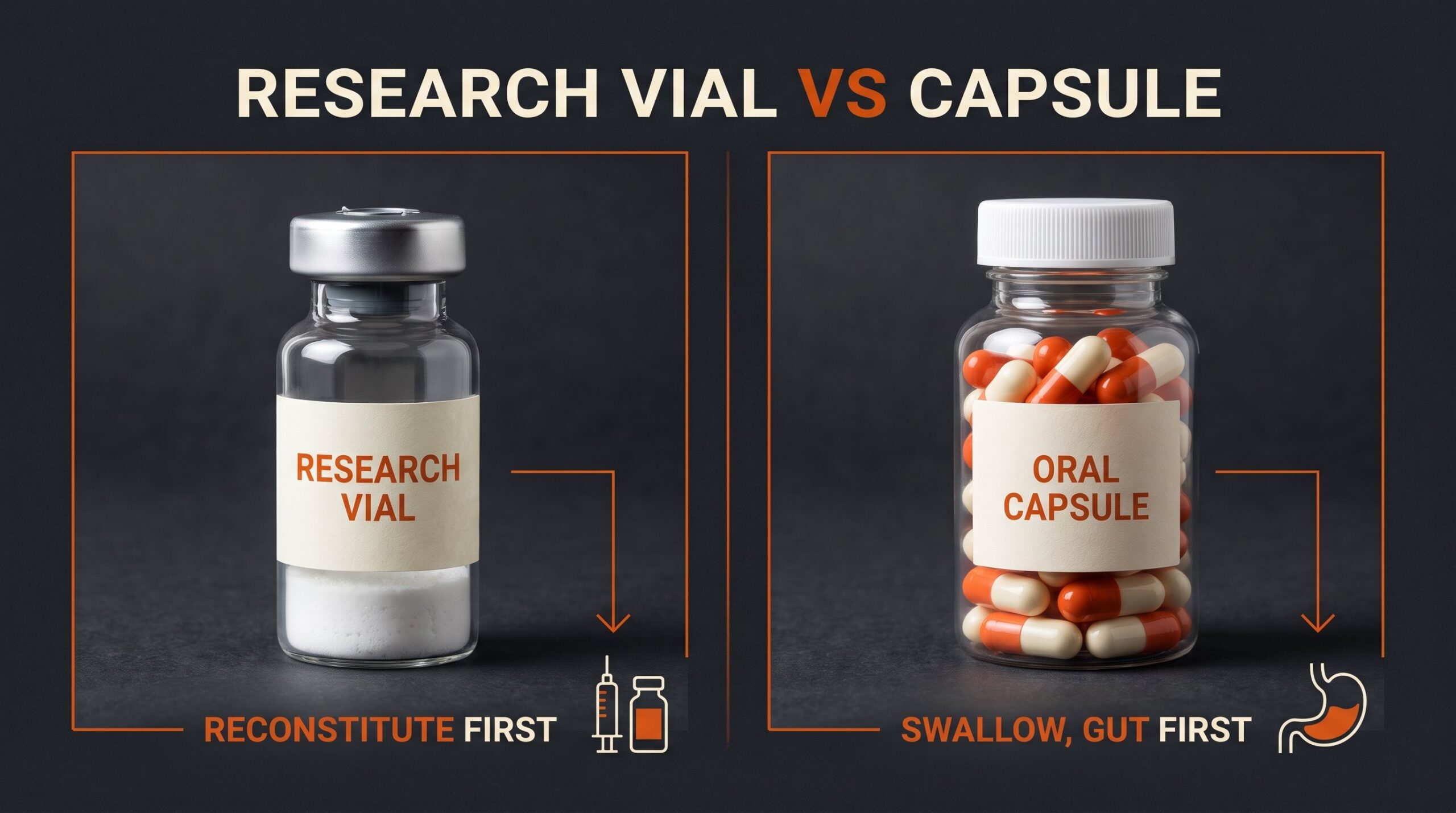
Most research peptides ship as a lyophilized cake. Freeze-dried on purpose. Stable enough to mail. Useless as a powder in a syringe. Reconstitution is dissolving that cake in a sterile diluent so you have a known volume. You are not “activating” it. Water on a warehouse shelf wrecks most of these sequences. The cake is logistics, not a ritual.
If that already feels like a foreign language, do not order the vial yet. Mixing skill: How to reconstitute peptides (without wasting 10% of the vial). Cloudy vial means you stop. I am not reprinting the protocol library here. Mastery lives in Pro.
Oral vs injectable is a route, not a courage ranking. Most peptides die in the stomach, which is why a pin is the default for a systemic or local research vial. BPC-157 is the annoying exception: unusually stable in gastric juice, so a capsule can match the lining as the workplace. Swallowing a capsule for a cranky shoulder is still the wrong route. Convenience is not a mechanism.
How to start without stacking five vials
One goal. One compound. One route. That is the whole beginner filter, and I am still not writing doses on a public page. If you are still asking what are peptides at the shopping-cart stage, you are not late. You are doing it in the right order.
If you cannot name the tissue or the job, you are not ready to name the peptide. Go back to Start Here and pick one. Healing a structure is not a gut lining — the tissue clocks are in how long peptides for healing take — which is not a GH-axis conversation, which is not peptides for weight loss. Busy is not a mechanism.
Do not start with a blend because the catalog sold a blend. Two sequences in one cake is two variables you cannot separate. Recipe cards stay in Pro. Track sleep, next-day training response, morning stiffness. Write a start date on the bottle. Foundations still win. Peptides sit on top of habits. They do not replace them.
Where beginners usually start
Match the lane. Then buy one thing.
Gut-route, off a needle while you learn: third-party-tested Limitless BPC-157 capsules, 250 mcg, code LEE20 in the URL. Same code on the Limitless store. Not a stealth tendon protocol.
Local research vial: BioLongevity BPC-157, 10 mg, code LEE15. Thymosin β4 / actin / migration: BioLongevity TB-500, 10 mg, same LEE15 — confirm the lot is the 43-amino-acid sequence. The BioLongevity home takes LEE15 at checkout. USA-made option: Limitless TB-500, LEE20.
Gut-stack only if you already understand the extras: BioGutPro. People also ask about BioRestore for a combined repair-class formula. Use code LEE15 at checkout. Start with one compound you can explain.
Frequently asked questions: what are peptides
What is the difference between a peptide and a protein?
Length, folding, and job. Same amino-acid bricks. Peptides are shorter chains, often signals. Proteins are longer, folded, and do structural or enzymatic work. IUPAC puts the usual protein cutoff around 50 residues and admits authors fight about it. Your whey shake is not a research peptide.
Are peptides the same thing as hormones? Or steroids?
No, and no. Some hormones are peptides. Most research peptides are not hormones. Anabolic steroids are synthetic androgens. Different chemistry, different receptors, different risk conversation. “Peptides are safer than steroids” is still not a green light.
Do I have to inject peptides?
No. Route follows the job. Oral BPC-157 is a gut-lining conversation. Topical GHK-Cu is a skin conversation.
If the search was a glow peptide — GHK-Cu versus the GLOW blend versus Klow — that is a different map than this beginner page.
Subcutaneous injection is common for systemic or local research vials because most peptides die in the stomach. If the compound is a lyophilized cake, you still have to reconstitute it.Are peptides legal?
The word is legal. The product is a lane. FDA-approved peptide drugs are medicines with a prescription for labeled uses. Compounding sits under a clinician. Research chemicals labeled not for human consumption are research materials, not approved treatments. Gray-market mystery vials are not “research” because someone said the word. If you compete in tested sport, WADA is the list that matters.
Can I take multiple peptides at once?
People do. Forums call it a stack. Two mechanisms still need two reasons. There is no high-quality human trial that blesses a five-vial beginner cart. Mastery lives in Peptides & Pump Pro, not in a blog comment.
Are collagen peptides the same as BPC-157?
No. Collagen peptides are hydrolyzed protein you swallow as food. BPC-157 is a 15-amino-acid gastric fragment. Same last name. Different molecule, different lane.
What does reconstitution actually mean?
Dissolving a freeze-dried cake in a sterile diluent so you have a known concentration. Not a ritual. Not “activating” the peptide. The how-to is the reconstitution article. Full classroom schedules stay in Pro.
The bottom line
What are peptides? Short amino-acid chains. Usually signals. Not proteins, not steroids, not a collagen tub, not a personality.
Pick the lane before you pick the SKU. Pharmacy, compounding, research catalog, gray market, and the supplement aisle are not interchangeable. Oral vs injectable is a route. Reconstitution exists because the cake is a shipping form. If you cannot tell TB-500 from BPC-157, you are not ready to buy either.
I built Peptides & Pump so people who still train can get this without a guru tax. Protocol library and a place to think out loud before you spend: Peptides & Pump Pro. It is $10 a month. Seven-day free trial. Cancel anytime. Not ready to pay? Use the free Knowledge Base first.
Do the reading. Respect the research. Do not let a vial, or a capsule, think for you.
Free guide
Get The Peptide PlaybookEnter your email and we’ll send the research PDF. Education only — not medical advice.
 Keep going on Peptides & Pump
Free is the peptide community. Pro is where you master it.
Free
Knowledge Base
The peptide community · 2,500+
- 2,500+ member peptide community
- Sourcing questions before you buy anything random
- The basics, from people actually using peptides
Pro
Peptides & Pump Pro
$10/mo · 7-day trial
- Science-backed protocol library
- 1-on-1 support from Lee and Matt
- Step-by-step video, plus a monthly $500 drawing
LEE20 Limitless LEE15 BioLongevity LEE10 Paramount LEE Peptira LEE10 S1
Next reads
Supplier footnote: Other research suppliers I mention when people ask: Paramount, Peptira (code LEE), and S1 Research (code LEE10). Match the product to the job. Do not collect bottles.
Disclaimer. Educational and research purposes only. Not medical advice. Not intended to diagnose, treat, cure, or prevent any disease. Research peptides discussed here (BPC-157, TB-500 / thymosin β4, GHK-Cu, and related compounds) are not FDA-approved for the uses people assign to them online. FDA-approved peptide drugs (insulin, certain GLP-1 agonists) are separate, labeled medicines. Most published evidence for research-community compounds is preclinical. Consult a qualified healthcare provider before starting any peptide or protocol, especially with a medical condition, prescription medication, or tested-sport status. Peptides & Pump does not sell peptides.
Affiliate disclosure. Some links are affiliate links. If you buy through them, I may earn a commission at no extra cost to you. Codes LEE15, LEE20, LEE10, and LEE are the ones I use. I only link suppliers I am willing to put my name on.
83 Comments