PT-141 (Bremelanotide): Desire Research + Rx Map
Key takeaways
- PT-141 is the research name. The FDA-approved medicine is bremelanotide (brand Vyleesi) — a melanocortin receptor agonist, not a PDE5 “blood-flow” drug.
- Approved use is narrow: acquired, generalized hypoactive sexual desire disorder in premenopausal women, after a clinician confirms the diagnosis. It is not a performance enhancer and not a casual weekend peptide.
- Evidence limits: Phase 3 RECONNECT data and an FDA label exist for the branded autoinjector. A research-catalog vial labeled PT-141 is not that autoinjector. Do not mash the lanes.
- Three access lanes stay separate: approved Rx (Vyleesi), clinician-directed care, and research catalogs. Name the lane before you name the SKU.
- Education only. Sexual-health questions belong with a qualified clinician. Full protocols stay in Peptides & Pump Pro.
People type PT-141 like they found a peptide version of Viagra.
They found a different map.
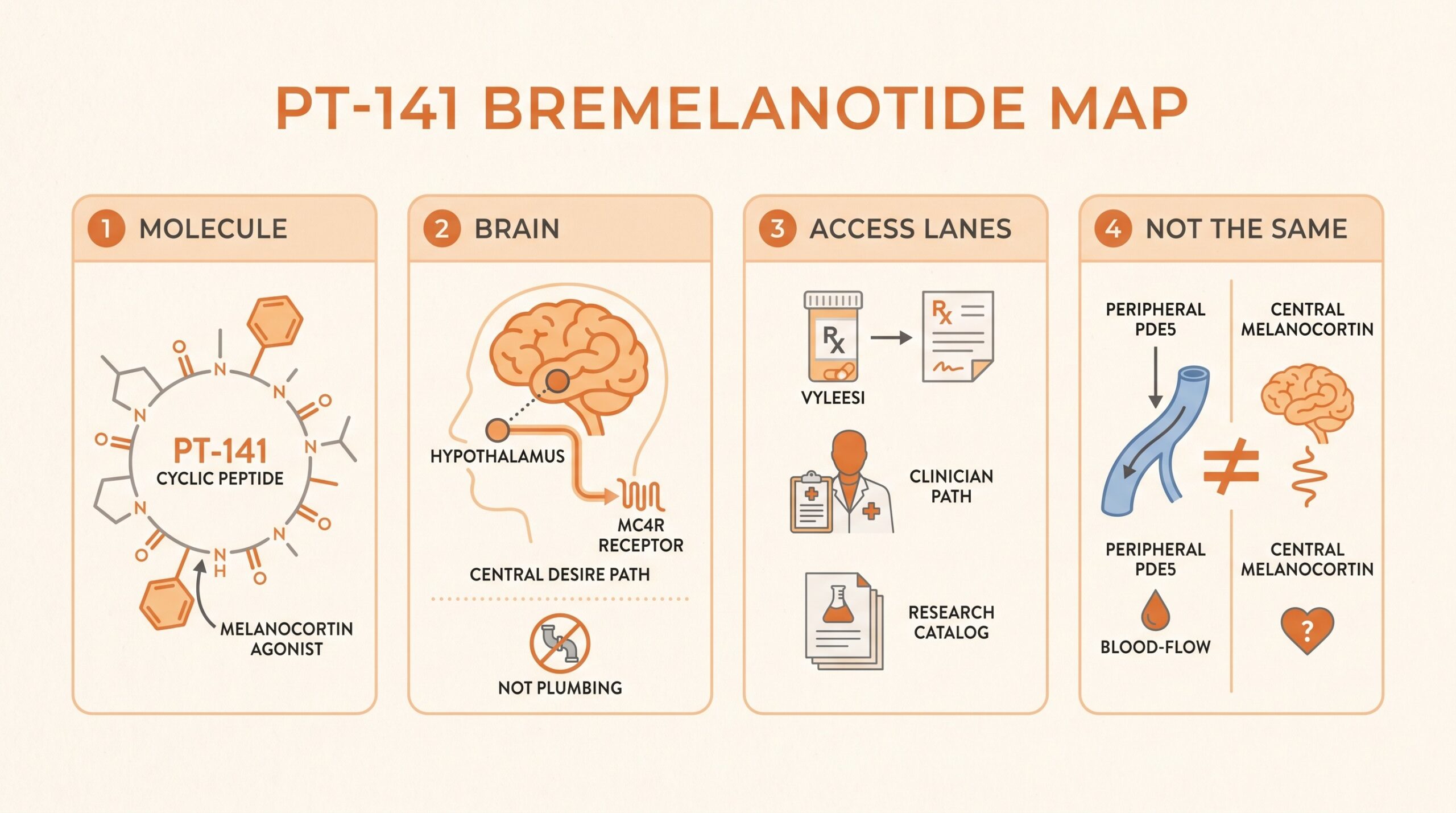
PT-141 is bremelanotide. Same molecule family you will see under the brand name Vyleesi when the conversation is about an FDA-labeled medicine. It is a short cyclic peptide built to hit melanocortin receptors — especially paths in the brain tied to desire and arousal. That is not the same job as a PDE5 inhibitor. Those drugs are about blood flow in the pipes. This one is about a signal upstream.
This page is the PT-141 / bremelanotide research + Rx map. Soft neighbors: Start Here, what are peptides, how to reconstitute peptides, NAD+, and how to sleep better. Stay here if you typed PT-141, bremelanotide, Vyleesi, melanocortin, or “the desire peptide.”
This is education. It is not medical advice. It is not a treat-ED hustle. It is not a substitute for clinician care. Sexual health is YMYL territory — get the diagnosis and the lane right before you get excited about a bottle.
What is PT-141 / bremelanotide?
A peptide is a short chain of amino acids. Bremelanotide is a cyclic heptapeptide. Research and forum talk still say PT-141. The FDA-approved subcutaneous autoinjector is branded Vyleesi.
So what is PT-141, in plain terms? A melanocortin receptor agonist. At the doses that matter clinically, the story leans on MC1R and MC4R. MC4R shows up in brain regions that help regulate sexual desire. MC1R also lives on pigment cells in skin — which is why pigmentation talk shows up in the safety file.
Analogy: think thermostat, not pipe wrench. A PDE5 drug is closer to opening valves in the plumbing so blood can move. Bremelanotide is closer to turning a thermostat in the control room upstairs. Same house. Different floor. Different tool.
How PT-141 is different from Viagra-class drugs
You do not need a urology fellowship. You need two jobs.
| Lane | What it actually is | What the evidence talk is | What it is not |
|---|---|---|---|
| PDE5 inhibitors | Peripheral blood-flow medicines (sildenafil, tadalafil, and cousins) | Large approved-drug files for erectile dysfunction in men | Not melanocortin agonists. Not Vyleesi. Not a research-catalog PT-141 vial |
| Bremelanotide / Vyleesi | Melanocortin receptor agonist autoinjector | FDA-approved for HSDD in premenopausal women; Phase 3 RECONNECT program | Not a performance enhancer. Not indicated for men or postmenopausal women on the label |
| Research-catalog PT-141 | Research-use presentation sold for lab research | Identity and purity claims on a catalog page — not a finished drug label | Not the Vyleesi autoinjector. Not a clinic protocol by itself |
You can be curious about all three. You cannot mash a PDE5 Reddit stack, a Vyleesi label, and a freeze-dried research cake into one weekend protocol and call it the same medicine.
Mechanism map (brain path, not plumbing)
Search volume is not a protocol. A caption that says “liquid Viagra” is not a protocol either.
Start with the receptors. Not the bottle.
- Melanocortin system in one sentence: a family of receptors that help the body read signals tied to pigmentation, energy, and — for MC4R in particular — sexual behavior circuits in the brain.
- MC4R in one sentence: a receptor concentrated in hypothalamic regions such as the medial preoptic area. Animal and review work ties activation here to desire and arousal pathways that involve dopamine release upstream of behavior.
- Why this matters: if desire is the complaint, a blood-flow drug may be the wrong floor of the building. If blood flow is the complaint, a central melanocortin agonist may be the wrong tool. Name the problem before you name the peptide.
A 2022 CNS Spectrums review walks the neurobiology story for bremelanotide in premenopausal HSDD. Classic early human work under the PT-141 code tested subcutaneous and intranasal forms years before the Vyleesi label. History is not a shopping list.
Stop-you stat: in the FDA clinical development program for the approved autoinjector, nausea showed up in about 40% of people — the most common side effect on the public safety summaries. Flushing and headache were also common. This is not a “side-effect-free weekend peptide” caption.
Evidence limits, stated plainly:
- The approved indication is HSDD in premenopausal women when a clinician says that diagnosis fits — and when low desire is not better explained by another medical problem, relationship problem, or medication effect.
- The label is not an indication for men, postmenopausal women, or “enhance sexual performance.”
- Transient blood-pressure rise and heart-rate drop can follow a dose. Uncontrolled hypertension and known cardiovascular disease are contraindications on the branded product.
- A research catalog is for research chemistry literacy. It is not a substitute for a labeled autoinjector or a clinician visit.
What the clinical file actually says
The Phase 3 story is the RECONNECT program. Kingsberg and colleagues published two identical randomized, double-blind, placebo-controlled trials in Obstetrics & Gynecology in 2019. Premenopausal women with HSDD used subcutaneous bremelanotide 1.75 mg as needed for 24 weeks versus placebo.
Both trials met their coprimary endpoints: sexual desire scores improved and distress related to low desire fell versus placebo. That paper is PubMed 31599840. Later papers add subgroup analyses, integrated safety, and mechanism reviews. Early PT-141 work from the mid-2000s sits upstream of the branded label — useful history, not a DIY recipe.
FDA approved Vyleesi in 2019. On-label teaching points from public labeling include as-needed subcutaneous use at least 45 minutes before anticipated sexual activity, no more than one dose in 24 hours, and a monthly dose-count ceiling. Those details live on the label and with a clinician. They are not a research-catalog dosing table on this free page.
Access lanes: Rx vs clinician path vs research catalog
Most confusion starts here.
- Approved Rx lane: Vyleesi autoinjector through a legitimate pharmacy path after a clinician decides it fits. Label, contraindications, counseling, follow-up.
- Clinician-directed lane: evaluation for HSDD or related sexual-health concerns, med review, relationship and mood context, and decisions that may or may not include a melanocortin agonist.
- Research-catalog lane: freeze-dried PT-141 presentations sold for laboratory research. Useful for identity literacy. Not a branded medicine. Not medical advice. Not “the same as Vyleesi with a coupon.”
If you are here because desire crashed after stress, poor sleep, a new antidepressant, relationship friction, or low hormones, start with the human problem. Peptides do not replace sleep, relationship work, or a meds review. Adjacent foundation reading: how to sleep better and NAD+.
Myths that waste money (and trust)
- “PT-141 is just peptide Viagra.” Wrong floor. Different mechanism neighborhood.
- “If Vyleesi is FDA-approved, every catalog vial is the same thing.” No. Lane mismatch.
- “It is for anyone who wants better sex this weekend.” The approved indication is specific. Performance marketing is not a diagnosis.
- “Nausea means it is working hard.” Nausea is a common adverse effect, not a badge of honor.
- “Self-experiment and stack it with whatever the forum said.” That is how people turn a research map into a medical problem. Do not do that.
How to think about next steps
If low desire is causing real distress, talk to a clinician who takes sexual health seriously. Bring the full picture: meds, mood, sleep, pain, relationship context, and cardiovascular history. Ask whether HSDD is even the right frame. Ask whether a melanocortin agonist belongs on the table — or whether something upstream needs fixing first.
If you are reading because a research catalog listed PT-141, keep the literacy job and the treatment job separate. Reconstitution math for research literacy lives on how to reconstitute peptides. Beginner peptide language lives on what are peptides. Protocol depth stays in Pro on purpose.
Partner research options (catalog literacy)
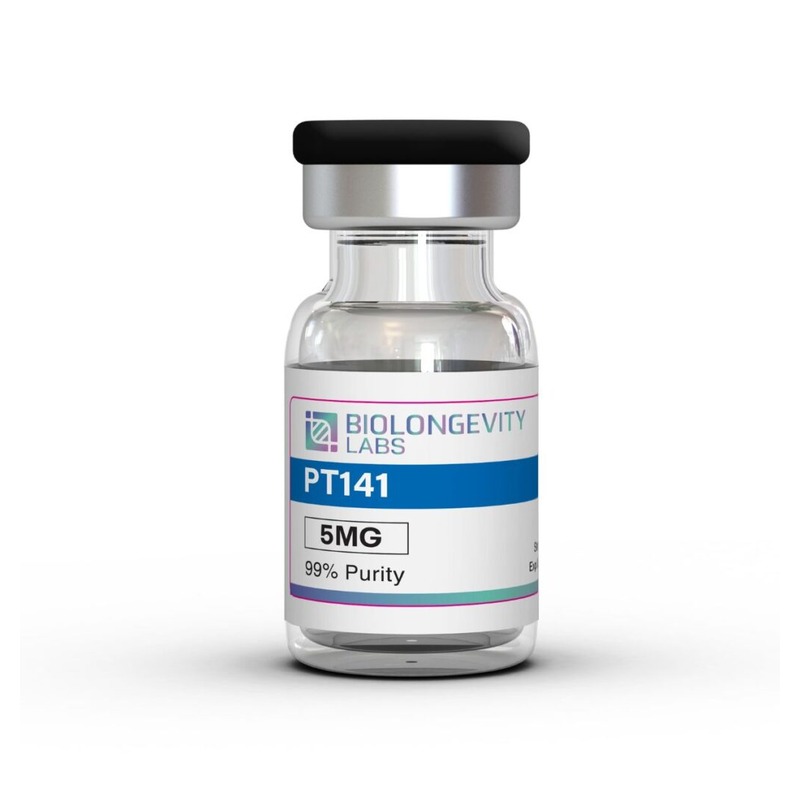
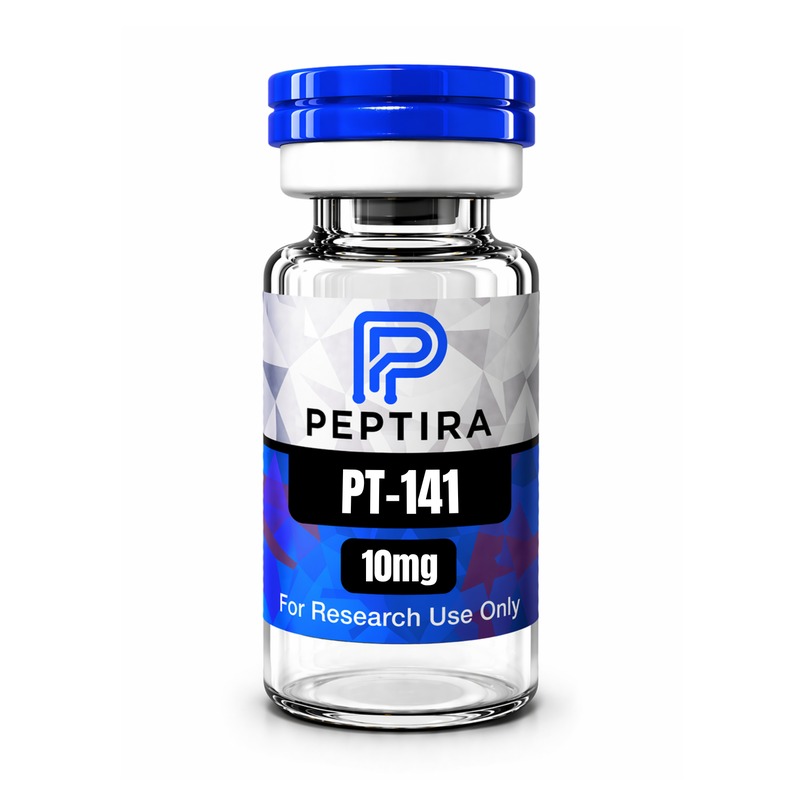
BioLongevity lists a PT-141 5 mg research presentation with code LEE15. Peptira lists a PT-141 research presentation with code LEE. Limitless has sheet rows for injectable and nasal-spray PT-141 presentations with code LEE20 — browse from the home chip when a product page is gated. Paramount and S1 do not have named PT-141 rows in the affiliate sheets I use, so they stay as home / shop chips only. I am not inventing a live card where the sheet has no SKU.
Research-catalog SKUs currently live on partner pages (not a treatment recommendation).
FAQs
Is PT-141 the same as Vyleesi?
Same active molecule family in the naming trail: PT-141 is the research code; bremelanotide is the drug name; Vyleesi is the branded autoinjector. A research-catalog vial is still not the labeled medicine.
Does PT-141 treat erectile dysfunction?
Early research explored male sexual response and combinations with PDE5 drugs. The FDA-approved indication for Vyleesi is HSDD in premenopausal women — not ED treatment marketing. Do not treat a caption as a urology plan.
Is a research PT-141 vial medical advice?
No. Catalog literacy is not a prescription. If desire distress is the real problem, start with a clinician.
Why do people mention nausea so much?
Because it is common in the clinical file. Plan for it in any clinician-directed conversation. It is not proof the peptide “hit.”
Can I just run a PT-141 protocol from a forum?
You can do a lot of unwise things. I would not. Name the chemical. Name the lane. Sexual-health self-experimentation without context is how people get hurt. Protocol depth lives in Pro on purpose.
Sources & Further Reading
Verified starting points. Classic early PT-141 work, Phase 3 primaries, mechanism and safety reviews. Not a protocol. Not a drug label. Not an endorsement to self-treat.
- RECONNECT Phase 3 trials, Obstet Gynecol 2019 — PubMed 31599840
- Neurobiology of bremelanotide for HSDD, CNS Spectr 2022 — PubMed 33455598
- Early PT-141 subjective sexual response in women, J Sex Med 2006 — PubMed 16839319
- Subcutaneous PT-141 safety / PK / PD evaluation, Int J Impot Res 2004 — PubMed 14999221
- Intranasal PT-141 double-blind evaluation, Int J Impot Res 2004 — PubMed 14963471
- Safety profile across clinical development, J Womens Health 2022 — PubMed 35147466
- RECONNECT subgroup analyses, J Womens Health 2022 — PubMed 35230162
- Review: bremelanotide for female HSDD, Neurol Int 2022 — PubMed 35076581
- Evaluation of bremelanotide injection for HSDD, Expert Opin Pharmacother 2023 — PubMed 36242769
Selected references above are Tier-1 style PubMed entries. Read primary sources. Do not treat a PubMed ID as a shopping list.
The bottom line
PT-141 is bremelanotide. Melanocortin agonist. Brain-path desire map — not a PDE5 pipe wrench. Real Phase 3 file. Real FDA-labeled medicine under the Vyleesi brand for a narrow HSDD indication. Research catalogs are a different lane.
Keep the lanes. Read the papers. Talk to a clinician about sexual-health distress. Do not buy a research cake because a caption told you it was weekend Viagra.
If you need the beginner on-ramp, use Start Here and what are peptides. Reconstitution literacy: how to reconstitute peptides. Foundation neighbors: how to sleep better and NAD+.
Free guide
Get The Peptide PlaybookEnter your email and we’ll send the research PDF. Education only — not medical advice.
I built Peptides & Pump so you can get this without a guru tax. If you want the protocol library, member discussions, and a place to think out loud before you spend money, that is Pro. If you are not ready to pay, use the free Knowledge Base first. Then come back and argue with me when you have read more than a caption.
 Keep going on Peptides & Pump
Free is the peptide community. Pro is where you master it. Codes are the links. Click them so the discount fires.
Free
Knowledge Base
The peptide community · 2,500+
- 2,500+ member peptide community
- Sourcing questions before you buy anything random
- The basics, from people actually using peptides
Pro
Peptides & Pump Pro
$10/mo · 7-day trial
- Science-backed protocol library
- 1-on-1 support from Lee and Matt
- Step-by-step video, plus a monthly $500 drawing
LEE20 Limitless LEE15 BioLongevity LEE10 Paramount LEE Peptira LEE10 S1
Supplier footnote: Research suppliers I mention when people ask about PT-141 research presentations: BioLongevity PT-141 5 mg (code LEE15) and Peptira PT-141 (code LEE). Browse wider catalogs via Limitless home (code LEE20), Paramount home (code LEE10), and S1 shop (code LEE10). Match the product to the job. Do not collect bottles. A research catalog is not a labeled sexual-health drug.
Disclaimer. This article is for educational and research purposes only. It is not medical advice. It is not intended to diagnose, treat, cure, or prevent any disease. PT-141, bremelanotide, Vyleesi, melanocortin agonists, and related research-catalog presentations are not presented here as treatments for erectile dysfunction, hypoactive sexual desire disorder outside a clinician’s care, performance enhancement, or any other condition. An FDA-approved branded medicine is not the same thing as a research-catalog vial. Always consult a qualified healthcare provider before starting any peptide, drug, supplement, or protocol, especially for sexual-health concerns or if you have a medical condition or take prescription medication. Peptides & Pump does not sell peptides.
Affiliate disclosure. Some links on this page are affiliate links. If you buy through them, I may earn a commission at no extra cost to you. Codes LEE15, LEE20, LEE, and LEE10 are the ones I actually use where a coupon fires. That commission is how I keep publishing free education. I only link suppliers I am willing to put my name on.