SS-31 (Elamipretide): Mitochondrial Peptide Research Map
Key takeaways
- SS-31 is a synthetic mitochondria-targeting tetrapeptide (D-Arg-Dmt-Lys-Phe-NH2) from the Szeto–Schiller (SS) research line — also called elamipretide, MTP-131, and historically Bendavia. It is not MOTS-c, not a GLP-1, and not a GH secretagogue.
- The research story is cardiolipin / inner-mitochondrial-membrane framing: classic primary papers from the mid-2000s onward, plus later clinical programs (Barth syndrome / TAZPOWER, cardiac, myopathy, retina). Evidence shape varies by program — mixed endpoints are mixed.
- Forzinity (elamipretide) is a labeled rare-disease drug conversation under accelerated approval for Barth syndrome. A lyophilized research-catalog “SS-31” cake does not inherit that label, that manufacturing license, or that indication.
- Research catalogs, compounding, and labeled drugs are three lanes. Name the lane before you name the SKU.
- Education, not a treatment. Full protocols stay in Peptides & Pump Pro ($10/mo, 7-day trial).
People type SS-31 like they found a mitochondria pill with a clinical-trial passport.
They found a four-amino-acid sequence with a long naming trail.
SS-31 is D-Arg-2′6′-dimethylTyr-Lys-Phe-NH2 — a synthetic tetrapeptide from the Szeto–Schiller mitochondria-targeting series. Same molecule you will also see labeled elamipretide, MTP-131, or older Bendavia talk. Different job from MOTS-c. Different job from a GLP-1. Different job from a research vial pretending it is a labeled rare-disease drug.
This page is the SS-31 / elamipretide research map — the mitochondrial spoke next to live /mots-c/. Start with Start Here if peptides are not day one, or what are peptides if you still need the format map. Stay here if you typed SS-31, elamipretide, MTP-131, Bendavia, BioAmplify, or “mitochondria peptide” and want to know what you are holding.
This is education. It is not medical advice. A research-catalog vial is not a treatment for heart failure, Barth syndrome, mitochondrial myopathy, kidney disease, retinal disease, aging, or “low energy.”
What is SS-31 (elamipretide)?
A peptide is a short chain of amino acids. Insulin is a peptide. Semaglutide is a peptide. SS-31 is a peptide. Naming the format does not name the mechanism.
SS-31 is four residues in an aromatic–cationic pattern designed to concentrate at the inner mitochondrial membrane. The clinical / regulatory spelling is usually elamipretide. Development codes include MTP-131. Older literature and press still say Bendavia. Catalogs often stamp SS-31. BioLongevity’s research SKU spelling is BioAmplify (SS-31 / elamipretide). Same chemistry conversation. Different labels on different objects.
So what is SS-31, in the way a beginner should hold it? A synthetic mitochondria-targeting tetrapeptide with a cardiolipin-oriented research file and a separate rare-disease labeled-drug conversation under the elamipretide / Forzinity name. Not MOTS-c. Not a forum “ATP booster” sticker. Not proof that a research cake is the approved Barth syndrome product.
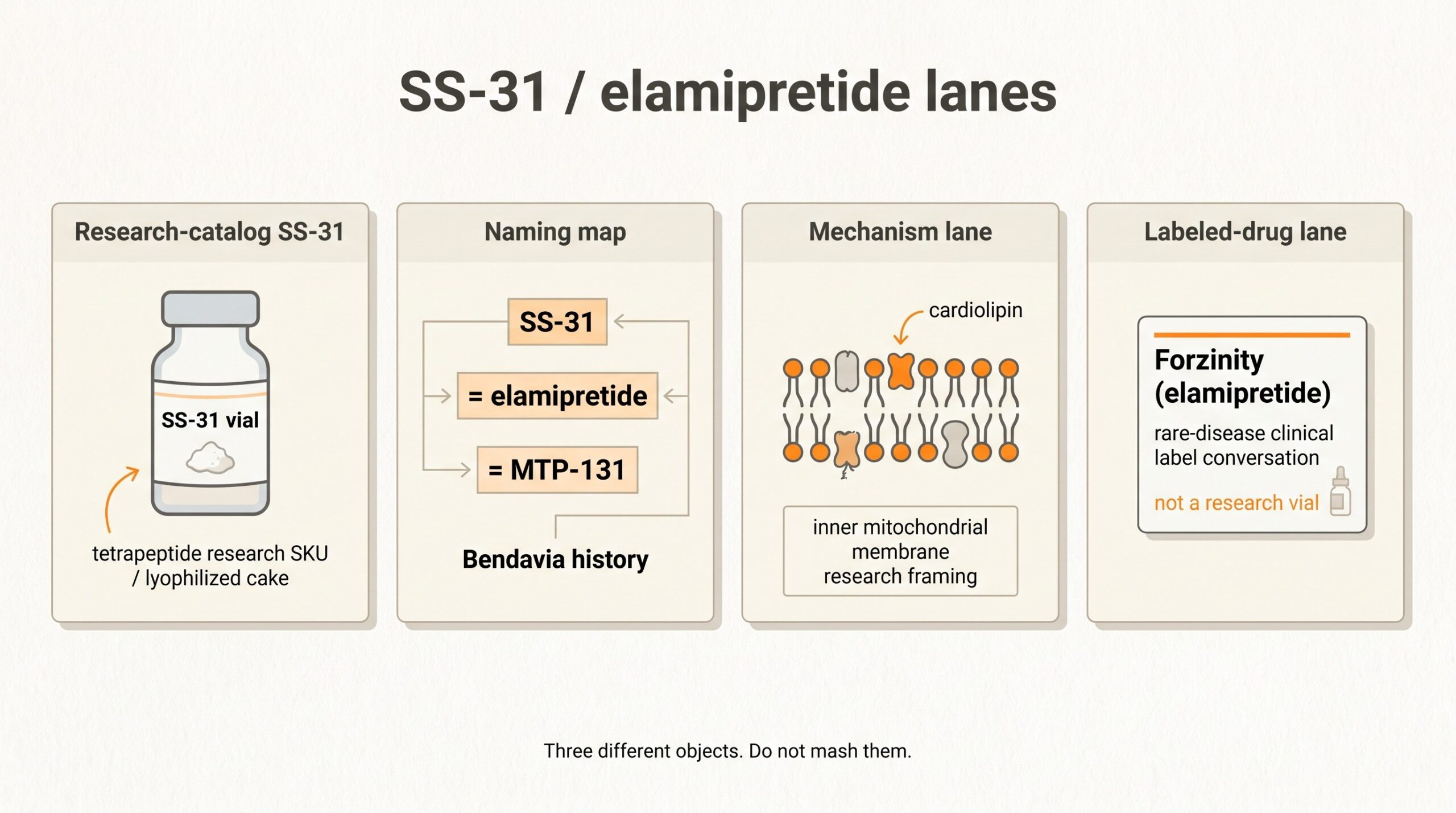
SS-31 vs MOTS-c vs “mito stack” captions
You do not need a membrane-biophysics degree. You need two peptides and two jobs.
| Lane | What it actually is | What the evidence conversation is | What it is not |
|---|---|---|---|
| SS-31 / elamipretide | Synthetic tetrapeptide (D-Arg-Dmt-Lys-Phe-NH2). Szeto–Schiller SS series. Also MTP-131 / Bendavia history. | Cardiolipin / IMM targeting; classic primary papers from 2004 onward; later clinical programs in Barth syndrome, cardiac, myopathy, and retina — endpoints mixed by program. | Not MOTS-c. Not a free “mitochondria upgrade” for healthy gym recovery. Not automatic inheritance of a Forzinity label. |
| MOTS-c | 16-amino-acid peptide encoded in mitochondrial DNA. Full map on /mots-c/. | AMPK / metabolic research framing — different origin story from a synthetic SS peptide. | Not SS-31. Same podcast neighborhood. Different molecule. |
| Forzinity (elamipretide) | Branded / labeled elamipretide product conversation for Barth syndrome under accelerated-approval framing in the published regulatory discussion. | Rare-disease clinical program (TAZPOWER and follow-on reporting). That is a drug-label lane. | Not your lyophilized research-catalog cake with a coupon code. |
| Epitalon / pineal longevity talk | Different peptide family. Map on /epitalon/. | Telomerase / pineal research neighborhood — not cardiolipin IMM targeting. | Not SS-31. Do not stack captions because both say “aging.” |
| GH secretagogues | GHRH analogs and GHS-R agonists that ask the pituitary for a GH pulse. | Maps on ipamorelin, sermorelin, tesamorelin. | Not SS-31. “Recovery” on a forum is not a shared mechanism. |
You can be interested in all of them. You cannot mash SS-31, MOTS-c, Forzinity, and a GH blend into one Reddit protocol and call a four-residue cake a clinical mitochondrial result.
Mechanism map (high level)
Search volume is not a protocol. Neither is a caption that says “fixes mitochondria.”
Classic primary literature for this line starts in the mid-2000s — Western Szeto–Schiller peptide chemistry, not a Russian clinical brand story like Selank/Semax. Zhao, Birk, and Szeto described cell-permeable peptide antioxidants targeted to the inner mitochondrial membrane that limited mitochondrial swelling and oxidative injury in model systems (PubMed 15178689, 2004). Follow-on review framing by Szeto covered mitochondria-targeted cytoprotective peptides for ischemia–reperfusion injury (PubMed 17999629, 2008). A later Br J Pharmacol review positioned the cardiolipin-protective compound class as a bioenergetics restoration tool in the research sense (PubMed 24117165, 2014).
Here is the beginner translation of what that literature actually is.
Inner-membrane / cardiolipin framing: SS-31 concentrates at the IMM and is discussed as interacting with cardiolipin — a signature phospholipid of that membrane — with knock-on talk about cristae architecture, electron-transport efficiency, and reactive oxygen species in model systems. A 2025 structure/mechanism review synthesizes that file under the elamipretide name (PubMed 39940712). Structure–activity work on mitochondria-targeted tetrapeptides sits next to that map (PubMed 35913044). Mechanism paragraphs in models are not marching orders.
Preclinical breadth (not a shopping list): Model literature extends into cardiac, renal, neurologic, and metabolic injury contexts. A kidney-focused review summarizes SS-31 as a mitochondria-targeting peptide across renal disease models and notes how limited dedicated clinical kidney programs still are (PubMed 35707274). Cachexia / energy-status model work exists too (PubMed 33670497). Preclinical breadth is an evidence shape. It is not a guarantee that a research-catalog product will treat human disease.
Clinical programs — read the endpoints: Elamipretide has been studied in multiple human programs. Barth syndrome (TAZPOWER) is the rare-disease file most people mean when they say “the clinical drug” (PubMed 33077895; long-term open-label extension reporting PubMed 38602181). Cardiac ischemia programs such as EMBRACE STEMI evaluated intravenous MTP-131 / Bendavia in STEMI and belong in the mixed-results drawer until you read the paper yourself (PubMed 26586786). Primary mitochondrial myopathy (MMPOWER-3) is another large randomized file — efficacy and safety reporting is public; do not crown a forum caption over the primary endpoint language in the paper (PubMed 37268435). Retina / AMD programs (ReCLAIM lineage) are yet another lane (PubMed 39605874). Accelerated-approval discussion for elamipretide in Barth syndrome is a regulatory object of its own (PubMed 41260682) — still not a research vial.
SS-31 next to MOTS-c: Podcasts stack “mito peptides.” Residues do not. MOTS-c is mtDNA-encoded. SS-31 is a synthetic SS tetrapeptide. Full MOTS-c map: /mots-c/.
If someone tells you a research-catalog SS-31 cake is Forzinity in a cheaper bottle, they are selling. Sequence-family talk is not manufacturing-license talk. Comparative animal or open-label clinical work is still not a free pass to self-treat heart failure, Barth syndrome, or “aging mitochondria.”
Evidence limits, stated plainly: Classic primary papers are real (2004–2014 Szeto–Schiller / cardiolipin framing). Newer reviews and clinical-program papers are real. Many indexed SS-31 / elamipretide papers remain preclinical. Human programs exist and do not all share the same endpoint success story — mixed or null primary endpoints in some trials mean mixed. Accelerated approval for a rare disease does not mint a general longevity indication, and it does not convert a research-catalog SKU into that labeled product. This page refuses to invent Russian “secret SS-31 clinics,” refuses to invent PubMed IDs, and refuses to crown a caption.
WADA and sport: if you compete, check the current prohibited list yourself. Peptide research chemicals are not a free pass because a catalog said “research use only.”
Research catalog vs compounding vs FDA / labeled drugs
Three lanes. Keep them.
Labeled drugs have an application, a label, an indication, manufacturing the agency inspects for that product. Elamipretide as Forzinity in the Barth syndrome accelerated-approval conversation lives in that regulatory neighborhood (PubMed 41260682). Your lyophilized SS-31 research cake is not that object.
Compounding is a pharmacy lane. A 503A pharmacy compounds for a patient with a prescription. That lane has its own FDA bulk-substance fights and state-board rules. A compounded elamipretide / SS-31 prescription, if a clinic offers one, is still not automatic inheritance of a branded rare-disease label. It is a different object from a research catalog with a coupon code.
Research catalogs sell named sequences for research use. COA if you are lucky. “Not for human consumption” on the page. Forums treat that disclaimer as a wink. I do not. A research-use SS-31 vial is a catalog SKU. It is not a compounding script. It is not Forzinity. Pretending otherwise is how people get hurt and how this page would get stupid.
I am not going to tell you to buy a research chemical for human use. I am not going to tell you to skip a doctor. I am going to tell you to name the lane before you name the SKU.
Reconstitution notes (high level only)
If a lyophilized cake is even on the table, learn the math before you invent a protocol.
How to reconstitute peptides is the public page for bacteriostatic water, U-100 insulin-syringe ticks, and not wasting 10% of the vial on foam and dead volume. Clinical elamipretide programs often used subcutaneous or intravenous drug product — that is a different object from a cake you reconstitute yourself. Read the label. Do not assume forum units equal a labeled dose schedule.
I will not dump an SS-31 units-and-days schedule on a public page. That is Pro on purpose.
Who this page is for (and who it is not)
Start with the question, not the vial.
This page is for you if you typed SS-31, elamipretide, MTP-131, Bendavia, or BioAmplify and want the research map before you spend money. Or if a podcast stacked SS-31 next to MOTS-c and you need the molecules separated.
This page is not for you if you want a diagnosis for heart failure, Barth syndrome, mitochondrial myopathy, kidney disease, macular degeneration, or “low cellular energy” from a blog. Those are clinician conversations. A research vial does not replace that visit.
Here is the order I give beginners.
1. Read first. Name the lane before you name the SKU. Research catalog, compound, or labeled drug.
2. Name the peptide. SS-31 / elamipretide is the tetrapeptide above. If the bottle also says “blend,” “MOTS-c,” or a second sequence, read every name on the label.
3. Do not crown the nickname. “Mito peptide” won the caption. It did not turn a research cake into Forzinity.
4. If a lyophilized cake is even on the table, learn the reconstitution math on the public page linked above — then stop. Protocol depth lives in Peptides & Pump Pro. Ten dollars a month. Seven-day trial.
Where I actually look when the job is an SS-31 research compound
Education first. You already got the map. This block is the labs I will put my name on, with the codes that fire. Research-use catalog pages. Not a treatment claim. Not a “buy this to fix mitochondria.”
Peptira has the in-stock SS-31 10 mg vial we feature here with code LEE. BioLongevity is our LEE15 partner lab — their BioAmplify / SS-31 path is there when you prefer that catalog. Paramount, Limitless, and S1 are linked below for their shops. Research-use catalog pages only — not a treatment claim, and not “buy this to fix mitochondria.”
Research-catalog SKUs we feature here (not a treatment recommendation).
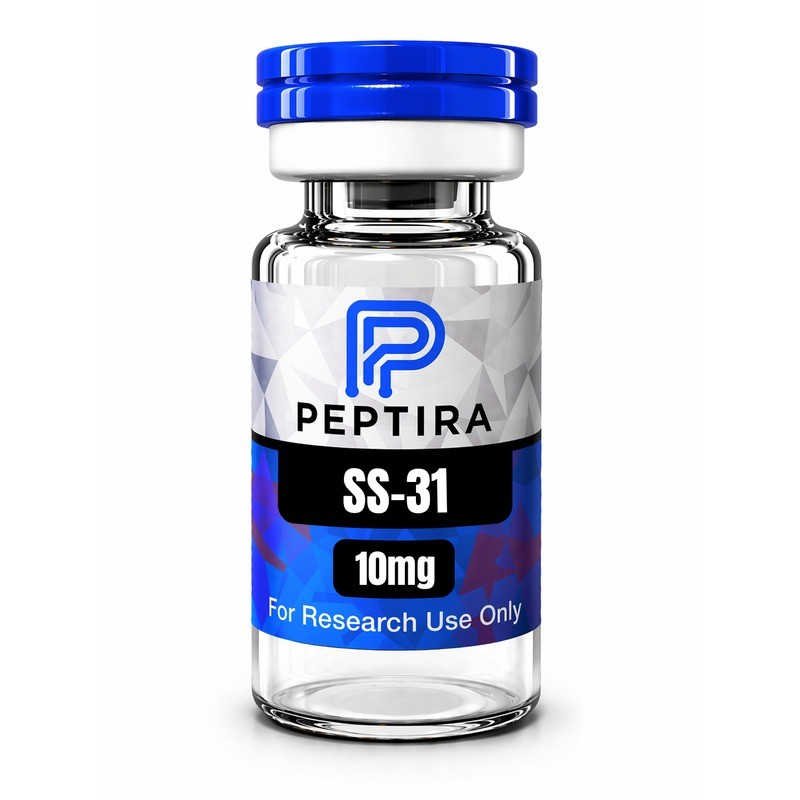 Peptira
SS-31 10 mg
LEEPeptira SS-31 10 mg · LEEBioLongevity BioAmplify / SS-31 10 mg · LEE15BioLongevity home · LEE15Paramount home · LEE10Limitless home · LEE20S1 shop · LEE10
Peptira has the in-stock SS-31 vial we feature here with code LEE. BioLongevity is our LEE15 partner lab — use that path when you prefer their catalog. Match the product to the job. Do not collect bottles. Education only — a research vial is not an approved drug, and it is not a back door to a rare-disease drug label.
Frequently asked questions about SS-31
Is SS-31 the same as elamipretide?
Same chemistry conversation. SS-31 is the research / catalog spelling from the Szeto–Schiller series. Elamipretide is the INN / clinical spelling. MTP-131 and Bendavia show up in older development talk. Read the bottle and the paper — do not assume a research SKU is the branded labeled product.
Is SS-31 the same as MOTS-c?
No. MOTS-c is a 16-amino-acid mtDNA-encoded peptide. SS-31 is a synthetic tetrapeptide. Podcasts stack them. Residues do not. Read the MOTS-c research map if that is the molecule you actually typed.
Is a research-catalog SS-31 the same as Forzinity?
No. Forzinity is the labeled elamipretide rare-disease conversation. A research-catalog vial inherits neither that indication nor that manufacturing license for human use.
Is SS-31 FDA-approved for aging or “mitochondrial optimization”?
No general aging / biohacking indication is what this page is claiming. The published accelerated-approval discussion is Barth syndrome–oriented under the elamipretide / Forzinity lane (PubMed 41260682). That is not a free longevity sticker for a coupon-code cake.
Does SS-31 “fix mitochondria”?
Not as a caption you can cash. Classic papers describe IMM-targeted peptide antioxidants and cardiolipin-protective framing in models (PubMed 15178689; PubMed 24117165). Clinical programs exist with mixed endpoint stories depending on the disease file. Different tool. Different evidence shape. Different risks. Do not substitute a research vial for a prescribed medicine. Talk to a clinician.
Can I just run an SS-31 protocol from a forum?
You can do a lot of unwise things. I would not. Name the sequence. Name whether you are holding a research catalog, a compounded script, or a fantasy about Forzinity. Protocol depth lives in Pro on purpose. This public page is the map, not the marching orders.
Selected references (research framing)
These are starting points for the published file — classic primary sources and newer clinical / review papers. Not a protocol, not a drug label, not an endorsement to self-treat. I am not inventing citations; every ID below was verified against PubMed before publish.
- Classic primary (2004): cell-permeable peptide antioxidants targeted to the inner mitochondrial membrane — PubMed 15178689.
- Classic primary / review framing (2008): mitochondria-targeted cytoprotective peptides for ischemia–reperfusion injury — PubMed 17999629.
- Classic cardiolipin-protective class review (2014) — PubMed 24117165.
- Structure / mechanism / therapeutic-potential review (elamipretide) — PubMed 39940712.
- Structure–activity relationships of mitochondria-targeted tetrapeptides — PubMed 35913044.
- Kidney-disease oriented SS-31 review — PubMed 35707274.
- TAZPOWER phase 2/3 Barth syndrome trial — PubMed 33077895.
- TAZPOWER long-term open-label extension (168-week reporting) — PubMed 38602181.
- EMBRACE STEMI phase 2a (MTP-131 / Bendavia in STEMI) — PubMed 26586786.
- MMPOWER-3 primary mitochondrial myopathy randomized trial — PubMed 37268435.
- ReCLAIM-2 AMD / geographic-atrophy program reporting — PubMed 39605874.
- Accelerated-approval / Barth syndrome therapeutic discussion — PubMed 41260682.
Read primary sources. Do not treat a PubMed ID as a shopping list. Note: SS-31’s classic primary literature is Szeto–Schiller Western peptide chemistry (2000s), not a Russian clinical brand file — inventing “Russian SS-31 clinics” would be fake authority, so this page does not.
The bottom line
SS-31 is a synthetic mitochondria-targeting tetrapeptide — elamipretide / MTP-131 / Bendavia in the naming trail — with a cardiolipin-oriented research map that runs from classic mid-2000s primary papers through mixed modern clinical programs. Real sequence. Real research intent. A research-catalog cake is still not Forzinity.
It is not MOTS-c. It is not a GH secretagogue. It is not a general aging drug sticker. Keep the lanes. Read the papers. Do not buy a four-residue cake because a caption told you it was a labeled mitochondrial cure.
If you need the beginner on-ramp, use Start Here and what are peptides. Reconstitution math, when a lyophilized cake is even on the table, is on how to reconstitute peptides. Adjacent mitochondrial reading that is already live: MOTS-c. Longevity-adjacent map: Epitalon.
Want the free field guide before you spend another dollar on a vial? Grab the Peptide Playbook — the short form on that page is how it ships. No naked PDF chase.
I built Peptides & Pump so you can get this without a guru tax. If you want the protocol library, member discussions, and a place to think out loud before you spend money, that is Pro. If you are not ready to pay, use the free Knowledge Base first. Then come back and argue with me when you have read more than a caption.
 Keep going on Peptides & Pump
Free is the peptide community. Pro is where you master it. Codes are the links. Click them so the discount fires.
Free
Knowledge Base
The peptide community · 2,500+
- 2,500+ member peptide community
- Sourcing questions before you buy anything random
- The basics, from people actually using peptides
Pro
Peptides & Pump Pro
$10/mo · 7-day trial
- Science-backed protocol library
- 1-on-1 support from Lee and Matt
- Step-by-step video, plus a monthly $500 drawing
LEE20 Limitless LEE15 BioLongevity LEE10 Paramount LEE Peptira LEE10 S1
Supplier footnote: Research suppliers I mention when people ask about SS-31 / elamipretide compounds: Peptira SS-31 10 mg (code LEE), and BioLongevity’s BioAmplify / SS-31 10 mg (code LEE15) or BioLongevity home. Also Paramount home (code LEE10), Limitless home (code LEE20), and the S1 shop (code LEE10). Match the product to the job. Do not collect bottles. Education only — a research vial is not an approved drug.
Disclaimer. This article is for educational and research purposes only. It is not medical advice. It is not intended to diagnose, treat, cure, or prevent any disease. SS-31, elamipretide, MTP-131, Bendavia, BioAmplify, and related research-catalog presentations are not presented here as treatments for heart failure, Barth syndrome, mitochondrial myopathy, kidney disease, macular degeneration, aging, fatigue, or any other condition. A research-catalog vial is not a compounded prescription and is not a labeled drug such as Forzinity. Most of the published evidence discussed here includes preclinical work and clinical-program literature with mixed endpoints; neither is a substitute for a clinician. Individual results vary. Always consult a qualified healthcare provider before starting any peptide, drug, supplement, or protocol, especially if you have a medical condition or take prescription medication. Peptides & Pump does not sell peptides.
Affiliate disclosure. Some links on this page are affiliate links. If you buy through them, I may earn a commission at no extra cost to you. Codes LEE15, LEE20, LEE, and LEE10 are the ones I actually use where a coupon fires. That commission is how I keep publishing free education. I only link suppliers I am willing to put my name on.


3 Comments
Comments are closed.