Follistatin 344 (FS344): Myostatin Research Map (Not Gene Therapy)
Key takeaways
- Verdict: Follistatin 344 is a serious muscle-brake-pathway research map. Mouse genetics and AAV gene therapy trials are loud. A research shelf vial is still not that clinic object.
- How it works in one line: Muscle-brake is a parking brake on muscle growth. Follistatin can bind it (and related TGF-β cousins). So the brake cannot fully engage ActRIIB.
- Your next step: Learn the three doors: research SKU vs AAV-FS344 clinic history vs basics. Treat partner vials as research options with codes that fire. Never treat them as a free-site muscle plan.
Verdict up front: FS 344 is worth knowing if you keep seeing “FS344” sold like a secret muscle-brake off-switch. It is not worth treating a research vial like Nationwide Children’s AAV gene therapy. This free page will not hand you a muscle-growth stack.
Real body-made protein. Real gene-mouse drama. Real Phase 1/2a gene delivery trials in Becker muscle disease. Zero honest path from “I bought a research vial” to “I just ran Mendell 2015.”.
Keep reading if you typed follistatin, FS344, FST344, muscle-brake inhibitor, “parking brake peptide,” or “is this the same as gene therapy” and want the map without forum noise. Skip if you want a dose chart. Skip if you want a black-market “cycle.” Skip if you want a claim that a research vial treats muscle disease, age muscle loss, injury, or “hardgainer genes.” Skip if you want a reason to skip protein, sleep, and training. Those asks belong in Pro or a real clinic — not a free ranking page.
Day-one basics still live on Start Here and what are peptides. Nearby maps when you are done here: IGF-1 LR3, Tesamorelin, Ipamorelin, MOTS-c, MK-677, peptides for muscle growth, protein intake. How to reconstitute peptides.
Teaching only. Not medical advice. A research shelf follistatin vial is not an FDA-approved muscle drug. It is not AAV1. CMV. FS344 gene therapy. It is not a green light to skip hormone-axis or TGF-β biology when people oversell “safe body-made.”.
What is follistatin 344?
FS is a naturally made glycoprotein that can bind and neutralize several TGF-β family ligands. Muscle-brake is the celebrity one for muscle talk. Activins are in the same neighborhood.
Your body already uses follistatin. That does not make a research vial “just topping up nature.”.
FS has splice versions. The short version of the shelf story: FS344 is the precursor form that processes toward in-blood FS315. Researchers favored that lane in gene therapy work. Because it was designed to hit muscle growth biology hard. Being less sticky to some off-target activin stories than the FS288-leaning isoform.
On partner shelves you will see names like FS, FS 344, or lab codes such as FLGR242. Shared research neighborhood. Different vials, COAs, and jobs.
Why this matters: forums mash body-made follistatin, AAV-FS344 gene therapy. A lyophilized research peptide into one “muscle-brake off” bucket. Shared pathway. Different objects.
So what for you: if a sales page never separates shelf peptide from AAV gene delivery, it is selling vibes.
The parking-brake mechanism (one analogy)
Here is the only picture I want stuck in your head.
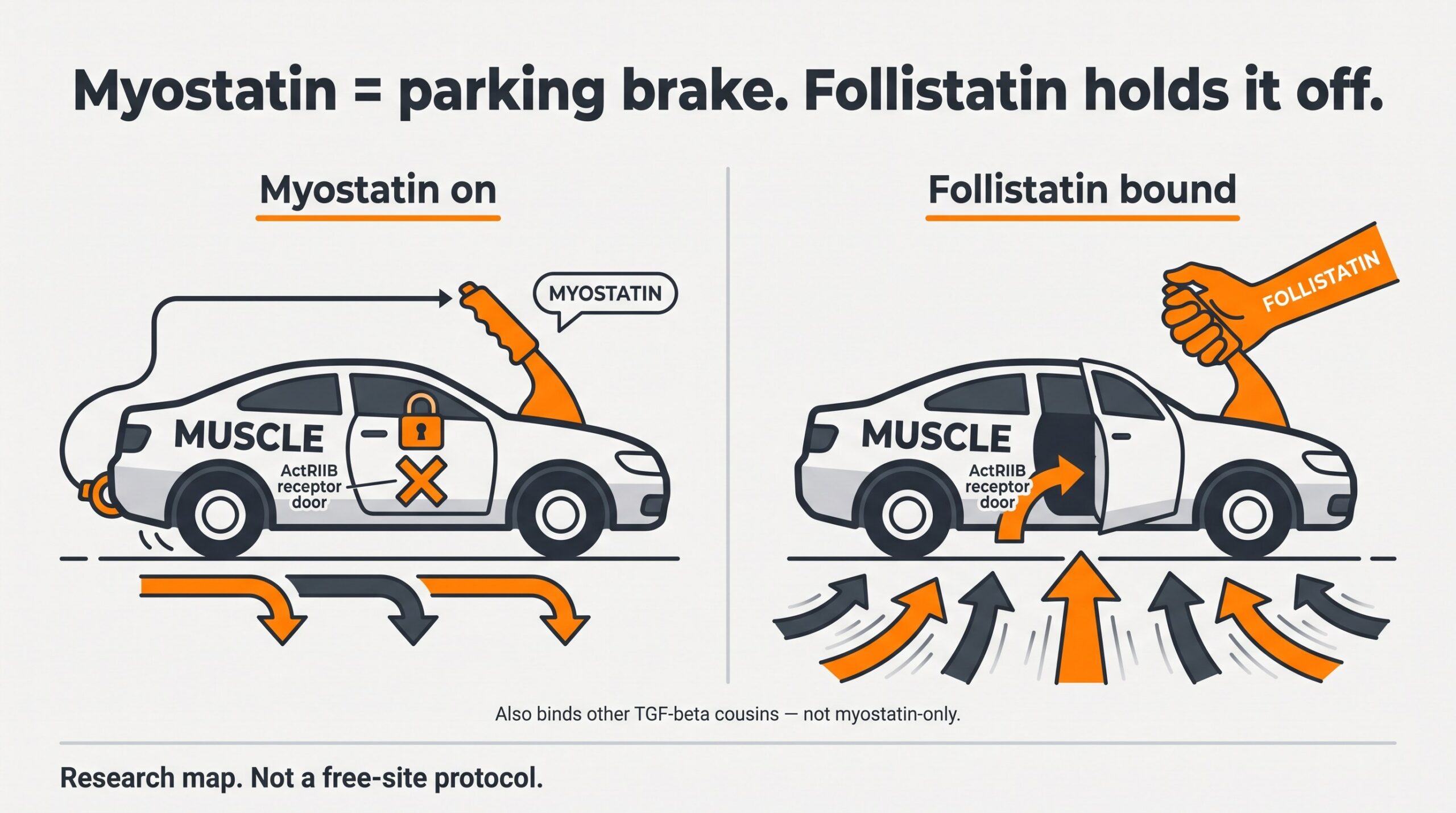
Think of muscle-brake as the parking brake on muscle growth. When it engages ActRIIB — a receptor door on muscle cells — the growth story gets quieter.
FS is a hand that can hold that brake lever so it cannot fully engage. Less brake pressure. More room for muscle-growth signals in the models that studied it.
One honesty check: FS is not a muscle-brake-only sniper. It also binds related TGF-β cousins. That wider net is part of why gene therapy teams cared about isoform choice and hormone-axis caution in the first place.
How sure are we? Pretty sure the biology is “signal trap on a growth-limit path.” Less sure that a research shelf peptide recreates gene-mouse extra making or AAV muscle delivery. Not sure at all that a vial cap equals Mendell’s into-muscle gene delivery protocol.
Why this matters: if you cannot explain “parking brake vs hand on the brake” in one sentence, you are not ready to open a cart.
So what for you: ask for the muscle-brake/ActRIIB story before you ask for a price.
The stop-you number (and what it is not)
The cleanest “this pathway is not a cartoon” number is not a gym mirror selfie. It is mouse genetics.
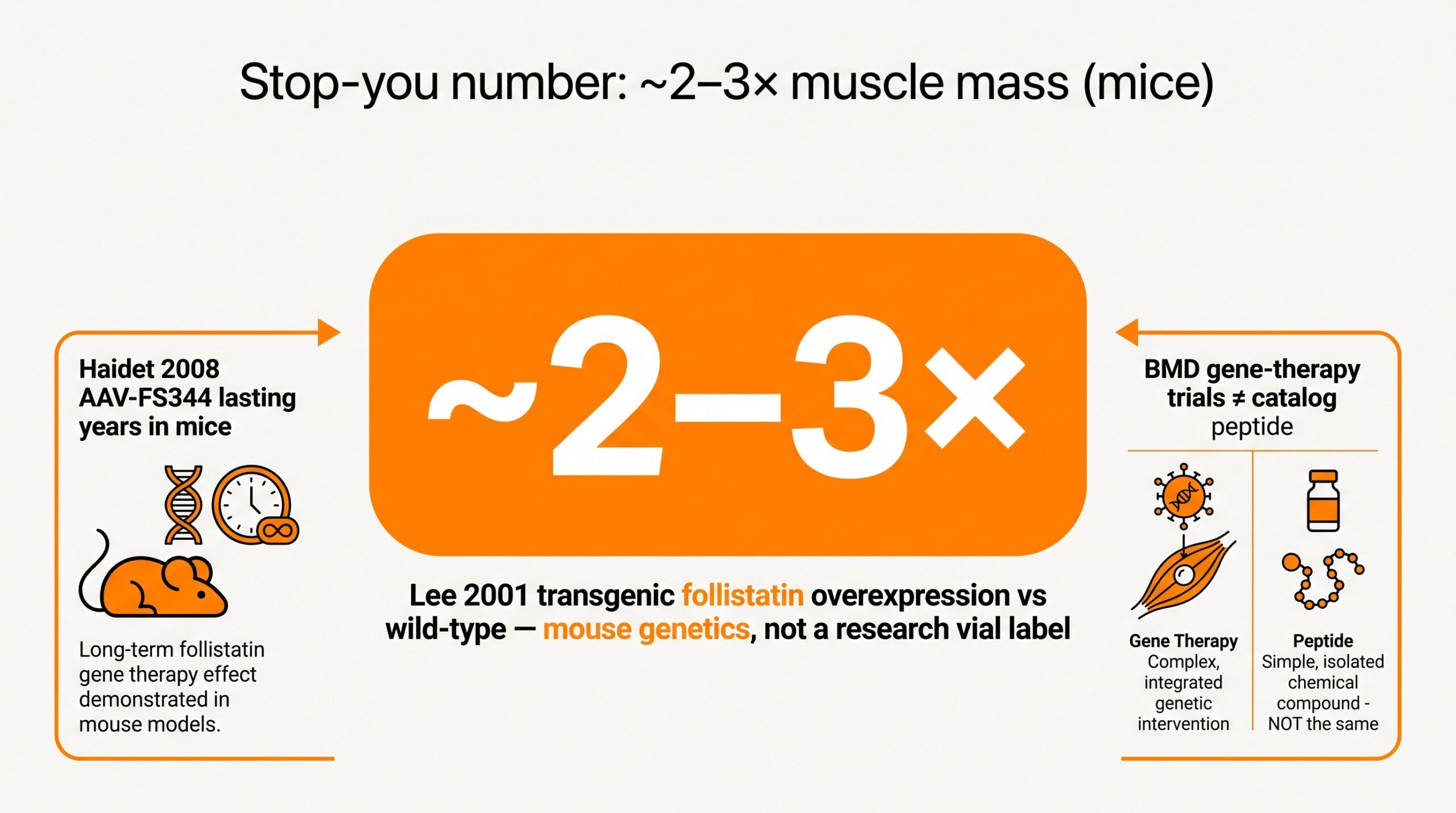
Lee and colleagues in 2001 built gene-changed mice that over-made FS in muscle. Muscle mass jumped hard. It matched the range seen in muscle-brake gene-off animals. Later reviews put that extra-production lane at about a 2–3× muscle-mass bump versus normal mice. Stacking can look even wilder when FS meets a muscle-brake-off background.
That is Motley Fool confidence framing in one line: real PNAS endpoints, genetics and extra making, not a research-vial label.
Haidet and colleagues then showed a different delivery story in 2008: a one-time virus-vector shot of muscle-brake-inhibitor genes, with FS-344 among the strongest long-term muscle size and strength signals in normal and dystrophic mouse models lasting more than two years.
On the human side, Mendell’s Phase 1/2a into-muscle AAV1.CMV.FS344 work in Becker muscle disease reported 6-minute walk gains in several people. Examples: 58 m and 125 m in lower-dose responders. Notes on tissue looked encouraging. That small proof trial reported no bad effects. That is gene therapy under a protocol. It is not your research cart.
Why this matters: the stop-you ratio is that roughly 2–3× mouse muscle-mass story for FS extra making — and the how-sure level for “my FS344 research vial is just DIY gene therapy” is still zero.
So what for you: be impressed by the pathway. Do not confuse gene-changed mice or AAV trials with a lyophilized shelf SKU.
Research shelf vs gene-therapy history vs basics
Three doors. Same word online. Different jobs.
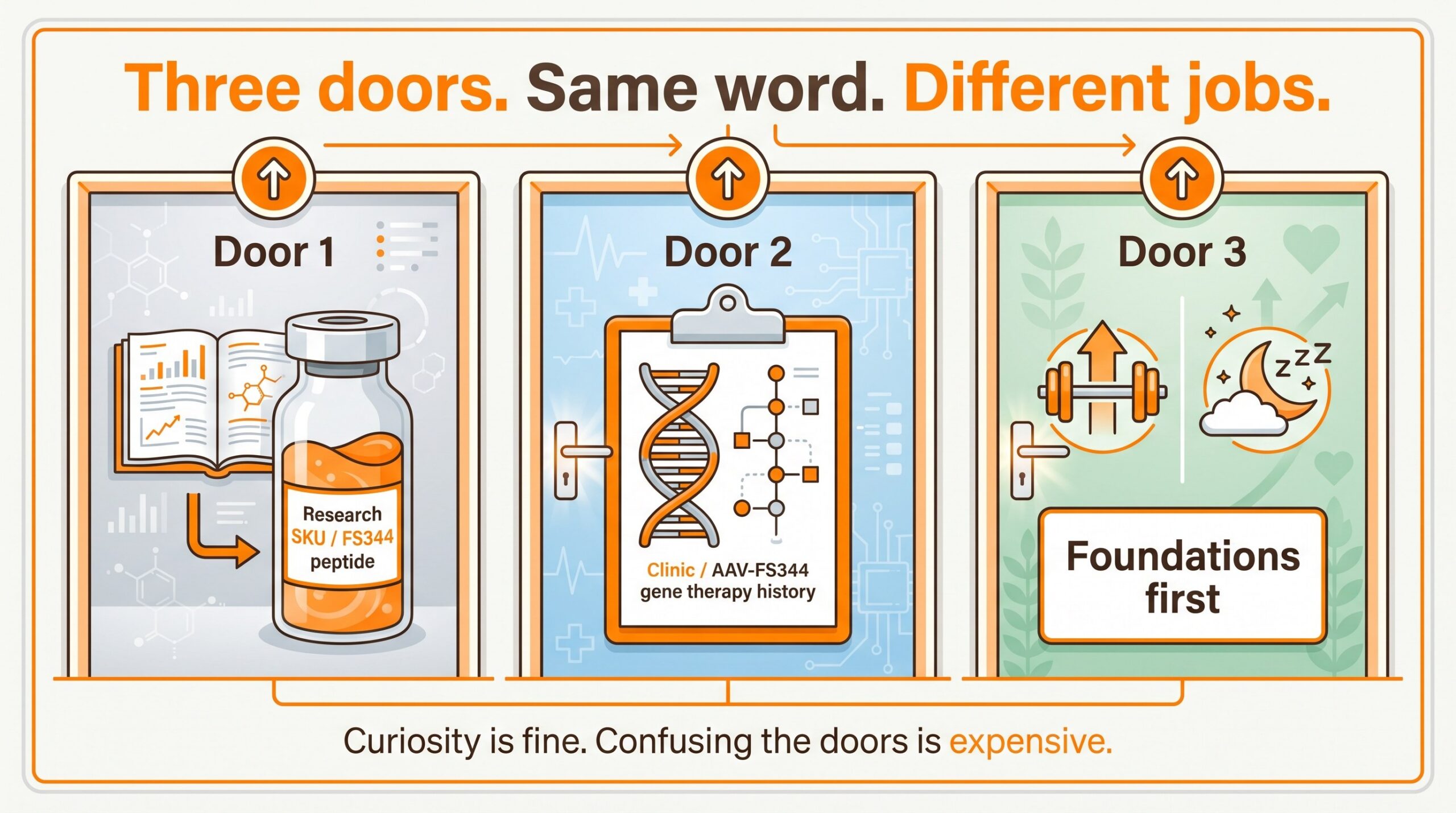
Door 1 — Research shelf. Partner shelves can list FS / FS344 as a research sequence. That is a SKU and a certificate story. It is not FDA-approved lifestyle muscle medicine and not a compounded Rx by default.
Door 2 — Clinic / gene therapy history. AAV1. CMV. FS344 trials in Becker muscle disease and related nerve-muscle work studied into muscle gene delivery under IRB protocols. Rodino-Klapac, Mendell, and colleagues built that translational lane carefully. Because early FS biology also touches FSH and reproductive caution. That door is not a mail-order vial with a coupon code.
Door 3 — Basics. Progressive weight training, enough protein, sleep that actually recovers, Zone 2 and VO2 work that raise the ceiling. A doctor if you have real nerve-muscle, endocrine, or oncology-adjacent questions. If your “problem” is inconsistent training plus 90 grams of protein pretending to be 180, a vial cap will not fix the root cause. See protein intake, how to sleep better, Zone 2, creatine, and HRV.
Why this matters: most money gets wasted when people buy Door 1. Wanting Door 2 outcomes.
So what for you: pick the door that matches your actual question before you open a cart.
FS344 vs FS315 vs “just muscle-brake”
Quick isoform honesty without turning this into a textbook.
- FS344 is the precursor form used in the famous AAV constructs. It processes toward in-blood FS315.
- FS315 is the serum-favoring isoform researchers liked for muscle work with lower cell-surface stickiness than the FS288 story.
- FS288 is the more tissue-adhesive cousin historically tied to stronger activin/FSH concern in the older reproductive biology file.
And again: FS is not a pure muscle-brake monoclonal. Wider ligand net. That is a feature in some disease models and a caution sticker in others.
Why this matters: social media flattens isoform choice into “FS = muscle-brake delete.”.
So what for you: if a page never mentions FS344/FS315 or activin caution, treat the how-sure level as low.
Myths that burn money
- “Body-made = safe vial.” Your body making FS is not the same as injecting a research peptide from a catalog.
- “FS344 research vial = AAV gene therapy.” One is a lyophilized SKU. The other is into muscle viral gene delivery under a trial protocol.
- “2–3× mouse muscle = my next bulk.” Transgenic extra making and knockout genetics are not a free ranking-page protocol.
- “If Limitless / Peptira / S1 do not list it, the pathway is fake.” Partner shelves differ. BioLongevity and Paramount currently carry public FS SKUs on this pass. Missing shelf ≠ missing biology.
- “Stack it with IGF-1 LR3 because both say muscle.” Shared interest neighborhood. Different mechanisms. Stacking forum screenshots is not a plan.
Why this matters: the expensive mistake is buying a story you cannot falsify.
So what for you: falsify the door first. Then decide whether a research SKU even belongs in the talk.
Partner research options (codes that fire)
If you are mapping research SKUs after you understand the doors, these are the public InStock FS partners on this publish pass. Codes live in the links. Click them so the discount fires.
FS heroes
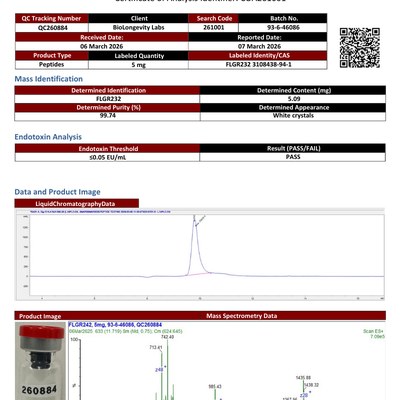
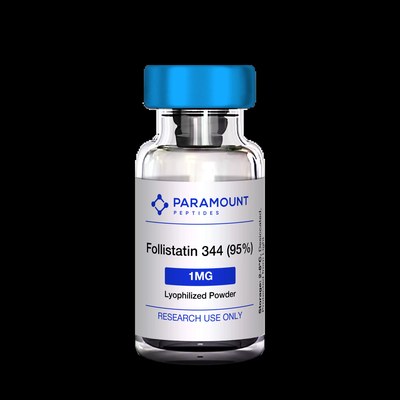
BioLongevity FS · LEE15Paramount FS 344 · LEE10
Adjacent research maps (convert)
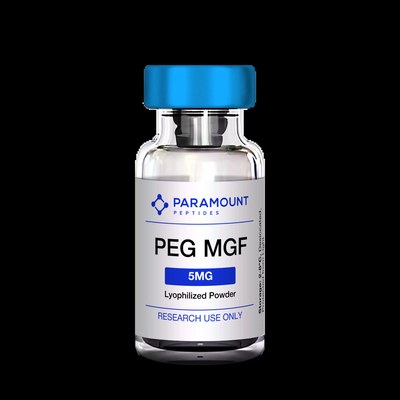 Paramount
PEG-MGF 5 mg
LEE10 Peptira
IGF-1 LR3
LEE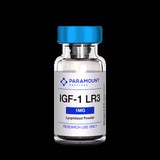 Paramount
IGF-1 LR3
LEE10 S1 Research
IGF-1 LR3
LEE10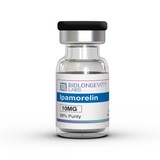 BioLongevity
Ipamorelin 10 mg
LEE15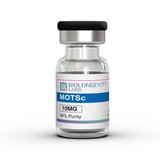 BioLongevity
MOTS-c 10 mg
LEE15 BioLongevity
Thymosin Alpha-1
LEE15Limitless home · LEE20Paramount home · LEE10Peptira home · LEES1 shop · LEE10BioLongevity home · LEE15
Why this matters: conversion without honesty is how domains die. These cards are research maps with tracking that works — not treatment claims.
So what for you: if you came for a protocol table, stop. If you came to understand the pathway and keep clean partner links, you are in the right place.
Related research maps
- IGF-1 LR3 — free-ligand / IGFBP bodyguard-bypass neighbor.
- Peptides for muscle growth — hub map without forum noise.
- Tesamorelin / Ipamorelin / MK-677 — GH-axis interest doors.
- MOTS-c / SS-31 — mitochondrial neighbors.
- Hexarelin / Thymosin Alpha-1 — adjacent catalog maps.
- FOXO4-DRI — longevity research interest with the same three-door discipline.
Evidence limits (read this twice)
Partner shelves are not selling AAV gene therapy. FS on a research shelf is not Mendell 2015 and not a DIY muscle-growth drug.
If you have a nerve-muscle diagnosis, unexplained weakness, endocrine questions, or oncology-adjacent concerns around growth-factor pathways, this is a doctor talk. Not a research-cart talk.
Why this matters: confidence framing protects your wallet and your risk file.
So what for you: use this page to get smarter. Use a doctor to get safer. Use Pro if you want plan depth without random forum screenshots.
Sources & Further Reading
- McPherron AC, et al. Regulation of skeletal muscle mass in mice by a new TGF-beta superfamily member. Nature. 1997. PubMed 9139826.
- McPherron AC, Lee SJ. Double muscling in cattle due to mutations in the myostatin gene. PNAS. 1997. PubMed 9356471.
- Lee SJ, McPherron AC. Regulation of myostatin activity and muscle growth. PNAS. 2001. PubMed 11459935.
- Haidet AM, et al. Long-term enhancement of skeletal muscle mass and strength by single gene administration of myostatin inhibitors. PNAS. 2008. PubMed 18334646.
- Rodino-Klapac LR, et al. Inhibition of myostatin with emphasis on follistatin as a therapy for muscle disease. Muscle Nerve. 2009. PubMed 19208403.
- Mendell JR, et al. A phase 1/2a follistatin gene therapy trial for Becker muscle disease. Molecular Therapy. 2015. PubMed 25322757.
- Al-Zaidy SA, et al. Follistatin Gene Therapy Improves Ambulation in Becker Muscular Dystrophy. Molecular Therapy. 2015. PubMed 27858738.
- Mendell JR, et al. Follistatin Gene Therapy for Sporadic Inclusion Body Myositis Improves Functional Outcomes. Molecular Therapy. 2017. PubMed 28279643.
- Wetzlich B, et al. Therapeutic applications and challenges in myostatin blocking for enhanced skeletal muscle mass and functions. Cells. 2025. PubMed 39340593.
The bottom line
Follistatin 344 is one of the loudest myostatin-pathway stories in the research aisle. Parking brake. Hand on the brake. Hard mouse numbers. Partner SKUs exist.
It is still not AAV gene therapy and not a DIY muscle drug. Read the three-door warning. Talk to a doctor about real neuromuscular or endocrine questions. Build training and protein habits that do not require a crimp cap.
Want the deeper protocol library after that? Pro is the paid door. Want the free research PDF? Grab the Playbook below.
Free guide
Get The Peptide PlaybookEnter your email and we’ll send the research PDF. Teaching only — not medical advice.
I built Peptides & Pump so you can get this without a guru tax. Free Knowledge Base first if you are not ready to pay. Pro if you want the protocol library.
 Keep going on Peptides & Pump
Free is the peptide community. Pro is the paid door. Codes are the links. Click them so the discount fires.
Free
Knowledge Base
The peptide community · 2,500+
- 2,500+ member peptide community
- Sourcing questions before you buy anything random.
- The basics, from people actually using peptides.
Pro
Peptides & Pump Pro
$10/mo · 7-day trial
- Science-backed protocol library
- 1-on-1 support from Lee and Matt.
- Step-by-step video, plus a monthly $500 drawing.
LEE20 Limitless LEE15 BioLongevity LEE10 Paramount LEE Peptira LEE10 S1.
Supplier footnote: Research suppliers I mention when people ask about follistatin: BioLongevity Follistatin (code LEE15), Paramount Follistatin 344 (code LEE10). Adjacent research maps: Paramount PEG-MGF, Peptira IGF-1 LR3, Paramount IGF-1 LR3, S1 IGF-1 LR3, Ipamorelin 10 mg, MOTS-c, Thymosin Alpha-1. Partner home/shop chips: Limitless (code LEE20), Paramount (code LEE10), Peptira (code LEE), S1 shop (code LEE10), plus BioLongevity home (code LEE15). Match the product to the job. Do not collect bottles..
Disclaimer. This article is for educational and research purposes only. It is not medical advice. It is not intended to diagnose, treat, cure, or prevent any disease. Follistatin, Follistatin 344, FS344, FS315, myostatin inhibitors, AAV-FS344 gene therapy constructs, IGF-1 LR3, PEG-MGF. Other related research compounds are not presented here as FDA-approved treatments you should self-administer for muscle growth, fat loss, injury repair, muscle disease, age-related muscle loss, or any other indication. Research peptides discussed here are research sequences. A research-shelf vial is not a compounded Rx and is not labeled gene therapy. Evidence discussed here includes mouse genetics, AAV preclinical work. Small human gene therapy trials. None of that is a substitute for a doctor. Individual results vary. Always consult a qualified healthcare provider before starting any peptide, drug, supplement, or protocol, especially if you have a medical condition, cancer history, or take Rx medication. Peptides & Pump does not sell peptides.
Affiliate disclosure. Some links on this page are affiliate links. If you buy through them, I may earn a commission at no extra cost to you. Codes LEE15, LEE20, LEE. LEE10 are the ones I actually use where a coupon fires. That commission is how I keep publishing free education. I only link suppliers I am willing to put my name on.