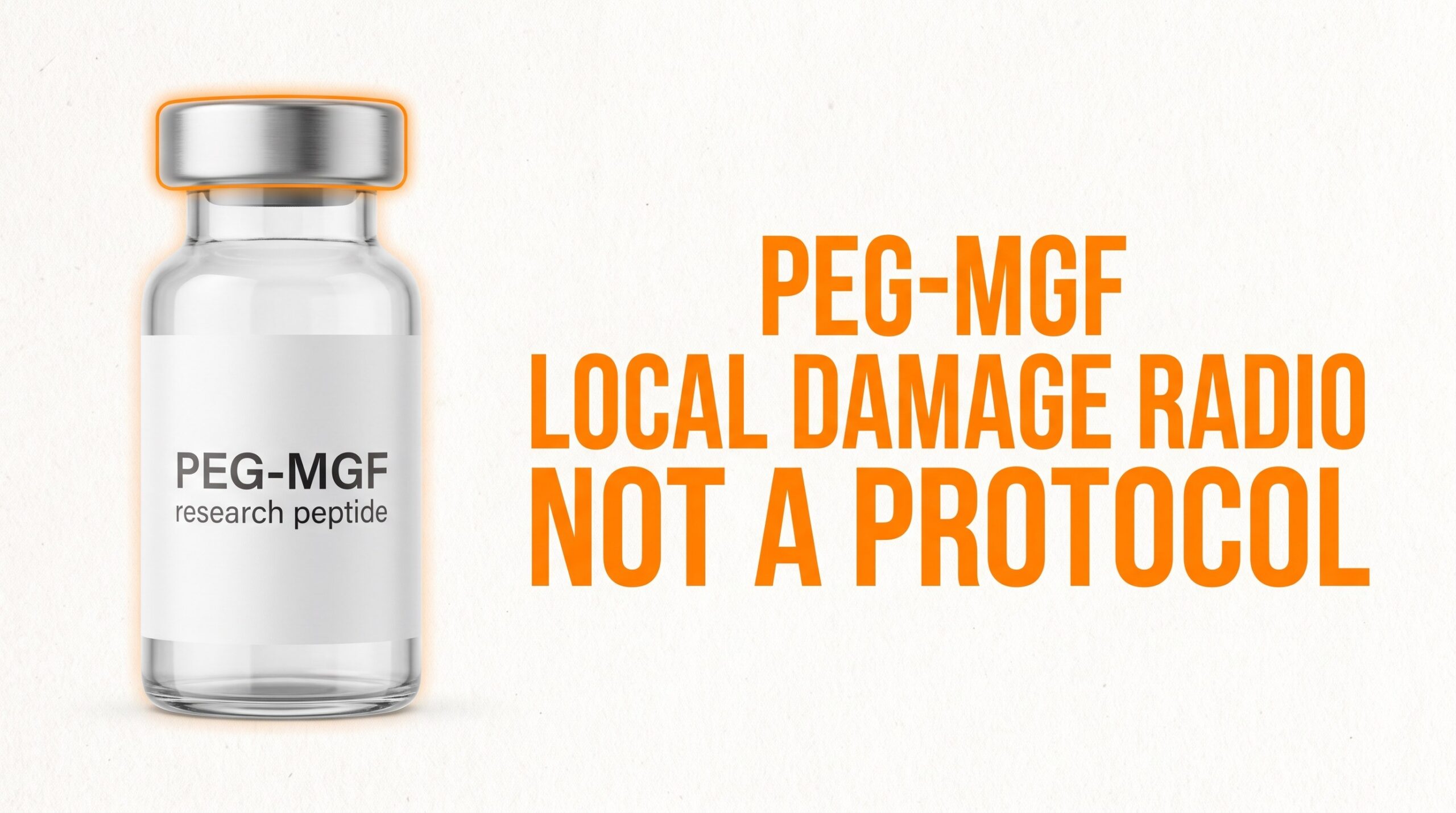
PEG-MGF Peptide (Mechano Growth Factor): Research Map (Not a Protocol)
Key takeaways
- Verdict: PEG-MGF is a serious IGF-1 splice / mechano-growth-factor research map — local load biology is real, and a PEGylated research vial is still not a free-site hypertrophy protocol.
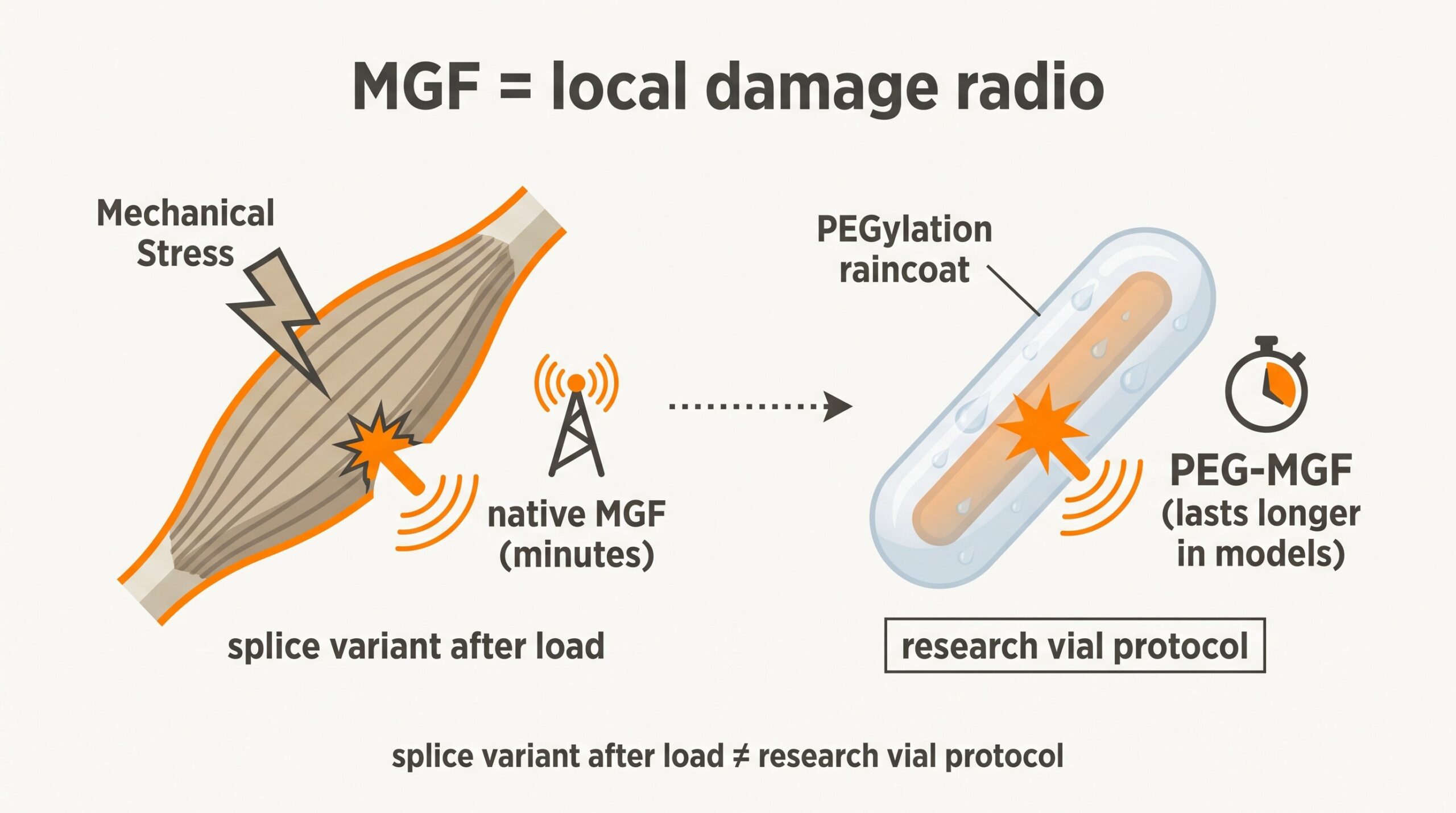
- Mechanism in one line: native MGF is the muscle’s short-lived local damage radio after mechanical stress; PEG is the raincoat researchers add so related peptides last longer in models.
- Your next step: learn the three doors (research SKU vs endogenous splice biology vs foundations), then treat partner vials as research options with codes that fire — never as a Discord cycle.
Verdict up front: PEG-MGF is worth understanding if you keep seeing “mechano growth factor” sold like a secret post-workout muscle flare. It is not worth treating a research vial like endogenous IGF-1Ec splicing inside your quads, and it is not a free ranking page that hands you a hypertrophy stack.
Real splice biology. Real young-vs-elderly exercise papers. Real PEGylation chemistry in research catalogs. Zero honest path from “I bought PEG-MGF” to “I just ran Hameed 2003 in my garage.”
Keep reading if you typed PEG-MGF, PEGylated MGF, MGF, IGF-1Ec, mechano growth factor, “local IGF,” or “is this the same as IGF-1 LR3” and want the map without Discord tax. Skip if you want a dosing table, a black-market “cycle,” a claim that a research vial treats sarcopenia, injury, ALS, heart failure, or “hardgainer genetics,” or a reason to skip sleep and protein. Those asks belong in Pro or a real clinic — not a free ranking page.
Day-one basics still live on Start Here and what are peptides. Adjacent maps when you are done here: IGF-1 LR3, Follistatin, Tesamorelin, Ipamorelin, MOTS-c, MK-677, peptides for muscle growth, protein intake, and how to reconstitute peptides.
Education only. Not medical advice. A research-catalog PEG-MGF or MGF vial is not an FDA-approved muscle drug, not mecasermin, not IGF-1 LR3, and not permission to ignore growth-factor caution when people oversell “just a local IGF.”
What is PEG-MGF?
Start with the plain name. MGF is short for mechano growth factor. Researchers use that nickname for an IGF-1 splice story that shows up when skeletal muscle gets stretched, loaded, or damaged.
Your body already splices the IGF-1 gene into more than one product. The celebrity gym version is often labeled IGF-1Ec in humans. Rodent papers sometimes call the matching lane IGF-IEb. Shared neighborhood. Different naming habits.
PEG-MGF is the research-catalog cousin where a polyethylene glycol chain — a PEGylation raincoat — is attached so the peptide hangs around longer in experimental systems than a naked short-lived MGF fragment.
On partner shelves you will see names like PEG-MGF, MGF, MGF (IGF-1Ec), or PEGylated mechano growth factor. Shared research neighborhood. Different vials, COAs, and jobs.
Why this matters: forums mash endogenous splice transcripts, synthetic MGF E-domain peptides, PEGylated research SKUs, and IGF-1 LR3 into one “local IGF” bucket. Shared family tree. Different objects.
So what for you: if a sales page never separates endogenous splicing from a PEGylated catalog peptide, it is selling vibes.
The local-damage-radio mechanism (one analogy)
Here is the only picture I want stuck in your head.
Think of native MGF as the muscle’s local damage radio. Heavy mechanical stress hits. The fiber sends a short flare that says “repair crew needed here.” In the classic splice story, that flare is brief and local — not a day-long circulating hormone blast.
PEG-MGF is researchers putting a clear raincoat on a related peptide so the signal does not vanish as fast in models. Longer half-life chemistry. Same curiosity neighborhood. Still not your quads rewriting exons after a squat session.
One honesty check from the reviews: Matheny and colleagues called MGF a putative product of IGF-I gene expression for a reason. The field still argues about which piece of the splice story does the real work — full isoform, E-domain peptide, or both — and how cleanly a vial maps onto that biology.
How sure should you be? Fairly sure mechanical load can change IGF-1 splice transcripts in muscle. Fairly sure young and old muscle do not always answer the same way. Much less sure that a PEGylated research peptide recreates endogenous local splicing. Zero sure that a crimp cap equals a resistance-training biopsy study.
Why this matters: if you cannot explain “local damage radio vs PEGylated catalog cousin” in one sentence, you are not ready to open a cart.
So what for you: ask for the splice-vs-SKU story before you ask for a price.
The stop-you number (and what it is not)
The cleanest “this pathway is not a cartoon” number is not a gym mirror selfie. It is a human biopsy paper.
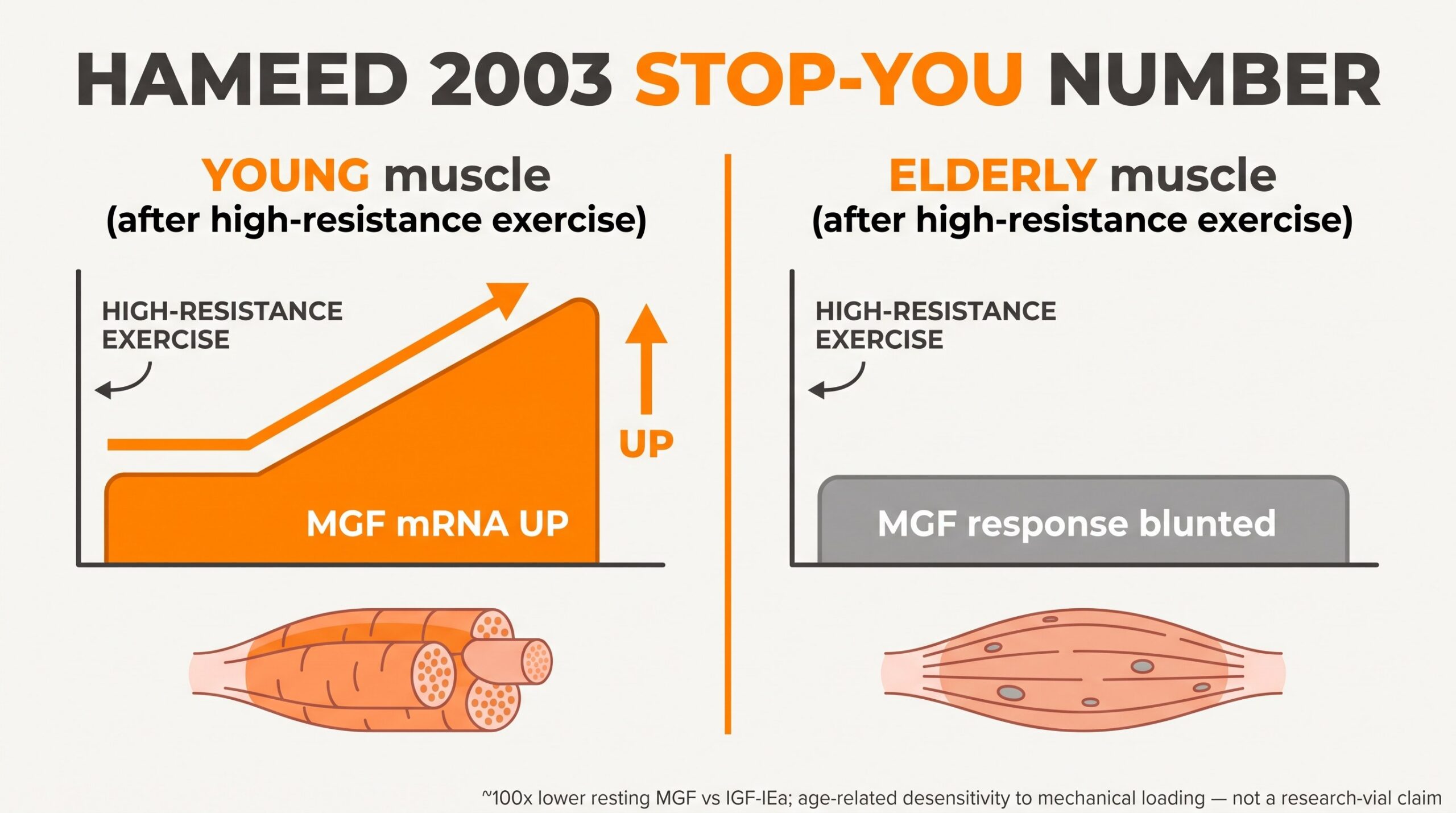
Hameed and colleagues in 2003 had young adults (25–36) and older adults (70–82) smash single-leg knee extensions at 80% of one-rep max. Biopsies came 2.5 hours later.
Resting MGF transcript levels sat roughly 100-fold lower than the more common IGF-IEa isoform. After the bout, young muscle showed a significant MGF mRNA rise. Elderly muscle did not match that response at the same time point. The authors called it age-related desensitivity to mechanical loading.
That is Motley Fool confidence framing in one line: real Journal of Physiology endpoints in humans, mRNA after loading, not a research-vial label.
Cell-culture work later showed MGF E-domain peptide can expand progenitor cell pools in healthy and diseased muscle cultures while IGF-I leans differentiation. Interesting repair-biology story. Still not a free ranking-page protocol.
Why this matters: the stop-you ratio is that roughly 100× lower resting MGF vs IGF-IEa story plus the young-up / elderly-blunted loading response — and the confidence level for “my PEG-MGF vial is just DIY Hameed 2003” is still zero.
So what for you: be impressed by the load-sensing biology. Do not confuse biopsy mRNA with a lyophilized catalog SKU.
Research catalog vs endogenous splice vs foundations
Three doors. Same word online. Different jobs.
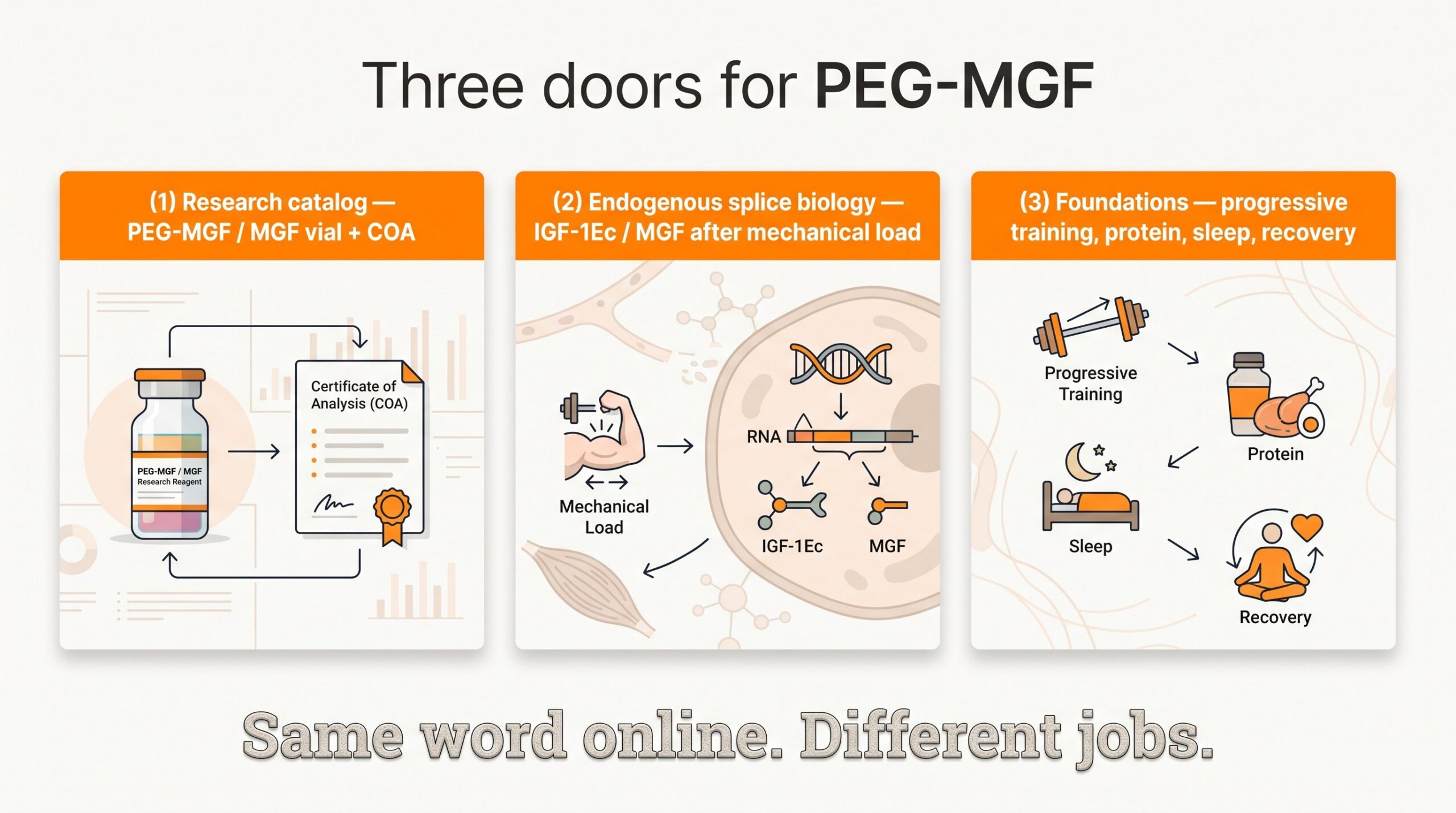
Door 1 — Research catalog. Partner shelves can list PEG-MGF and MGF / IGF-1Ec as research sequences. That is a SKU and a certificate story. It is not FDA-approved lifestyle muscle medicine and not a compounded prescription by default.
Door 2 — Endogenous splice biology. Stretch, stimulation, and resistance-loading papers mapped how IGF-1 splice variants change after mechanical stress. Yang, McKoy, Goldspink, Hameed, and later reviews built that file. That door is muscle transcription after load. It is not a mail-order vial with a coupon code.
Door 3 — Foundations. Progressive resistance training that actually progresses, enough protein, sleep that recovers, Zone 2 and VO2 work that raise the ceiling, and a clinician if you have real neuromuscular, endocrine, or oncology-adjacent questions. If your “problem” is inconsistent training plus 90 grams of protein pretending to be 180, a crimp cap will not fix the root cause. See protein intake, how to sleep better, Zone 2, creatine, and HRV.
Why this matters: most money gets wasted when people buy Door 1 while wanting Door 2 outcomes.
So what for you: pick the door that matches your actual question before you open a cart.
PEG-MGF vs MGF vs IGF-1 LR3
Quick lane honesty without turning this into a textbook.
- MGF / IGF-1Ec is the splice / E-domain research neighborhood tied to mechanical load and local repair talk.
- PEG-MGF is the PEGylated catalog cousin built for longer presence in experimental systems.
- IGF-1 LR3 is a different free-ligand / IGFBP bodyguard-bypass analog map — see the IGF-1 LR3 page. Shared IGF family curiosity. Different job.
And again: PEGylation is chemistry, not magic hypertrophy. Longer circulation in a model is not “more muscle guaranteed.”
Why this matters: Instagram flattens three different research objects into “local IGF = gains.”
So what for you: if a page never separates MGF splice biology from PEG-MGF from LR3, treat the confidence level as low.
Myths that burn money
- “Endogenous MGF = safe vial.” Your muscle splicing IGF-1 transcripts after a hard set is not the same as injecting a PEGylated research peptide from a catalog.
- “PEG-MGF research vial = Hameed biopsy biology.” One is a lyophilized SKU. The other is mRNA measured in human muscle after loading.
- “100× lower resting MGF = I need a bottle.” That ratio describes isoform abundance at rest. It is not a shopping list.
- “If Limitless / Peptira / S1 do not list PEG-MGF, the pathway is fake.” Partner catalogs differ. BioLongevity and Paramount currently carry public PEG-MGF / MGF SKUs on this pass. Missing shelf ≠ missing biology.
- “Stack it with IGF-1 LR3 and Follistatin because all three say muscle.” Shared curiosity neighborhood. Different mechanisms. Stacking Discord screenshots is not a plan.
Why this matters: the expensive mistake is buying a story you cannot falsify.
So what for you: falsify the door first. Then decide whether a research SKU even belongs in the conversation.
Partner research options (codes that fire)
If you are mapping research SKUs after you understand the doors, these are the public InStock PEG-MGF / MGF partners on this publish pass. Codes live in the links. Click them so the discount fires.
PEG-MGF / MGF heroes
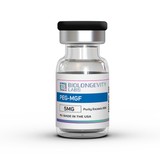
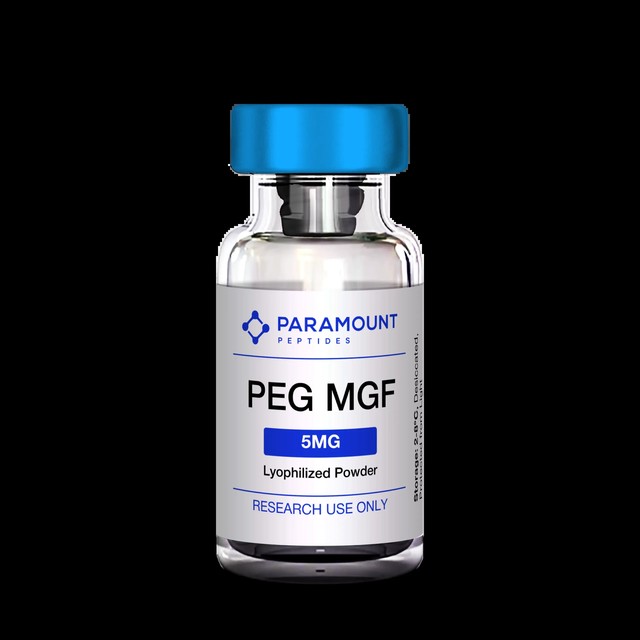
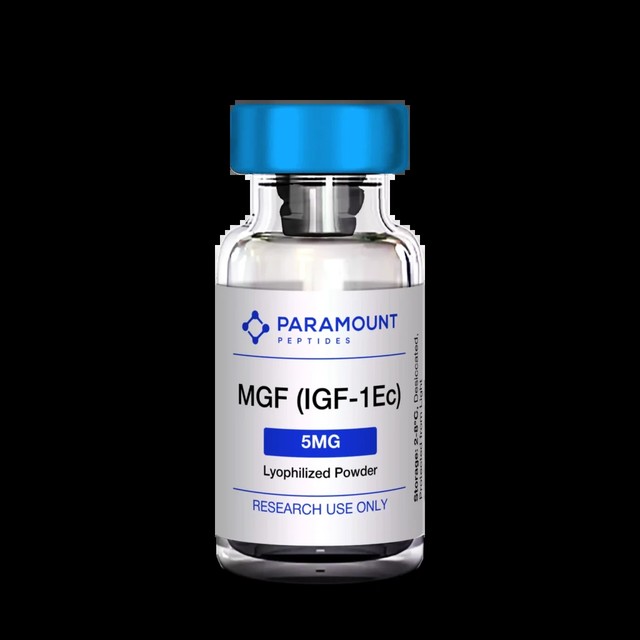
BioLongevity PEG-MGF · LEE15Paramount PEG-MGF · LEE10Paramount MGF · LEE10
Adjacent research maps (convert)
 Peptira
IGF-1 LR3
LEE Paramount
IGF-1 LR3
LEE10 S1 Research
IGF-1 LR3
LEE10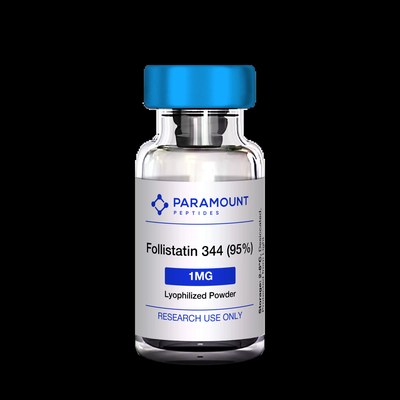 Paramount
Follistatin 344
LEE10 BioLongevity
Follistatin
LEE15 BioLongevity
Ipamorelin 10 mg
LEE15 BioLongevity
MOTS-c 10 mg
LEE15Limitless home · LEE20Paramount home · LEE10Peptira home · LEES1 shop · LEE10BioLongevity home · LEE15
Why this matters: conversion without honesty is how domains die. These cards are research maps with tracking that works — not treatment claims.
So what for you: if you came for a protocol table, stop. If you came to understand the pathway and keep clean partner links, you are in the right place.
Related research maps
- IGF-1 LR3 — free-ligand / IGFBP bodyguard-bypass neighbor
- Follistatin — myostatin parking-brake neighbor
- Peptides for muscle growth — hub map without Discord tax
- Tesamorelin / Ipamorelin / MK-677 — GH-axis curiosity doors
- MOTS-c / SS-31 — mitochondrial neighbors
- Hexarelin / Thymosin Alpha-1 — adjacent catalog maps
- FOXO4-DRI — longevity research curiosity with the same three-door discipline
Evidence limits (read this twice)
Partner catalogs are not selling endogenous muscle splicing. PEG-MGF on a research shelf is not Hameed 2003 and not a DIY hypertrophy drug.
If you have a neuromuscular diagnosis, unexplained weakness, endocrine questions, cancer history, or oncology-adjacent concerns around growth-factor pathways, this is a clinician conversation. Not a research-cart conversation.
Why this matters: confidence framing protects your wallet and your risk file.
So what for you: use this page to get smarter. Use a clinician to get safer. Use Pro if you want protocol depth without random Discord screenshots.
Sources & Further Reading
- Yang S, et al. Cloning and characterization of an IGF-1 isoform expressed in skeletal muscle subjected to stretch. J Muscle Res Cell Motil. 1996. PubMed 8884603
- McKoy G, et al. Expression of insulin growth factor-1 splice variants and structural genes in rabbit skeletal muscle induced by stretch and stimulation. J Physiol. 1999. PubMed 10087355
- Hameed M, et al. Expression of IGF-I splice variants in young and old human skeletal muscle after high resistance exercise. J Physiol. 2003. PubMed 12562960
- Ates K, et al. The IGF-I splice variant MGF increases progenitor cells in ALS, dystrophic, and normal muscle. FEBS Lett. 2007. PubMed 17531227
- Hameed M, et al. Effects of eccentric cycling exercise on IGF-I splice variant expression in the muscles of young and elderly people. Scand J Med Sci Sports. 2008. PubMed 18067523
- Riddoch-Contreras J, et al. Mechano-growth factor, an IGF-I splice variant, rescues motoneurons and improves muscle function in SOD1(G93A) mice. Exp Neurol. 2009. PubMed 19038252
- Matheny RW Jr, et al. Minireview: Mechano-growth factor: a putative product of IGF-I gene expression involved in tissue repair and regeneration. Endocrinology. 2010. PubMed 20130113
- Roberts MD, et al. IGF-1 splice variant and IGF-1 peptide expression patterns in young and old human skeletal muscle prior to and following sequential exercise bouts. Eur J Appl Physiol. 2010. PubMed 20668872
- Kandalla PK, et al. Mechano Growth Factor E peptide (MGF-E) activates human muscle progenitor cells and induces an increase in their fusion potential at different ages. Mech Ageing Dev. 2011. PubMed 21354439
- Schlegel W, et al. Insulin-like growth factor I (IGF-1) Ec/Mechano Growth factor — a splice variant of IGF-1 within the growth plate. PLoS One. 2013. PubMed 24146828
The bottom line
PEG-MGF is one of the loudest local-IGF stories in the research aisle. Damage radio. PEGylation raincoat. Hard human biopsy numbers. Partner SKUs exist.
It is still not endogenous splicing in your quads and not a DIY muscle drug. Read the three-door warning. Talk to a clinician about real neuromuscular or endocrine questions. Build training and protein habits that do not require a crimp cap.
Want the deeper protocol library after that? Pro is the paid door. Want the free research PDF? Grab the Playbook below.
Free guide
Get The Peptide PlaybookEnter your email and we’ll send the research PDF. Education only — not medical advice.
I built Peptides & Pump so you can get this without a guru tax. Free Knowledge Base first if you are not ready to pay. Pro if you want the protocol library.
 Keep going on Peptides & Pump
Free is the peptide community. Pro is the paid door. Codes are the links. Click them so the discount fires.
Free
Knowledge Base
The peptide community · 2,500+
- 2,500+ member peptide community
- Sourcing questions before you buy anything random
- The basics, from people actually using peptides
Pro
Peptides & Pump Pro
$10/mo · 7-day trial
- Science-backed protocol library
- 1-on-1 support from Lee and Matt
- Step-by-step video, plus a monthly $500 drawing
LEE20 Limitless LEE15 BioLongevity LEE10 Paramount LEE Peptira LEE10 S1
Supplier footnote: Research suppliers I mention when people ask about PEG-MGF: BioLongevity PEG-MGF 5 mg (code LEE15), Paramount PEG-MGF 5 mg (code LEE10), Paramount MGF (IGF-1Ec) (code LEE10). Adjacent research maps: Peptira IGF-1 LR3, Paramount IGF-1 LR3, S1 IGF-1 LR3, Paramount Follistatin 344, BioLongevity Follistatin, Ipamorelin 10 mg, MOTS-c. Partner home/shop chips: Limitless (code LEE20), Paramount (code LEE10), Peptira (code LEE), S1 shop (code LEE10), plus BioLongevity home (code LEE15). Match the product to the job. Do not collect bottles.
Disclaimer. This article is for educational and research purposes only. It is not medical advice. It is not intended to diagnose, treat, cure, or prevent any disease. PEG-MGF, MGF, mechano growth factor, IGF-1Ec, IGF-IEb, IGF-1 LR3, Follistatin, and other related research compounds are not presented here as FDA-approved treatments you should self-administer for muscle growth, fat loss, injury repair, sarcopenia, ALS, heart failure, or any other indication. Research peptides discussed here are research sequences; a research-catalog vial is not a compounded prescription. Evidence discussed here includes splice-variant expression studies, cell culture, and animal work; none of that is a substitute for a clinician. Individual results vary. Always consult a qualified healthcare provider before starting any peptide, drug, supplement, or protocol, especially if you have a medical condition, cancer history, or take prescription medication. Peptides & Pump does not sell peptides.
Affiliate disclosure. Some links on this page are affiliate links. If you buy through them, I may earn a commission at no extra cost to you. Codes LEE15, LEE20, LEE, and LEE10 are the ones I actually use where a coupon fires. That commission is how I keep publishing free education. I only link suppliers I am willing to put my name on.