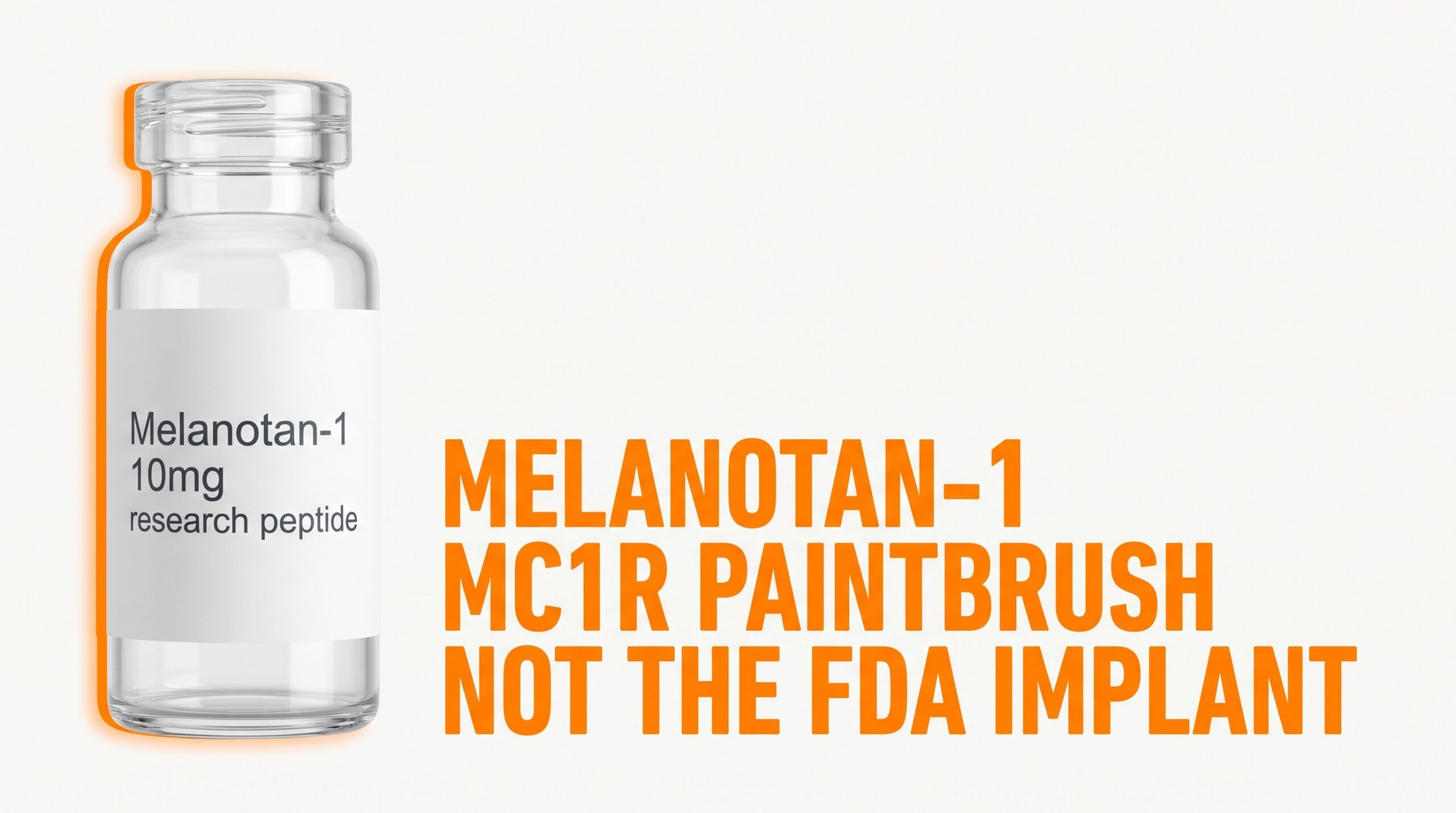
Melanotan-1 Peptide (NDP-MSH / Afamelanotide Chemistry): Research Map (Not Scenesse)
Key takeaways
- Verdict: Melanotan-1 is the MC1R “paintbrush” cousin of alpha-MSH — same chemistry family as FDA afamelanotide for EPP, not a free-site tan protocol and not Melanotan-2.
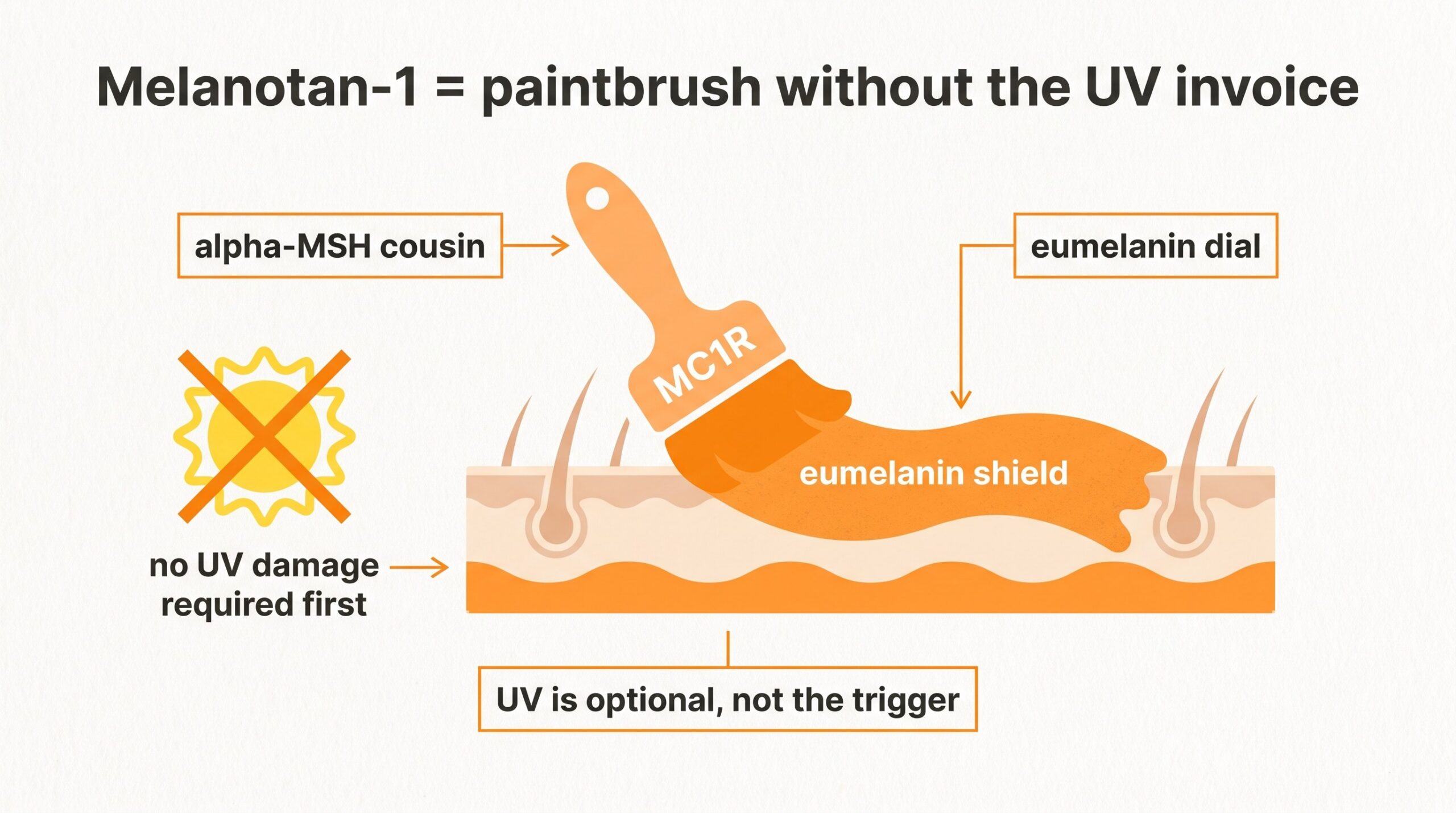
- Mechanism in one line: it turns the eumelanin dial on melanocortin-1 receptors without needing a UV burn as the invoice.
- Your next step: learn the three doors (research vial vs FDA implant vs foundations), keep sunscreen honesty, and only treat partner SKUs as research options with codes that fire.
Verdict up front: Melanotan-1 is worth understanding if you care about melanocortin biology and why “tan peptide” captions keep collapsing two different molecules into one shopping cart. It is not worth treating a research vial like Scenesse, and it is not Melanotan-2 with the loud sexual-side-effect reputation.
Real human pharmacology. One FDA-approved implant cousin for a rare photosensitivity disease. No free ranking page that says “skip sunscreen and buy a crimp cap.”
Keep reading if you typed melanotan-1, MT-1, NDP-MSH, afamelanotide, MC1R, or “is this the FDA tan drug” and want the map without forum tax. Skip if you want a tanning protocol, a Melanotan-2 stack, a reason to ditch SPF, or a claim that a research vial treats EPP, vitiligo, melanoma risk, or “pale gym skin.” Those asks belong in Pro or a real clinic — not a free ranking page.
Day-one basics still live on Start Here and what are peptides. Adjacent maps when you are done here: PT-141, GHK-Cu, GLOW, Hexarelin, Kisspeptin, and how to reconstitute peptides.
Education only. Not medical advice. A research-catalog Melanotan-1 vial is not Scenesse, not a treatment for erythropoietic protoporphyria, not a melanoma-prevention drug, and not permission to skip shade or sunscreen.
What is Melanotan-1?
Melanotan-1 is a lab-made cousin of alpha-melanocyte-stimulating hormone.
Chemists usually write it as [Nle4, D-Phe7]-alpha-MSH, also called NDP-MSH. Two amino-acid swaps make the chain tougher against enzymes than natural alpha-MSH, so the signal lasts longer at the melanocortin-1 receptor.
Sawyer and colleagues published that design in 1980. Levine and colleagues later showed subcutaneous dosing could raise skin tanning in humans. Fitzgerald and colleagues mapped melanin responses in people with MC1R variant alleles — the genetics often tied to fair, hard-to-tan skin.
In the clinic world, the same active chemistry shows up as afamelanotide, sold as a controlled-release implant under the brand Scenesse for adults with erythropoietic protoporphyria. That is a rare genetic photosensitivity disease where light can cause severe pain. It is not a lifestyle tanning indication.
In plain English: Melanotan-1 is the MC1R paintbrush in the research aisle. Afamelanotide is the regulated implant cousin for a specific disease. Same family. Different door.
Why this matters: forums mash Melanotan-1, Melanotan-2, and Scenesse into one “tan shot” caption. The chemistry family is shared. The jobs are not.
So what for you: if a sales page never separates MT-1 from MT-2 or never mentions the FDA implant lane, it is selling vibes.
The paintbrush without the UV invoice (one analogy)
Here is the only picture I want stuck in your head.
Think of Melanotan-1 as a paintbrush for the eumelanin dial on MC1R. Natural alpha-MSH is part of the body’s response after UV stress. The synthetic cousin was built to push melanogenesis hard and last longer — so pigment can rise without treating a sunburn as the required invoice.
Eumelanin is the brown-black pigment that absorbs and scatters light and helps mop up reactive oxygen species. Pheomelanin is the redder pigment story often linked with fair MC1R-variant skin. Melanotan-1 research leans toward tipping the eumelanin side of that ledger.
That does not mean “UV is now free.” It means the mechanism does not require UV damage as the first step. Sunscreen, shade behavior, and dermatology follow-up still matter. A paintbrush is not a force field.
How sure should you be? Fairly sure NDP-MSH / Melanotan-1 is a potent MC1R agonist with human tanning and melanin data in older pharmacology files, and that afamelanotide implants have Phase 3 evidence in EPP. Much less sure that a research-catalog vial recreates a regulated implant schedule or that darker skin from any source equals cancer insurance.
Why this matters: if you cannot explain “MC1R eumelanin dial without UV as the required trigger” in one sentence, you are not ready to open a cart.
So what for you: ask for the receptor story and the door story before you ask for a price.
The stop-you number (and what it is not)
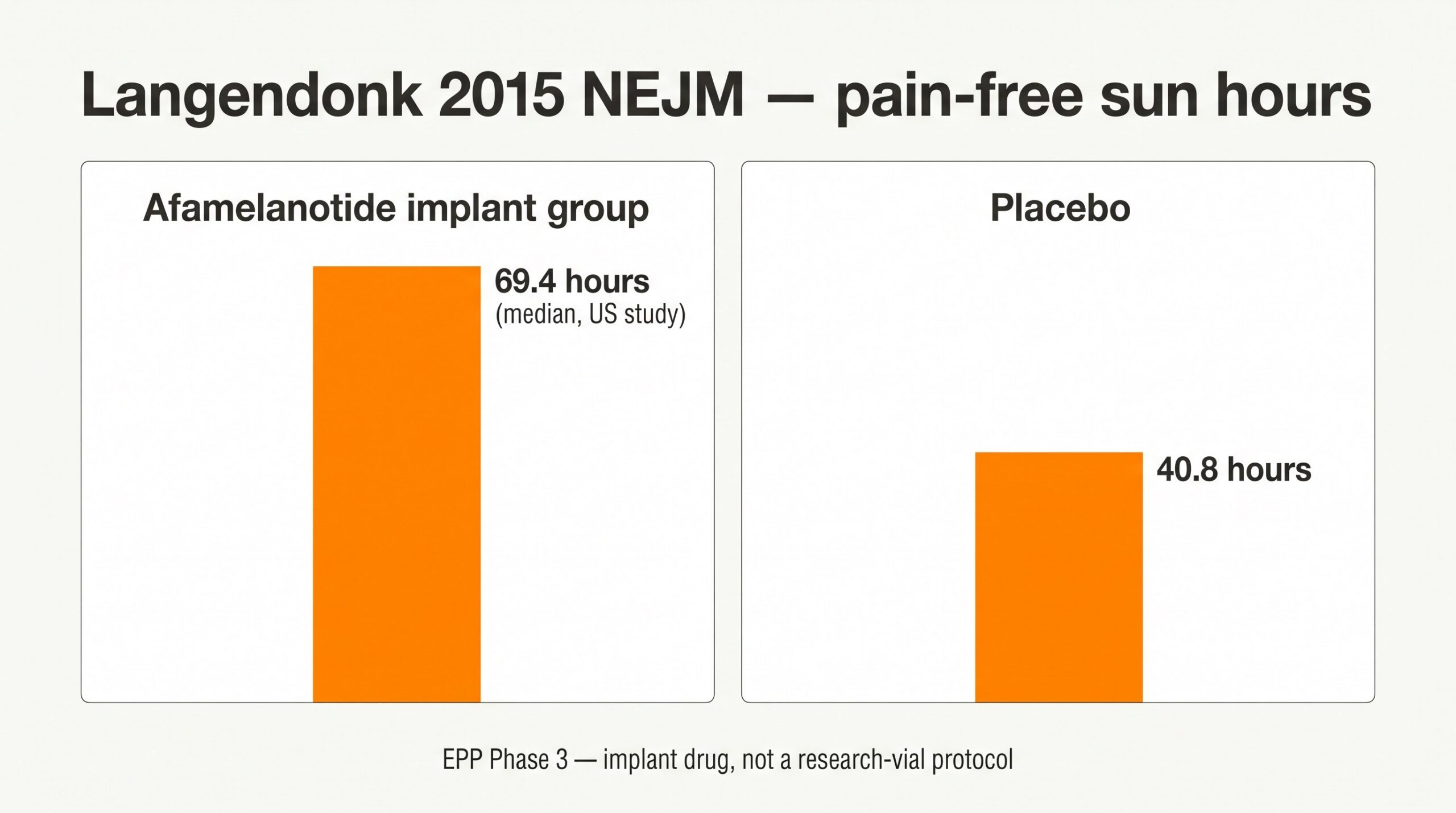
The cleanest “this chemistry is not a cartoon” human number for this page is not a beach selfie. It is the Langendonk 2015 New England Journal of Medicine Phase 3 program for afamelanotide implants in erythropoietic protoporphyria.
Two multicenter, randomized, double-blind, placebo-controlled trials used subcutaneous implants containing 16 mg afamelanotide every 60 days.
In the U.S. study, median duration of pain-free direct sunlight after six months was about 69.4 hours with afamelanotide versus about 40.8 hours with placebo (P = 0.04). In the European Union study, median pain-free time after nine months was about 6.0 hours versus 0.8 hours (P = 0.005), and phototoxic reactions were fewer in the afamelanotide arm.
That is Motley Fool confidence framing in one line: the implant drug moved a hard quality-of-life endpoint in a rare photosensitivity disease under trial conditions. A research vial on a partner shelf is not that implant, not that schedule, and not an EPP prescription.
Levine 1991 and Fitzgerald 2006 are the older healthy-volunteer / melanin-synthesis receipts for Melanotan-style dosing outside the EPP implant label. Useful for mechanism honesty. Still not a free-site tan protocol.
Why this matters: the stop-you number is that roughly 69.4 vs 40.8 median pain-free sun hours in the U.S. EPP implant trial — and the confidence level for “my Melanotan-1 research vial is Scenesse” is still zero.
So what for you: be impressed by the human biology. Do not confuse an FDA-labeled implant story with a crimp-cap shopping cart.
Research catalog vs FDA implant vs foundations
Three doors. Same molecule family online. Different jobs.
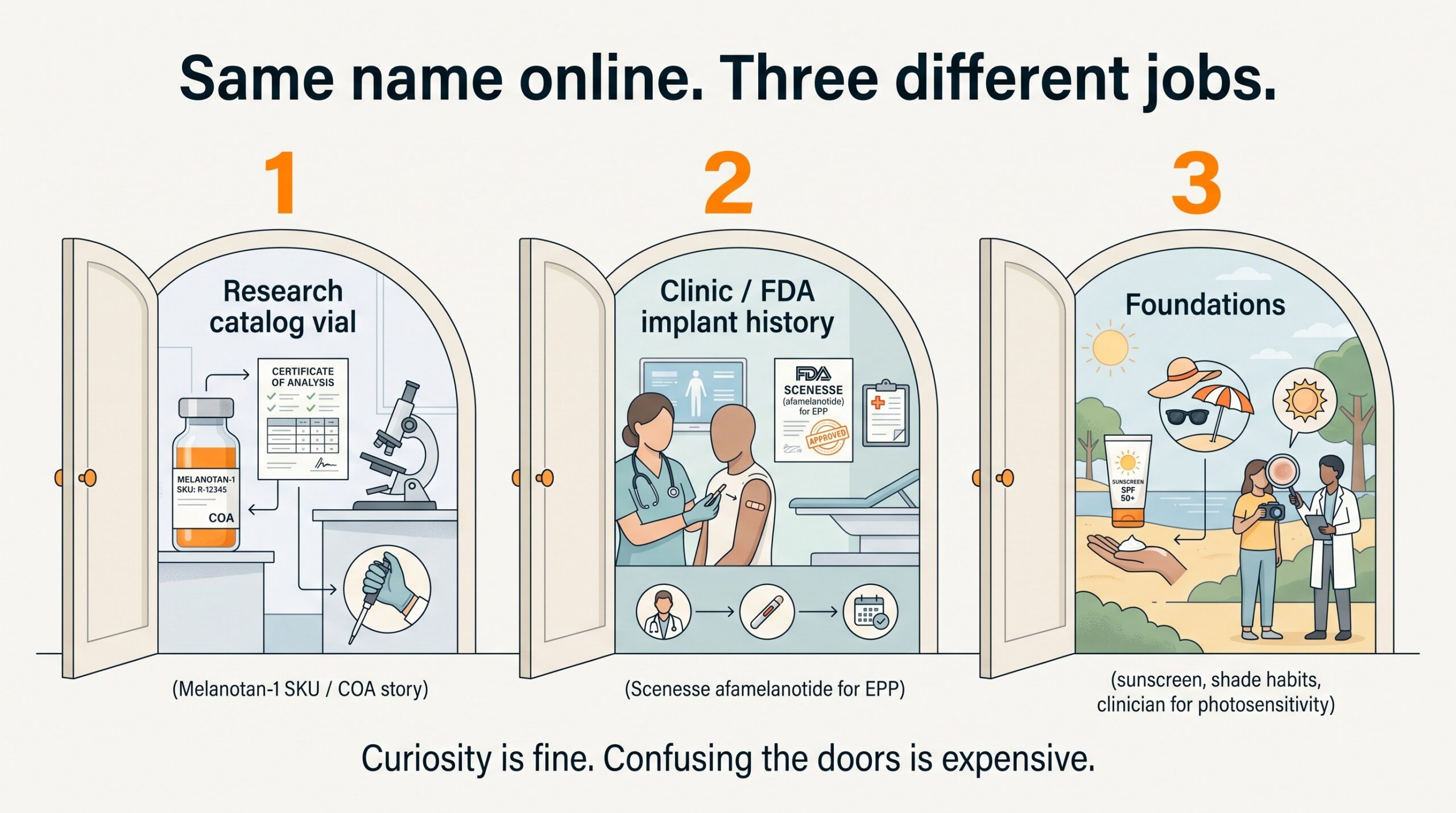
Door 1 — Research catalog. Partner shelves can list Melanotan-1 / MT-1 as a research sequence. That is a SKU and a certificate story. It is not Scenesse, not an EPP prescription, and not FDA-approved lifestyle tanning.
Door 2 — Clinic / FDA implant history. Afamelanotide (Scenesse) is a regulated subcutaneous implant indicated to increase pain-free light exposure in adults with a history of phototoxic reactions from erythropoietic protoporphyria. Trial maps, specialty clinics, and labeled risk/benefit live here.
Door 3 — Foundations. Broad-spectrum sunscreen, shade behavior, clothing, dermatology follow-up if you have moles that change, and a clinician if you have real photosensitivity disease. If your “problem” is wanting a tan while ignoring UV math, a peptide caption will not fix the root cause.
Why this matters: people lose money and risk when they buy Door 1 while pretending it is Door 2.
So what for you: foundations and a clinician first for disease questions. Research curiosity second. Pro if you want protocol depth later.
Melanotan-1 vs Melanotan-2 vs other melanocortin maps
Quick orientation, not a stack recipe.
Melanotan-1 (NDP-MSH / afamelanotide chemistry): longer linear alpha-MSH analog. MC1R-forward pigment story. FDA implant cousin for EPP. Research vials are still research vials.
Melanotan-2: shorter cyclic analog with a louder multi-receptor reputation historically tied to nausea and sexual side effects in older melanocortin work. Different molecule. Different risk caption. Do not buy MT-2 because a cart titled it “stronger Melanotan.”
PT-141 (bremelanotide): another melanocortin-family story aimed at sexual desire in labeled clinical context — not a tan peptide. See the PT-141 map.
Skin / copper / glow lanes: GHK-Cu and GLOW are separate research maps people confuse with “skin peptides.” Different receptors. Different jobs.
Why this matters: “tan peptide” is a marketing bucket. Receptor selectivity and regulatory door are the real filters.
So what for you: pick the map that matches the question you actually have. Do not buy the loudest vial by default.
Who this page is (and is not) for
This page is for curious readers who want the Melanotan-1 / afamelanotide cascade explained cleanly and want partner SKUs labeled as research options.
This page is not for anyone trying to treat EPP, vitiligo, melanoma risk, acne, erectile issues, or “pale winter skin” with a crimp-cap vial from a research catalog.
Melanocortin and photosensitivity topics are high YMYL. Education is fine. Disease hustle is how domains die.
Related foundation reads on this site: sauna, cold plunge, sleep, protein intake, Zone 2, HRV, and VO2 max as recovery context — never as “peptides that treat sun damage.”
Why this matters: the expensive mistake is buying a story you cannot falsify.
So what for you: keep a clinician in the loop for true photosensitivity disease, changing moles, or any hormone/sexual-health workup adjacent to melanocortin drugs. Do not argue with captions.
Where I look for a Melanotan-1 research compound
Partner reality on today’s check: BioLongevity lists Melanotan 1 (10 mg) InStock on a public product page via Drive-tracked url_id=107. Paramount did not show a Melanotan-1 Drive row on this pass. Peptira tracks Melanotan-2 as a separate SKU — different molecule, so it stays off the hero card. Limitless Melanotan-1 looks VIP-gated rather than a clean public product URL, so it stays a home chip only.
Research-catalog SKU currently live on partner check (not a treatment recommendation).
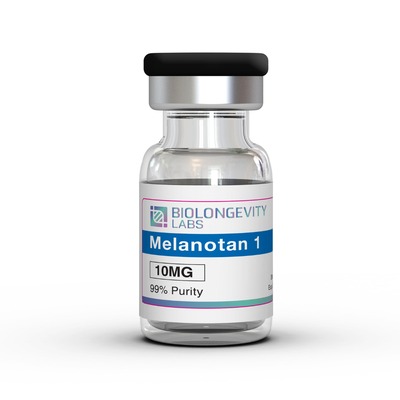 BioLongevity
Melanotan 1 10 mg
LEE15BioLongevity Melanotan 1 10 mg · LEE15Limitless home · LEE20BioLongevity home · LEE15Paramount home · LEE10Peptira home · LEES1 shop · LEE10
If you ever reconstitute a lyophilized research peptide, learn the math first on how to reconstitute peptides. That page is public education. It is not a Melanotan-1 protocol.
Why this matters: one InStock hero card beats five mystery tabs when you are only browsing research options.
So what for you: match the SKU photo to the link. Codes only work when the tracking fires.
Related research maps (convert after foundations)
Foundation first. Then research curiosity. Never “peptides that treat sun damage / pale skin / EPP” as a claim.
If you are mapping adjacent research shelves after the Melanotan-1 story, these partner SKUs were InStock on today’s check:
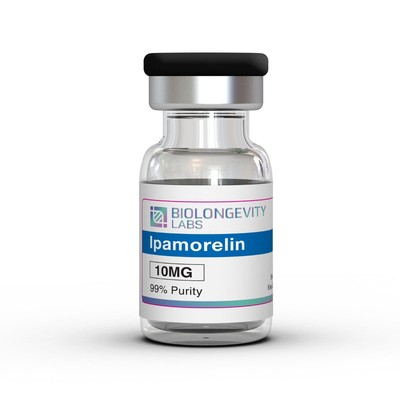 BioLongevity
Ipamorelin 10 mg
LEE15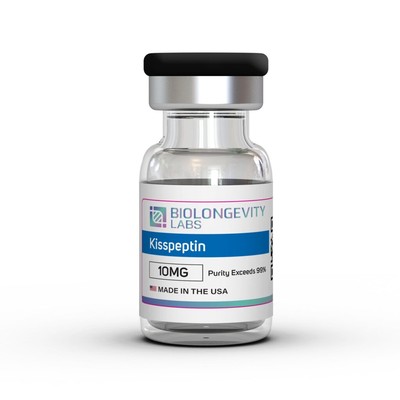 BioLongevity
Kisspeptin 10 mg
LEE15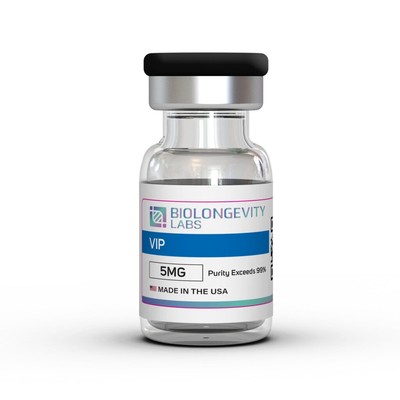 BioLongevity
VIP 5 mg
LEE15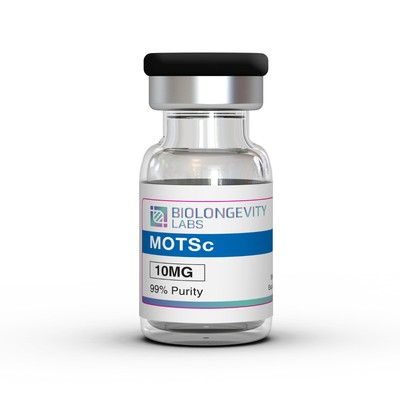 BioLongevity
MOTS-c 10 mg
LEE15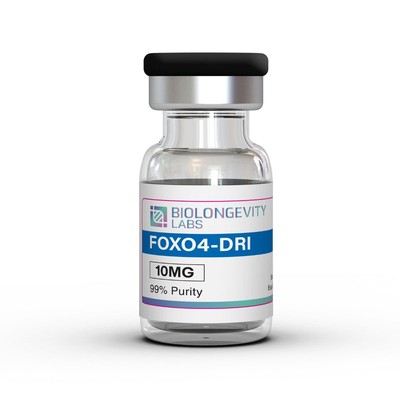 BioLongevity
FOXO4-DRI 10 mg
LEE15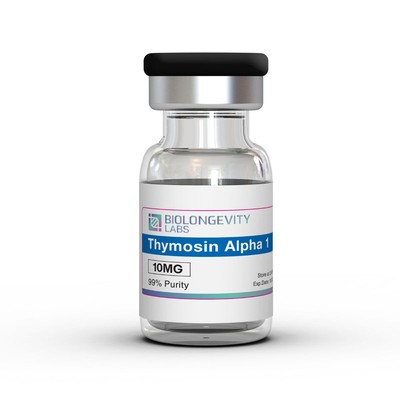 BioLongevity
Thymosin Alpha-1 10 mg
LEE15Deep-dive pages for the ones that already have ranking maps: Ipamorelin, Kisspeptin, VIP, MOTS-c, FOXO4-DRI, TA1, Hexarelin, PT-141.
Evidence limits
Strongest clean human biology punch for a ranking reader is the Langendonk 2015 NEJM afamelanotide implant program in EPP, plus Sawyer / Levine / Fitzgerald for the Melanotan-1 / NDP-MSH design and melanin story.
Partner catalogs are not selling Scenesse. Melanotan-1 on a research shelf is not an EPP medicine, and neither is a DIY tan protocol.
If you have true photosensitivity disease, changing moles, unexplained skin pain after light, or questions about melanocortin drugs and sexual side effects, this is a clinician conversation. Not a research-cart conversation.
Why this matters: confidence framing protects your wallet and your risk file.
So what for you: use this page to get smarter. Use a clinician to get safer. Use Pro if you want protocol depth without random Discord screenshots.
Sources & Further Reading
- Sawyer TK, et al. 4-Norleucine, 7-D-phenylalanine-alpha-melanocyte-stimulating hormone: a highly potent alpha-melanotropin with ultralong biological activity. Proc Natl Acad Sci U S A. 1980. PubMed 6777774
- Levine N, et al. Induction of skin tanning by subcutaneous administration of a potent synthetic melanotropin. JAMA. 1991. PubMed 1658407
- Fitzgerald LM, et al. Effect of MELANOTAN, [Nle(4), D-Phe(7)]-alpha-MSH, on melanin synthesis in humans with MC1R variant alleles. Peptides. 2006. PubMed 16293341
- Langendonk JG, et al. Afamelanotide for Erythropoietic Protoporphyria. N Engl J Med. 2015. PubMed 26132941
- Hadley ME, Dorr RT. Melanocortin peptide therapeutics: historical milestones, clinical studies and commercialization. Peptides. 2006. PubMed 16412534
- Hadley ME. Discovery and development of novel melanogenic drugs. Melanotan-I and -II. Pharm Biotechnol. 1998. PubMed 9760697
- Harms JH, et al. Mitigating photosensitivity of erythropoietic protoporphyria patients by an agonistic analog of alpha-melanocyte stimulating hormone. Photochem Photobiol. 2009. PubMed 19656325
- Böhm M, et al. Beneficial effects of the melanocortin analogue Nle4-D-Phe7-α-MSH in acne vulgaris. J Eur Acad Dermatol Venereol. 2012. PubMed 22845050
The bottom line
Melanotan-1 is one of the cleaner melanocortin stories in the research-peptide aisle. MC1R paintbrush. NDP-MSH design. Hard human biology in Langendonk 2015 for the implant cousin. Partner SKUs exist.
It is still not a DIY tan drug and not Melanotan-2. Read the three-door warning. Talk to a clinician about real photosensitivity disease. Build sun habits that do not require a crimp cap.
Want the deeper protocol library after that? Pro is the paid door. Want the free research PDF? Grab the Playbook below.
Free guide
Get The Peptide PlaybookEnter your email and we’ll send the research PDF. Education only — not medical advice.
I built Peptides & Pump so you can get this without a guru tax. Free Knowledge Base first if you are not ready to pay. Pro if you want the protocol library.
 Keep going on Peptides & Pump
Free is the peptide community. Pro is where you master it. Codes are the links. Click them so the discount fires.
Free
Knowledge Base
The peptide community · 2,500+
- 2,500+ member peptide community
- Sourcing questions before you buy anything random
- The basics, from people actually using peptides
Pro
Peptides & Pump Pro
$10/mo · 7-day trial
- Science-backed protocol library
- 1-on-1 support from Lee and Matt
- Step-by-step video, plus a monthly $500 drawing
LEE20 Limitless LEE15 BioLongevity LEE10 Paramount LEE Peptira LEE10 S1
Supplier footnote: Research suppliers I mention when people ask about Melanotan-1: BioLongevity Melanotan 1 10 mg (code LEE15). Adjacent research maps on BioLongevity: Ipamorelin 10 mg, Kisspeptin 10 mg, VIP 5 mg, MOTS-c, FOXO4-DRI, Thymosin Alpha-1. Partner home/shop chips: Limitless (code LEE20), Paramount (code LEE10), Peptira (code LEE), S1 shop (code LEE10), plus BioLongevity home (code LEE15). Match the product to the job. Do not collect bottles.
Disclaimer. This article is for educational and research purposes only. It is not medical advice. It is not intended to diagnose, treat, cure, or prevent any disease. Melanotan-1, afamelanotide, Melanotan-2, and other melanocortin analogues are not presented here as FDA-approved treatments you should self-administer for tanning, erythropoietic protoporphyria, vitiligo, melanoma prevention, acne, sexual dysfunction, or any other indication. Research peptides discussed here are research sequences; a research-catalog vial is not a compounded prescription and is not Scenesse. Evidence discussed here includes controlled human pharmacology studies, Phase 3 implant trials in EPP, and melanocortin reviews; none of that is a substitute for a clinician. Individual results vary. Always consult a qualified healthcare provider before starting any peptide, drug, supplement, or protocol, especially if you have a medical condition or take prescription medication. Peptides & Pump does not sell peptides.
Affiliate disclosure. Some links on this page are affiliate links. If you buy through them, I may earn a commission at no extra cost to you. Codes LEE15, LEE20, LEE, and LEE10 are the ones I actually use where a coupon fires. That commission is how I keep publishing free education. I only link suppliers I am willing to put my name on.