VO2 Max: What It Is, Why It Matters, and How to Raise the Ceiling
Key takeaways
- Verdict: VO2 max is your aerobic engine ceiling — how much oxygen heart, lungs, and muscle can process per minute when you go all-out. Raising it is one of the strongest lifestyle-linked longevity signals we have.
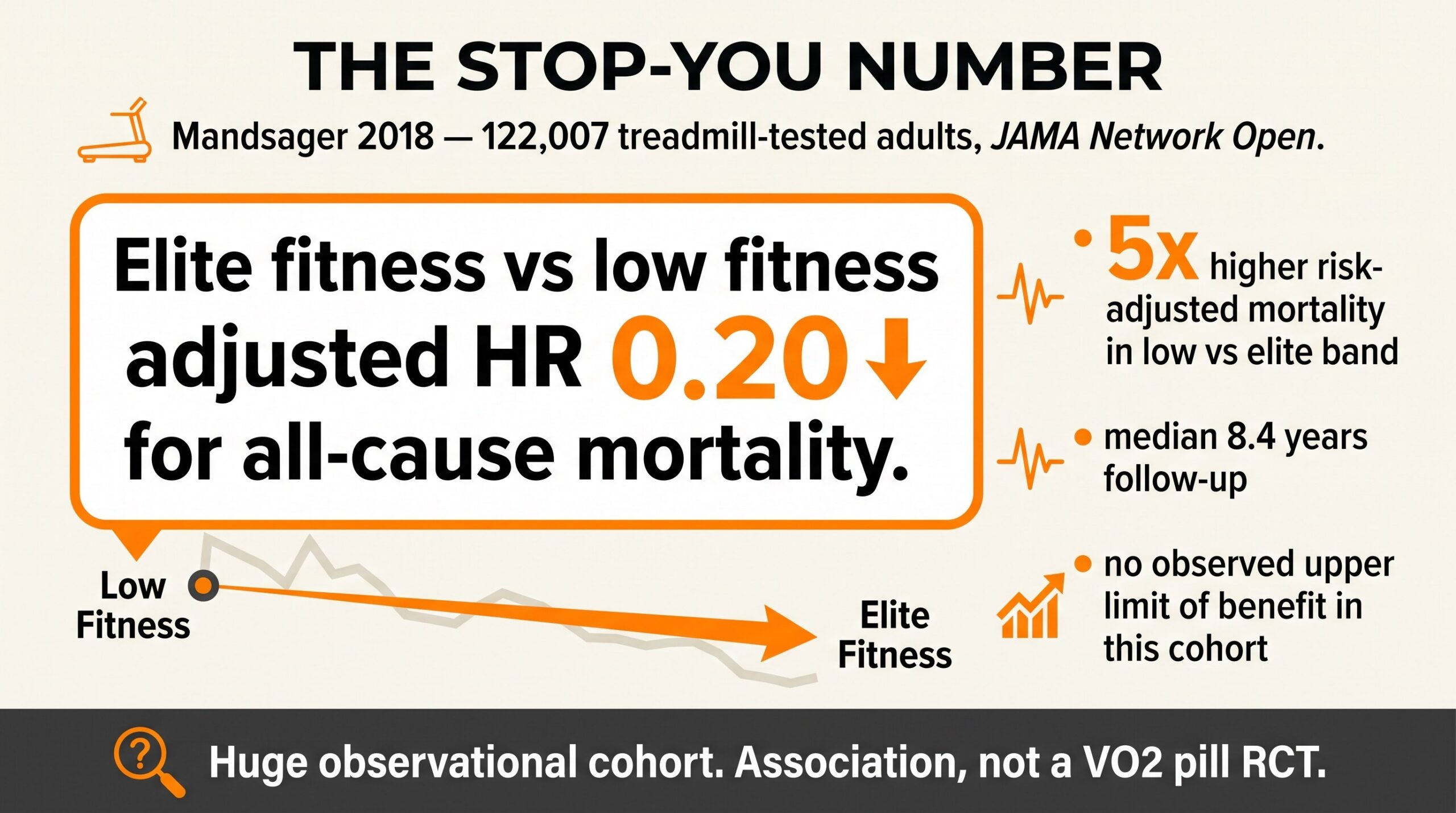
- Stop-you frame: in 122,007 treadmill-tested adults, elite fitness vs low fitness carried an adjusted hazard ratio of 0.20 for all-cause mortality (JAMA Network Open, 2018).
- Your next step: stack easy base + honest hard sparks + sleep/protein, treat wearables as estimates, and keep peptides off this page as a VO2 prescription.
Verdict up front: VO2 max is worth caring about. It is not worth turning into a gadget religion, a shame score, or a reason to buy a vial.
Think ceiling height on an engine. Higher ceiling means more oxygen delivery and use when you push hard. Training can raise that ceiling. Sleep and consistency protect the gain. A peptide catalog cannot replace the work.
Keep reading if you want the plain-English map: what VO2 max is, how labs vs wearables differ, what the big fitness-mortality papers actually say, and how to train toward a higher ceiling without influencer math. Skip if you want a cardiac-rehab order set, a disease-cure claim, or a peptide stack “for VO2.” Those asks do not belong on this free education page.
Day-one site basics live on Start Here. Adjacent foundations: Zone 2 training, sauna benefits, how to sleep better, creatine benefits, and protein intake. Mitochondrial research curiosity can wait on MOTS-c — as literacy, never as a VO2 drug.
Education only. Not medical advice. Not a treatment for heart disease, diabetes, or “low fitness.” If you have chest pain, known cardiovascular disease, or a clinician already managing exercise limits, that conversation stays with them.
What VO2 max actually is
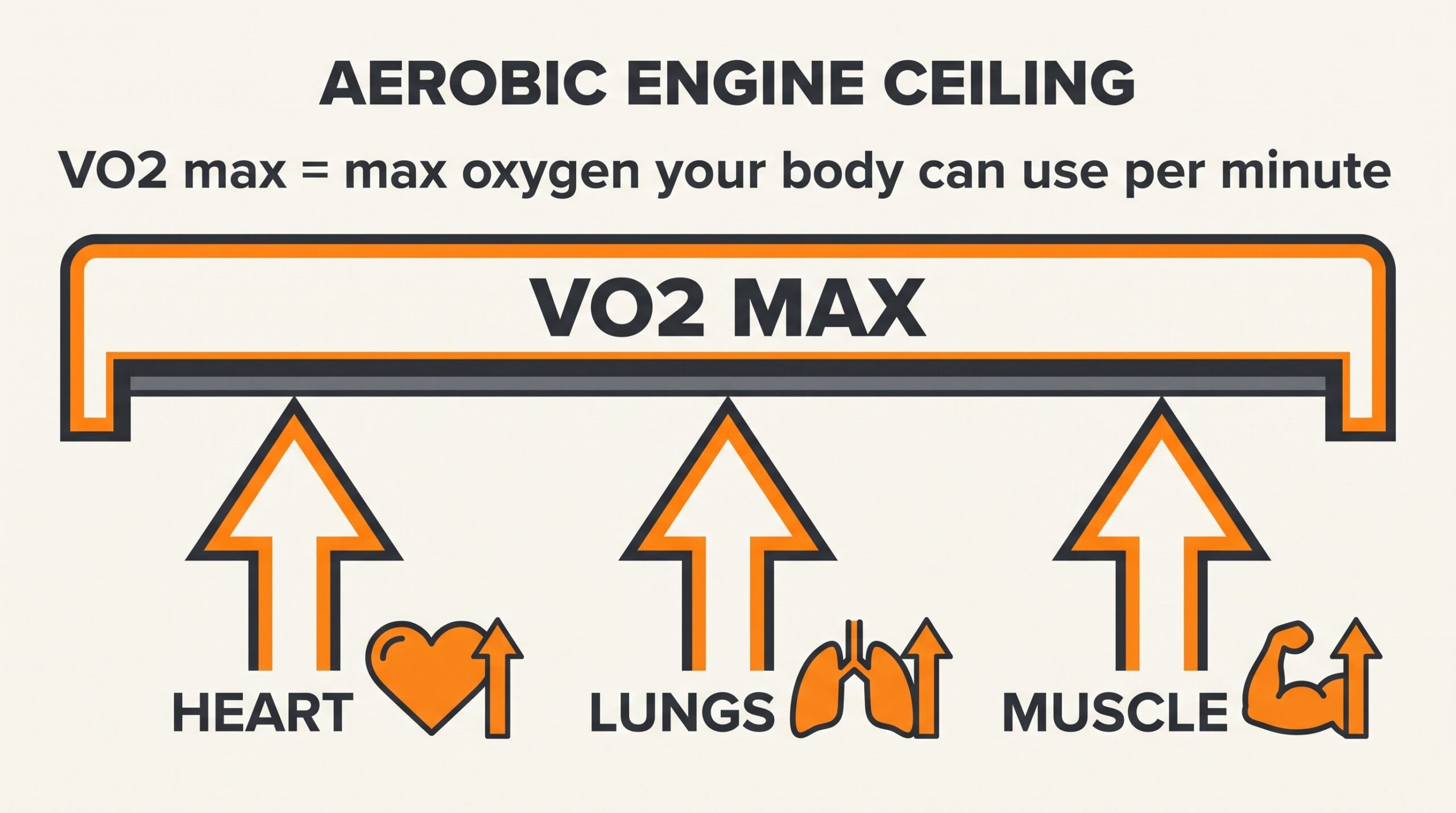
VO2 max is the maximum rate of oxygen your body can take in, transport, and use during intense exercise. Labs often report it as milliliters of oxygen per kilogram of body weight per minute. Clinicians and researchers also talk about cardiorespiratory fitness, or CRF — the broader fitness story VO2 max sits inside.
A MET is a metabolic equivalent. Roughly one MET equals resting oxygen use. Climbing fitness by a few METs is a big deal in the epidemiology. It is not a personality award.
How sure should you be on the definition? Extremely sure. This is standard exercise physiology, not a podcast invention.
Why this matters: once you see VO2 max as a measurable ceiling, you stop treating random “burn” workouts as a strategy.
So what for you: care about the engine capacity, not only the calorie number on a screen.
The stop-you number (and how sure to be)
Mandsager and colleagues followed 122,007 adults after symptom-limited treadmill testing at a large U.S. center. They sorted people into age- and sex-matched fitness bands from low to elite. Over a median 8.4 years, risk-adjusted all-cause mortality fell as fitness rose. Elite performers versus the low band carried an adjusted hazard ratio of 0.20. Flip it: the low band looked about five times worse than elite after adjustment. There was no observed upper limit of benefit in that analysis.
That is the stop-you number. Not because it proves a VO2 pill exists. Because a huge real-world treadmill cohort put a hard association on the table in JAMA Network Open.
Kodama’s classic JAMA meta-analysis of healthy cohorts found about a 13% lower all-cause mortality risk per 1-MET higher fitness (pooled RR 0.87). A 2022 Mayo Clinic Proceedings update across 37 cohorts and more than 2.2 million people still showed top-versus-bottom fitness tertiles around a 45% lower all-cause mortality risk, with roughly an 11% lower risk per 1-MET.
How sure should you be? Fairly sure the inverse association between CRF and mortality is one of the strongest signals in preventive lifestyle science. Less sure that your watch’s VO2 estimate equals a lab cardiopulmonary exercise test. Observational work can still hide healthy-user bias. Fitness is modifiable, but it is not a guarantee sticker.
The American Heart Association has argued for treating cardiorespiratory fitness like a clinical vital sign. Blair’s older Aerobics Center work already showed low fitness predicting mortality in healthy men and women. The modern papers made the dose story sharper.
Why this matters: the evidence tier is large-cohort epidemiology and meta-analysis — not a randomized “raise VO2, erase death” drug trial.
So what for you: treat fitness gains as high-leverage health work, not as internet theater.
Lab test vs wearable estimate
A cardiopulmonary exercise test — often called CPET or CPX — is the gold-standard way to measure VO2 max in a lab with gas analysis. Treadmill equations that estimate METs from stage and speed are also widely used in clinic cohorts like Mandsager’s.
Consumer wearables estimate VO2 max from heart-rate response to walking, running, or cycling. Useful trend tools. Not courtroom evidence. If your watch jumps five points after one good night of sleep, celebrate the recovery — then remember the model is still guessing.
Why this matters: confusing an estimate with a measured ceiling creates fake plateaus and fake victories.
So what for you: use the wearable for direction. Use a lab when a clinician needs precision.
The engine-ceiling analogy (one picture)
Here is the mechanism picture I want stuck in your head.
Your heart is the pump. Your lungs are the intake. Your muscles are the customers that actually burn the oxygen. VO2 max is the ceiling on that whole delivery-and-use chain when you go all-out.
Raise the ceiling and hard efforts cost less relative strain. Daily life feels less “out of breath for no reason.” That is why longevity researchers keep staring at CRF even when the internet wants a supplement story instead.
Why this matters: if you understand the ceiling, you stop hunting for a shortcut around the pump, the intake, and the muscle.
So what for you: train the system. Do not cosplay a breakthrough with a research vial.
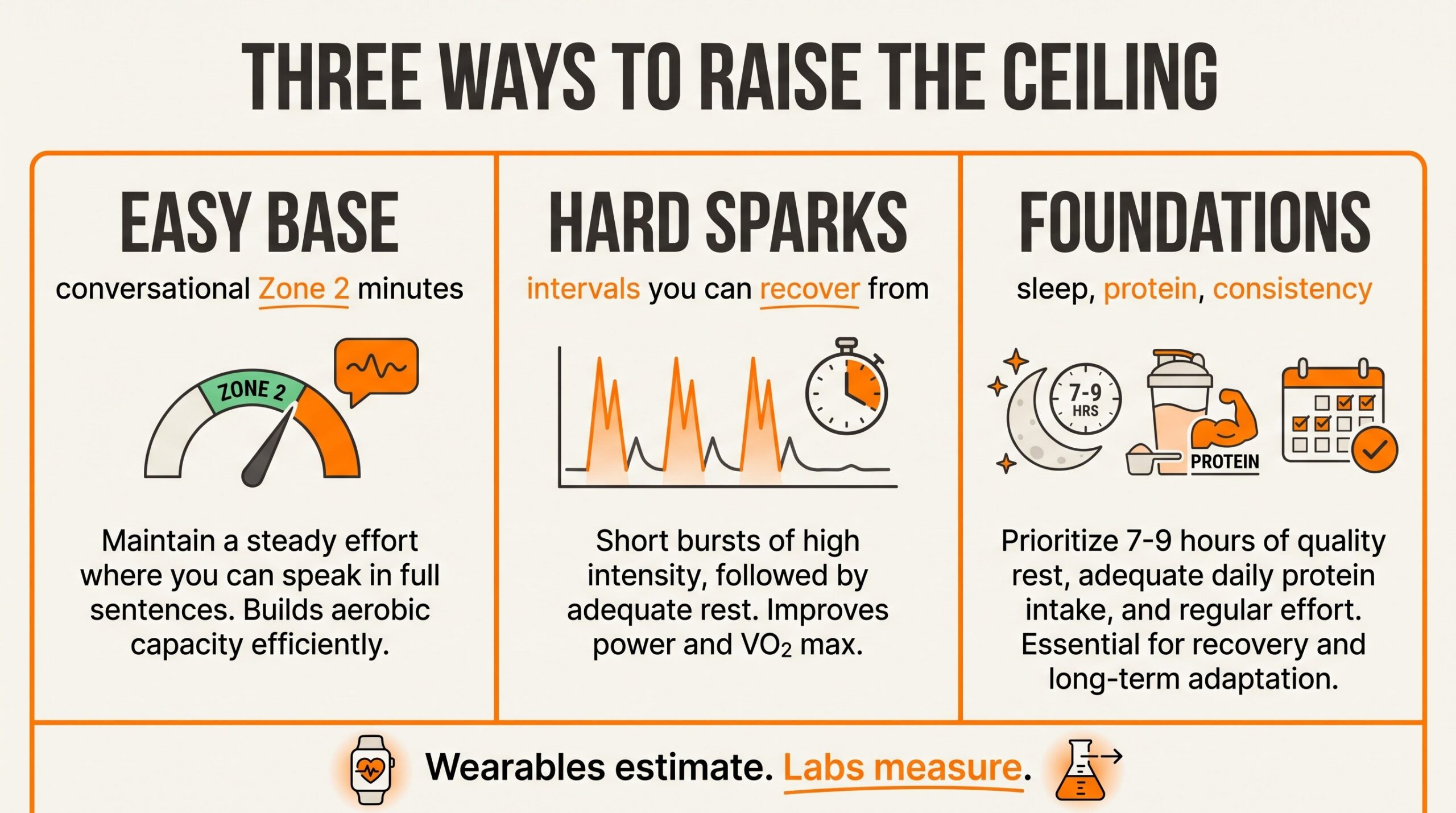
How to raise VO2 max without guru math
Education map. Not a prescription. Not rehab orders.
- Protect easy base minutes. Conversational aerobic work builds the engine you will later redline. See the Zone 2 training map.
- Add hard sparks you can recover from. Intervals, hills, or short high-effort repeats raise the ceiling when the easy days stay honest. Polarized endurance research from Seiler-influenced work keeps reminding coaches: most time easy, some time truly hard.
- Lift. Muscle is part of the oxygen customer base. Protein still matters. See protein intake and creatine benefits.
- Sleep like it is training. Adaptation happens when you are not collecting fatigue. See how to sleep better.
- Optional recovery heat. Sauna is an adjunct habit with Finnish cohort signal — not a VO2 substitute. See sauna benefits.
ACSM’s quantity-and-quality position stand still frames progressive aerobic work as a core adult fitness lane. Boring consistency beats a heroic two-week VO2 challenge you abandon.
Why this matters: the training distribution is the product. The watch score is a report card.
So what for you: schedule easy miles and a few honest hard sessions before you buy another sensor.
Myths that waste your week
- “My watch VO2 is medical truth.” It is an estimate. Trends help. Courtroom certainty does not.
- “Only HIIT raises VO2.” Hard work helps. A base you can recover from is what lets hard work land.
- “Elite fitness is dangerous so I should stay average.” Mandsager’s analysis did not find an upper benefit limit in that cohort. Individual medical histories still need a clinician.
- “I need a peptide for VO2 max.” Hard no on this page. Fitness is the lever. Research maps are adjacent literacy.
- “Low VO2 means I failed as a person.” It means you have a trainable ceiling. Start where you are.
Why this matters: bad myths either scare people away from training or push them into vial cosplay.
So what for you: keep the training. Drop the slogan.
Foundations that sit beside VO2
Peptides & Pump is a peptide education site. VO2 max is still a foundation fitness habit.
Soft links worth your time:
- Zone 2 training — conversational aerobic base
- Sauna benefits — recovery heat adjunct
- How to sleep better — adaptation needs sleep
- Protein intake — muscle still needs building blocks
- Creatine benefits — grocery-aisle performance support
- MOTS-c — mitochondrial peptide research map only; never a VO2 prescription
Hard line: this page will never say “inject peptide X to raise VO2 max.” Earn the ceiling. Read research maps later if you are curious.
Why this matters: foundation stacking beats catalog cosplay for fitness outcomes.
So what for you: protect easy base and hard sparks before you chase a mitochondrial SKU.
Evidence limits
Most mortality papers on CRF are observational. Fitness tracks with other healthy behaviors. Referral treadmill cohorts are not identical to every healthy adult at home. Wearable estimates are noisier than gas-exchange labs.
This page does not claim VO2 training cures metabolic disease, replaces cardiac rehab, or justifies unsupervised hard intervals with a medical history you have not cleared.
Why this matters: confidence framing protects your week and your risk file.
So what for you: train the ceiling you can recover from, keep a clinician in the loop when your history is not simple, and treat influencer VO2 absolutism as entertainment.
Sources & Further Reading
- Mandsager K, et al. Association of cardiorespiratory fitness with long-term mortality among adults undergoing exercise treadmill testing. JAMA Netw Open. 2018. PubMed 30646252
- Kodama S, et al. Cardiorespiratory fitness as a quantitative predictor of all-cause mortality and cardiovascular events in healthy men and women: a meta-analysis. JAMA. 2009. PubMed 19454641
- Kunutsor SK, et al. Objectively assessed cardiorespiratory fitness and all-cause mortality risk: an updated meta-analysis of 37 cohort studies involving 2,258,029 participants. Mayo Clin Proc. 2022. PubMed 35562197
- Ross R, et al. Importance of assessing cardiorespiratory fitness in clinical practice: a case for fitness as a clinical vital sign: a scientific statement from the American Heart Association. Circulation. 2016. PubMed 27881567
- Imboden MT, et al. Cardiorespiratory fitness and mortality in healthy men and women. J Am Coll Cardiol. 2018. PubMed 30384883
- Blair SN, et al. Physical fitness and all-cause mortality. A prospective study of healthy men and women. JAMA. 1989. PubMed 2795824
- Garber CE, et al. American College of Sports Medicine position stand. Quantity and quality of exercise for developing and maintaining cardiorespiratory, musculoskeletal, and neuromotor fitness in apparently healthy adults. Med Sci Sports Exerc. 2011. PubMed 21694556
- Seiler S. What is best practice for training intensity and duration distribution in endurance athletes? Int J Sports Physiol Perform. 2010. PubMed 20861519
- Reed JL, Pipe AL. The talk test: a useful tool for prescribing and monitoring exercise intensity. Curr Opin Cardiol. 2014. PubMed 25010379
The bottom line
VO2 max is your aerobic engine ceiling with some of the strongest fitness-mortality associations in the literature. Build easy base. Add hard sparks you can recover from. Protect sleep and protein. Treat wearable scores as estimates.
It is not a youth drug. It is not cardiac rehab. It is not a peptide indication.
Related research maps (after the ceiling work is handled)
VO2 first. Habitual aerobic training and honest recovery beat any catalog. When foundation is already moving — Zone 2, hard sparks, sleep, protein, creatine — some readers want adjacent research literacy on mitochondrial maps. That is curiosity after the work, not a shortcut around it.
Hard line: these are research-catalog options next to the fitness map. They are not “peptides that raise VO2,” not an engine drug stack, and not a reason to skip a clinician when your history is not simple.
Start with the maps: MOTS-c, SS-31, NAD+. Partner vials below are for readers who already earned the base and still want the research SKU conversation.
Research-catalog SKUs currently live on partner audits (not a treatment recommendation).
 Limitless
MOTS-C
LEE20 BioLongevity
MOTS-c 10 mg
LEE15 Peptira
MOTS-C 10 mg
LEE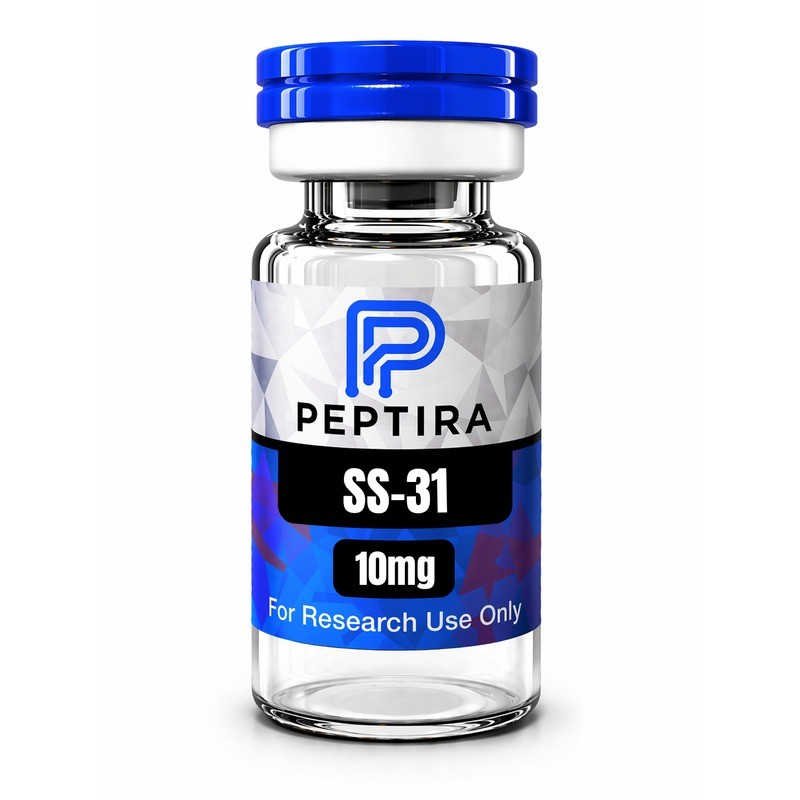 Peptira
SS-31 10 mg
LEE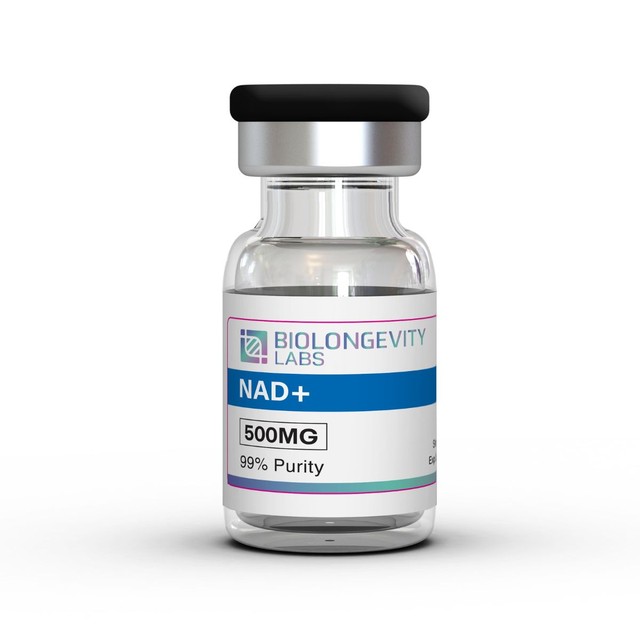 BioLongevity
NAD+ 500 mg
LEE15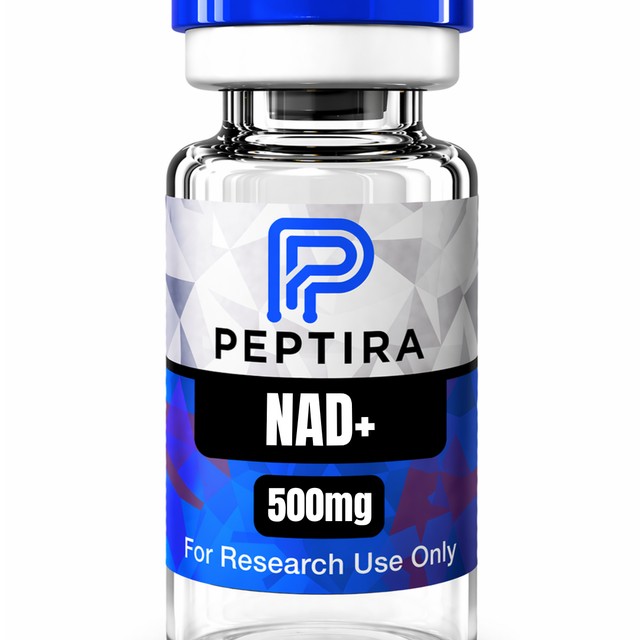 Peptira
NAD+ 500 mg
LEEMatch the map to the curiosity. Do not collect bottles to “unlock” VO2. Earn the ceiling first.
Want deeper protocol libraries after foundations are handled? Pro is the paid door. Want the free research PDF? Grab the Playbook below.
Free guide
Get The Peptide PlaybookEnter your email and we’ll send the research PDF. Education only — not medical advice.
I built Peptides & Pump so you can get foundation education without a guru tax. VO2 max is one of those foundations. Free Knowledge Base first if you are not ready to pay. Pro if you want the protocol library after the basics are handled.
Related reads: What are peptides · Zone 2 training · Sauna benefits · How to sleep better · MOTS-c · SS-31 · NAD+


One Comment
Comments are closed.