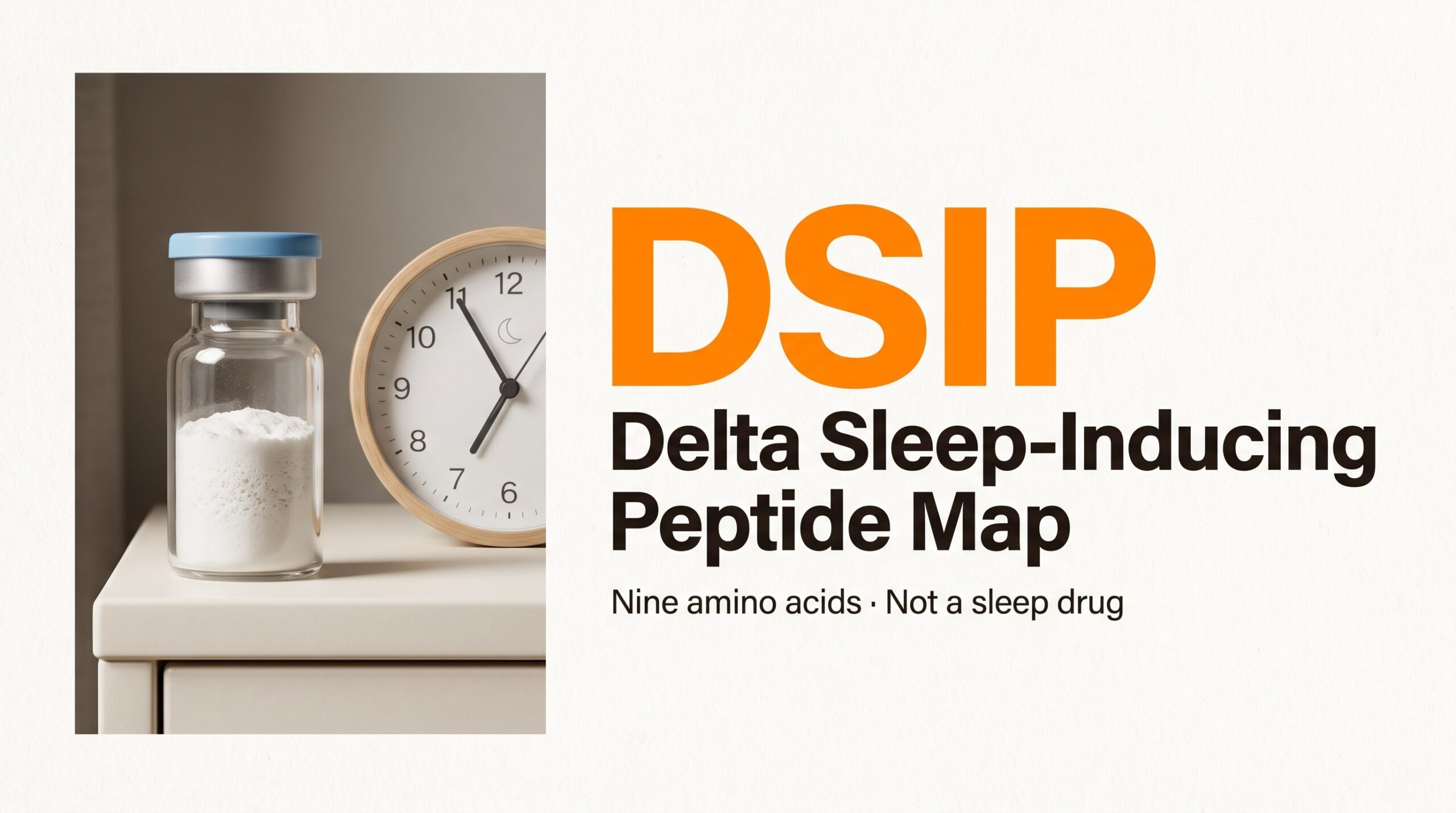
DSIP: Delta Sleep-Inducing Peptide Research Map (Not a Sleep Drug)
Key takeaways
- DSIP is a nine-amino-acid peptide named after rabbit brain-wave work in 1977. The name is a lab nickname. It is not an FDA-approved sleep drug.
- Human work is small and mostly intravenous. Originating-group papers look warmer. An independent 1992 insomnia study concluded short-term DSIP is not likely of major therapeutic benefit.
- A 2006 Journal of Neurochemistry review called DSIP a still unresolved riddle. No gene. No receptor. Weak sleep-factor hypothesis. That is the confidence haircut.
- If the actual job is a better night, start with how to sleep better. Light, timing, caffeine. Not a research vial.
- Education, not a treatment. Full protocols stay in Peptides & Pump Pro ($10/mo, 7-day trial).
People type DSIP like they found a sleep molecule with a scientific last name.
They found nine amino acids and a nickname from a rabbit EEG lab.
DSIP stands for delta sleep-inducing peptide. Delta is a slow brain-wave pattern tied to deep sleep. Researchers in Basel named the chain after the wave they saw after they infused it into rabbit brains. That is a lab history. It is not a U.S. sleep-drug label.
Why this matters right now: catalogs stamp the nickname on a lyophilized cake and the internet hears Ambien with extra syllables. Stay here if you typed DSIP, delta sleep-inducing peptide, or “the sleep peptide” and want the map before you spend money. If peptides are not day one, start with Start Here or what are peptides. If the actual job is a working night, the foundation page is already live: how to sleep better.
This is education. It is not medical advice. A research-catalog vial is not a treatment for insomnia, apnea, jet lag, or “I need to sleep.”
What is DSIP?
A peptide is a short chain of amino acids. Insulin is a peptide. Semaglutide is a peptide. DSIP is a peptide. Naming the format does not name the job.
DSIP is nine residues. Catalogs write the sequence as Trp-Ala-Gly-Gly-Asp-Ala-Ser-Gly-Glu. Shorthand: WAGGDASGE. Schoenenberger and Monnier characterized that chain in the Proceedings of the National Academy of Sciences in 1977. They isolated it from rabbit cerebral venous blood, then synthesized it, then compared it with fragments and look-alikes under double-blind brain-infusion conditions. Only the full nine-residue peptide moved the delta and spindle EEG pattern in that rabbit file (PubMed 265572).
So what is DSIP, in the way a beginner should hold it? A synthetic nonapeptide with a 1970s sleep-factor nickname. Nonapeptide means nine amino acids in a chain. Molecular weight in the early reviews lands around 849. Not melatonin. Not Pinealon. Not an FDA-approved insomnia medicine.
How sure are we of even that much? The sequence is not in dispute. Nine residues is a real peptide. The research intent is not in dispute either. The jump from “named sequence with papers” to “this vial will put you in deep sleep” is where the caption goes to work. This page refuses that jump.
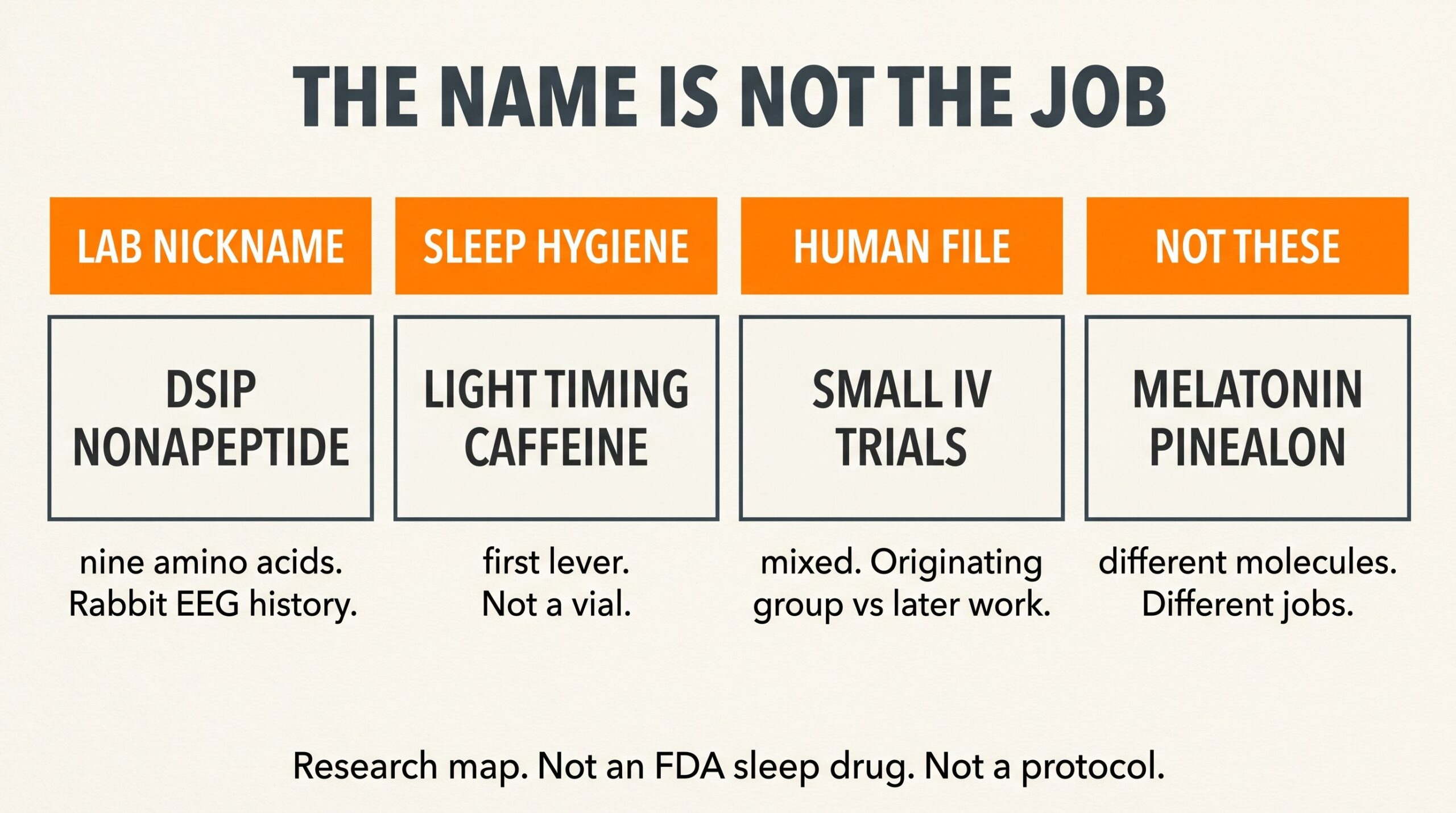
DSIP vs melatonin vs Pinealon vs a working night
You do not need a sleep-lab degree. You need four names and four jobs. Why should you care? Because the mash-up is how people spend money on the wrong bottle and then blame the molecule.
| Lane | What it actually is | What the evidence conversation is | What it is not |
|---|---|---|---|
| DSIP | Synthetic nine-amino-acid peptide. Lab nickname from rabbit delta EEG. Catalog spelling: DSIP / delta sleep-inducing peptide. | 1977 isolation. Small human IV studies from the originating group. An independent 1992 insomnia trial. A 2006 review that still called it a riddle. | Not an FDA sleep drug. Not melatonin. Not a hygiene replacement. |
| Sleep hygiene / body clock | Light, timing, caffeine cutoff, alcohol honesty, a cool dark quiet room. Full map on /how-to-sleep-better/. | Decades of circadian and sleep-medicine literature. Cheap. Often skipped. Not a cure for apnea or chronic insomnia. | Not a peptide. Not a reason to skip a clinician if you snore, gasp, or collapse in the daytime. |
| Melatonin | A pineal hormone people buy as an OTC sleep conversation. | A different molecule. Different evidence file. Different regulatory lane as a dietary supplement in the U.S. | Not DSIP. Same “sleep” word in the caption. Different chain. |
| Pinealon / Epitalon | Short pineal / cortex bioregulator peptides. Pinealon is three residues. Epitalon is four. Maps on /pinealon/ and /epitalon/. | A different research neighborhood. Do not stack them because a podcast said pineal. | Not DSIP. Same gland-story energy. Different residue count. |
| GH secretagogues | GHRH analogs and ghrelin-receptor keys that ask the pituitary for a GH pulse. Some of that file touches sleep architecture. | Maps on MK-677, ipamorelin, CJC / ipa. | Not DSIP. Do not mash a sleep nickname into a GH stack because both say recovery. |
You can be interested in all of them. You cannot mash DSIP, melatonin, Pinealon, and a GH blend into one Reddit protocol and call a nine-residue cake a sleep-clinic result.
Mechanism map (high level)
Search volume is not a protocol. Neither is a caption that says “the delta-sleep peptide.”
Here is the beginner translation of what the literature actually is. I will tell you the so-what before I dump the detail. Then I will tell you how sure we should be.
The green-candle ticker. They named this peptide after the EEG wave they liked in rabbits. That is like naming a stock SleepCo because one candle was green. The chart is real. The ticker is not a prescription. Schoenenberger and Monnier infused the synthetic chain into a rabbit brain ventricle. A ventricle is a fluid space inside the brain, not a gym pin. Only the full nine-residue peptide moved delta and spindle patterns versus fragments and look-alikes in that 1977 file (PubMed 265572). So what: the isolation is real science. The nickname is a hypothesis that got printed on a bottle.
Graf and Kastin reviewed the early map in 1984. They called DSIP a nonapeptide of molecular weight 849. Animal work showed mainly delta-sleep in rabbits, rats, mice, and some human reports. Cats leaned more REM. The dose-response was U-shaped. Too little did little. Too much did little. That is a messy curve, not a straight “more is better” story (PubMed 6145137). A 1986 update from the same pair added extra-sleep talk: pain, withdrawal, immunohistochemistry. The sleep-factor story was already leaking sideways (PubMed 3550726).
Yehuda and Carasso reviewed DSIP in 1988 as a tool for investigating sleep onset, not as a finished drug. They listed extra jobs too: temperature, heart rate, blood pressure, pain threshold. Some effects showed up before the animal even looked asleep (PubMed 3286557). So what: even friendly reviews did not treat this as a simple knockout drop.
The stop-you stat. In 2006, Kovalzon and Strekalova wrote a mini-review in the Journal of Neurochemistry titled “Delta sleep-inducing peptide (DSIP): a still unresolved riddle.” Nearly thirty years after isolation, they said the sleep-factor hypothesis was extremely poorly documented and still weak. No DSIP gene isolated. No protein. No related receptor. Natural occurrence still obscure. Structure unlike other peptide families (PubMed 16539679). That is not a forum opinion. That is a peer-reviewed confidence haircut. If someone tells you DSIP is the proven sleep peptide, they are selling past the review.
Stress chemistry, not just a pillow. Graf, Kastin, Coy, and Fischman reported in 1985 that DSIP reduced CRF-stimulated corticosterone release in a rat model. CRF is a brain-to-pituitary stress signal. Corticosterone is the rat version of the downstream stress steroid. The peptide did not blunt ACTH-driven release, which pointed at the pituitary rather than the adrenal gland (PubMed 2995861). So what: even the originating neighborhood kept finding extra-sleep jobs. A stress-axis paper is not a reason to buy a vial for your job interview. It is a reason the nickname oversells sleep.
If someone tells you DSIP is the peptide that knocks you into delta sleep like a switch, they are selling. Sleep biology is also a stress, pain, and clock conversation. That does not mean DSIP treats those problems. It means the pathways are not toys. I am not dunking the molecule. The sequence is real. The 1977 isolation is real. Some animal EEG work is real. This page refuses to crown a caption — and refuses to invent a U.S. drug label.
Evidence limits, stated plainly: most indexed DSIP sleep papers are small, old, intravenous, and concentrated in an originating group. Independent work exists and is cooler. No gene, no receptor, no modern Phase 3 insomnia program. That concentration is not a conspiracy. It is a confidence haircut.
WADA and sport: if you compete, check the current prohibited list yourself. Peptide research chemicals are not a free pass because a catalog said “research use only.”
The human file is mixed. Read both sides.
Why this matters: forums quote the warm papers and bury the cooler ones. A Foolish reader wants both.
First-in-human, 1981. Schneider-Helmert, Gnirss, Monnier, Schenker, and Schoenenberger gave six healthy volunteers a slow morning IV of 25 nanomoles per kilogram in a double-blind crossover. Subjects reported sleep pressure. Median total sleep time in a 130-minute window after the infusion rose 59 percent versus placebo. Later that night they saw shorter sleep onset and better sleep efficiency. The authors still said it did not look like classic sedation (PubMed 6895513). How sure should you be? Six people. Originating group. Slow intravenous infusion, not a research-catalog subcutaneous pin. A 59 percent bump in a short daytime window is a real number from a real paper. It is not a sleep-clinic trophy.
Same year, a Lancet letter said synthetic DSIP improved sleep in insomniacs (PubMed 6112579). A 1983 Neuropsychobiology paper from Schneider-Helmert and Schoenenberger bundled five human studies. Slow injection mattered. Sleep-induction latency around one hour. Duration talk up to 20 hours. They described somnogenic properties plus extra psychophysiological effects (PubMed 6689058). Later originating-group sleep-lab papers in middle-aged and elderly chronic insomniacs, and in severe 24-hour insomnia, kept reporting improvement under IV dosing (PubMed 3792404; PubMed 3622582).
Then the independent check. Bes, Hofman, Schuur, and Van Boxtel at the University of Amsterdam ran 16 chronic insomniacs in a double-blind matched-pairs parallel design. Afternoon IV, 25 nanomoles per kilogram, three nights. Objective sleep efficiency looked a bit higher and sleep latency a bit shorter versus placebo. One tiredness score moved inside the DSIP group. The authors then said the statistically significant effects were weak and in part could be an incidental placebo-group change. Subjective sleep quality did not move. Their conclusion, in plain English: short-term treatment of chronic insomnia with DSIP is not likely to be of major therapeutic benefit (PubMed 1299794).
That is the so-what. Originating-group IV work is warmer. The independent insomnia trial is cooler. A 2006 review still called the sleep-factor idea weak. None of this is a U.S. labeled drug. None of this is a reason to skip CBT-I or a sleep-clinic visit if you have a real disorder.
Route matters. The human file is intravenous, often slow, often dosed in nanomoles per kilogram. A lyophilized research cake you reconstitute at home is not that protocol. I will not launder one into the other.
Research catalog vs compounding vs FDA drugs
Three lanes. Keep them. Why this matters: the coupon code does not change the lane.
FDA-approved sleep drugs have an application, a label, an indication, manufacturing the agency inspects for that product. There is no DSIP insomnia tablet in that U.S. drawer. Zolpidem, suvorexant, daridorexant, and CBT-I programs are different regulatory objects. None of them is your lyophilized nine-residue cake. Melatonin as an OTC dietary supplement is a different object again.
Compounding is a pharmacy lane. A 503A pharmacy compounds for a patient with a prescription. That lane has its own FDA bulk-substance fights and state-board rules. A compounded DSIP prescription, if a clinic offers one, is still not an approved insomnia drug. It is a different object from a research catalog with a coupon code.
Research catalogs sell named sequences for research use. COA if you are lucky. “Not for human consumption” on the page. Forums treat that disclaimer as a wink. I do not. A research-use DSIP vial is a catalog SKU. It is not a compounding script. It is not a labeled drug. Pretending otherwise is how people get hurt and how this page would get stupid.
I am not going to tell you to buy a research chemical for human use. I am not going to tell you to skip a doctor. I am going to tell you to name the lane before you name the SKU.
Reconstitution notes (high level only)
If a lyophilized cake is even on the table, learn the math before you invent a protocol.
How to reconstitute peptides is the public page for bacteriostatic water, U-100 insulin-syringe ticks, and not wasting 10% of the vial on foam and dead volume. Some catalogs also sell a spray. That is a different object from a cake you mix yourself. Read the label. Do not assume spray math equals injectable math. Do not assume either one equals the slow IV used in 1980s sleep labs.
I will not dump a DSIP units-and-days schedule on a public page. That is Pro on purpose.
Who this page is for (and who it is not)
Start with the question, not the vial.
This page is for you if you typed DSIP, delta sleep-inducing peptide, or “the sleep peptide” and want the research map before you spend money. Or if a podcast stacked DSIP next to melatonin and you need the residue count separated.
This page is not for you if you want a diagnosis for insomnia, apnea, restless legs, or jet-lag collapse from a blog. Those are clinician conversations. A research vial does not replace that visit. Loud snoring, gasping, or falling asleep at red lights belongs with a clinician — not a catalog.
Here is the order I give beginners.
1. Read first. If the job is a better night, do the hygiene map before you name a peptide. Morning light. Dim evenings. A real caffeine cutoff. That page already exists.
2. Name the peptide. DSIP is nine residues. If the bottle also says spray, blend, or a second sequence, read every name on the label.
3. Do not crown the nickname. “Delta sleep-inducing” won the caption in 1977. It did not win a U.S. label. It did not win a gene or a receptor by 2006.
4. If a lyophilized cake is even on the table, learn the reconstitution math on the public page linked above — then stop. Protocol depth lives in Peptides & Pump Pro. Ten dollars a month. Seven-day trial.
Where I actually look when the job is a DSIP research compound
Education first. You already got the map. This block is the labs I will put my name on, with the codes that fire. Research-use catalog pages. Not a treatment claim. Not a pitch to treat insomnia with a catalog vial.
Partner reality on today’s audit: BioLongevity lists DSIP 5 mg in stock, and that SKU sits on Lee’s Drive generators sheet. Limitless lists a DSIP vial and a DSIP spray on the Drive sheet; both pages return HTTP 200, but pricing is login-gated and the public schema talks out of stock — chips, not hero cards. Paramount, Peptira, and S1 have public DSIP product URLs in the wild. Those rows are not on the Drive generators sheet, so they get home or shop chips only. I do not invent product hrefs.
Research-catalog SKU currently live on partner audit (not a treatment recommendation).
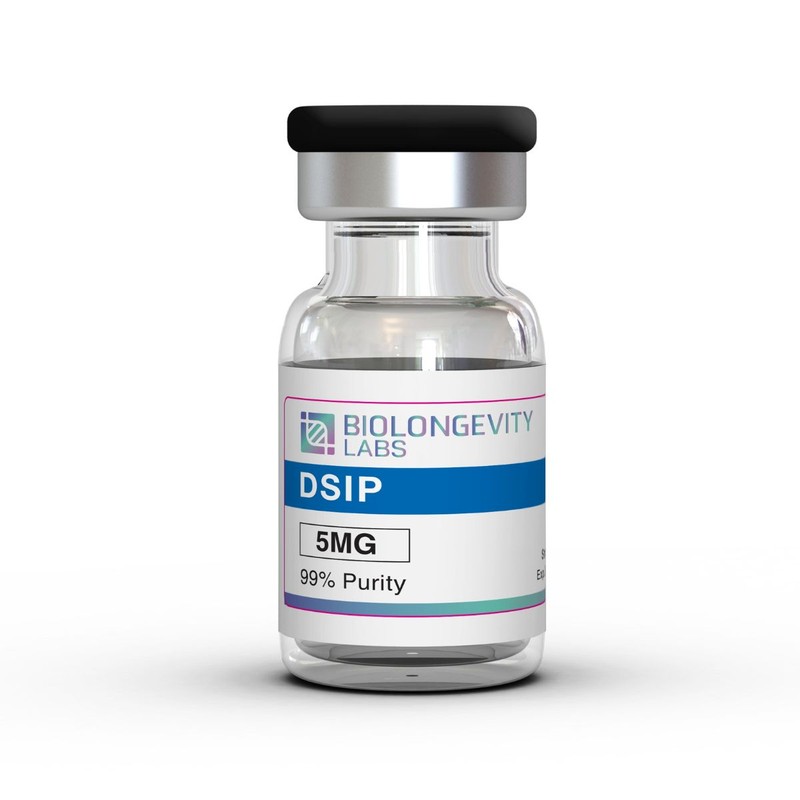 BioLongevity
DSIP 5 mg
LEE15Limitless DSIP 5 mg · LEE20Limitless DSIP spray · LEE20BioLongevity DSIP 5 mg · LEE15Paramount home · LEE10Peptira home · LEES1 shop · LEE10
Limitless DSIP pages exist on the Drive sheet, but they are login-gated on a public visit, so they get chips instead of a hero card. Paramount, Peptira, and S1 DSIP product URLs are not on the generators sheet, so I will not box them. Match the product to the job. Do not collect bottles. Do not use a research catalog as a back door to a sleep diagnosis.
Frequently asked questions about DSIP
Is DSIP a proven sleep drug?
No. DSIP is not an FDA-approved drug to treat insomnia, apnea, jet lag, or any other sleep disorder. The 1977 isolation is real. The human IV file is small and mixed. A 2006 review still called the sleep-factor hypothesis weak.
Is DSIP the same as melatonin?
No. Melatonin is a pineal hormone people buy for sleep. DSIP is a nine-amino-acid peptide named after rabbit delta EEG. Same marketing word. Different molecule. If the job is a better night, start with how to sleep better.
Is DSIP the same as Pinealon?
No. Pinealon is three residues from a pineal / cortex bioregulator line. DSIP is nine residues from a 1970s sleep-factor isolation. Read the Pinealon research map if that is the molecule you actually typed.
Did human studies show it works?
Some originating-group IV studies reported better sleep measures. An independent 1992 chronic-insomnia trial concluded short-term DSIP is not likely of major therapeutic benefit. That is mixed, not a trophy. Talk to a clinician if this is a medical question.
Do I inject DSIP at bedtime like a sleep shot?
The published human work is mostly slow intravenous infusion, often in the afternoon or morning depending on the paper. That is not a public-page bedtime map. I am not writing an injection protocol here. If you need that level of protocol, that is a clinician plus the Pro library, not a blog comment.
Can I just run a DSIP protocol from a forum?
You can do a lot of unwise things. I would not. Name the sequence. Name whether you are holding a research catalog, a compounded script, or a fantasy. Protocol depth lives in Pro on purpose. This public page is the map, not the marching orders.
Selected references (research framing)
These are starting points for the published file — not a protocol, not a drug label, not an endorsement to self-treat. I am not inventing citations. Every ID below was verified against PubMed before publish.
- Isolation and characterization of the nine-residue chain from rabbits — PubMed 265572.
- Early review: nonapeptide, molecular weight 849, U-shaped dose talk — PubMed 6145137.
- Update review: extra-sleep jobs enter the file — PubMed 3550726.
- First human volunteer study: six people, slow morning IV, 59% median total-sleep bump in a 130-minute window — PubMed 6895513.
- Lancet letter: synthetic DSIP in insomniacs — PubMed 6112579.
- Five human studies bundled: latency, duration, extra psychophysiological effects — PubMed 6689058.
- Middle-aged and elderly chronic insomniacs, originating-group sleep lab — PubMed 3792404.
- Severe chronic insomnia, 24-hour sleep-wake behavior — PubMed 3622582.
- Independent Amsterdam insomnia trial: not likely of major therapeutic benefit — PubMed 1299794.
- Still unresolved riddle: no gene, no receptor, weak sleep-factor hypothesis — PubMed 16539679.
- DSIP and CRF-stimulated corticosterone in a rat model — PubMed 2995861.
- Sleep-onset-mechanism review, extra physiologic jobs — PubMed 3286557.
Read primary sources. Do not treat a PubMed ID as a shopping list.
The bottom line
DSIP is a nine-amino-acid peptide with a 1977 rabbit-EEG nickname. Real sequence. Real isolation paper. Not an FDA-approved sleep drug.
It is not melatonin. It is not Pinealon. It is not a hygiene replacement. Keep the lanes. Read the independent trial next to the originating-group file. Do not buy a nine-residue cake because a caption told you it was a labeled sleep medicine without side effects.
If you need the beginner on-ramp, use Start Here and what are peptides. If the job is a better night, start with how to sleep better. Reconstitution math, when a lyophilized cake is even on the table, is on how to reconstitute peptides. Want the free field guide before you spend another dollar on a vial? Grab the Peptide Playbook — the short form on that page is how it ships. Adjacent reading already live: Pinealon, Epitalon, Selank, Semax, and MK-677.
Free guide
Get The Peptide PlaybookEnter your email and we’ll send the research PDF. Education only — not medical advice.
I built Peptides & Pump so you can get this without a guru tax. If you want the protocol library, member discussions, and a place to think out loud before you spend money, that is Pro. If you are not ready to pay, use the free Knowledge Base first. Then come back and argue with me when you have read more than a caption.
 Keep going on Peptides & Pump
Free is the peptide community. Pro is where you master it. Codes are the links. Click them so the discount fires.
Free
Knowledge Base
The peptide community · 2,500+
- 2,500+ member peptide community
- Sourcing questions before you buy anything random
- The basics, from people actually using peptides
Pro
Peptides & Pump Pro
$10/mo · 7-day trial
- Science-backed protocol library
- 1-on-1 support from Lee and Matt
- Step-by-step video, plus a monthly $500 drawing
LEE20 Limitless LEE15 BioLongevity LEE10 Paramount LEE Peptira LEE10 S1
Supplier footnote: Research suppliers I mention when people ask about DSIP: BioLongevity DSIP 5 mg (code LEE15). Limitless lists a DSIP vial and a DSIP spray (code LEE20) but public pricing is login-gated. Paramount, Peptira, and S1 had no Drive-sheet product URL — use Paramount home (code LEE10), Peptira home (code LEE), and S1 shop (code LEE10). Match the product to the job. Do not collect bottles.
Disclaimer. This article is for educational and research purposes only. It is not medical advice. It is not intended to diagnose, treat, cure, or prevent any disease. DSIP (delta sleep-inducing peptide) is not an FDA-approved drug for insomnia, sleep apnea, jet lag, pain, withdrawal, stress, or any other indication. Research peptides discussed here are research sequences; a research-catalog vial is not a compounded prescription and is not a labeled drug. Most of the published evidence discussed here includes small old intravenous studies, originating-group sleep-lab work, and preclinical papers; none of that is a substitute for a clinician. Individual results vary. Always consult a qualified healthcare provider before starting any peptide, drug, supplement, or protocol, especially if you have a medical condition or take prescription medication. Loud snoring, gasping, or severe daytime sleepiness belongs with a clinician. Peptides & Pump does not sell peptides.
Affiliate disclosure. Some links on this page are affiliate links. If you buy through them, I may earn a commission at no extra cost to you. Codes LEE15, LEE20, LEE, and LEE10 are the ones I actually use where a coupon fires. That commission is how I keep publishing free education. I only link suppliers I am willing to put my name on.