LL-37: Cathelicidin Antimicrobial Peptide Research Map
Key takeaways
- LL-37 is the active C-terminal fragment of human cathelicidin hCAP18. Your body already makes it as part of innate immunity. Catalog vials are a different object from that endogenous signal.
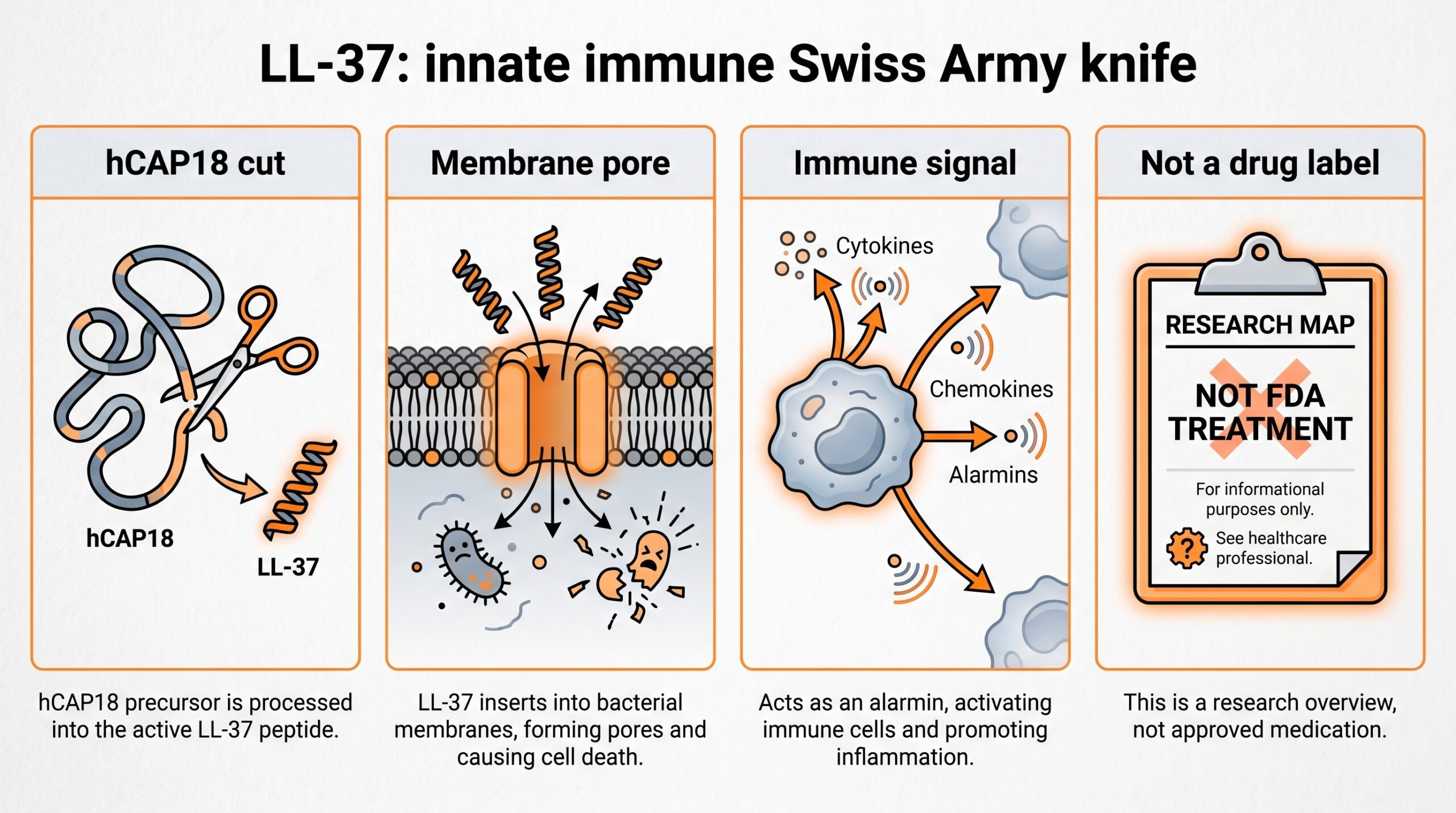
- Think of it as a molecular Swiss Army knife. It can punch pores in microbial membranes, recruit immune cells, and talk to wound-repair pathways. That range is real. It is also why captions get out over their skis.
- A 2003 skin paper found high hCAP18/LL-37 in acute wound epithelium and almost none at the edge of chronic ulcers. That is a biology clue, not a shopping receipt.
- Topical LL-37 reached human wound trials. A small 2014 venous-ulcer study looked warmer. A larger 2021 Phase IIb study did not beat placebo in the full population. Hold both.
- Education, not a treatment. Research-catalog LL-37 is not an FDA-approved antibiotic or wound drug. Full protocols stay in Peptides & Pump Pro ($10/mo, 7-day trial).
People type LL-37 like they found a pocket antibiotic with a scientific last name.
They found the business end of the only human cathelicidin. Your neutrophils already carry the longer precursor. Catalogs sell a 37-residue research sequence. Same letters. Different lane.
LL-37 is a short chain of amino acids. A peptide is just that — a short protein scrap. This one sits at the C-terminal end of hCAP18, the human cathelicidin antimicrobial protein. Cathelicidin is a family name for host-defense peptides. Humans only have one member of that family. The gene story and the processing story are older than the Instagram vial.
Why this matters right now: search volume is real. Partner shelves are real. The paper file is dense, mixed, and worth reading before you spend money. Stay here if you typed LL-37, hCAP18, FALL-39, or “the antimicrobial peptide” and want the map. If peptides are day one, start with Start Here or what are peptides. Adjacent immune and healing maps already live: KPV, Thymosin Alpha-1, BPC-157, oral BPC-157, and TB-500.
This is education. It is not medical advice. A research-catalog vial is not a treatment for infection, a chronic wound, an autoimmune flare, or “I feel inflamed.”
What is LL-37?
Start with the parent, not the bottle.
In 1995, Agerberth and colleagues predicted a cysteine-free human peptide antibiotic from bone-marrow cDNA and named it FALL-39 after the first four residues. They chemically synthesized the putative peptide and showed antibacterial activity. That paper is the discovery stamp most people never read (PubMed 7529412).
One year later, Gudmundsson, Agerberth, Odeberg, and colleagues sequenced the human FALL39 gene. Exons 1–3 encode the signal and cathelin region. Exon 4 encodes the mature antibacterial peptide. They isolated the mature form from granulocytes and named it LL-37 after the first two leucines and the 37-residue length (PubMed 8681941). So what: LL-37 is not a random lab invention. It is the cleaved business end of a human gene product.
How does the cut happen? Sørensen and colleagues showed in 2001 that extracellular proteinase 3 cleaves hCAP18 to release LL-37 after neutrophil exocytosis. That is a physiological processing step, not a catalog reconstitution tip (PubMed 11389039). Cowland, Borregaard, and colleagues had already mapped hCAP18 synthesis into neutrophil specific granules (PubMed 9326247).
So what is LL-37, in the way a beginner should hold it? The active 37-amino-acid fragment of human cathelicidin. Endogenous innate immunity. Not KPV. Not Thymosin Alpha-1. Not an FDA-approved antibiotic.
LL-37 vs antibiotics vs KPV vs a clinician visit
You do not need an immunology degree. You need four lanes. Why should you care? Because people mash “kills microbes” into “replace my antibiotic” and then blame the molecule when reality arrives.
| Lane | What it actually is | What the evidence conversation is | What it is not |
|---|---|---|---|
| LL-37 / hCAP18 | Human cathelicidin C-terminal fragment. Also cataloged as a research peptide sequence. | Dense basic science. Pore formation and immune modulation. Human topical wound trials exist and do not all agree. No U.S. drug label for infection treatment as a research vial. | Not a broad-spectrum antibiotic substitute. Not a clinician visit. |
| Classic antibiotics | Labeled drugs with indications, dosing, resistance maps, and FDA manufacturing for that product. | Standard of care when a clinician decides infection needs a drug. Decades of clinical use. | Not LL-37. Different object. Do not launder a host-defense peptide into a Z-Pak. |
| KPV / TA1 | Different research peptides. KPV is an alpha-MSH fragment often discussed for gut/skin calm. Thymosin Alpha-1 is a different immune-education chain. Maps on /kpv-peptide/ and /thymosin-alpha-1/. | Different literature. Different residue counts. Same “immune” aisle energy does not make them the same molecule. | Not LL-37. Do not stack captions. |
| BPC-157 / TB-500 | Repair and angiogenesis research neighborhoods. Maps on /bpc-157/, /oral-bpc-157/, and /tb-500/. | Wound and soft-tissue research talk. Not antimicrobial cathelicidin biology. | Not LL-37. Healing word overlap is not mechanism overlap. |
| Clinician workup | Culture when it belongs. Imaging. Debridement. Compression for venous ulcers. Glucose control for diabetic wounds. Meds review. | Standard of care. Cheap relative to a mystery vial when infection or a non-healing wound is the actual job. | Not a research peptide. Spreading infection, fever, or a rapidly worsening wound belongs with urgent care — not a catalog. |
You can be interested in all of them. You cannot mash LL-37, KPV, BPC-157, and amoxicillin into one Reddit protocol and call a research vial a clinic result.
Mechanism map: the Swiss Army knife
Search volume is not a protocol. Neither is a caption that says “kills all infections.”
Here is the beginner translation. I will give you the so-what before the detail. Then I will tell you how sure we should be.
The analogy. LL-37 behaves like a molecular Swiss Army knife for innate defense. One blade punches holes in microbial membranes. Another blade waves at immune cells. Another blade shows up in wound-repair talk. A Swiss Army knife is useful. It is not a surgical suite. And owning a research copy of one blade does not mean your body’s factory settings just transferred to a vial.
The pore blade. LL-37 is amphipathic and helical under the right salt and concentration conditions. Amphipathic means one face likes water and one face likes fat. Johansson, Gudmundsson, Rottenberg, and colleagues showed in 1998 that conformation tracks antibacterial activity against Gram-positive and Gram-negative bacteria (PubMed 9452503). Turner, Cho, Dinh, and colleagues mapped activity against a panel of pathogens, including under physiologic salt for several organisms (PubMed 9736536). Xhindoli, Pacor, Benincasa, and colleagues later reviewed LL-37 as both a pore-forming antibacterial peptide and a host-cell modulator. That dual job is the whole plot (PubMed 26556394). Dürr, Sudheendra, and Ramamoorthy summarized the same “only human cathelicidin” story with structure and membrane biophysics (PubMed 16716248).
The stop-you stat. In 2003, Heilborn, Nilsson, Kratz, and colleagues reported that hCAP18 rises sharply in human skin after acute wounding, peaks around 48 hours, and appears in epithelium migrating over the wound bed. In chronic ulcers, hCAP18 levels were low, and immunoreactivity for hCAP18/LL-37 was absent in ulcer-edge epithelium. Blocking LL-37 antibodies slowed re-epithelialization in their organ-cultured skin model (PubMed 12603850). So what: your body’s own cathelicidin shows up when acute skin repair is running and goes quiet where chronic ulcers stall. That is a biology finding. It is not proof that a research vial fixes a diabetic foot or a venous ulcer. It is also not a reason to ignore compression, glucose, or a wound clinic.
The immune-signal blade. Kahlenberg and Kaplan reviewed how LL-37 can amplify inflammation and autoimmunity pathways, including links to neutrophil extracellular traps and DNA sensing in diseases like lupus and psoriasis (PubMed 24185823). Bucki, Leszczyńska, Namiot, and colleagues called it a multitask antimicrobial peptide for the same reason — direct kill plus immune orchestration (PubMed 20049649). So what: “your body makes it” is not a safety slogan. Endogenous does not mean free of downside when dosing, context, or disease state change.
Evidence limits, stated plainly: most of the file is cell work, animal work, and endogenous human biology. Topical pharmaceutical LL-37 reached randomized human wound trials. Those trials do not automatically bless a lyophilized research cake from a catalog. Endogenous hCAP18/LL-37 is not the same regulatory object as an exogenous research SKU. There is no FDA approval on this page for research LL-37 as an infection treatment.
The human wound file: warm, then cooler
Why this matters: forums quote the warm trial and bury the larger miss. A Foolish reader wants both.
Warm side. Grönberg, Mahlapuu, Ståhle, and colleagues ran a first-in-man randomized, placebo-controlled trial of topical LL-37 on hard-to-heal venous leg ulcers. Thirty-four participants. After a placebo run-in, a four-week double-blind phase tested 0.5, 1.6, or 3.2 mg/mL LL-37 versus placebo, twice weekly. Healing-rate constants for 0.5 and 1.6 mg/mL were about sixfold and threefold higher than placebo. The authors called the treatment safe and effective in that design (PubMed 25041740). How sure should you be? Small N. Short treatment window. Venous ulcers under study conditions. Not a catalog vial. Not every wound type.
Cooler side. The same research neighborhood later ran HEAL LL-37, a Phase IIb multicentric randomized placebo-controlled trial in 148 patients with hard-to-heal venous leg ulcers. Median ulcer duration about 20 months. Mean wound size about 11.6 cm² at randomization. Efficacy analysis on the full study population did not show significant improvement versus placebo for LL-37 at 0.5 or 1.6 mg/mL (PubMed 34687253). So what: a larger, later trial failed to confirm a clean win in the full population. That is not “LL-37 is fake.” It is a confidence haircut on the shopping caption.
Another human wound signal sits in diabetic foot work. Miranda, Bramono, Yunir, and colleagues reported a randomized double-blind controlled trial of LL-37 cream for diabetic foot ulcer healing (PubMed 37480520). Read it as one more clinical object under study — still not a U.S. labeled drug, and still not your research catalog cake.
Animal and model work keeps moving. Xi, Du, Xue, and colleagues reported LL-37 promoted wound healing in diabetic mice via TFEB-dependent autophagy talk (PubMed 38423213). Mice are not clinics. Hold the species gap.
Urinary-tract innate defense is a different chapter. Chromek and colleagues showed epithelium-derived cathelicidin protects the urinary tract in a Nature Medicine file, with clinical E. coli resistance to LL-37 tracking infection severity (PubMed 16751768). That supports endogenous biology. It does not turn a research vial into a UTI protocol.
Research catalog vs compounding vs FDA drugs
Three lanes. Keep them. Why this matters: the coupon code does not change the lane.
FDA-approved antimicrobials and wound drugs have an application, a label, an indication, and manufacturing the agency inspects for that product. There is no research-catalog LL-37 infection tablet or shot in that U.S. drawer on this page. Labeled antibiotics, antivirals, and standard wound products live in that drawer when they do. None of them is your research sequence just because a caption said antimicrobial.
Compounding is a pharmacy lane. A 503A pharmacy compounds for a patient with a prescription. That lane has its own FDA bulk-substance fights and state-board rules. A compounded LL-37 script, if a clinic even offers one, is still not an approved infection drug. It is a different object from a research catalog with a coupon code.
Research catalogs sell named sequences for research use. COA if you are lucky. “Not for human consumption” on the page. Forums treat that disclaimer as a wink. I do not. A research-use LL-37 vial is a catalog SKU. It is not a compounding script. It is not a labeled antibiotic. Pretending otherwise is how people get hurt and how this page would get stupid.
I am not going to tell you a research catalog is a back door to an infectious-disease clinic. I am going to tell you to name the lane before you name the SKU.
Myths that waste money
Myth: “LL-37 kills all infections.” No. Spectrum depends on organism, salt, concentration, and context. Turner’s panel already showed winners and resistant cases. A host-defense peptide is not a universal sterilizer.
Myth: “It is the same as antibiotics.” No. Antibiotics are labeled drugs with defined targets and stewardship rules. LL-37 is a multifunctional host peptide. Mechanism overlap on “microbes die” does not make the regulatory objects identical.
Myth: “Safe because your body makes it.” Endogenous production does not equal exogenous dose safety. The same peptide shows up in autoimmunity and inflammation reviews. Context matters. Disease state matters. Talk to a clinician if this is a medical question.
Myth: “One warm venous-ulcer trial means the bottle works.” Hold Grönberg 2014 next to Mahlapuu 2021. Warm then cooler. That is how adult readers read trials.
Reconstitution notes without a protocol dump
Partner shelves for LL-37 are often lyophilized cakes. Read the label. Learn the math before you invent a schedule. How to reconstitute peptides is the public page for bacteriostatic water, U-100 insulin-syringe ticks, and not wasting 10% of the vial on foam and dead volume.
I will not dump an LL-37 micrograms-and-days schedule on a public page. That is Pro on purpose. Skin copper and stack maps live on Glow / GHK-Cu and GHK-Cu if that is the adjacent lane you actually meant.
Who this page is for — and who it is not
Start with the question, not the bottle.
This page is for you if you typed LL-37, hCAP18, FALL-39, or “cathelicidin peptide” and want the research map before you spend money. Or if a podcast stacked LL-37 next to antibiotics and you need the lanes separated.
This page is not for you if you want a diagnosis for cellulitis, osteomyelitis, a diabetic foot infection, sepsis, or a rapidly worsening wound from a blog. Those are clinician conversations. A research vial does not replace that visit. Fever, red-streaking lymphangitis, or a blackening wound edge belongs with urgent or emergency care — not a catalog.
Here is the order I give beginners.
1. Read first. If the job is a non-healing wound, start with perfusion, pressure offloading, glucose, nutrition, and a wound clinic before you name a peptide. Protein and recovery basics still matter; we mapped intake on protein intake when that is the foundation gap.
2. Name the peptide. LL-37 is cathelicidin. If the bottle also says KPV, BPC-157, or a blend, read every name on the label. A blend is not solo LL-37.
3. Do not crown the caption. “Antimicrobial peptide” won a real biology title. It did not win a U.S. infection-drug label for research vials.
4. If a research SKU is even on the table, stop at the map. Protocol depth lives in Peptides & Pump Pro. Ten dollars a month. Seven-day trial.
Where I actually look when the job is an LL-37 research compound
Education first. You already got the map. This block is the labs I will put my name on, with the codes that fire. Research-use catalog pages. Not a treatment claim. Not a clinic substitute.
Partner reality on today’s check: BioLongevity lists LL-37 5 mg in stock. Limitless has a product page online; treat it as a chip, not a false in-stock hero. Paramount, Peptira, and S1 get home or shop chips only. I do not invent product hrefs.
Research-catalog SKU currently live on partner check (not a treatment recommendation).
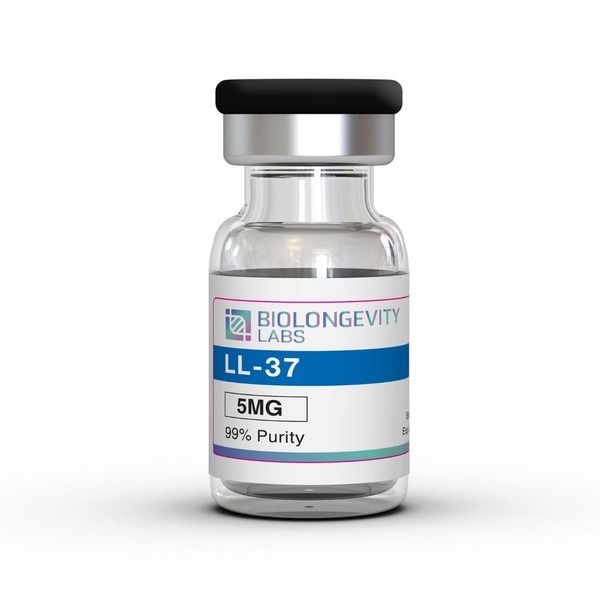 BioLongevity
LL-37 5 mg
LEE15BioLongevity LL-37 5 mg · LEE15Limitless LL-37 · LEE20BioLongevity home · LEE15Paramount home · LEE10Peptira home · LEES1 shop · LEE10
Match the product to the job. Do not collect bottles. Do not use a research catalog as a back door to an infection diagnosis.
Frequently asked questions about LL-37
Is LL-37 a proven antibiotic drug?
No. LL-37 is not an FDA-approved drug to treat bacterial infection, viral infection, chronic wounds, or autoimmunity. The peptide is real human biology. Research vials are research objects. Clinical topical work exists and is mixed.
Is LL-37 the same as KPV or Thymosin Alpha-1?
No. Different chains. Different literature. Read the KPV research map or the Thymosin Alpha-1 research map if that is the molecule you actually typed.
Did human studies show LL-37 helps wounds?
Some topical pharmaceutical studies exist. A small 2014 venous-ulcer RCT looked warmer. A larger 2021 Phase IIb trial did not beat placebo in the full population. A diabetic-foot cream RCT also exists. None of that is a labeled U.S. drug, and none of it automatically equals a research-catalog vial.
Can I just run an LL-37 protocol from a forum?
You can do a lot of unwise things. I would not. Name the sequence. Name whether you are holding a research catalog, a compounded script, or a fantasy. Protocol depth lives in Pro on purpose. This public page is the map, not the marching orders.
Is LL-37 safe because my body already makes it?
Endogenous production is not a free pass. The same peptide appears in inflammation and autoimmunity reviews. Context and disease state matter. Talk to a clinician.
Is research LL-37 the same as the LL-37 used in wound trials?
Not automatically. Trial material is a pharmaceutical topical preparation under a protocol. A lyophilized research cake is a catalog SKU. Same letters can still be different objects.
Selected references
These are starting points for the published file — not a protocol, not a drug label, not an endorsement to self-treat. I am not inventing citations. Every ID below was verified against PubMed before publish.
- Discovery of FALL-39 as a putative human peptide antibiotic — PubMed 7529412.
- FALL39 gene and processing to mature LL-37 in granulocytes — PubMed 8681941.
- hCAP-18 localization to neutrophil specific granules — PubMed 9326247.
- Proteinase 3 cleavage of hCAP-18 to LL-37 — PubMed 11389039.
- Conformation-dependent antibacterial activity — PubMed 9452503.
- Activity panel of neutrophil LL-37 — PubMed 9736536.
- Review: only human cathelicidin member — PubMed 16716248.
- Review: pore-forming peptide and host-cell modulator — PubMed 26556394.
- Multitask antimicrobial peptide review — PubMed 20049649.
- Acute wound induction and absence in chronic ulcer epithelium — PubMed 12603850.
- First-in-man venous leg ulcer RCT — PubMed 25041740.
- HEAL LL-37 Phase IIb venous ulcer RCT, full population not significant vs placebo — PubMed 34687253.
- Diabetic foot ulcer LL-37 cream RCT — PubMed 37480520.
- Inflammation and autoimmune review — PubMed 24185823.
- Urinary-tract cathelicidin protection — PubMed 16751768.
- Diabetic mouse wound model, autophagy talk — PubMed 38423213.
Read primary sources. Do not treat a PubMed ID as a shopping list.
The bottom line
LL-37 is the active fragment of human cathelicidin hCAP18. Real innate-immunity chemistry. Not an FDA-approved antibiotic or wound drug.
It is not KPV. It is not Thymosin Alpha-1. It is not a clinician visit. Keep the lanes. Read the warm 2014 venous-ulcer signal next to the cooler 2021 Phase IIb miss. Do not buy a catalog vial because a caption told you it replaces antibiotics.
If you need the beginner on-ramp, use Start Here and what are peptides. Reconstitution math is on how to reconstitute peptides. Want the free field guide before you spend another dollar on a bottle? Grab the Peptide Playbook — the short form on that page is how it ships. Adjacent reading already live: KPV, Thymosin Alpha-1, BPC-157, TB-500, Glow, and GHK-Cu.
Free guide
Get The Peptide PlaybookEnter your email and we’ll send the research PDF. Education only — not medical advice.
I built Peptides & Pump so you can get this without a guru tax. If you want the protocol library, member discussions, and a place to think out loud before you spend money, that is Pro. If you are not ready to pay, use the free Knowledge Base first. Then come back and argue with me when you have read more than a caption.
 Keep going on Peptides & Pump
Free is the peptide community. Pro is where you master it. Codes are the links. Click them so the discount fires.
Free
Knowledge Base
The peptide community · 2,500+
- 2,500+ member peptide community
- Sourcing questions before you buy anything random
- The basics, from people actually using peptides
Pro
Peptides & Pump Pro
$10/mo · 7-day trial
- Science-backed protocol library
- 1-on-1 support from Lee and Matt
- Step-by-step video, plus a monthly $500 drawing
LEE20 Limitless LEE15 BioLongevity LEE10 Paramount LEE Peptira LEE10 S1
Supplier footnote: Research suppliers I mention when people ask about LL-37: BioLongevity LL-37 5 mg (code LEE15). Limitless product page: Limitless LL-37 (code LEE20). Paramount, Peptira, and S1 home/shop chips: Paramount (code LEE10), Peptira (code LEE), S1 shop (code LEE10), plus BioLongevity home (code LEE15). Match the product to the job. Do not collect bottles.
Disclaimer. This article is for educational and research purposes only. It is not medical advice. It is not intended to diagnose, treat, cure, or prevent any disease. LL-37 (the C-terminal fragment of human cathelicidin hCAP18; historically linked to FALL-39) is not an FDA-approved drug for infection, wound healing, autoimmunity, inflammation, or any other indication. Research peptides discussed here are research sequences; a research-catalog vial is not a compounded prescription and is not a labeled drug. Endogenous human cathelicidin biology is not the same object as an exogenous research SKU. Most of the published evidence discussed here includes cell and animal studies, endogenous human biology papers, and mixed topical clinical trials; none of that is a substitute for a clinician. Individual results vary. Always consult a qualified healthcare provider before starting any peptide, drug, supplement, or protocol, especially if you have a medical condition or take prescription medication. Spreading infection, fever, or a rapidly worsening wound belongs with urgent or emergency care. Peptides & Pump does not sell peptides.
Affiliate disclosure. Some links on this page are affiliate links. If you buy through them, I may earn a commission at no extra cost to you. Codes LEE15, LEE20, LEE, and LEE10 are the ones I actually use where a coupon fires. That commission is how I keep publishing free education. I only link suppliers I am willing to put my name on.