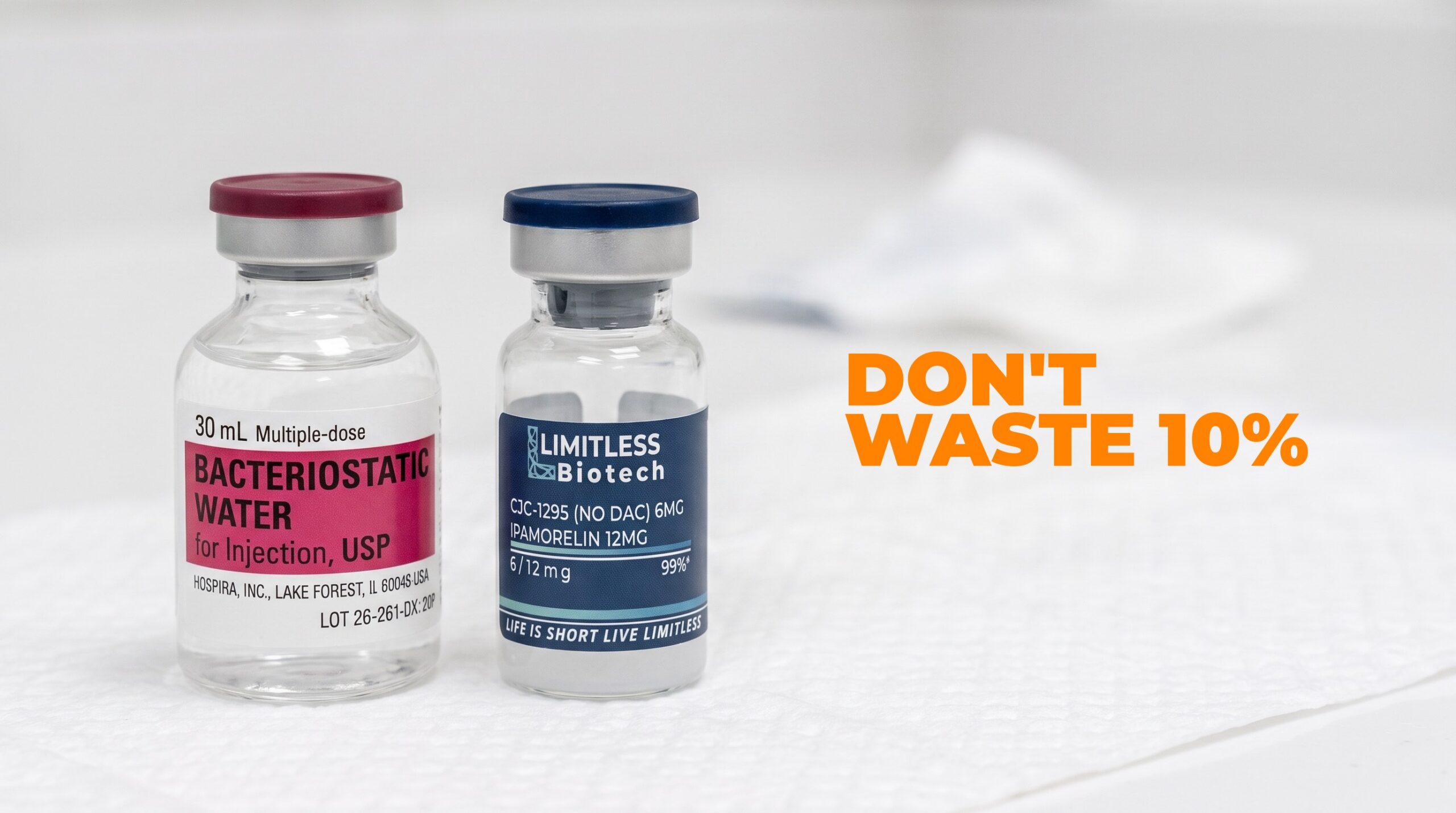
How to Reconstitute Peptides (Without Wasting 10% of the Vial)
Key Takeaways
- How to reconstitute peptides is freeze-dried powder plus bacteriostatic water, swirled, labeled, refrigerated. Not a ritual.
- Three skills before you crack a stopper: U-100 tick marks, venting the vial, and dead space. Dead space is how you quietly waste about 10% of a vial.
- Example math, not a prescription: 5 mg + 2 mL BAC water = 25 mcg per unit on a U-100. Write it on the cap.
- Cloudy, crystals, a cake that will not dissolve: you stop. You do not “see if it clears in the fridge.”
People ruin peptides in the first four minutes. They blast water onto the cake, shake it, skip the swab, guess the units, then leave 10% of the vial in a syringe hub and call the compound a scam.
I would rather you watch a video than waste a vial because you “eyeballed it.” If you still need the map of what peptides even are, read that first. If you do not know why you bought the vial, go to Start Here. If the question is duration, not mixing, read how long peptides for healing take. Mixing is a skill. It is not a reason to collect bottles.
This page is education and research. It is not a prescription. It is not medical advice. Your clinician owns anything after that sentence.
What “reconstitute” actually means
Most research peptides ship as a lyophilized cake. Freeze-dried on purpose. Stable for shipping. Useless as a powder in a syringe. You add a sterile diluent, usually bacteriostatic water, so the peptide dissolves into a known volume. That volume is how you do the math. You are not “activating” it. You are dissolving it.
The cake should go clear. Colorless, or the faint tint the COA told you to expect. No chunks. No cloud that will not leave. No crystals on the glass. If it looks like dishwater, you stop.
BAC water vs sterile water
Bacteriostatic water is sterile water plus a preservative, typically 0.9% benzyl alcohol. That preservative is why a research workflow can make multiple withdrawals from one reconstituted vial instead of cracking a single-use sterile water ampule every time.
Sterile water has no preservative. Once you puncture that world, the clock is different. People who “just use whatever” mix those two up and then argue about why a vial went off.
Peptides & Pump does not sell peptides or medical supplies. You want actual bacteriostatic water, third-party tested, from a named supplier. Limitless sells reconstitution solution, code LEE20 in the URL. That is a solvent. It is not a treatment.
Do not use tap or bottled water. Do not grab bacteriostatic sodium chloride unless the solubility notes say so. If a COA says otherwise, follow the COA.
U-100 tick marks (the lines are volume)
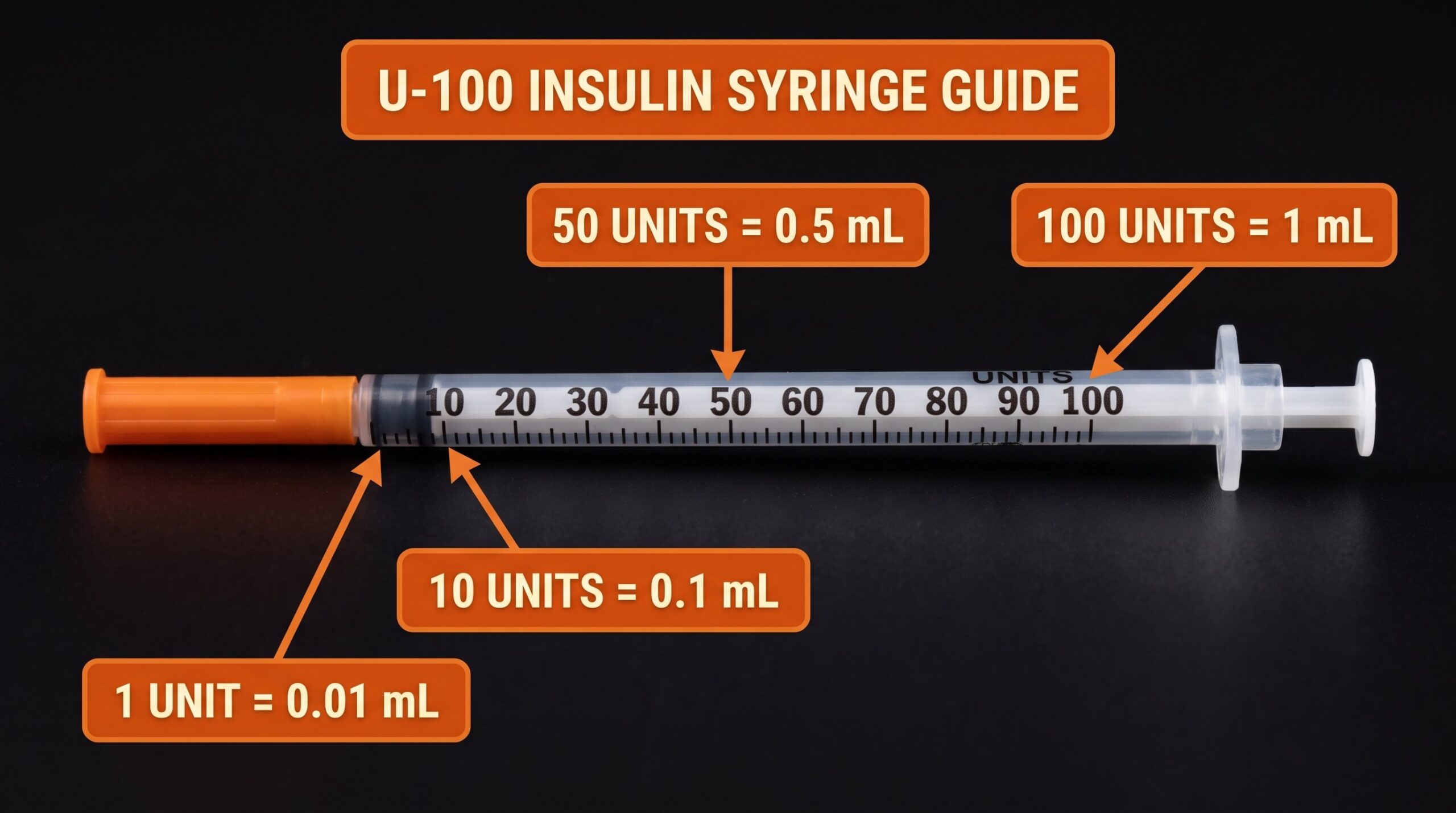
A standard insulin syringe is a U-100. One hundred units = 1 mL. The tick marks on the barrel are volume, not milligrams of peptide. For a reconstituted research vial, one unit is 0.01 mL of whatever you mixed.
On a 1 mL U-100, the long lines are usually 10-unit marks (0.1 mL). The short ticks are 1 unit on many 1 mL barrels. A 0.3 mL or 0.5 mL syringe packs the same math into finer lines. If you cannot see the number you meant, you picked the wrong barrel.
- 100 units = 1 mL
- 50 units = 0.5 mL
- 20 units = 0.2 mL
- 10 units = 0.1 mL
- 1 unit = 0.01 mL
The milligrams are on the vial. You choose how much water to add. That sets micrograms per unit. Skip this and you are playing darts.
How to reconstitute peptides: the math, not a dose
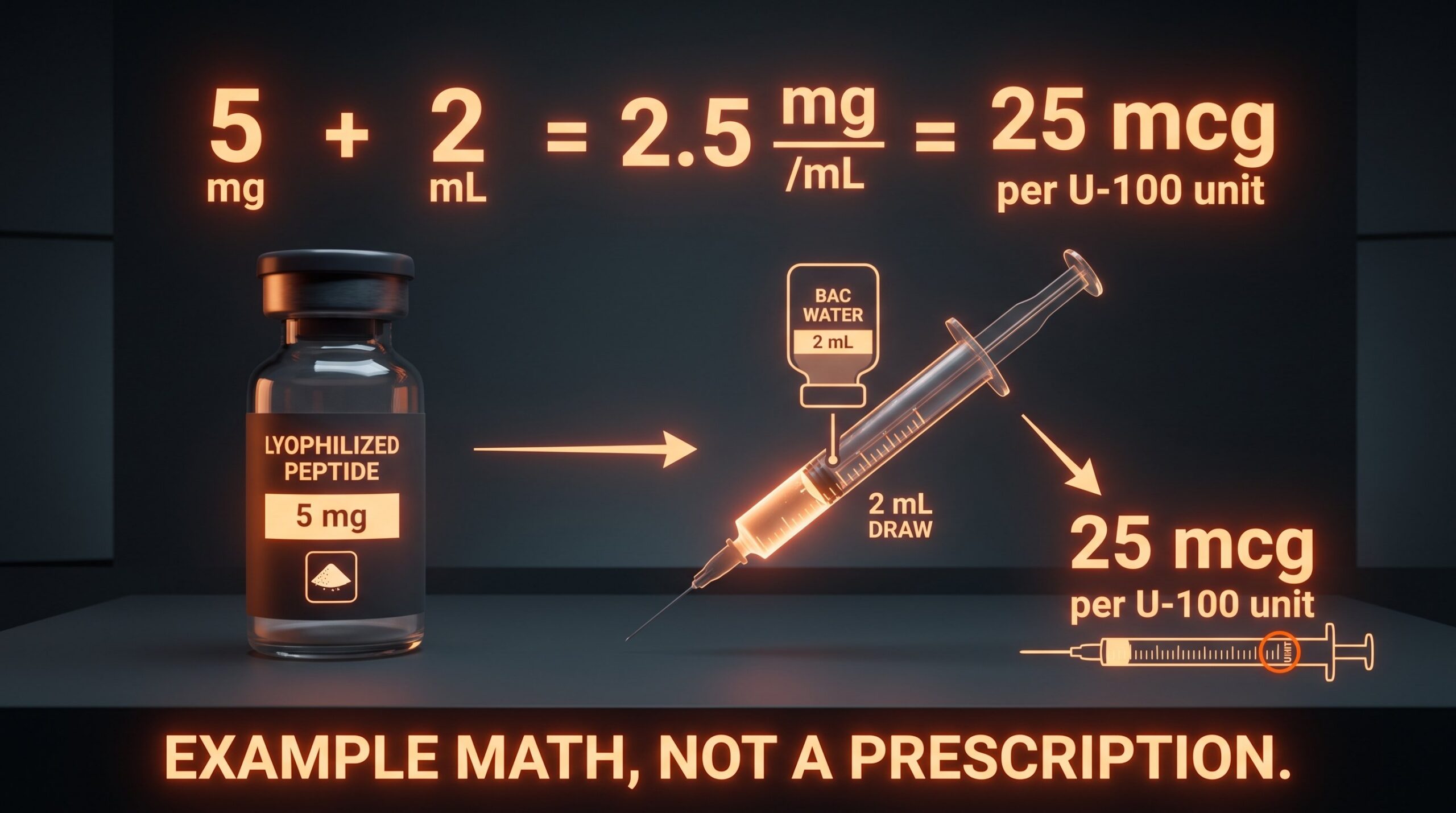
Education example, not a protocol. A 5 mg vial plus 2 mL of BAC water.
5 mg = 5,000 mcg. 2 mL = 200 units on a U-100. 5,000 ÷ 200 = 25 mcg per unit.
| U-100 draw | Volume | Example (5 mg + 2 mL) |
|---|---|---|
| 1 unit | 0.01 mL | 25 mcg |
| 4 units | 0.04 mL | 100 mcg |
| 10 units | 0.10 mL | 250 mcg |
| 20 units | 0.20 mL | 500 mcg |
| 40 units | 0.40 mL | 1,000 mcg (1 mg) |
| Whole vial | 2.00 mL | 5,000 mcg (5 mg) |
Change the water, change the table. 5 mg + 1 mL is 50 mcg per unit. 10 mg + 2 mL is also 50 mcg per unit. Pick a volume that makes the math easy. Write it on the cap. I am not telling you to run 250 mcg of anything. Protocol numbers belong with a clinician and, if you want the member library, in Peptides & Pump Pro.
Vent the vial or fight the vial
A sealed vial is a pressure system. Add liquid, pressure goes up. Pull liquid out of the BAC vial, pressure goes down. Skip that and the plunger fights you, BAC sprays, or you foam an expensive cake.
- Clean hands. Clean counter. Pop the caps. Swab both stoppers. Let them dry.
- Draw air equal to the BAC volume you want. Push that air into the BAC vial so you are not pulling against a vacuum. Draw the water. Tap bubbles out. Hit the number you meant.
- Needle through the peptide stopper at an angle. Tip against the glass, not the cake. Let the water run down the wall. Slow. Some lyophilized vials are under vacuum and will suck the water in. Do not let it slam onto the powder.
- As volume goes in, pressure rises. Vent it. Pull the extra air back into the syringe, or park a second sterile needle as a vent while you add the water.
- Swirl. Do not shake. Rolling between your palms is fine. Shaking makes foam.
- Look at it. Clear? Label the peptide, the concentration, and the date. Fridge.
Watch the hands. Pause it. Do not play it in the background.
The 10% you never see (dead space)
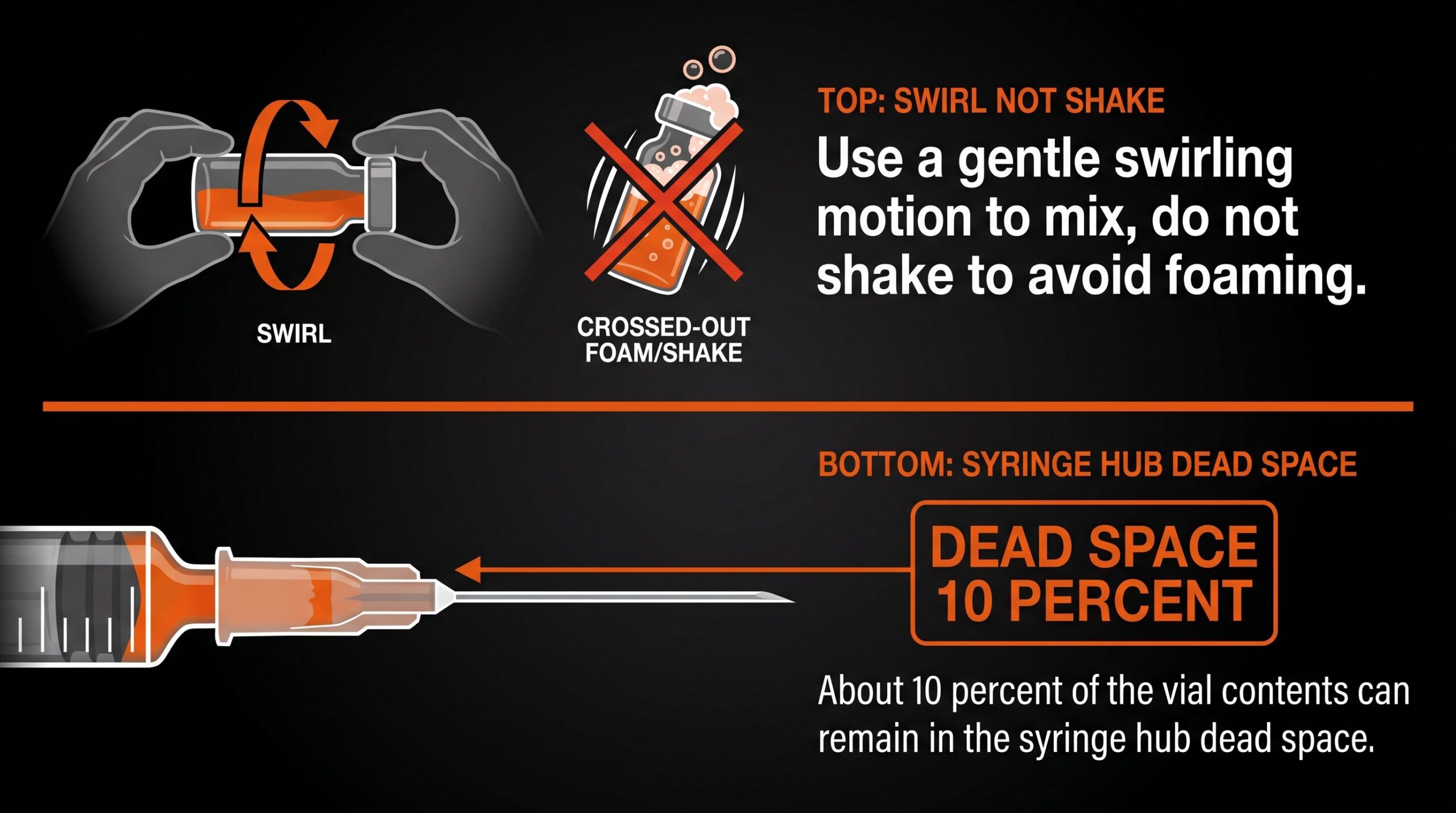
Syringes have a hub. Needles have a bore. Stoppers hold a last film of liquid. None of that shows up on the barrel marks.
Dead space is the volume sitting in the hub and needle after you push the plunger home. On a cheap insulin syringe it is often 0.04 to 0.07 mL, about 4 to 7 units. If your working draw is 20 units, that hub is not a rounding error. Across a 2 mL vial, leftover in hubs plus the last film under the stopper is how people quietly leave about 10% of the peptide in plastic. Geometry. Not a mystical loss.
- Use the same syringe style every time so the hub is a known quantity.
- Invert the peptide vial, keep the needle in the liquid, pull past your number, then adjust down.
- Do not squirt peptide onto a cotton ball “to clear the needle” unless you mean to donate product to the trash.
- The last 10 units are the expensive ones. Tip the vial. Do not declare it empty while 0.1 mL is still hiding on the glass.
Low dead-space syringes exist. I am not writing a medical-device list. I am telling you the physics so you stop blaming the COA.
Cloudy, crystals, and when you stop
Clear and dissolved is the pass. Everything else is a fail until proven otherwise.
Undissolved cake: time and a gentle swirl. Some peptides take a minute. They do not take a shake, kettle water, or a truck dashboard.
Persistent cloud, flecks, crystals on the glass, color that does not match the lot: stop. Send the supplier the lot number and a photo. A third-party-tested vendor would rather look at a picture than have you “try it anyway.”
Crystals after the fridge are the other trap. Some peptides crash out of solution when they get cold, especially if you mixed them concentrated. Do not warm, shake, and hope the crystals are “just the BAC.” Photo. Lot number. Stop.
This is the boring skill we talk through in the free Peptides & Pump Knowledge Base on Skool. Bring a photo. Bring the lot. Do not bring a stranger’s dose chart and ask us to bless it.
Storage: before you mix, and after
Unreconstituted lyophilized vials want dry, dark, and whatever temperature the vendor printed. Fridge is common. Freezer is a vendor call, not a default. Keep the stopper on.
After BAC water, the refrigerator is the workplace. Not the door. Not a hot car. Not a gym bag for six hours. Label the date you mixed it.
Community practice talks about a roughly 28-day window on the solvent side, plus whatever stability the specific peptide actually has. That is not a guarantee. Cloudy or crystals a week later is the same stop rule as day one. Do not freeze-thaw a reconstituted vial for fun. If you cannot keep it cold on the road, you do not have a travel protocol. You have a melted experiment.
What to buy for mixing
Solvent and a named research vial if that is the job. Codes fire in the URL. Research use. Not a treatment claim. Get clean syringes and swabs from a legitimate source.
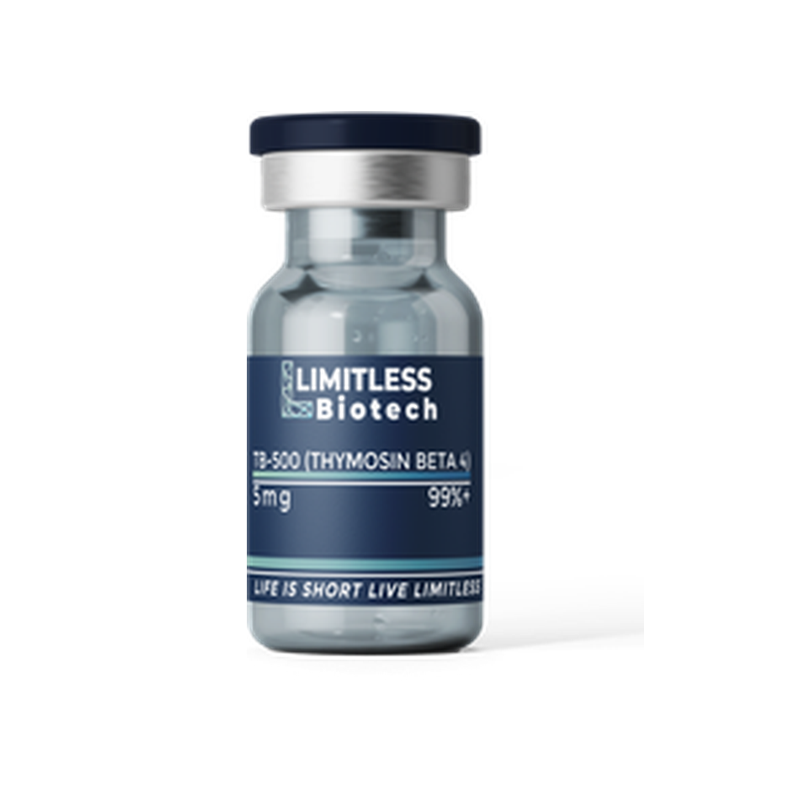
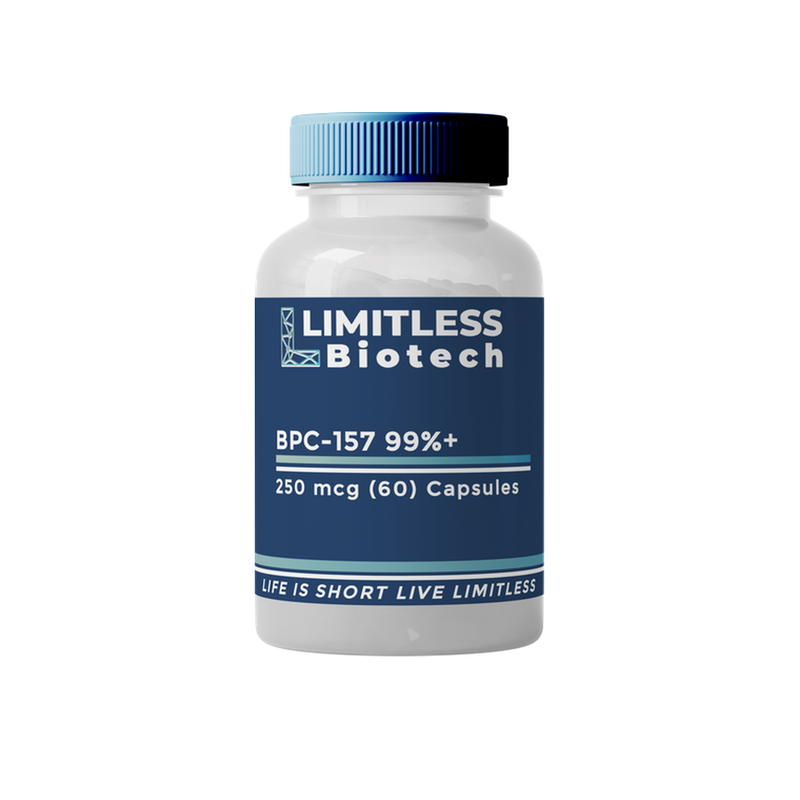
Limitless store · LEE20Limitless TB-500 · LEE20Limitless reconstitution solution · LEE20Limitless BPC capsules · LEE20BioGutPro · LEE15BioLongevity home · LEE15
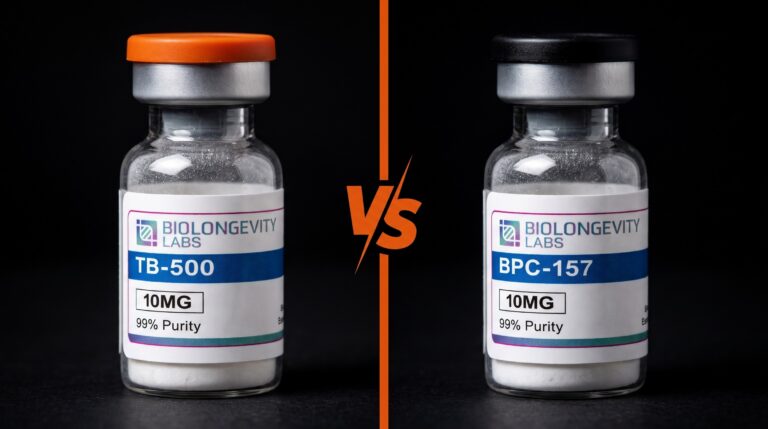
If the cake is a GLOW blend, mixing is still mixing, but the job is not a single named sequence — map that on the glow peptide page first. If the job is gut, you may not need a vial: Is oral BPC-157 worth it? TB-500 vs BPC-157 filter: TB-500.
Frequently asked questions about reconstituting peptides
How much bacteriostatic water do I add?
Enough to make the math easy and the draw practical. Teaching example: 2 mL into a 5 mg vial is 25 mcg per unit on a U-100. 1 mL into the same vial is 50 mcg per unit. Neither is a dose. Write the concentration on the vial.
Can I shake the vial to make it dissolve faster?
No. Swirl. Roll. Be patient. If it will not dissolve after a gentle swirl and a couple of minutes, that is a product or diluent problem, not a motivation problem.
Why did I lose so much of the vial?
Dead space. Hub volume. The last film under the stopper. Squirting peptide into a cotton ball to “clear the needle.” Count the geometry before you blame the milligrams on the label.
How long does a reconstituted vial last in the fridge?
See storage above. BAC water is why people talk in weeks instead of hours. The peptide still has its own stability. Label the date. Cloudy or crystals later is the same stop rule as day one.
Do oral BPC-157 capsules need reconstitution?
No. If the job is gut, read the oral BPC-157 article and skip the syringe. If the job is a lyophilized research vial, you are on this page for a reason.
Where is the actual protocol, not just the mixing math?
Not here. Public pages stay on education, sourcing, and the skill. The protocol library lives in Peptides & Pump Pro. Mixing questions belong in the free Knowledge Base. A qualified clinician belongs in the loop before any of this becomes “your protocol.”
The bottom line
How to reconstitute peptides is a handling skill, not a personality. BAC water down the glass. Swirl, do not shake. Vent the pressure. Learn the U-100 tick marks. Budget for dead space so you stop donating 10% of every vial to the hub. Cloudy or crystals means stop. Fridge after you mix. Date on the cap.
The videos are on my Rumble channel so you can see the hands. TB-500 vs BPC is the job-site filter. Oral BPC is the capsule conversation. Mixing sits under the vials.
I built Peptides & Pump so you can get this without a guru tax. Protocol library and member discussions: Peptides & Pump Pro, $10 a month, seven-day free trial, cancel anytime. Not ready to pay? Use the free Knowledge Base first.
Do the reading. Respect the research.
Free guide
Get The Peptide PlaybookEnter your email and we’ll send the research PDF. Education only — not medical advice.
 Keep going on Peptides & Pump
Free is the peptide community. Pro is where you master it.
Free
Knowledge Base
The peptide community · 2,500+
- 2,500+ member peptide community
- Sourcing questions before you buy anything random
- The basics, from people actually using peptides
Pro
Peptides & Pump Pro
$10/mo · 7-day trial
- Science-backed protocol library
- 1-on-1 support from Lee and Matt
- Step-by-step video, plus a monthly $500 drawing
LEE20 Limitless LEE15 BioLongevity LEE10 Paramount LEE Peptira LEE10 S1
Next reads
Supplier footnote: Other research suppliers I mention when people ask: Paramount, Peptira (code LEE), and S1 Research (code LEE10). Match the product to the job. Do not collect bottles.
Disclaimer. This article is for educational and research purposes only. It is not medical advice. It is not intended to diagnose, treat, cure, or prevent any disease. TB-500, BPC-157, CJC-1295, ipamorelin, bacteriostatic water, and related peptides are not FDA-approved for the uses discussed here. Most of the published evidence is preclinical. Individual results vary. Always consult a qualified healthcare provider before starting any peptide, supplement, or protocol, especially if you have a medical condition or take prescription medication. Peptides & Pump does not sell peptides.
Affiliate disclosure. Some links on this page are affiliate links. If you buy through them, I may earn a commission at no extra cost to you. Codes LEE15, LEE20, LEE10, and LEE are the ones I actually use. That commission is how I keep publishing free education. I only link suppliers I am willing to put my name on.
29 Comments