MOTS-c vs 5-Amino-1MQ: Two Metabolic Research Compounds, Compared in Plain English
Key takeaways
- Verdict: MOTS-c and 5-Amino-1MQ get lumped together. They are not the same kind of thing. MOTS-c is a peptide your own cells make. 5-Amino-1MQ is a lab-made small molecule.
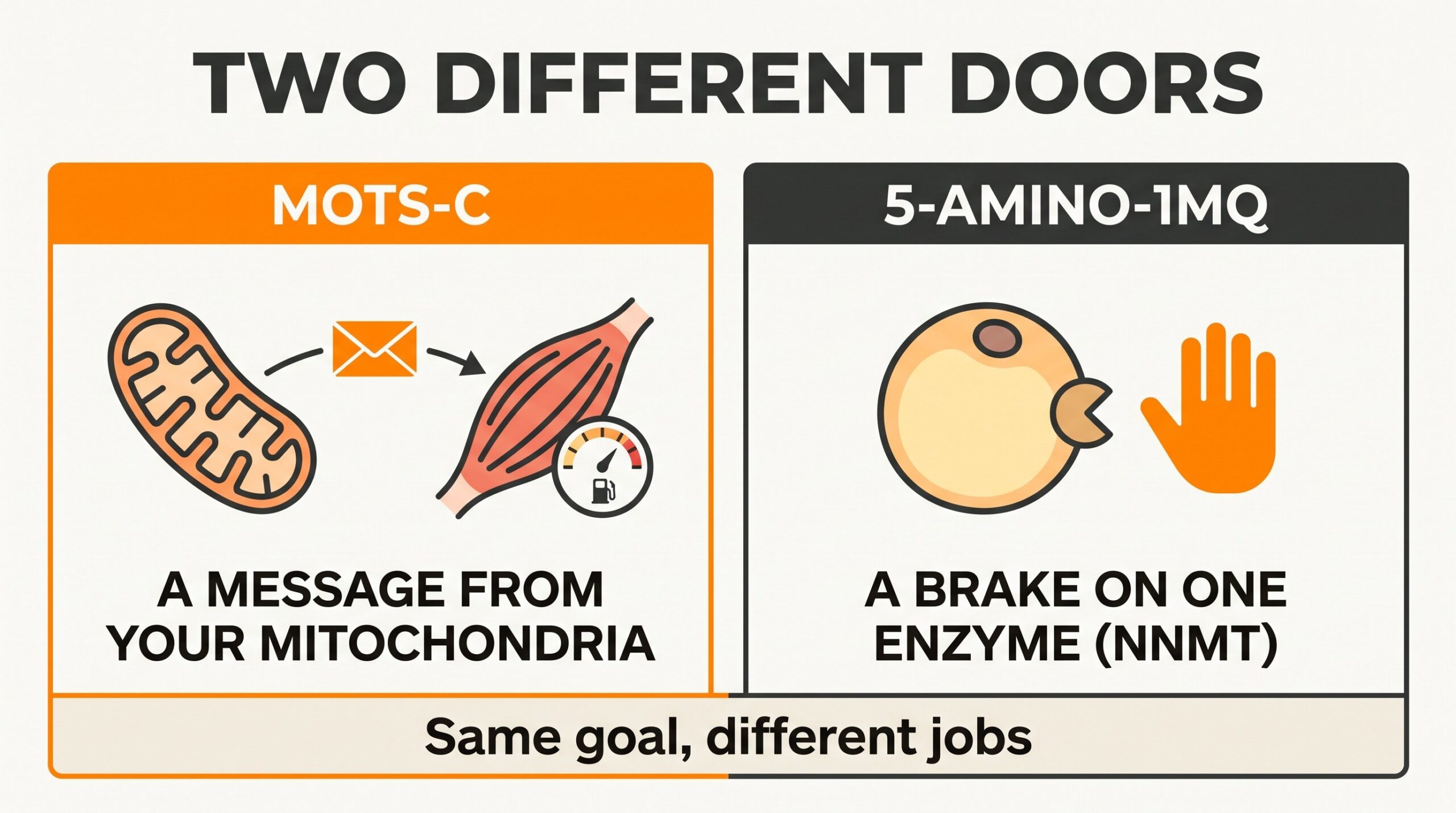
- MOTS-c is a message from your mitochondria. It nudges your cells’ fuel gauge, called AMPK. 5-Amino-1MQ puts a brake on one enzyme, called NNMT.
- Both look good in mice. Neither has a published human trial. Not one.
- Exercise moves both levers on its own. It raises your own MOTS-c and lowers NNMT in fat. Education only. Not medical advice.
Verdict up front: If you searched MOTS-c vs 5-Amino-1MQ, here is the short answer. They aim at a similar goal. They take very different roads to get there. And neither one has been proven in people.
MOTS-c is a tiny protein piece. Your mitochondria make it. Mitochondria are the power plants inside your cells. 5-Amino-1MQ is a small man-made molecule. It was built in a lab to block one enzyme.
Why this matters: people buy these two like they are twins. They are not. If you know which door each one knocks on, you can read the hype much faster.
Keep reading if you want the plain-English map. We cover what each one is, how each one works, what the studies show, and where the gaps are. New here? Start with our full pages on MOTS-c and 5-Amino-1MQ. Or read what peptides are first. You can skip this page if a doctor already runs your plan. Your chart beats any blog.
Quick note. This page is education. It is not medical advice. It does not diagnose or treat anything. It is not a how-to or a dosing guide. Neither compound is FDA-approved for any use.
MOTS-c vs 5-Amino-1MQ at a glance
Here is the whole fight on one card. We explain every line below.
| MOTS-c | 5-Amino-1MQ | |
|---|---|---|
| What it is | A peptide. A chain of 16 amino acids. | A small molecule. Not a peptide at all. |
| Where it comes from | Your own mitochondria make it. | Made in a lab. Your body does not make it. |
| Main job in studies | Turns up the cell’s fuel gauge (AMPK). | Blocks one enzyme (NNMT). |
| Main tissue in studies | Muscle first. | Fat first, then muscle and liver. |
| Best animal result | Mice on junk food gained less fat and kept better blood sugar control. | Obese mice lost weight and fat without eating less. |
| Human data | Blood levels and gene studies. No published treatment trial. | Studies of the enzyme in human fat. No published trial of the compound. |
| Sports status | Named on the WADA banned list. | Not named on the list by name. |
| FDA status | Not approved. | Not approved. |
Why this matters: the biggest line in that table is the human data row. Everything else is a mouse story until people are tested.
What is MOTS-c?
Start with the power plant. Each of your cells has hundreds of mitochondria. They turn food into usable energy. They also carry their own tiny set of genes. That is odd. Almost all your genes live in the cell’s center, the nucleus.
For a long time, scientists thought those mitochondria genes were boring. Just parts lists. Then they found short hidden codes tucked inside them. One of those codes makes MOTS-c.
In 2015, a team at the University of Southern California described it in the journal Cell Metabolism. MOTS-c is 16 amino acids long. Amino acids are the small building blocks of protein. The name is short for “mitochondrial open reading frame of the 12S rRNA-c.” Write it out like this: a hidden recipe inside one mitochondria gene. That gene is called 12S.
That first study found MOTS-c mostly acts on muscle. In mice, it helped stop the blood sugar problems that come with age and with a high-fat diet. It also kept mice from gaining as much fat on that diet.
Later work added more. When a cell is under stress, MOTS-c can travel into the nucleus. There, it helps switch on genes, including stress-defense genes. Think of it as the power plant sending a memo to headquarters. Scientists call this mito-nuclear talk.
MOTS-c is part of a small family. Researchers now count eight of these mitochondria-made peptides. Another well-known one is called humanin.
Why this matters: MOTS-c is not a drug someone invented. It is a signal your body already makes. That makes it interesting. It does not make an outside vial safe or proven.
What is 5-Amino-1MQ?
Now the other side. 5-Amino-1MQ is short for 5-amino-1-methylquinolinium. That is a mouthful. Here is the plain version: it is a small ring-shaped molecule made in a lab.
Here is a fact most sellers skip. 5-Amino-1MQ is not a peptide. It has no amino acid chain. It gets sold next to peptides, so people assume it is one. It is closer to a classic pill-type drug molecule.
It was built for one job: to block an enzyme called NNMT. An enzyme is a protein that speeds up one chemical step in your body. NNMT stands for nicotinamide N-methyltransferase. Write it out like this: the enzyme that tags vitamin B3 for removal.
A team at the University of Texas Medical Branch tested a series of these molecules in 2017. They screened several families. The quinoliniums came out on top. 5-Amino-1MQ belongs to that group.
Why this matters: “peptide” on the label does not tell you much. Here, the label is wrong. Know what is actually in the vial, and how little it has been tested.
How they work: two different doors
Both compounds aim at the same big goal. Burn fuel better. Store less fat. Keep muscle working. But they push on different parts of the machine.
MOTS-c and the fuel gauge
Your cells have a fuel gauge. It is a protein called AMPK. When fuel runs low, AMPK lights up. Then the cell does three things. It burns more fat. It pulls in more sugar. It slows down building projects that cost energy.
Exercise turns AMPK up. So does fasting. So does the diabetes drug metformin, in part.
MOTS-c turns AMPK up in a sneaky way. In the 2015 work, it slowed a cell process called the folate cycle. That caused a buildup of a molecule called AICAR. AICAR is a known AMPK switch. So MOTS-c tricks the gauge into reading “low fuel.”
A 2024 study found another piece. MOTS-c grabs onto a protein called CK2 and turns it on in muscle. Muscle then took in more sugar in mice. In fat, the same peptide turned CK2 down. Same messenger. Different effect in a different tissue.
5-Amino-1MQ and the B3 brake
Now picture vitamin B3. Your body uses one form of it, nicotinamide, to rebuild NAD+. NAD+ is a helper molecule. Your cells need it to make energy. Levels tend to drop with age in many tissues.
NNMT grabs nicotinamide and sticks a small tag on it. That tag is a methyl group. The tagged B3 then heads out in urine. To make that tag, NNMT burns a molecule called SAM. SAM is the body’s main methyl donor. Write it out like this: SAM hands out tiny chemical labels all over the cell.
So when NNMT runs hot, two things drain. Less B3 is left to make NAD+. And SAM gets used up.
In a 2014 Nature paper, a Harvard team found NNMT was high in the fat and liver of obese and diabetic mice. When they turned the gene down, the mice burned more energy. They were protected from diet-driven weight gain. Their fat had more SAM and more NAD+.
5-Amino-1MQ is a chemical way to do that same thing. Block NNMT. Keep more B3 and SAM in the cell.
Why this matters: MOTS-c turns up a switch. 5-Amino-1MQ takes a foot off a drain. Those are different doors. That is also why nobody can promise what happens when you mix them.
What the research shows for MOTS-c
In mice
The mouse results are the reason people care. In the first study, MOTS-c shots kept mice on a high-fat diet from gaining as much fat. It also kept their insulin working better. Insulin is the hormone that moves sugar out of your blood and into cells.
A 2021 study in Nature Communications went after fitness. MOTS-c boosted running performance in young, middle-aged, and old mice. The team also started treatment very late in life, at about 23 months. For a mouse, that is old. Shots three times a week still improved physical capacity.
Another mouse study tied MOTS-c to muscle loss signals. It lowered myostatin. Myostatin is a protein that tells muscle to stop growing.
In people
Here is where it gets thin. Human MOTS-c studies mostly measure it. They do not give it.
- Exercise raises it. In the 2021 study, hard exercise raised MOTS-c in human muscle and blood.
- But not always much. A Swedish study split 30 adults into three groups: cycling, leg lifting, or rest. After cycling, MOTS-c only showed a trend toward going up. Humanin rose clearly.
- Blood levels are messy. A Chilean study compared 10 lean and 10 obese adults. Their MOTS-c levels were about the same, near 0.5 ng/mL. A 2024 review pooled 7 studies and 602 people. MOTS-c ran lower in diabetes but higher in obesity. Those point in opposite directions.
- A gene clue. Some people of East Asian descent carry a one-letter change in the MOTS-c gene. It swaps one amino acid, called K14Q. In more than 27,000 people across three groups, men with this change had more type 2 diabetes. The link was strongest in men who moved the least. In mice, the K14Q version did not work like normal MOTS-c.
That gene clue is the best human hint so far. It suggests your own MOTS-c matters. It does not show that a vial of it helps anyone.
One more honest note. Many of the main MOTS-c papers come from the lab that found it. Several authors list ties to CohBar, a company that licensed MOTS-c. That is normal in science. It is also a reason to wait for outside teams to confirm.
Why this matters: “your body makes it and exercise raises it” is true. “Taking it works in people” has not been shown.
What the research shows for 5-Amino-1MQ
In mice
The Texas team ran the key studies. In 2018, they gave an NNMT blocker to obese mice on a high-fat diet. The mice lost body weight and white fat. Their fat cells shrank. Their cholesterol dropped. And here is the part sellers love: the mice did not eat less food. The authors saw no obvious side effects.
In cell tests, the blockers were picky. They did not hit similar enzymes or the enzymes that rebuild NAD+. In fat cells, they raised NAD+ and SAM and cut fat-making.
Later mouse work added more:
- With a diet change (2021). Obese mice switched to a lean diet lost fat faster with the blocker than with the diet alone. Their body makeup ended up close to mice that were never fat.
- A 28-day test of 5A1MQ (2024). In obese mice, it limited weight and fat gain, improved blood sugar handling, and cut liver fat.
- Old muscle (2019). In 24-month-old mice with a muscle injury, the blocker helped muscle stem cells. Healed fibers were nearly twice as big. Muscle force was about 70% higher than in untreated old mice.
- With exercise (2024). Old mice on the blocker had about 40% better grip strength than couch-bound mice. Exercise alone gave about 20%. Both together gave about 60%.
Honest note again. Several of these studies list authors who founded or work for Ridgeline Therapeutics. That company develops NNMT blockers. Good data can come from companies. Still, outside teams need to repeat it.
In people
We searched PubMed in October 2026. We found no published human trial of 5-Amino-1MQ. None.
What we do have is human data on the enzyme. A 2015 German study looked at fat samples from about 200 surgery patients. People with type 2 diabetes had about twice as much NNMT in their fat. More NNMT went with worse insulin action. Then came a twist. Exercise programs and weight-loss surgery both lowered NNMT in fat.
The liver twist
This is the part most pages skip. NNMT is not simply a bad guy.
The liver makes the most NNMT in the body. A 2015 Nature Medicine study found that in mouse liver, NNMT’s product helped. That product is called MNAM. Adding MNAM to a high-fat diet lowered liver fat and cholesterol in mice. A journal comment summed it up in its title: “A bad actor in fat makes good in liver.”
Other mouse work points the other way. Mice built to make extra NNMT got worse fatty liver. And mice with NNMT fully removed did not pass a key sugar test any better. Results changed with sex and diet.
Why this matters: blocking an enzyme everywhere is not the same as blocking it only in fat. Nobody knows yet what whole-body blocking does in people over months.
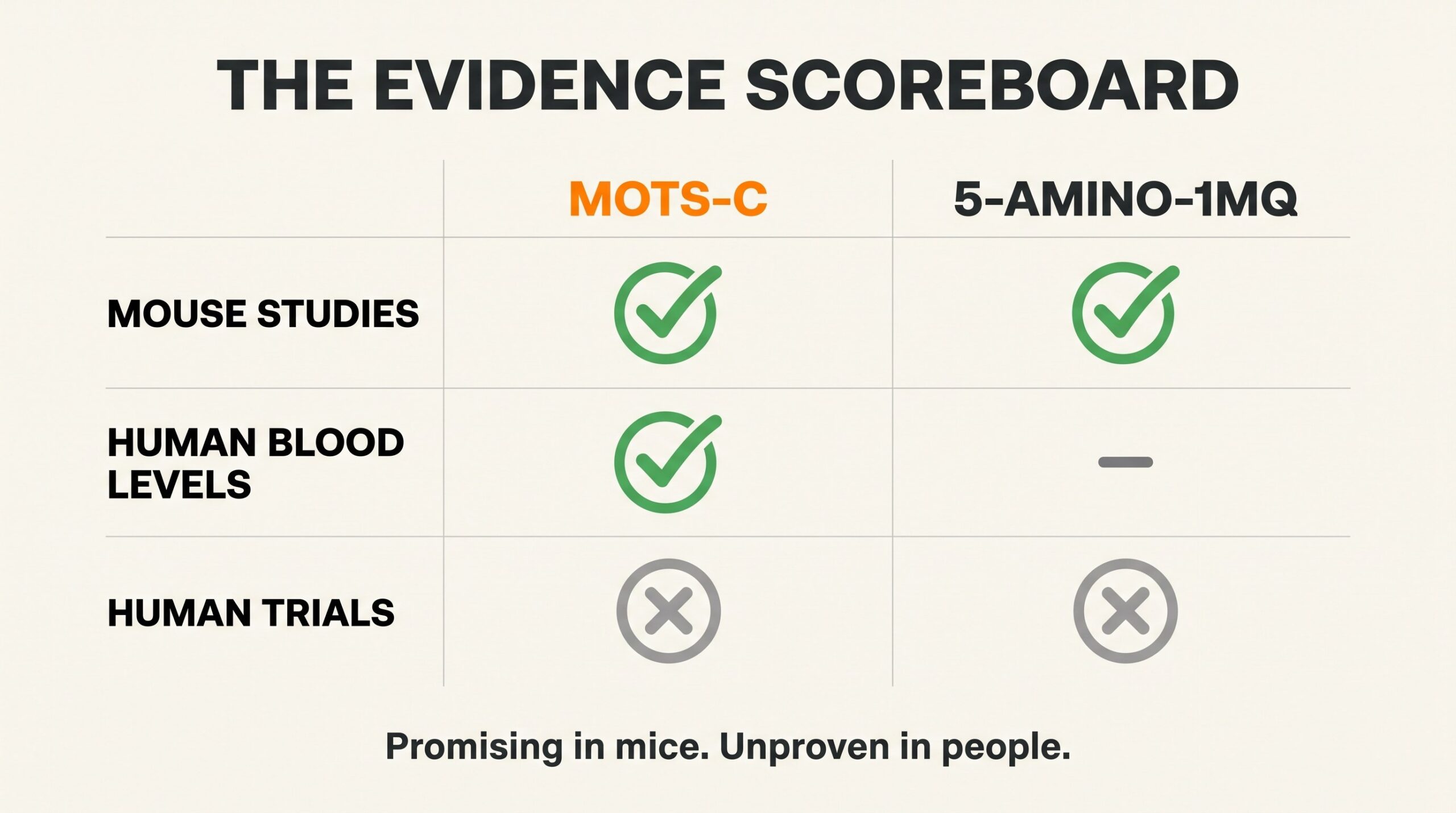
Head-to-head: the evidence scoreboard
Put the two side by side by type of proof. This is how a doctor reads it.
| Type of proof | MOTS-c | 5-Amino-1MQ |
|---|---|---|
| Cell studies | Yes. Many. | Yes. Many. |
| Mouse studies | Yes. Fat, sugar, fitness, aging. | Yes. Fat, sugar, liver, old muscle. |
| Human blood or tissue levels | Yes. Mixed results. | Of the enzyme, yes. Of the drug, no. |
| Human gene link | Yes. The K14Q variant. | Not for the drug itself. |
| Published human treatment trial | No. | No. |
| Long-term human safety data | No. | No. |
So who wins? On science, MOTS-c has a bit more human context. Your body makes it, and we can measure it. 5-Amino-1MQ has a tighter, more targeted mouse story, mostly from one research group. On human proof, it is a tie at zero.
Why this matters: a tie at zero is not a reason to pick one. It is a reason to be careful with both.
Safety and the big unknowns
When there are no human trials, there is no human side-effect list. That is not the same as “no side effects.” It means nobody has counted.
Here is what we can say:
- Not approved. The FDA has not approved MOTS-c or 5-Amino-1MQ for any use. Vials online are sold as research chemicals for lab use. They are not sold for people.
- Purity is a gamble. One lab checked two custom-made peptides with a scanning tool called NMR. One fifth to almost half of the powder was mannitol, a sugar alcohol. It was not on the label. A 2025 European study looked at 324 seized “performance” products. About 1 in 4 was sold as a supplement, and some were overdosed.
- Sports ban. The World Anti-Doping Agency’s 2026 list names MOTS-c. It sits with other AMPK switches like AICAR. It is banned at all times, in and out of competition.
- Doctors’ view. A 2026 sports-medicine review covered MOTS-c and other unapproved peptides. Its bottom line: good animal data, scarce human safety data, and real potential for harm.
- Body-wide effects. Both work on basic energy systems. Those systems touch every organ. The liver twist above shows how one change can help in one tissue and hurt in another.
If you are pregnant, nursing, under 18, managing a health condition, or taking any prescription, these are not for you. Talk to your doctor before you try anything that changes how your body handles fuel.
Why this matters: “early and exciting” and “safe for you” are two different claims. Only the first one is true today.
Can you use MOTS-c and 5-Amino-1MQ together?
This question comes up a lot. Some makers even sell a blend with both plus NAD+.
On paper, the doors are different. MOTS-c turns up the fuel gauge. 5-Amino-1MQ saves B3 and SAM. Different doors can team up. We explain that idea in our guide to peptide stacks.
But “different doors” is a guess, not a test. No published study has given both to people. As far as we can find, none has tested the pair in mice either. Two untested compounds do not add up to one tested combo.
This page does not give dosing, mixing, or timing steps. That is a job for a clinician who knows your health.
Why this matters: if one compound is unproven, two at once is more unproven, not less.
Who this comparison is for
This page is for curious readers. Maybe you saw both names on a podcast. Maybe a friend swears by one. Maybe you are a coach or a clinician and patients keep asking.
If you are trying to pick between them, here is the honest frame:
- You are curious about mitochondria and exercise biology. MOTS-c is the more interesting read. It is a real signal your body makes.
- You are curious about fat cells, B3, and NAD+. 5-Amino-1MQ and the NNMT story fit you. Pair it with our page on NAD+ and NMN.
- You want to lose fat or feel better. Neither is proven for that in people. The tools that are proven come first, and some are prescription drugs your doctor can discuss, like the ones in our tirzepatide vs semaglutide guide.
Why this matters: the right first question is not “which one?” It is “have I done the basics that move these same levers for free?”
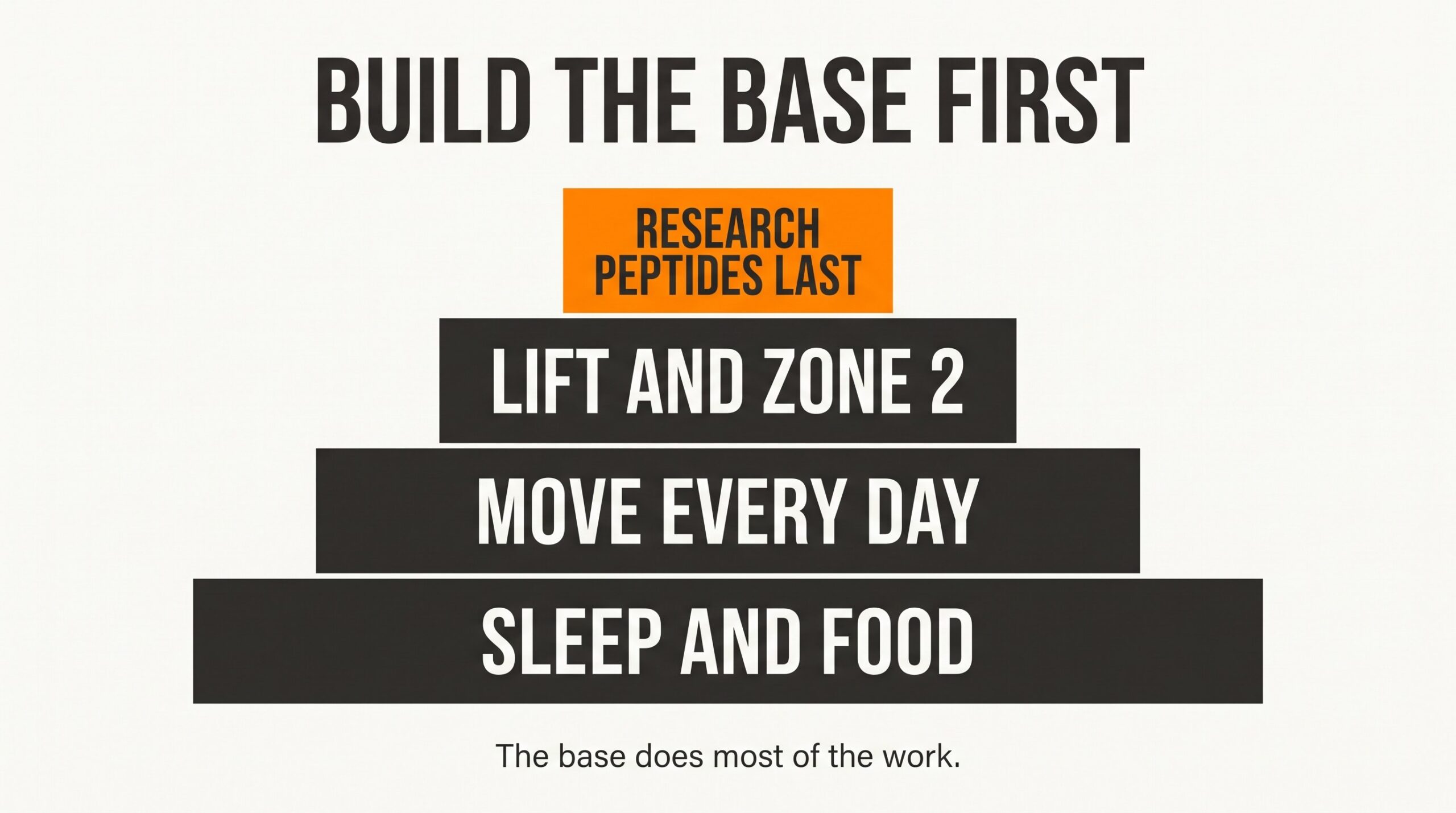
Build the base first: exercise moves both levers
Here is the coolest part of this whole comparison. Exercise already does what both compounds try to do.
- MOTS-c side. Hard exercise raised MOTS-c in human muscle and blood. It also turns up AMPK, the fuel gauge, on its own.
- 5-Amino-1MQ side. A 12-week exercise program lowered NNMT in human fat. So did weight-loss surgery.
- The gene clue. Men with the weaker K14Q MOTS-c had the most diabetes risk when they moved the least. Movement seemed to blunt the risk.
So the base is not a boring add-on. It is the main event. Start with these:
- Sleep. Seven to nine hours. See how to sleep better.
- Protein. Enough to hold muscle. See protein intake.
- Easy cardio. Zone 2 builds mitochondria. See zone 2 training and VO2 max.
- Lifting. Muscle is your biggest sugar sink. See creatine benefits for a cheap, well-studied helper.
Why this matters: if the base is not in place, no vial will fix it. If it is in place, you may not need the vial.
How to judge any MOTS-c or 5-Amino-1MQ claim
Use these five questions on any post, ad, or podcast clip:
- Was it in people or mice? For both compounds, almost every result is mice.
- Did they give it, or just measure it? Measuring MOTS-c in blood is not the same as taking it.
- Who ran the study? Check if the authors own a stake in the compound.
- Is it a peptide? 5-Amino-1MQ is not. If a seller gets that wrong, what else did they get wrong?
- Who made the vial? Look for third-party test reports. Read our guide to counterfeit research peptides.
Want the bigger safety picture? Read are peptides safe, peptide side effects, and are peptides legal.
Why this matters: these five questions will save you more money than any discount code.
Neighbors in the energy lane
MOTS-c and 5-Amino-1MQ get shelved next to a few other names. Here is the quick map.
- NAD+. The helper molecule 5-Amino-1MQ is meant to protect. Levels fall with age in many tissues. Also see NAD+ injections.
- SS-31. A peptide built to sit on the inner wall of mitochondria. Another power-plant idea.
- Glutathione. Your main inside-the-cell antioxidant. A small 12-person pilot found oral liposomal glutathione raised blood stores. The study was paid for by a supplement maker.
- AOD-9604. A piece of growth hormone studied for fat. The FDA lists it among compounding substances with possible safety risks.
- SLU-PP-332. A lab molecule called an “exercise mimic.” Mouse data only.
For fat loss as a whole, see peptides for fat loss and peptides for weight loss.
MOTS-c vs 5-Amino-1MQ FAQ
What is the main difference between MOTS-c and 5-Amino-1MQ?
MOTS-c is a peptide made by your mitochondria. It turns up the cell’s fuel gauge, AMPK. 5-Amino-1MQ is a lab-made small molecule. It blocks the enzyme NNMT, which uses up vitamin B3 and SAM.
Is 5-Amino-1MQ a peptide?
No. It is a small ring-shaped molecule called a methylquinolinium. It is sold next to peptides, but it has no amino acid chain.
Which is better for fat loss, MOTS-c or 5-Amino-1MQ?
Neither has been tested for fat loss in a published human trial. Both reduced fat gain in mice. Mouse results often do not carry over to people.
Are MOTS-c and 5-Amino-1MQ safe?
Nobody knows, because neither has human safety trials. Both are unapproved research compounds. Purity of online vials varies. Talk to a clinician who knows your health.
Can MOTS-c and 5-Amino-1MQ be stacked?
They work on different systems, so some people pair them. No published study has tested the pair in people. This page does not give dosing or mixing steps.
Does exercise raise MOTS-c?
Yes. Exercise raised MOTS-c in human muscle and blood in one study. Another found only a trend after cycling. Exercise also lowered NNMT in human fat.
Is MOTS-c banned in sports?
Yes. WADA’s 2026 Prohibited List names MOTS-c as an AMPK activator. It is banned at all times.
Is MOTS-c or 5-Amino-1MQ FDA-approved?
No. Neither is approved for any medical use in the United States.
Energy lane research maps from partners
Foundation first: sleep, protein, lifting, and easy cardio carry most of the load. If you are researching the energy lane after that, these are in-stock partner listings for the compounds covered on this page. They are research-catalog products sold for lab use. They are not treatments. They are not FDA-approved, and none has a published human trial for the uses people talk about online.
MOTS-c, 5-Amino-1MQ, and NAD+ — in stock
 BioLongevity
MOTS-c 10 mg
LEE15 BioLongevity
5-Amino-1MQ 10 mg
LEE15 S1 Research
MOTS-c
LEE10 BioLongevity
NAD+ 500 mg
LEE15NAD+, AOD-9604, and glutathione neighbors — in stock
 Paramount
NAD+ Biofermented 1000 mg
LEE10 Paramount
NAD+ Synthetic 1000 mg
LEE10 Paramount
AOD-9604 6 mg
LEE10 S1 Research
Glutathione 1500 mg
LEE10Partner homes
S1 shop · LEE10 Peptira home · LEE Paramount home · LEE10 BioLongevity home · LEE15 Limitless home · LEE20 Their catalog needs a quick research-access sign-up before prices show. Use code LEE20 at checkout.
Research maps only. Codes live in the links. Education framing — not a treat-disease pitch.
Key takeaways (echo)
- MOTS-c is a 16-amino-acid peptide your mitochondria make. It turns up the cell’s fuel gauge, AMPK.
- 5-Amino-1MQ is a lab-made small molecule, not a peptide. It blocks the enzyme NNMT, which burns through vitamin B3 and SAM.
- Both look promising in mice. Neither has a published human trial, and long-term safety in people is unknown.
- NNMT is not simply bad. In mouse liver, its product may help. Blocking it everywhere is a big unknown.
- Exercise raises your own MOTS-c and lowers NNMT in fat. Build the base first, and bring a clinician into any decision.
Get the Peptide Playbook
Free email map for building the foundation first, then thinking clearly about peptides without the guru noise.
Related reads: MOTS-c · 5-Amino-1MQ · Peptide stacks · NAD+ · NAD+ injections · NMN · SS-31 · Glutathione · AOD-9604 · SLU-PP-332 · Peptides for fat loss · Peptides for weight loss · Tirzepatide vs semaglutide · Zone 2 training · VO2 max · Protein intake · Creatine benefits · How to sleep better · What are peptides · How peptides work · Research peptides · Are peptides safe · Counterfeit research peptides · List of peptides · Start here · Community
Sources & Further Reading
- Lee C, et al. The mitochondrial-derived peptide MOTS-c promotes metabolic homeostasis and reduces obesity and insulin resistance. Cell Metab. 2015. PMID 25738459
- Kim KH, et al. The Mitochondrial-Encoded Peptide MOTS-c Translocates to the Nucleus to Regulate Nuclear Gene Expression in Response to Metabolic Stress. Cell Metab. 2018. PMID 29983246
- Reynolds JC, et al. MOTS-c is an exercise-induced mitochondrial-encoded regulator of age-dependent physical decline and muscle homeostasis. Nat Commun. 2021. PMID 33473109
- Kumagai H, et al. MOTS-c modulates skeletal muscle function by directly binding and activating CK2. iScience. 2024. PMID 39559755
- Kumagai H, et al. MOTS-c reduces myostatin and muscle atrophy signaling. Am J Physiol Endocrinol Metab. 2021. PMID 33554779
- von Walden F, et al. Acute endurance exercise stimulates circulating levels of mitochondrial-derived peptides in humans. J Appl Physiol (1985). 2021. PMID 34351816
- Cataldo LR, et al. Plasma MOTS-c levels are associated with insulin sensitivity in lean but not in obese individuals. J Investig Med. 2018. PMID 29593067
- Zhou Q, et al. The correlation between mitochondrial derived peptide (MDP) and metabolic states: a systematic review and meta-analysis. Diabetol Metab Syndr. 2024. PMID 39160573
- Zempo H, et al. A pro-diabetogenic mtDNA polymorphism in the mitochondrial-derived peptide, MOTS-c. Aging (Albany NY). 2021. PMID 33468709
- Lee C, et al. MOTS-c: A novel mitochondrial-derived peptide regulating muscle and fat metabolism. Free Radic Biol Med. 2016. PMID 27216708
- Miller B, et al. Mitochondria-derived peptides in aging and healthspan. J Clin Invest. 2022. PMID 35499074
- Mendias CL, et al. Safety and Efficacy of Approved and Unapproved Peptide Therapies for Musculoskeletal Injuries and Athletic Performance. Sports Med. 2026. PMID 41966639
- Hardie DG, et al. AMPK: a nutrient and energy sensor that maintains energy homeostasis. Nat Rev Mol Cell Biol. 2012. PMID 22436748
- Kraus D, et al. Nicotinamide N-methyltransferase knockdown protects against diet-induced obesity. Nature. 2014. PMID 24717514
- Neelakantan H, et al. Structure-Activity Relationship for Small Molecule Inhibitors of Nicotinamide N-Methyltransferase. J Med Chem. 2017. PMID 28548833
- Neelakantan H, et al. Selective and membrane-permeable small molecule inhibitors of nicotinamide N-methyltransferase reverse high fat diet-induced obesity in mice. Biochem Pharmacol. 2018. PMID 29155147
- Sampson CM, et al. Combined nicotinamide N-methyltransferase inhibition and reduced-calorie diet normalizes body composition and enhances metabolic benefits in obese mice. Sci Rep. 2021. PMID 33707534
- Babula JJ, et al. Nicotinamide N-methyltransferase inhibition mitigates obesity-related metabolic dysfunction. Diabetes Obes Metab. 2024. PMID 39161060
- Neelakantan H, et al. Small molecule nicotinamide N-methyltransferase inhibitor activates senescent muscle stem cells and improves regenerative capacity of aged skeletal muscle. Biochem Pharmacol. 2019. PMID 30753815
- Dimet-Wiley AL, et al. Nicotinamide N-methyltransferase inhibition mimics and boosts exercise-mediated improvements in muscle function in aged mice. Sci Rep. 2024. PMID 38969654
- Kannt A, et al. Association of nicotinamide-N-methyltransferase mRNA expression in human adipose tissue and the plasma concentration of its product, 1-methylnicotinamide, with insulin resistance. Diabetologia. 2015. PMID 25596852
- Hong S, et al. Nicotinamide N-methyltransferase regulates hepatic nutrient metabolism through Sirt1 protein stabilization. Nat Med. 2015. PMID 26168293
- Trammell SA, et al. NNMT: A Bad Actor in Fat Makes Good in Liver. Cell Metab. 2015. PMID 26244929
- Komatsu M, et al. NNMT activation can contribute to the development of fatty liver disease by modulating the NAD (+) metabolism. Sci Rep. 2018. PMID 29872122
- Brachs S, et al. Genetic Nicotinamide N-Methyltransferase (Nnmt) Deficiency in Male Mice Improves Insulin Sensitivity in Diet-Induced Obesity but Does Not Affect Glucose Tolerance. Diabetes. 2019. PMID 30552109
- Pissios P. Nicotinamide N-Methyltransferase: More Than a Vitamin B3 Clearance Enzyme. Trends Endocrinol Metab. 2017. PMID 28291578
- Covarrubias AJ, et al. NAD(+) metabolism and its roles in cellular processes during ageing. Nat Rev Mol Cell Biol. 2021. PMID 33353981
- Sinha R, et al. Oral supplementation with liposomal glutathione elevates body stores of glutathione and markers of immune function. Eur J Clin Nutr. 2018. PMID 28853742
- Choules MP, et al. NMR reveals an undeclared constituent in custom synthetic peptides. J Pharm Biomed Anal. 2020. PMID 31671336
- Barrios MM, et al. SARMs, Metabolic Modulators and Growth Hormone Secretagogues in Suspected Illegal Medicines, Bought as Sport Performance Enhancers: A Retro- and Prospective Study Within the GEON. Drug Test Anal. 2025. PMID 40551438
- U.S. Food and Drug Administration. Certain bulk drug substances for use in compounding that may present significant safety risks (includes AOD-9604). Content current as of April 2026. FDA.gov
- World Anti-Doping Agency. The 2026 Prohibited List, S4.4.1 (AMPK activators, including MOTS-c). WADA