Cold Plunge Benefits: What Cold Water Immersion Actually Does
Key takeaways
- Verdict: A cold plunge is a short, controlled cold stress — useful for next-day soreness in some training blocks, not a youth drug, not a disease cure, and not a peptide target.
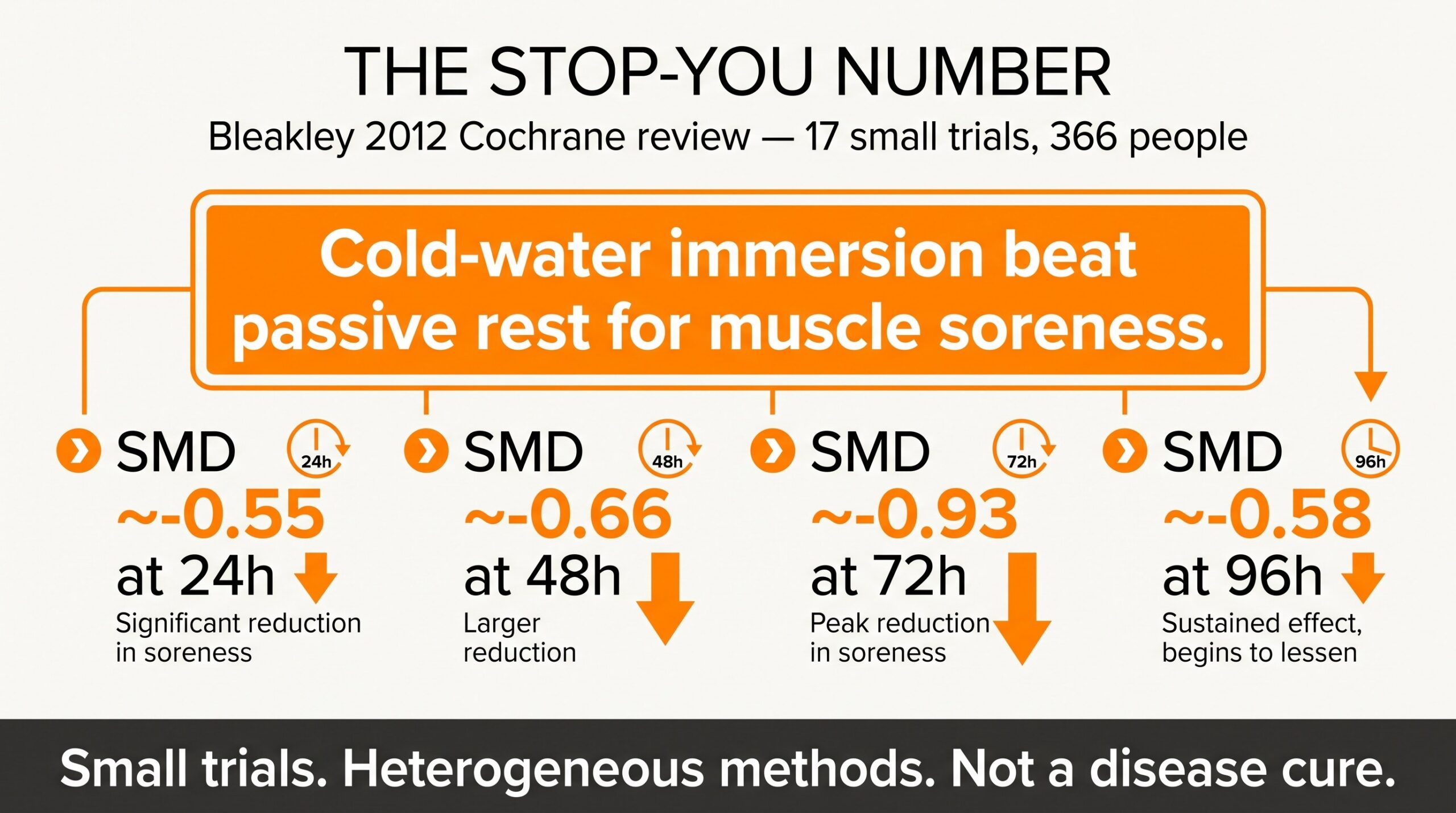
- Stop-you frame: a Cochrane review of 17 small trials (366 people) found cold-water immersion beat passive rest for muscle soreness at 24–96 hours (SMD about −0.55 to −0.93; Bleakley 2012).
- Your next step: respect cold shock, use a sane dose window when you try it, pair heat as contrast if you already sauna, and keep research vials off this page as a “cold replacement.”
Verdict up front: cold plunge is worth understanding if you train hard, recover poorly, or already sit in a sauna and wonder what the ice tub noise is about. It is not worth turning into a personality, a winter-swimming death wish, or a reason to buy a research peptide.
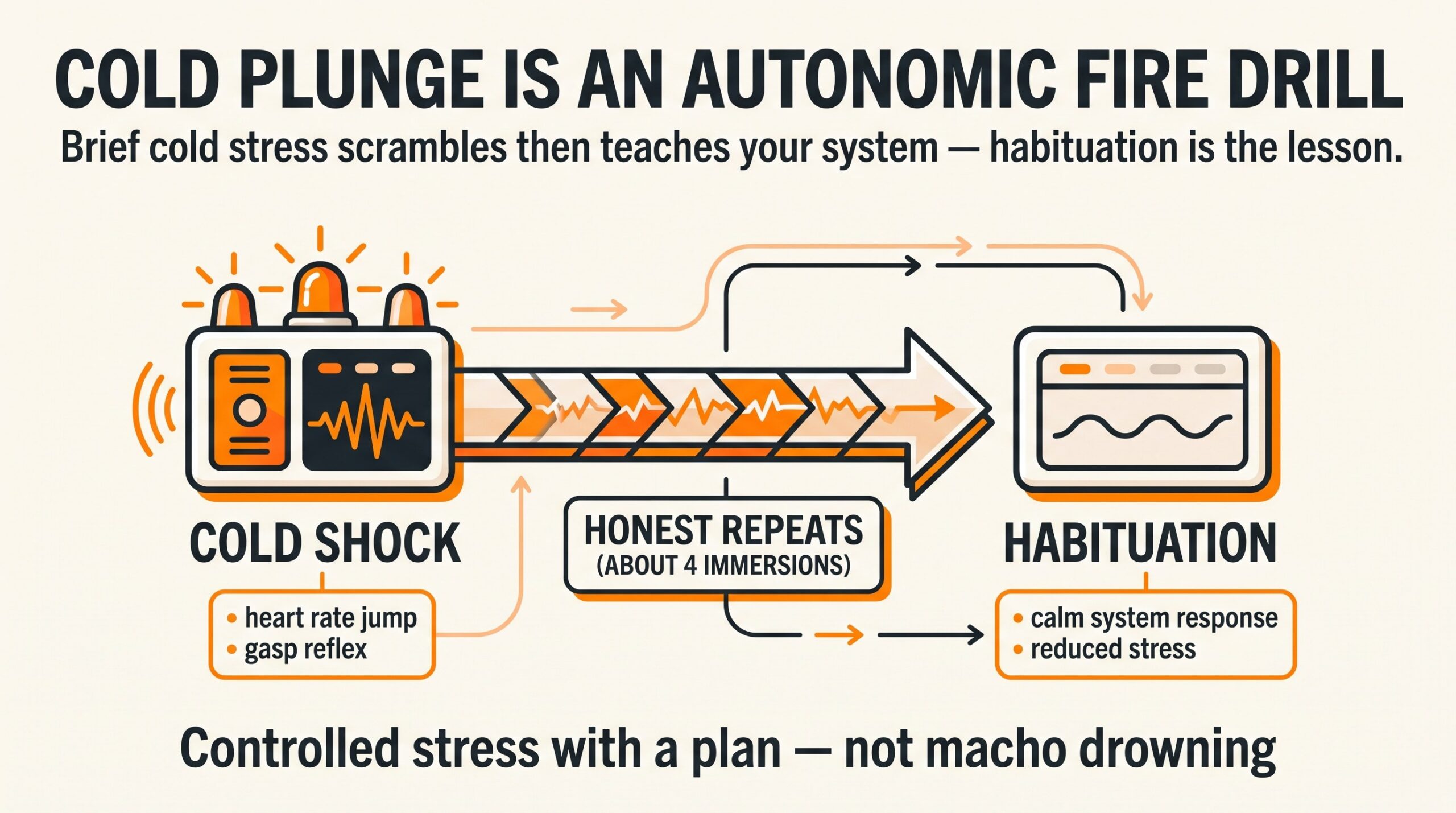
Think fire drill for your autonomic nervous system. Cold hits the skin. Heart rate jumps. Breathing wants to gasp. That scramble is the cold shock response. After a handful of honest exposures, the drill gets quieter for most people. The win is controlled stress with a plan — not proving you are tougher than physics.
Keep reading if you want the plain map: what cold-water immersion actually changes, what the recovery papers can justify, how contrast fits next to sauna, and how to think about risk without influencer cosplay. Skip if you want a disease-cure claim, a Wim Hof medical protocol, or a peptide stack “for cold tolerance.” Those asks do not belong on this free education page.
Day-one site basics live on Start Here. Adjacent foundations: sauna benefits, HRV, Zone 2 training, VO2 max, how to sleep better, creatine benefits, and protein intake. Mitochondrial research curiosity can wait on MOTS-c and SS-31 — as literacy, never as a cold drug.
Education only. Not medical advice. Not a treatment for depression, autoimmune disease, heart failure, or “inflammation.” Known heart disease, uncontrolled blood pressure, Raynaud’s-type issues, pregnancy questions, seizure risk, or panic around water stay with a clinician. Cold water can kill. Respect it.
What a cold plunge actually is
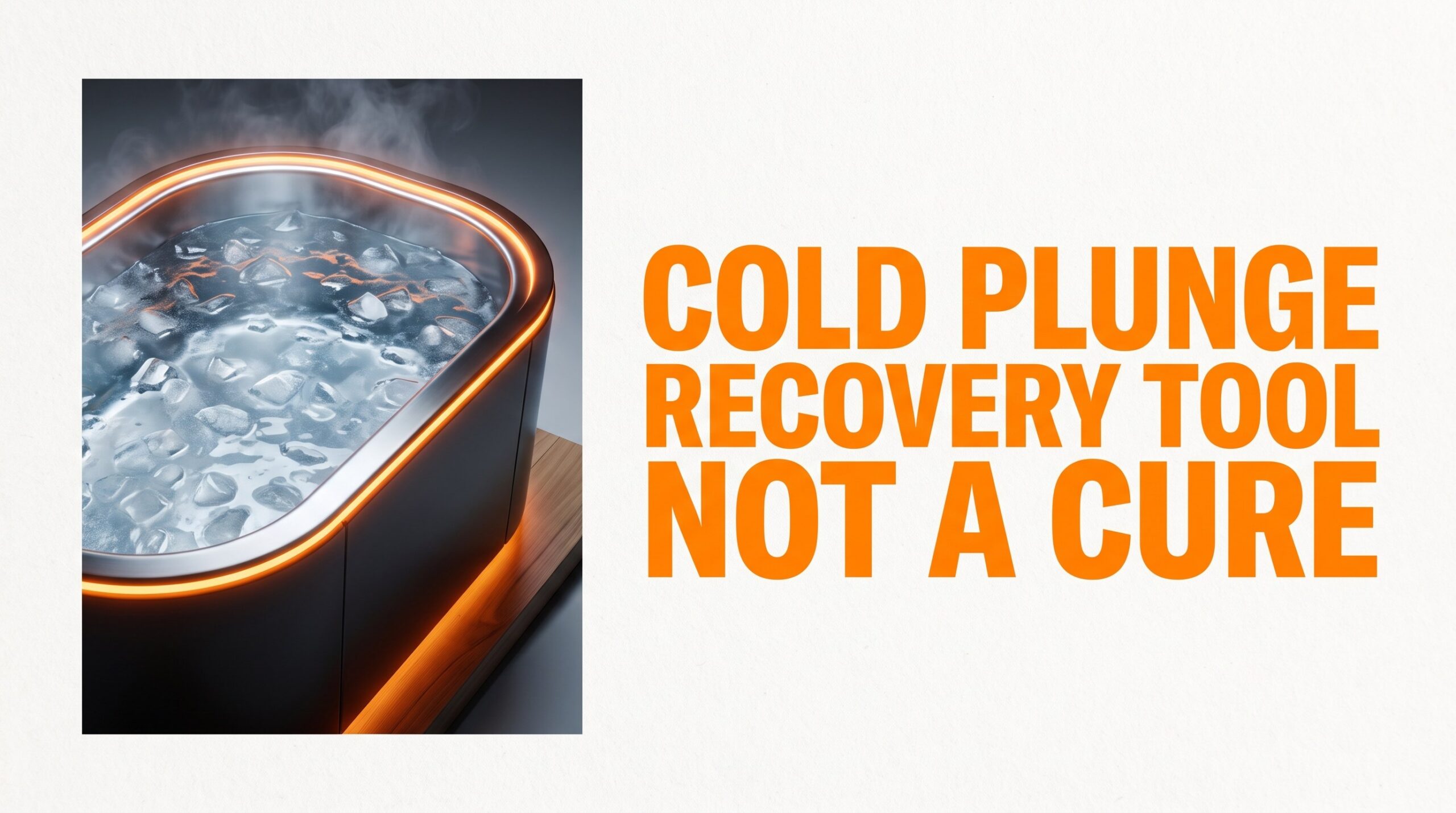
Cold-water immersion means getting a large share of your body into water cold enough to stress you on purpose. Research papers often talk about temperatures under about 15°C. A backyard tub, a commercial plunge, a lake, or a carefully run shower all sit in the same family. Same idea. Different risk profiles.
People chase three stories. Recovery after hard training. Mood and toughness theater. Metabolic / brown-fat hype. Only the first has a clean sports-medicine evidence trail for most civilian readers. The others need tighter confidence framing.
How sure should you be on the definition? Extremely sure. Cold water is a physical stimulus. Marketing is optional.
Why this matters: once you see plunge as a dose of cold stress, you stop treating every viral clip like a protocol.
So what for you: decide whether you want recovery help, contrast fun next to heat, or neither — before you buy a tub.
The stop-you number (and how sure to be)
Bleakley and colleagues ran a Cochrane review on cold-water immersion for muscle soreness after exercise. Seventeen small trials. Three hundred sixty-six people. Study quality was low. Protocols varied. Still, pooled results favored cold-water immersion over passive rest for soreness at 24 hours (SMD about −0.55), 48 hours (about −0.66), 72 hours (about −0.93), and 96 hours (about −0.58).
That is the stop-you frame. Not because ice is magic. Because the best-known systematic review in this lane still found a real, if messy, edge versus doing nothing for next-day ache.
Machado’s later dose-response meta-analysis pointed toward a practical window many coaches still echo: water roughly 11–15°C and immersions around 11–15 minutes when the goal is soreness management versus passive recovery. Xiao’s 2023 meta-analysis across twenty studies also saw drops in soreness and some fatigue markers, with the usual caveat that methods differ hard across labs.
How sure should you be? Fairly sure cold can blunt soreness versus passive rest in short-term sports settings. Less sure it is the best recovery tool for every athlete every week. Even less sure that a two-minute Instagram dunk equals a trial protocol. And not sure at all that cold cures disease.
Why this matters: the evidence tier is Cochrane-plus-meta for soreness — not a randomized “cold plunge erases aging” drug trial.
So what for you: use cold as an optional recovery lever after hard sessions when sore legs are the problem. Do not draft it as your entire health plan.
Cold shock is not a personality test
The first seconds matter more than the brand of tub. Cold shock can spike heart rate, drive gasping, and raise drowning risk if your airway is near water you cannot control. Tipton’s drowning-physiology work still frames immersion and submersion as different problems with overlapping autonomic chaos.
Good news for adults who train the stimulus carefully: a 2024 systematic review and meta-analysis on cold-shock habituation found the scary scramble often quiets after roughly four repeated immersions, with study-to-study variation. Habituation is real. It is not immortality.
Espeland’s 2022 review of voluntary cold exposure called the broader health story what it is: a continuing debate. Small groups. Mixed methods. Winter swimmers may already be a healthier self-selected crowd. Do not paste their biomarkers onto your first panic dunk.
Why this matters: confusing toughness with airway control is how people get hurt.
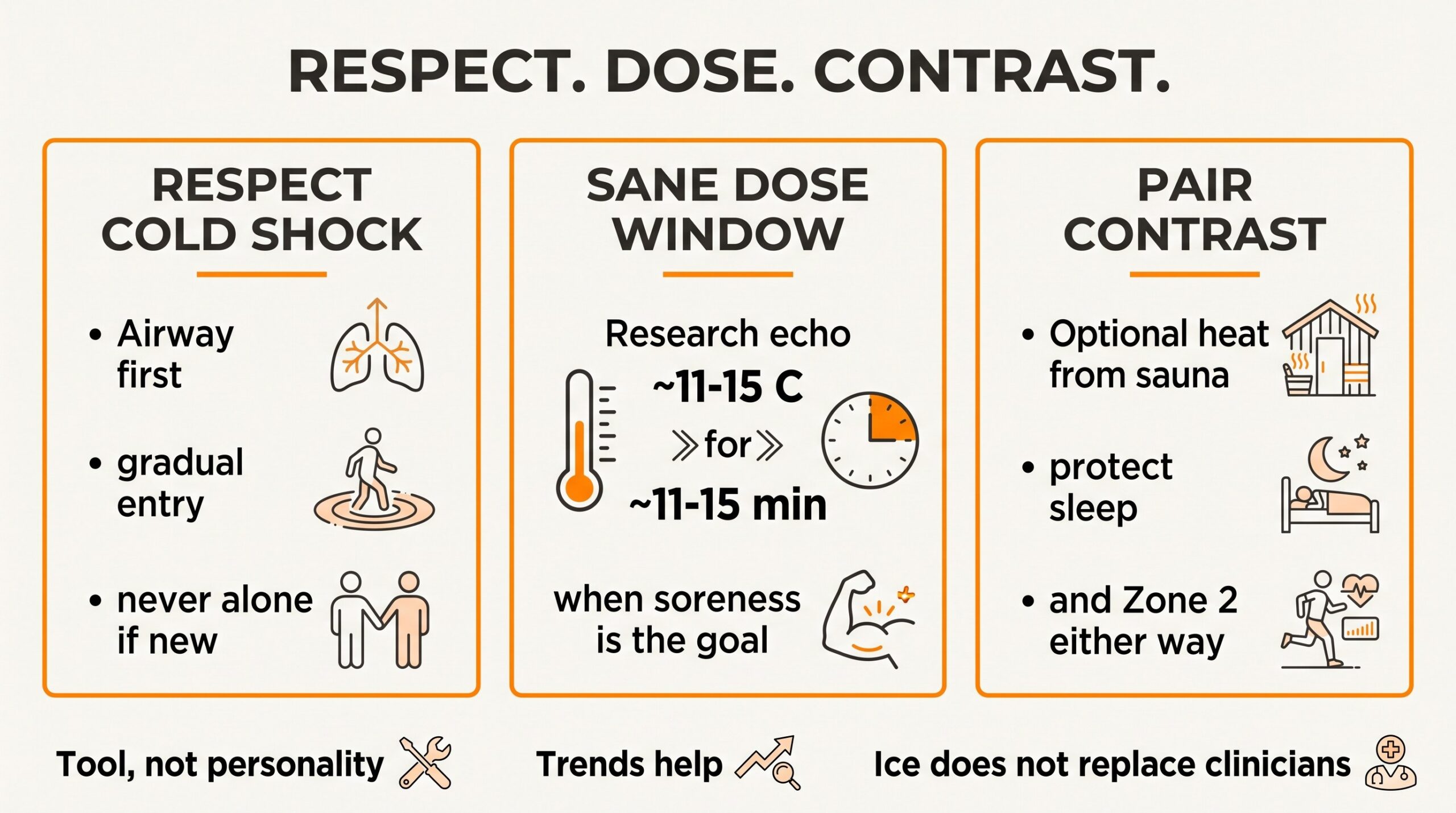
So what for you: enter gradually, keep your mouth above water you trust, never plunge alone if you are new, and abort if rhythm or breathing feels wrong.
The fire-drill analogy (one picture)
Here is the mechanism picture I want stuck in your head.
Your nervous system runs push and brake. Cold is a fire alarm. Alarms are useful when they are rare, brief, and followed by a return to baseline. Pull the alarm every hour and you do not get braver. You get fried.
After hard lifting or dense team sport, some athletes use that alarm as a circuit breaker on next-day soreness. After easy Zone 2 or skill work, you may not need the alarm at all. Context first. Tub second.
Why this matters: if you understand the fire drill, you stop hunting for a vial that “replaces cold” and start picking when cold is even the right stress.
So what for you: schedule cold like a tool. Do not collect suffering as a hobby.
How to think about a sane cold session
Education map. Not a prescription. Not a cardiac order set.
- Clear the obvious risk flags with a clinician when they apply. Heart history, blood-pressure chaos, pregnancy questions, seizure risk, panic in water — those are not influencer problems.
- Start shorter and warmer than the internet. Research windows often sit colder and longer than a first civilian dunk. Earn the dose.
- When soreness is the goal, remember the Machado-style window as a research echo: roughly 11–15°C and around 11–15 minutes shows up in dose-response pooling. Your tub thermometer and your tolerance both matter.
- Time it after the session you are recovering from if next-day ache is the target. Do not drop into ice right before you need peak power if explosive output still matters that day.
- Pair with heat as contrast if you already sauna. Contrast is a rhythm, not a religion. See sauna benefits.
- Protect sleep and easy aerobic base anyway. Cold does not excuse alcohol, late screens, or skipping Zone 2. Watch recovery trends on HRV without turning the ring into a judge.
Higgins and colleagues looked at cold-water immersion and contrast water therapy in team-sport recovery. Hydrotherapy can help some readiness markers in that world. It is still not a license to ignore programming, food, or sleep.
Why this matters: the process around the tub beats the tub brand.
So what for you: earn a boring, repeatable cold habit — or skip it and keep training.
Myths that waste your week
- “Cold plunge cures depression / autoimmunity / aging.” Hard no on this page. Mood anecdotes exist. Disease-cure claims do not clear the bar here.
- “Colder and longer is always better.” Dose-response work argues for a middle window on soreness. Macho extremes raise risk without proving virtue.
- “If I gasp, I should push through underwater.” No. Airway first. Always.
- “I need a peptide for cold adaptation.” Hard no. Cold is a physics stimulus. Research maps are adjacent literacy after foundations.
- “Contrast therapy means punish yourself in both directions.” Contrast is optional pairing with heat. It is not a dare.
Why this matters: bad myths either scare people away from a useful tool or shove them into unsafe cosplay.
So what for you: keep the tool. Drop the slogan.
Foundations that sit beside cold
Peptides & Pump is a peptide education site. Cold plunge is still a recovery-literacy foundation.
Soft links worth your time:
- Sauna benefits — heat sibling and contrast partner
- HRV — autonomic recovery signal without DIY diagnosis
- Zone 2 training and VO2 max — the engine cold cannot replace
- How to sleep better — still the biggest civilian recovery lever
- Protein intake and creatine benefits — training support, not cold drugs
- MOTS-c / SS-31 / NAD+ — mitochondrial research maps only; never a cold prescription
Hard line: this page will never say “inject peptide X to replace your cold plunge.” Earn the recovery. Read research maps later if you are curious.
Why this matters: foundation stacking beats catalog cosplay for recovery outcomes.
So what for you: protect sleep, easy base, and sane stress before you chase a mitochondrial SKU.
Evidence limits
Most recovery trials are small. Protocols vary on temperature, depth, timing, and what “trained” means. Cochrane found an effect versus passive rest and still called study quality low. Broader health claims for voluntary cold sit in Espeland’s “continuing debate” bucket. Cold shock and drowning physiology are not optional footnotes.
This page does not claim cold plunge cures depression, replaces cardiac care, burns meaningful fat for lean people by itself, or justifies unsupervised ice after a warning from your clinician.
Why this matters: confidence framing protects your week and your risk file.
So what for you: use cold when the recovery case is clear, keep a clinician in the loop when risk is not simple, and treat influencer ice absolutism as entertainment.
Sources & Further Reading
- Bleakley C, et al. Cold-water immersion (cryotherapy) for preventing and treating muscle soreness after exercise. Cochrane Database Syst Rev. 2012. PubMed 22336838
- Machado AF, et al. Can water temperature and immersion time influence the effect of cold water immersion on muscle soreness? A systematic review and meta-analysis. Sports Med. 2016. PubMed 26581833
- Xiao F, et al. Effects of cold water immersion after exercise on fatigue recovery and exercise performance — meta analysis. Front Physiol. 2023. PubMed 36744038
- Espeland D, et al. Health effects of voluntary exposure to cold water — a continuing subject of debate. Int J Circumpolar Health. 2022. PubMed 36137565
- Habituation of the cold shock response: a systematic review and meta-analysis. J Therm Biol. 2024. PubMed 38211547
- Bierens JJLM, Lunetta P, Tipton M, Warner DS. Physiology of drowning: a review. Physiology (Bethesda). 2016. PubMed 26889019
- Higgins TR, Greene DA, Baker MK. Effects of cold water immersion and contrast water therapy for recovery from team sport: a systematic review and meta-analysis. J Strength Cond Res. 2017. PubMed 27398915
- Laukkanen T, et al. Association between sauna bathing and fatal cardiovascular and all-cause mortality events. JAMA Intern Med. 2015. PubMed 25705824 (heat sibling / contrast context)
- Laukkanen JA, Laukkanen T, Kunutsor SK. Cardiovascular and other health benefits of sauna bathing: a review of the evidence. Mayo Clin Proc. 2018. PubMed 30077204
The bottom line
Cold plunge is a fire drill with a real soreness signal in sports meta-analyses and a real risk file if you disrespect cold shock. Use a sane dose when next-day ache is the problem. Pair heat if contrast fits your life. Protect sleep and easy aerobic base either way.
It is not a youth drug. It is not a disease clinic. It is not a peptide indication.
Related research maps (after the recovery base is handled)
Cold first when it earns a slot. Sleep, training distribution, heat, and honest recovery beat any catalog. When foundation is already moving — sleep, Zone 2, sauna/contrast literacy — some readers want adjacent research literacy on mitochondrial peptide maps. That is curiosity after the work, not a shortcut around it.
Hard line: these are research-catalog options next to the recovery map. They are not “peptides that replace cold plunge,” not a toughness drug stack, and not a reason to skip a clinician when risk is not simple.
Start with the maps: MOTS-c, SS-31, NAD+. Partner vials below are for readers who already earned the base and still want the research SKU conversation.
Research-catalog SKUs currently live on partner audits (not a treatment recommendation).
 Limitless
MOTS-C
LEE20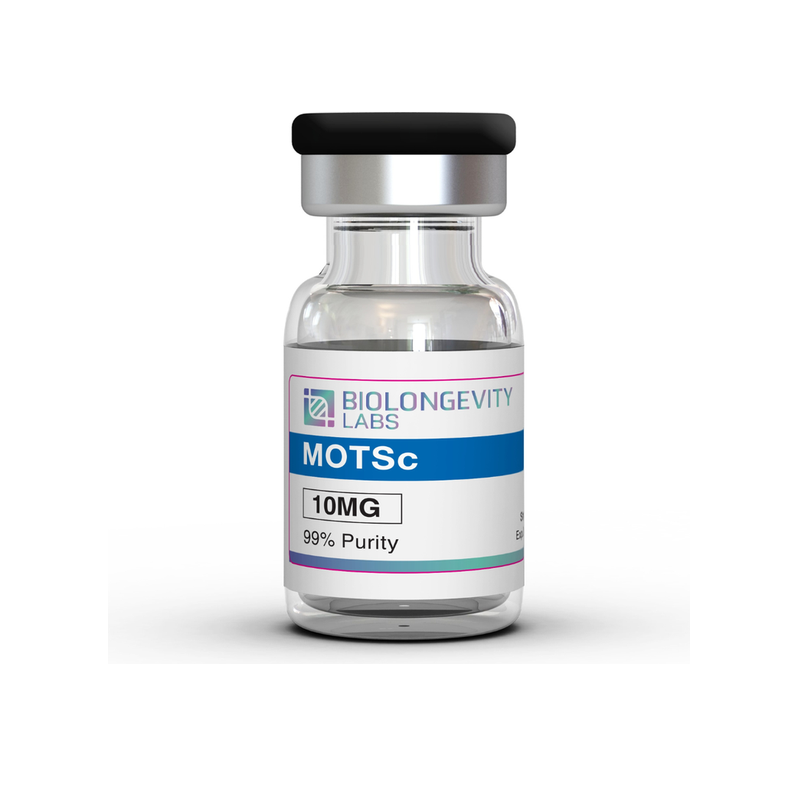 BioLongevity
MOTS-c 10 mg
LEE15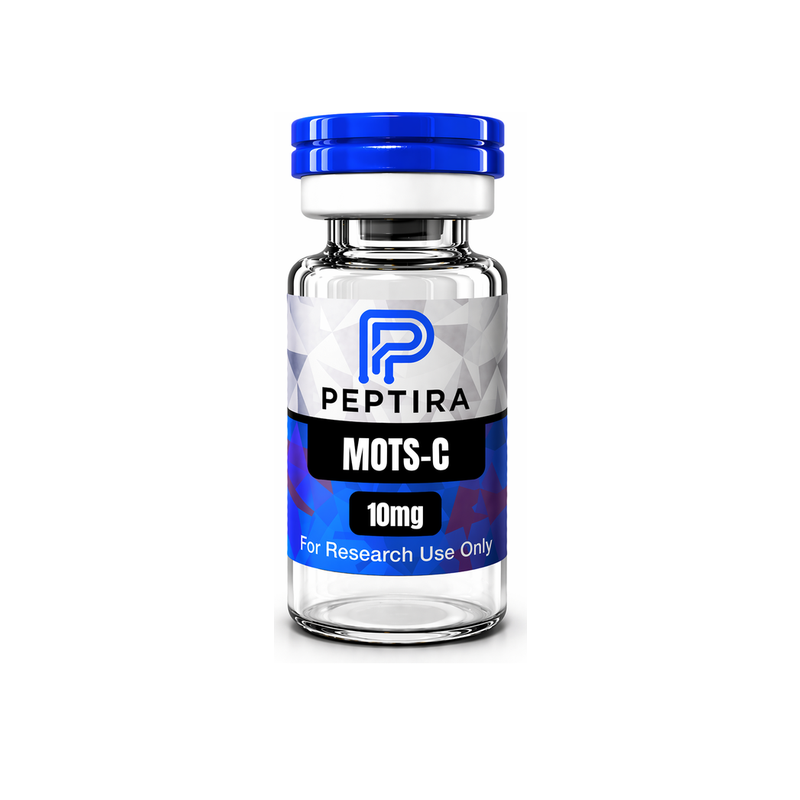 Peptira
MOTS-C 10 mg
LEE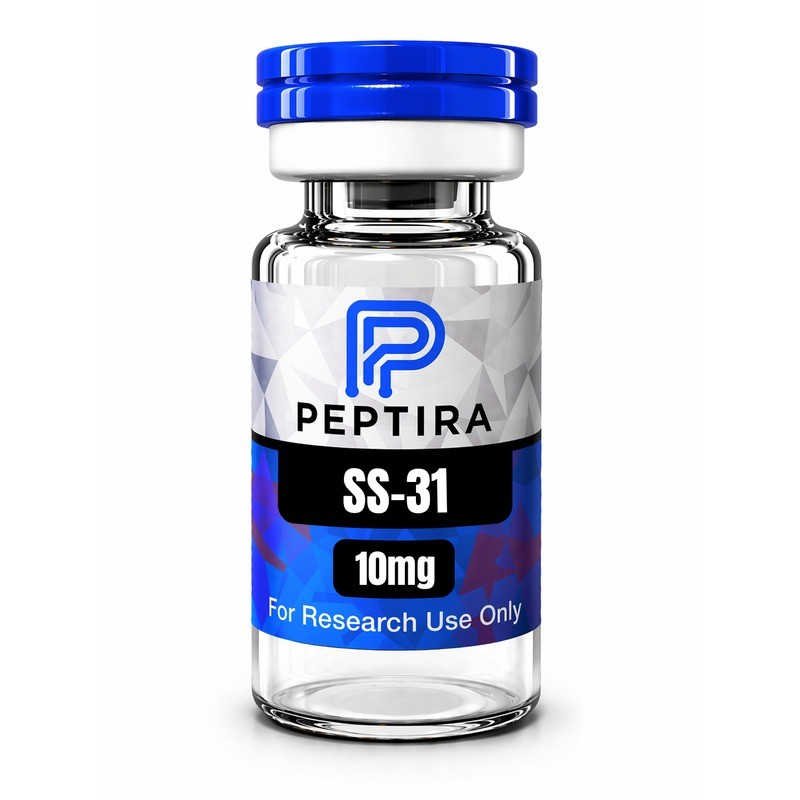 Peptira
SS-31 10 mg
LEE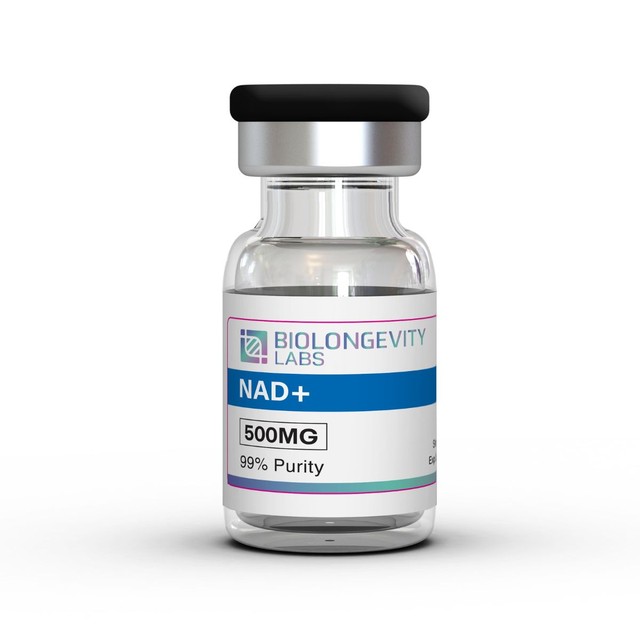 BioLongevity
NAD+ 500 mg
LEE15 Peptira
NAD+ 500 mg
LEEMatch the map to the curiosity. Do not collect bottles to “unlock” toughness. Earn the recovery first.
Want deeper protocol libraries after foundations are handled? Pro is the paid door. Want the free research PDF? Grab the Playbook below.
Free guide
Get The Peptide PlaybookEnter your email and we’ll send the research PDF. Education only — not medical advice.
I built Peptides & Pump so you can get foundation education without a guru tax. Cold plunge is one of those foundations. Free Knowledge Base first if you are not ready to pay. Pro if you want the protocol library after the basics are handled.
Related reads: What are peptides · Sauna benefits · HRV · Zone 2 training · VO2 max · How to sleep better · MOTS-c · SS-31 · NAD+