 PEPTIDES & PUMP
Menu
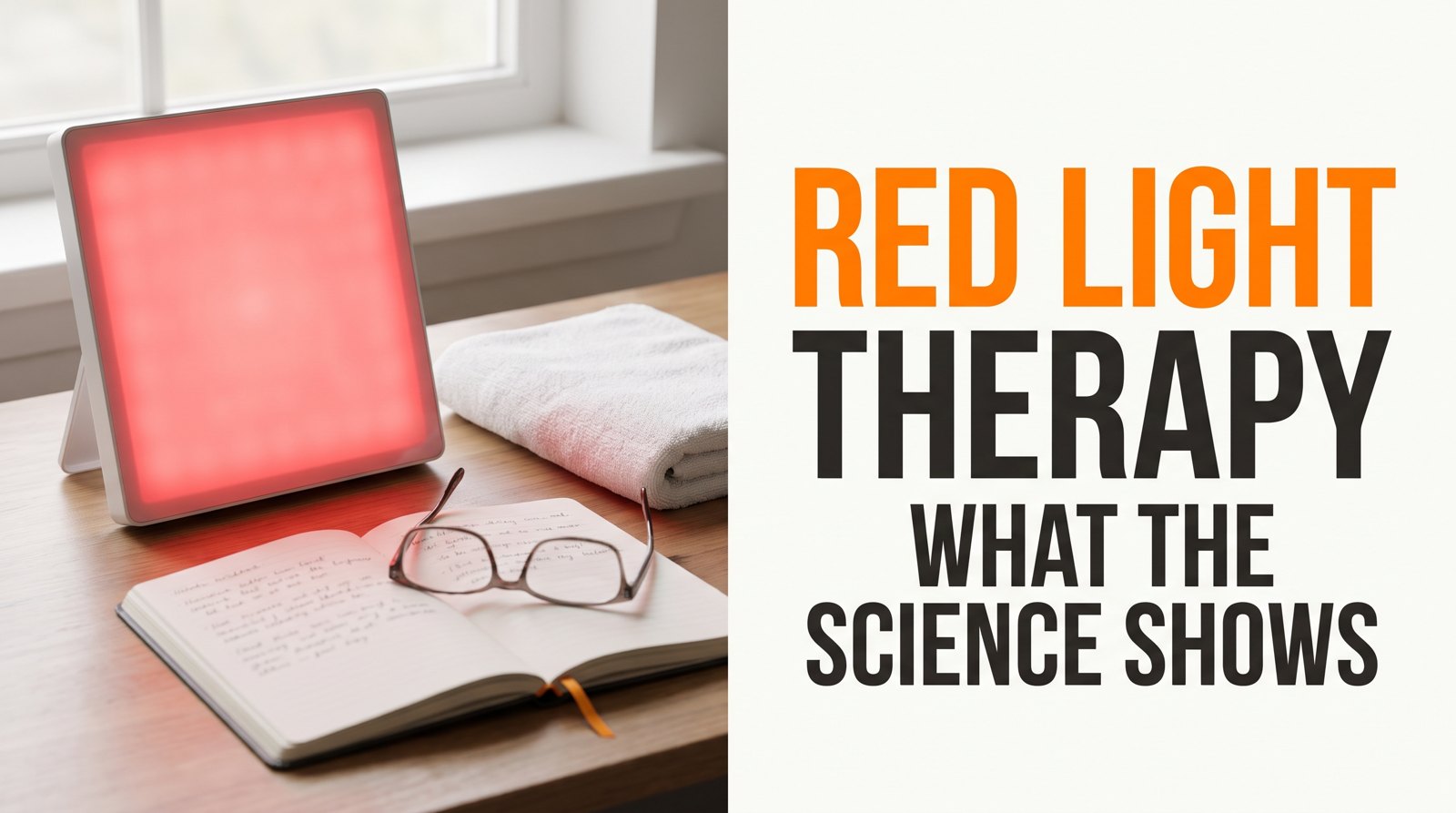
Red Light Therapy: Benefits, Risks, and What the Science Really Shows
Red light therapy is not magic, and it is not a scam. Light at certain colors can change how cells behave. What trials show for hair, skin, pain and cancer-care uses, and where the data stops.

Peptide Insider Free email + the Peptide Playbook PDF.Get it free
Education only. Not medical advice. Unsubscribe anytime.
Research education, not medical advice. Talk with a licensed clinician before you act on anything here.
Red light therapy is not magic, and it is not a scam.
Light at certain colors does change how cells behave. That has been studied for more than 50 years. Some uses have solid trials. Others are still mostly marketing.
Here’s what the studies found, and where the data stops, before you spend money on a panel.
Key takeaways
- Verdict: Red light therapy is real science with real limits. It has fair evidence for a few things and weak evidence for most of what social media promises.
- Best support: pattern hair loss (sham-controlled trials), neck pain and knee arthritis pain (meta-analyses), and preventing mouth sores in some cancer care (a guideline).
- Middle: skin wrinkles and texture, and workout performance. Small or mixed studies.
- Weak: sleep, fat loss, hormones, and “detox.” Little or no good human data.
- Main risk: your eyes. Never stare into the light. Education only. Not medical advice.
What people ask us about red light therapy
Paraphrased from the kinds of questions people bring to our community. These are anecdotes, not data.
- “Does it actually work for hair or skin?”
- “Can it help workouts or recovery?”
- “Is a home panel the same as a clinic device?”
Straight answers below. No bro-science, no hype. Every study is linked at the bottom so you can check me.
Verdict up front: Red light therapy is not magic, and it is not a scam. Light at certain colors does change how cells behave. That has been studied for more than 50 years. Some uses have solid trials behind them. Many of the claims you see in ads do not. This page sorts the strong from the weak, with a receipt for each claim.
Why this matters: home panels, masks, and helmets are everywhere now, and some cost a lot. Before you spend money and time, know what the studies found and where the data stops.
Keep reading for the plain-English version first and the doctor-level details in gray boxes. New here? Our Start Here page explains how this site works. Into recovery habits? Red light sits next to sauna, cold plunge, and Zone 2 training on our map.
A note on who is writing this: I am a researcher sharing what the published science says. I am not a doctor, and this is not medical advice. Every number below comes from a PubMed record or an FDA database, linked in the sources.
What people are asking about red light
The same questions come up again and again in our community and in Reddit threads about red light panels. These are paraphrased, not quotes. They are anecdotes about what people want to know, not data:
- “I bought a panel. Is it doing anything, or is it just a warm glow?”
- “Can red light regrow my hairline?”
- “Will it fix my wrinkles, or should I just use a serum?”
- “Someone said it raises testosterone and helps sleep. True?”
- “How close, how long, and is it safe for my eyes?”
Fair questions. Each one gets an answer below, with the receipt.
What is red light therapy?
Red light therapy means shining low-power red or near-infrared light on your skin from LEDs or low-power lasers. It does not burn or cut. It is not a tanning bed (UV light) or a sauna (heat).
Scientists now call it photobiomodulation, or PBM. Older papers call it low-level laser therapy, or LLLT. Same idea, different name.
Two kinds of light show up in the studies:
- Red light. You can see it. Many trials on this page used light around 630 to 670 nanometers (nm), a unit for the color of light.
- Near-infrared light. Just past what your eyes can see. Many trials used around 800 to 900 nm. It tends to reach a bit deeper into tissue.
A 1960s accident that started it all
The story starts in Hungary. Lasers were brand new. In 1968, a surgical team led by E. Mester published a German-language paper on how laser beams affected hair growth in mice (Mester 1968). That team went on to study laser light on wound healing, including a 1971 paper in the American Journal of Surgery (Mester 1971).
The next big chapter came from Russia. T. Karu, at a laser research center of the Russian Academy of Sciences, spent years asking a simple question: what in a cell actually absorbs this light? Her answer pointed to an enzyme in the mitochondria called cytochrome c oxidase (Karu 1999; Karu 2010).
Think of mitochondria as the power plants in your cells. Karu’s work suggested red and near-infrared light can nudge one of the plant’s machines, which then sets off a chain of signals inside the cell.
For the clinicians reading
Karu (1999) reviewed four candidate primary mechanisms with cytochrome c oxidase as the putative photoacceptor: altered redox state of respiratory chain components, singlet oxygen generation, localized transient heating of chromophores, and increased superoxide with downstream H2O2. Secondary signaling includes changes in pHi, [Ca2+]i, cAMP, and ATP (PMID 10365442). Hamblin (2017) adds light-sensitive calcium ion channels as a second chromophore class, with a brief ROS burst, nitric oxide release, and transcription factor activation. In oxidatively stressed cells, ROS fall and inflammatory markers decrease (PMID 28748217). Most of this mechanism work is in vitro and animal.
The dose problem: more is not better
Here is a part most ads skip. Light therapy seems to follow a curve. A little light can help cells. A lot more light can do nothing, or even hold cells back. Scientists call this a biphasic dose response, and some use an old name for it, the Arndt-Schulz curve (Huang 2009).
That review was honest. It said the treatment “remains controversial in mainstream medicine,” partly because there are so many settings to choose: color, power, time, and how often. So when a friend says red light “did nothing” or “changed my life,” they may have used very different doses.
What this means for you
Longer and closer is not automatically better. Most of the positive trials used set times, set distances, and a few sessions a week, not hours a day. If you own a device, follow its instructions rather than guessing. And treat any study result as true only for the settings that study used.
Hair: the strongest consumer use
Pattern hair loss, the common kind tied to genes and hormones, is where red light has its best home-device evidence.
In a 2009 trial, men with pattern hair loss used a handheld laser comb at 655 nm or a look-alike sham device for 26 weeks. Of the 110 men who finished, the real device group had a much bigger rise in hair density than the sham group (Leavitt 2009).
A larger set of four trials in 2014 tested laser combs in men and women (Jimenez 2014). After 26 weeks, the number of thick (terminal) hairs per square centimeter went up by about 18 to 26 in the laser groups. In the sham groups, the rise was about 2 to 9. No serious side effects were reported.
Two more trials used a helmet with red lasers and LEDs at 655 nm, every other day for 16 weeks. Men had a 39% bigger rise in hair counts than placebo (Lanzafame 2013). Women had a 37% bigger rise (Lanzafame 2014).
The FDA cleared the HairMax LaserComb in January 2007 (510(k) K060305). The FDA’s device class for laser hair combs describes the use as promoting hair growth in men with pattern hair loss, Norwood-Hamilton classes IIa to V. Many more devices have been cleared since.
For the clinicians reading
Jimenez 2014: four RCTs, 269 randomized (128 male, 141 female), lasercomb 7, 9, or 12 beams vs sham, whole scalp 3x/week for 26 weeks. Efficacy analysis n=225. Mean terminal hair change at 26 weeks: +20.2, +20.6 (female 9- and 12-beam), +18.4, +20.9, +25.7 per cm2 (male 7-, 9-, 12-beam) vs sham +2.8, +3.0, +1.6, +9.4, +9.4 (p from <0.0001 to 0.0249). Lanzafame 2013 (n=41 completers) and 2014 (n=42) used a 655 nm helmet, 25 min every other day x 16 weeks. Small samples. Note: FDA 510(k) clearance (product code OAP, class II, 21 CFR 890.5500) is substantial equivalence, not PMA approval.
What this means for you
If your hair is thinning, red light is one of the few home options with sham-controlled trials. It is slow (months) and needs a schedule. See a dermatologist first to learn what kind of hair loss you have. For the peptide side of this topic, see peptides for hair growth.
Skin: wrinkles, texture, and collagen
This is the claim behind most LED masks. The evidence is real but small.
In a 2007 study from Korea, 76 people with facial wrinkles got LED light on one side of the face only, twice a week for four weeks (Lee 2007). Groups got 830 nm, 633 nm, both, or a sham light. In the three real-light groups, measured wrinkles fell by up to 36% and skin elasticity rose by up to 19%, compared with where people started. Skin samples showed more collagen and elastic fibers. No side effects were reported.
A 2014 trial in Germany had 136 people (Wunsch 2014). The 113 treated people got red light or a red-to-near-infrared mix, twice a week for 30 sessions. Compared with 23 untreated people, they had better complexion, less roughness, and more collagen on ultrasound. The wider mix did not beat red alone.
A Harvard review called this light helpful for wrinkles, acne scars, and some scar healing, and urged more testing (Avci 2013).
What this means for you
Red light may soften fine lines a little over weeks. It will not replace sunscreen or sleep. Note: the Korean “36%” was compared with the start, not with the sham group. Our peptides for skin and copper peptides pages cover the other half of the skin story.
Pain: neck and knees
Pain is where the clinical research is deepest, mostly with low-power lasers used by therapists.
A 2009 review in The Lancet pooled 16 randomized trials with 820 people who had neck pain (Chow 2009). Across 11 trials that scored pain on a 100-point scale, laser therapy cut pain by about 20 points more than the comparison. In chronic neck pain, relief lasted up to 22 weeks after treatment. Side effects were mild and no different from placebo.
A 2019 review pooled 22 placebo-controlled trials with 1,063 people with knee arthritis (Stausholm 2019). Laser therapy lowered pain by about 14 points on a 100-point scale more than placebo at the end of treatment. At the recommended doses, the gap was about 19 points. The review also pointed out that major knee arthritis guidelines do not recommend laser therapy.
For the clinicians reading
Chow 2009 (Lancet): 16 RCTs, n=820. Acute neck pain RR for improvement 1.69 (95% CI 1.22-2.33) vs placebo (2 trials). Chronic neck pain RR 4.05 (2.74-5.98) (5 trials); VAS reduction 19.86 mm (10.04-29.68) across 11 trials; 22.07 mm (17.42-26.72) at 1-22 weeks follow-up (7 trials). Stausholm 2019 (BMJ Open): 22 RCTs, n=1,063; VAS -14.23 mm (7.31-21.14) at end of therapy; WALT-recommended doses -18.71 mm (9.42-27.99), peaking at 31.87 mm 2-4 weeks after therapy. Effective doses 4-8 J at 785-860 nm or 1-3 J at 904 nm per spot. Two authors are former WALT board members (declared). Clinic laser protocols do not map onto consumer LED panels.
What this means for you
These were mostly clinic lasers aimed at exact spots, not a bedroom panel. For chronic pain, ask a physical therapist, and keep doing the strength work. Our peptides for healing page covers what people ask about the injury side.
Cancer care: the most “medical” use
Some cancer treatments cause painful mouth sores called oral mucositis. The cancer care groups MASCC and ISOO reviewed the evidence in 2019 (Zadik 2019). They recommend light therapy to help prevent these sores in people having a stem cell transplant or head and neck radiation, using specific set protocols. They found the evidence too weak to make a guideline for treating sores that are already there.
Workouts and recovery
Athletes love the idea of light before training. A 2015 review pooled 13 good-quality trials (Leal-Junior 2015). Light used before exercise added about 5.5 more reps and about 4 more seconds before exhaustion compared with placebo. Results were most consistent when light was used before, not after, the workout.
A bigger 2018 review of 39 trials (861 people) found some benefit for reps, time to exhaustion, and strength, but rated the quality of evidence as “very low to moderate” (Vanin 2018). The studies were small and used very different settings.
What this means for you
A few extra reps in a lab is not a better season. For recovery, sleep, protein, and smart training do far more. See protein intake, creatine, and HRV for the basics that move the needle.
Sleep, fat loss, and hormones: the weak zone
Sleep. One 2012 study gave 20 female basketball players 30 minutes of red light every night for 14 days, or no light (Zhao 2012). The light group had better sleep scores and higher melatonin. But it was tiny, and the comparison group got no light at all. That is a hint, not proof. Our how to sleep better and peptides for sleep pages cover what actually has data.
Fat loss, testosterone, and “detox.” We did not find good human trials that support these claims for home red light panels. If someone sells you a panel for these reasons, ask for the study. Our peptides for fat loss page explains why weight claims need big, long trials.
Safety: what can go wrong
In the trials above, side effects were rare and mild. A few real risks still stand out.
- Eyes. This is the big one. Eye doctors in China have tested a low-power red light device to slow nearsightedness in kids. A 2022 trial in 264 children found it slowed eye growth a lot over a year with no serious harm seen (Jiang 2022). But in 2023, doctors reported retinal damage in a 12-year-old girl after repeated red-light laser use (Liu 2023). The lesson: light aimed at the eye is a medical treatment, not a wellness hack. Wear eye protection and do not stare into panels.
- Light-sensitive drugs. Some medicines make skin more sensitive to light. Check with your clinician or pharmacist.
- Heat. Strong panels used too close can feel hot. Red light is not meant to burn.
- Cancer worry. A 2023 review found no clinical trial data linking skin light therapy to new or returning cancer (Glass 2023). That review covered set skin-care settings. If you have had skin cancer, ask your doctor first.
For the clinicians reading
Jiang 2022 (Ophthalmology): n=264, age 8-13, 650 nm desktop device, ~1600 lux, 0.29 mW for a 4-mm pupil, 3 min twice daily 5 days/week; 12-month axial elongation 0.13 mm vs 0.38 mm (difference 0.26 mm, 95% CI 0.20-0.31). No severe adverse events on BCVA or OCT. Liu 2023 (JAMA Ophthalmol) is a single case report of retinal damage after repeated low-level red-light laser exposure. Glass 2023 concludes PBM appears oncologically safe for skin rejuvenation within established parameters. In vivo tumor models were mixed.
How to think about home devices
We do not give device protocols. But read the market with clear eyes. FDA “clearance” means a device is similar to one already sold, not that every claim on the box works. A study result applies to its own color, dose, and schedule. And sleep, protein, training, and sunscreen beat any gadget. Light is a side dish.
Where peptides fit (and where they do not)
People who like red light often ask about GHK-Cu, a copper peptide studied for skin and hair. Lab and gene data suggest GHK-Cu boosts collagen and elastin and supports skin repair (Pickart 2018). That is a separate research lane from light. No study we found has tested red light plus GHK-Cu together in people. If you see a “stack” claim, it is a guess, not data.
Research-use GHK-Cu vials are not approved for human use. Topical copper-peptide serums are a different product type. Read our GHK-Cu, GLOW, and how to spot fake peptides pages before you buy anything, and see peptide side effects for the risk side.
What we still do not know
- There is no agreed dose for most uses.
- Few trials tested popular full-body home panels.
- Most trials ran weeks to months, not years.
- Many hair trials tested one brand’s device.
FAQ
Does red light therapy actually work?
For some uses, yes, with fair evidence. Sham-controlled trials found more hair in pattern hair loss, and reviews found less pain in neck pain and knee arthritis. A cancer care group recommends it to help prevent mouth sores in some cancer treatments. For many other claims, the data is thin or missing.
What is the difference between red light and near-infrared light?
Red light is visible and sits around 630 to 670 nanometers in many of the trials on this page. Near-infrared is just past what your eyes can see, around 800 to 900 nanometers in many trials. Near-infrared tends to reach a little deeper. Both are used in what scientists call photobiomodulation.
Is red light therapy FDA-approved?
Some devices are FDA-cleared, which is not the same as approved. Clearance means a device is similar enough to one already sold. The HairMax LaserComb was cleared in 2007 for hair growth in men with pattern hair loss. Clearance covers one device and use, not red light in general.
Can red light therapy help with wrinkles?
Small controlled studies say it may help a bit. In one split-face study, LED light at 633 and 830 nanometers reduced wrinkles compared with baseline. In another trial with 136 people, red light improved skin roughness and collagen density compared with an untreated group. These were short studies, and results were modest.
Is red light therapy safe?
In trials it has had few side effects. The main risk is to the eyes. Doctors reported retinal damage in a 12-year-old after repeated red-light laser use. Do not stare into the light, and ask a doctor first if you have an eye condition or take light-sensitizing drugs.
Does red light therapy help sleep?
The evidence is very thin. One study of 20 female basketball players found better sleep scores after 14 nights of red light, but the comparison group got no light at all. That is not strong proof.
Should I use red light therapy with GHK-Cu?
No study has tested red light plus GHK-Cu together in people, so we do not know. They are two separate research topics that both touch skin repair. Research-use GHK-Cu vials are not approved for human use.
The bottom line
Red light therapy has a real science story, from Mester’s lab in Hungary to Karu’s mitochondria work in Russia to modern trials. It has fair evidence for pattern hair loss, some kinds of pain, and preventing mouth sores in certain cancer care. Skin and workout results are modest. Sleep, fat loss, and hormone claims are mostly hope. Protect your eyes, match the study settings, and keep the basics first.
The short version, one more time
- Best evidence: hair loss, neck and knee pain, and mouth sore prevention in some cancer care.
- Modest evidence: wrinkles, skin texture, and workout reps.
- Weak evidence: sleep, fat loss, testosterone, detox.
- More light is not always better. Protect your eyes. FDA-cleared is not FDA-approved.
Related reads: Sauna benefits · Cold plunge · Zone 2 training · VO2 max · HRV · How to sleep better · GHK-Cu · Copper peptides · Peptides for skin · Peptides for hair growth · KLOW · What are peptides · Start Here · Community
Sellers we work with
Disclosure: these are affiliate links. We may earn a commission at no extra cost to you. We do not sell light devices. Listing a product does not mean it is safe, effective, or approved for human use. Products sold for research are not for human consumption. Always check the COA for your own batch.
Skin-lane copper peptides (in stock when checked)
BioLongevity Labs
GHK-Cu 50mg
The copper peptide behind most skin-repair research. Batch COA on the page.
View GHK-Cu (research use) code LEE15 auto-applies
BioLongevity Labs
GLOW Blend
GHK-Cu with BPC-157 and TB-500 in one research vial.
View GLOW (research use) code LEE15 auto-applies
Paramount Peptides
GHK-Cu 50mg
Second GHK-Cu source. Match the COA to your batch.
View GHK-Cu (research use) my link, no code needed
Paramount Peptides
Cu GLOW Serum
A topical copper-peptide serum, not an injectable vial.
View Cu (research use) my link, no code needed
BioLongevity Labs
Full research catalog with batch COAs on product pages.
BioLongevity home code LEE15
Paramount Peptides
Research catalog. Check the COA and batch number before you order.
Paramount home my link, no code needed
Limitless Biotech
Their catalog needs a quick research-access sign-up before prices show. Use code LEE20 at checkout.
Shopping for research vials? See where to buy GHK-Cu: four labs compared on sizes, COAs and codes, plus the listing with no copper in it.
Primary sources
We link the original study or document, not a summary.
- PubMedMester E, Szende B, Gärtner P. [The effect of laser beams on the growth of hair in mice]. Radiobiol Radiother (Berl). 1968;9(5):621-6. [Article in German] PMID: 5732466
- PubMedMester E, Spiry T, Szende B, Tota JG. Effect of laser rays on wound healing. Am J Surg. 1971;122(4):532-5. PMID: 5098661
- PubMedKaru T. Primary and secondary mechanisms of action of visible to near-IR radiation on cells. J Photochem Photobiol B. 1999;49(1):1-17. PMID: 10365442
- PubMedKaru TI. Multiple roles of cytochrome c oxidase in mammalian cells under action of red and IR-A radiation. IUBMB Life. 2010;62(8):607-10. PMID: 20681024
- PubMedHuang YY, Chen AC, Carroll JD, Hamblin MR. Biphasic dose response in low level light therapy. Dose Response. 2009;7(4):358-83. PMID: 20011653
- PubMedHamblin MR. Mechanisms and applications of the anti-inflammatory effects of photobiomodulation. AIMS Biophys. 2017;4(3):337-361. PMID: 28748217
- PubMedAvci P, Gupta A, Sadasivam M, et al. Low-level laser (light) therapy (LLLT) in skin: stimulating, healing, restoring. Semin Cutan Med Surg. 2013;32(1):41-52. PMID: 24049929
- PubMedLee SY, Park KH, Choi JW, et al. A prospective, randomized, placebo-controlled, double-blinded, and split-face clinical study on LED phototherapy for skin rejuvenation. J Photochem Photobiol B. 2007;88(1):51-67. PMID: 17566756
- PubMedWunsch A, Matuschka K. A controlled trial to determine the efficacy of red and near-infrared light treatment in patient satisfaction, reduction of fine lines, wrinkles, skin roughness, and intradermal collagen density increase. Photomed Laser Surg. 2014;32(2):93-100. PMID: 24286286
- PubMedLeavitt M, Charles G, Heyman E, Michaels D. HairMax LaserComb laser phototherapy device in the treatment of male androgenetic alopecia: a randomized, double-blind, sham device-controlled, multicentre trial. Clin Drug Investig. 2009;29(5):283-92. PMID: 19366270
- PubMedJimenez JJ, Wikramanayake TC, Bergfeld W, et al. Efficacy and safety of a low-level laser device in the treatment of male and female pattern hair loss: a multicenter, randomized, sham device-controlled, double-blind study. Am J Clin Dermatol. 2014;15(2):115-27. PMID: 24474647
- PubMedLanzafame RJ, Blanche RR, Bodian AB, et al. The growth of human scalp hair mediated by visible red light laser and LED sources in males. Lasers Surg Med. 2013;45(8):487-95. PMID: 24078483
- PubMedLanzafame RJ, Blanche RR, Chiacchierini RP, Kazmirek ER, Sklar JA. The growth of human scalp hair in females using visible red light laser and LED sources. Lasers Surg Med. 2014;46(8):601-7. PMID: 25124964
- PubMedChow RT, Johnson MI, Lopes-Martins RA, Bjordal JM. Efficacy of low-level laser therapy in the management of neck pain: a systematic review and meta-analysis of randomised placebo or active-treatment controlled trials. Lancet. 2009;374(9705):1897-908. PMID: 19913903
- PubMedStausholm MB, Naterstad IF, Joensen J, et al. Efficacy of low-level laser therapy on pain and disability in knee osteoarthritis: systematic review and meta-analysis of randomised placebo-controlled trials. BMJ Open. 2019;9(10):e031142. PMID: 31662383
- PubMedZadik Y, Arany PR, Fregnani ER, et al; MASCC/ISOO Mucositis Study Group. Systematic review of photobiomodulation for the management of oral mucositis in cancer patients and clinical practice guidelines. Support Care Cancer. 2019;27(10):3969-3983. PMID: 31286228
- PubMedLeal-Junior EC, Vanin AA, Miranda EF, et al. Effect of phototherapy (low-level laser therapy and light-emitting diode therapy) on exercise performance and markers of exercise recovery: a systematic review with meta-analysis. Lasers Med Sci. 2015;30(2):925-39. PMID: 24249354
- PubMedVanin AA, Verhagen E, Barboza SD, Costa LOP, Leal-Junior ECP. Photobiomodulation therapy for the improvement of muscular performance and reduction of muscular fatigue associated with exercise in healthy people: a systematic review and meta-analysis. Lasers Med Sci. 2018;33(1):181-214. PMID: 29090398
- PubMedZhao J, Tian Y, Nie J, Xu J, Liu D. Red light and the sleep quality and endurance performance of Chinese female basketball players. J Athl Train. 2012;47(6):673-8. PMID: 23182016
- PubMedJiang Y, Zhu Z, Tan X, et al. Effect of repeated low-level red-light therapy for myopia control in children: a multicenter randomized controlled trial. Ophthalmology. 2022;129(5):509-519. PMID: 34863776
- PubMedLiu H, Yang Y, Guo J, Peng J, Zhao P. Retinal damage after repeated low-level red-light laser exposure. JAMA Ophthalmol. 2023;141(7):693-695. PMID: 37227712
- PubMedGlass GE. Photobiomodulation: a systematic review of the oncologic safety of low-level light therapy for aesthetic skin rejuvenation. Aesthet Surg J. 2023;43(5):NP357-NP371. PMID: 36722207
- PubMedPickart L, Margolina A. Regenerative and protective actions of the GHK-Cu peptide in the light of the new gene data. Int J Mol Sci. 2018;19(7):1987. PMID: 29986520
- FDAU.S. FDA. 510(k) Premarket Notification K060305, HairMax LaserComb (Lexington International, LLC), decision date January 18, 2007. Product code OAP. FDA 510(k) database
Partner labs · research use
Where I’d buy GHK-Cu
Research vials from the labs I check first. Tap through my link, then use the code at checkout. Codes don’t stack.
BioLongevity Labs
GHK-Cu 50 mg
Code LEE15
Enter the code at checkout.
Shop BioLongevity →Limitless Biotech
GHK-Cu
Code LEE20
Prices show after a quick research-access sign-up.
Shop Limitless →Paramount Peptides
GHK-Cu
No code: my link
Click my link first. If Paramount shows its own sale code, use that one.
Shop Paramount →Or browse a whole lab:
Limitless hides prices until you sign up for research access. Get Limitless research access →
Affiliate links: I may earn a commission at no extra cost to you. Research-use products only. I don’t give dosing. Education, not medical advice.
Peptide Insider · free email
Get the research before the hype.
Lee’s Peptide Insider: new studies, FDA moves, and protocols explained in plain English. Join free and get the Peptide Playbook PDF.
Education only. Not medical advice. Unsubscribe anytime.
Keep reading
 Intermittent Fasting: What the Trials Really Show (and How Not to Lose Muscle)
 Thymalin: The Russian Thymus Peptide and What the Research Really Shows
 Semax vs Selank: What 25 Years of Russian Research Actually Shows
Free PDF
The Peptide Playbook
The research checklist Lee uses: named sequences, how to read a COA, and the questions to bring to your doctor. Free when you join Peptide Insider.
2 Comments
Comments are closed.