
 PEPTIDES & PUMP
Menu
TRIUMPH-1 Retatrutide Phase 3 Results, Explained: Weight, Knees, and Sleep Apnea
TRIUMPH-1 moved retatrutide from Phase 2 hype to Phase 3 data in the New England Journal of Medicine. What the trial found for weight, knee pain and sleep apnea, and the side-effect catch.

Peptide Insider Free email + the Peptide Playbook PDF.Get it free
Education only. Not medical advice. Unsubscribe anytime.

Research education, not medical advice. Talk with a licensed clinician before you act on anything here.
TRIUMPH-1 is the trial that moved retatrutide from “big Phase 2 hype” to “big Phase 3 data.”
In the New England Journal of Medicine, people on the top dose lost about a quarter of their body weight. That is a real result. It is not a shopping caption.
Here’s what the trial actually tested for weight, knees and sleep apnea, plus the side-effect catch.
Key takeaways
- Verdict: TRIUMPH-1 is the first big Phase 3 obesity trial of retatrutide. It showed large weight loss over 80 weeks. Retatrutide is still investigational and not FDA-approved.
- Average weight change at 80 weeks: -25.0% on 12 mg, -23.7% on 9 mg, and -17.6% on 4 mg, versus -3.9% on placebo. This counts everyone randomized, even people who stopped the drug.
- The trial had 2,339 adults with obesity and no diabetes. Built into it were smaller trials for knee pain (574 people) and sleep apnea (243 people). Both improved more than on placebo.
- Gut side effects were the most common. A companion diabetes trial also saw more low blood pressure and odd skin sensations.
- A research vial is not the trial drug. Education only. Not medical advice.
What people ask us about TRIUMPH-1
Paraphrased from the kinds of questions people bring to our community. These are anecdotes, not data.
- “How much weight did people lose?”
- “Is retatrutide approved now?”
- “How does it compare to semaglutide or tirzepatide?”
Straight answers below. No bro-science, no hype. Every study is linked at the bottom so you can check me.
Verdict up front: TRIUMPH-1 is the trial that moved retatrutide from “big Phase 2 hype” to “big Phase 3 data.” In the New England Journal of Medicine, people on the top dose lost about a quarter of their body weight, on average, over 80 weeks. That is a real, peer-reviewed result. It is also not an approval, not a dosing guide, and not a reason to buy a research vial. This page walks you through what the trial tested, what it found, what the words mean, and what is still unknown.
Keep reading for the plain-English version first and the doctor-level details in gray boxes. New to this drug? Our retatrutide research map covers the basics. New to peptides in general? Start with what peptides are.
A note on who is writing this: I am a researcher sharing what the published science says. I am not a doctor, and this is not medical advice. Every number below comes from a PubMed record or the official trial registry, linked in the sources.
What people are asking about TRIUMPH-1
When the results came out, the same questions kept showing up in community threads and Reddit posts about retatrutide. These are paraphrased, not quotes, and they are anecdotes about what people want to know, not data:
- “Is the 25% number real, or is it the best-case version?”
- “Does this mean my doctor can prescribe it now?”
- “Is this better than tirzepatide?”
- “How bad are the side effects, really?”
- “Why is everyone talking about knees and sleep apnea?”
Fair questions. Each one gets an answer below, with the receipt.
What is retatrutide? Three locks, one key
Your gut makes hormones that talk to your brain, pancreas, and liver after you eat. Three of them matter here:
- GLP-1 helps you feel full and slows how fast your stomach empties. Semaglutide works here.
- GIP is another gut hormone that works with insulin. Tirzepatide hits GLP-1 and GIP.
- Glucagon works on the liver and can raise how much energy the body burns.
Retatrutide is one molecule that turns on all three receptors. That is why people call it a “triple agonist.” In Lilly’s discovery paper, the drug (then called LY3437943) had more GIP activity than glucagon or GLP-1 activity. In obese mice, the glucagon part added extra energy burn on top of eating less (Coskun 2022). An early human study in type 2 diabetes found a half-life of about 6 days, which fits a once-a-week shot (Urva 2022).
For the full mechanism story, see our retatrutide page. For how it compares to the two-lock glucagon drugs, see mazdutide vs retatrutide, survodutide, and pemvidutide.
The road to Phase 3
Before TRIUMPH-1, the number everyone quoted came from a 2023 Phase 2 trial in the same journal. It had 338 adults with obesity. At 48 weeks, the 12 mg group had an average weight change of -24.2%, versus -2.1% on placebo (Jastreboff 2023). Side effects were mostly in the gut, mostly mild to moderate, and tied to dose. Starting at a lower dose helped somewhat. Heart rate went up with dose, peaked at 24 weeks, and then came down.
A second Phase 2 trial, in 281 people with type 2 diabetes, found that retatrutide lowered HbA1c (a 3-month blood sugar marker) by up to -2.02% at 24 weeks on 12 mg, versus -0.01% on placebo (Rosenstock 2023).
Why this matters: Phase 2 trials are small and short. They tell drug makers which doses to test. Phase 3 is the big, long test that regulators lean on. TRIUMPH-1 is that test for obesity.
What TRIUMPH-1 actually tested
Here is the setup, in plain words (Jastreboff 2026. Registry NCT05929066):
- Who: adults with obesity who did not have diabetes. The registry lists a BMI of 30 or more, or 27 or more with a weight-related health problem such as high blood pressure. People also had to have tried and failed at least one diet.
- How many: 2,339 people were randomized.
- What they got: a weekly shot under the skin of retatrutide at 4 mg, 9 mg, or 12 mg, or a placebo shot.
- How long: 80 weeks. That is about a year and a half.
- Blinding: double-blind. Neither the people nor the study staff knew who got what.
- Main goals: percent change in body weight for 9 mg and 12 mg versus placebo. Two smaller trials were built in. One tested knee pain in 574 people with knee osteoarthritis. One tested sleep apnea in 243 people.
This “trial inside a trial” setup is called a basket design. The TRIUMPH program as a whole is four Phase 3 trials with more than 5,800 people. TRIUMPH-1 and TRIUMPH-2 are the two weight trials with the knee and sleep apnea studies nested inside (Giblin 2026).
For the clinicians reading
Phase 3, randomized, double-blind, placebo-controlled. Once-weekly SC retatrutide 4, 9, or 12 mg vs placebo for 80 weeks in adults with obesity without diabetes. Primary outcomes were evaluated for 9 mg and 12 mg each vs placebo: percent change in body weight; WOMAC pain change in the knee OA subgroup (n=574); AHI change in the OSA subgroup (n=243). Weight end points used a treatment-regimen estimand (ITT). OA and OSA end points used a hybrid-treatment estimand, with ITT also reported (PMID 42814954). ClinicalTrials.gov NCT05929066 (master protocol J1I-MC-GZBJ) lists status Completed, start July 2023, primary completion April 2026, actual enrollment 2,335, and a registered extension subset with weight change at week 104. The abstract reports 2,339 randomized. We use the published figure. Funded by Eli Lilly.
The headline result: weight
At 80 weeks, here is the average change in body weight (Jastreboff 2026):
| Group | Average weight change at 80 weeks | Gap vs placebo |
|---|---|---|
| Placebo | -3.9% | – |
| Retatrutide 4 mg | -17.6% | Not given in the abstract |
| Retatrutide 9 mg | -23.7% | -19.8 points |
| Retatrutide 12 mg | -25.0% | -21.0 points |
Treatment-regimen estimand (intention-to-treat). P<0.001 for 9 mg and 12 mg vs placebo. Source: NEJM abstract, PMID 42814954.
The word you need to know: estimand
Here is the part most headlines skip. Drug trials can report weight loss two main ways.
- Treatment-regimen estimand: counts everyone who was randomized, even people who stopped the shots or never stuck with them. It answers: “What happens to a group of people who are told to take this drug?” It is the more cautious, real-world number.
- Efficacy estimand: asks what happens if people stay on the drug as planned. It usually looks a bit bigger.
The TRIUMPH-1 numbers above are the treatment-regimen numbers. So the “25%” is not the cherry-picked version. The abstract does not give an efficacy-estimand number, so we do not quote one.
What this means for you
If you see a different TRIUMPH number on social media, check two things: which trial it came from (TRIUMPH-1 has no diabetes; TRIUMPH-2 does) and which estimand it uses. Two honest numbers can differ by a few points just because they answer different questions. Also remember these are averages. Some people lose much more, and some lose much less.
Knee pain: the TRIUMPH-1 osteoarthritis study
Extra weight puts extra load on knees. So Lilly built a knee study into TRIUMPH-1. It had 574 people with painful knee osteoarthritis. Pain was scored with a standard knee pain questionnaire called WOMAC. Lower is better.
At 80 weeks, pain scores fell by -3.2 (4 mg), -3.5 (9 mg), and -3.6 (12 mg), versus -1.9 on placebo. The gaps versus placebo were -1.6 and -1.8 points for 9 mg and 12 mg (Jastreboff 2026). A separate report on the knee trials gives the same results to two decimals, and also a stand-alone knee trial called TRIUMPH-4. In TRIUMPH-4, 445 people were randomized. At 68 weeks, weight change was -20.0% (9 mg) and -23.7% (12 mg), versus -4.6% on placebo (Schnitzer 2026).
One honest flag from that knee report: in both trials, serious adverse events were more common with retatrutide than with placebo. The abstract does not break down which events.
Want the full knee story? TRIUMPH-4 and TRIUMPH-1-OA now have their own page: retatrutide for knee osteoarthritis, explained. It covers the placebo-adjusted pain numbers, the side-effect dropouts, Lilly funding, and why no cartilage repair was shown.
For the clinicians reading
TRIUMPH-1-OA WOMAC pain change at week 80, hybrid-treatment estimand: -3.22 / -3.48 / -3.64 (4/9/12 mg) vs -1.87 placebo. Differences -1.35 (95% CI -1.92 to -0.78), -1.61 (-2.20 to -1.02), -1.77 (-2.34 to -1.20). ITT differences: -0.96, -1.41, -1.64 (P≤0.005 for all). The main TRIUMPH-1 abstract reports ITT changes of -3.4 / -3.9 / -4.1 vs -2.5. TRIUMPH-4 (n=445, 9 or 12 mg, 68 weeks) hybrid differences -1.83 and -1.61 (PMID 43001755; PMID 42814954).
Sleep apnea: fewer breathing pauses
Obstructive sleep apnea means your airway keeps closing during sleep. Doctors count the pauses with a number called AHI, the apnea-hypopnea index. It is the average number of breathing pauses or near-pauses per hour of sleep.
The sleep apnea study inside TRIUMPH-1 had 243 people. Their apnea was serious: the average AHI at the start was 58.6 events per hour, and average body weight was 119.6 kg (Grunstein 2026).
At 80 weeks, AHI fell by 22.9 (4 mg), 34.3 (9 mg), and 31.7 (12 mg) events per hour, versus 9.9 on placebo. The gaps versus placebo were 24.4 and 21.9 events per hour for 9 mg and 12 mg (Jastreboff 2026). A matching sleep apnea study inside TRIUMPH-2, in 448 people with type 2 diabetes, also showed bigger drops than placebo: 19.2, 24.7, and 25.4 versus 10.3 events per hour (Grunstein 2026).
What this means for you
Fewer pauses per hour is a big deal. But the starting point was very high, so many people may still have had apnea at the end. The abstract does not say how many reached a normal AHI. If you snore loudly, gasp at night, or feel wiped out every day, get a sleep test. A weight-loss drug is not a stand-in for that. More on sleep in our peptides for sleep guide.
Side effects: the honest catch
The TRIUMPH-1 abstract says one thing about safety: the most common side effects were in the gut. It does not list rates. We will not make them up.
The companion trial, TRIUMPH-2, does give numbers. It tested the same doses for 80 weeks in 1,152 adults with obesity and type 2 diabetes. Keep in mind that is a different group of people (Bellido 2026):
- Diarrhea: 27% (4 mg), 34% (9 mg), 34% (12 mg), versus 13% on placebo.
- Nausea: 14%, 21%, and 28%, versus 8% on placebo.
- Low blood pressure (hypotension): 1%, 5%, and 6%, versus under 1% on placebo.
- Dysesthesia (odd skin feelings, like tingling or burning): 4%, 6%, and 7%, versus 1% on placebo.
- Stopping the drug because of side effects or death: 4% (4 mg), 12% (9 mg), 8% (12 mg), versus 5% on placebo.
Seven people died in TRIUMPH-2 across all groups, including one on placebo. The investigators judged all deaths as not related to the study drug. In TRIUMPH-2, weight change at 80 weeks was -11.9%, -16.8%, and -18.8% on retatrutide, versus -5.1% on placebo (treatment-regimen estimand). People with diabetes often lose less weight on these drugs than people without it.
What this means for you
Bigger weight loss came with more stomach trouble at higher doses. A drop in blood pressure and strange skin sensations are newer flags to watch as more data comes out. In the trials, doctors watched every person and adjusted care. That safety net does not exist when someone injects a research vial at home. Read more on peptide side effects and whether peptides are safe.
How does it stack up against semaglutide and tirzepatide?
Everyone wants a winner. Here are the main obesity trials, each with a treatment-regimen style number:
| Drug (trial) | Length | Top-dose average weight change | Placebo |
|---|---|---|---|
| Semaglutide 2.4 mg (STEP 1) | 68 weeks | -14.9% | -2.4% |
| Tirzepatide 15 mg (SURMOUNT-1) | 72 weeks | -20.9% | -3.1% |
| Retatrutide 12 mg (TRIUMPH-1) | 80 weeks | -25.0% | -3.9% |
Sources: STEP 1, PMID 33567185; SURMOUNT-1, PMID 35658024; TRIUMPH-1, PMID 42814954.
Now the warning. These are three different trials with different people, lengths, and years. Comparing them is like comparing race times run on different tracks. The retatrutide trial was also the longest. Only a head-to-head trial can say which drug wins, and none has been published. For the two older drugs, see tirzepatide vs semaglutide.
Is retatrutide approved? Where it stands
No. As of this writing, retatrutide is an investigational drug. The 2026 sleep apnea paper uses that exact word (Grunstein 2026). It is not FDA-approved for weight loss, diabetes, sleep apnea, or knee pain. A strong Phase 3 trial is one step. Regulators still have to review the full data, including safety.
Three things to keep straight:
- The trial drug was made by Lilly under drug-maker rules and given with medical follow-up.
- Research vials sold online with “retatrutide” on the label are not the trial drug. They have no approval and no Phase 3 behind them. Learn how to spot fake peptides.
- Compounded versions live in their own legal fight. See our pages on the HHS peptide compounding policy and the FDA warning on unapproved GLP-1 drugs.
We do not give dosing instructions. The trial doses are not a recipe. They were part of a supervised plan with medical checks.
What TRIUMPH-1 does not tell us yet
- What happens after you stop. The abstract does not report weight after stopping the drug. The registry lists an extension group followed to week 104, but those results are not in the abstract.
- Heart outcomes. TRIUMPH-1 was not built to show fewer heart attacks or strokes. The TRIUMPH program lists a separate trial in people with heart disease, TRIUMPH-3 (Giblin 2026).
- Muscle versus fat. The abstract reports total weight, not how much was fat versus lean mass.
- Who paid. Eli Lilly funded the trial, and several authors work for Lilly. That is normal for drug trials. It is still worth knowing.
- The full paper. We read the PubMed abstract and the registry. The full NEJM text isn’t free to read, so finer details (like exact side-effect rates in TRIUMPH-1) are left out on purpose.
What this means for you
TRIUMPH-1 is strong evidence that retatrutide causes large weight loss in a supervised trial. It is not yet evidence about long-term safety, life after stopping, or real-world use. If weight loss is your goal right now, the approved options and the basics (protein, strength training, sleep) are where a doctor will start. Our peptides for weight loss page maps the landscape.
Want to see how the journal itself framed it? NEJM shared the study on X here: NEJM post on TRIUMPH-1.
FAQ
What is TRIUMPH-1?
TRIUMPH-1 is a Phase 3 trial of retatrutide run by Eli Lilly. It enrolled adults with obesity who did not have diabetes. People got a weekly shot of retatrutide (4 mg, 9 mg, or 12 mg) or a placebo for 80 weeks. The results were published in the New England Journal of Medicine in 2026.
How much weight did people lose in TRIUMPH-1?
At 80 weeks, average weight change was -17.6% on 4 mg, -23.7% on 9 mg, and -25.0% on 12 mg, versus -3.9% on placebo. These numbers use the treatment-regimen estimand. That means everyone who was randomized counts, even people who stopped the drug.
Is retatrutide FDA-approved?
No. Retatrutide is an investigational drug. It is not FDA-approved for weight loss or anything else. A positive Phase 3 trial is a step toward approval, not approval itself.
Is retatrutide better than tirzepatide or semaglutide?
No head-to-head trial has been published that answers this. Retatrutide's TRIUMPH-1 weight numbers are higher than the main tirzepatide and semaglutide trials, but those trials used different people, lengths, and rules. Cross-trial comparisons are a hint, not proof.
What are the side effects of retatrutide?
In TRIUMPH-1, the most common side effects were in the gut. In the related TRIUMPH-2 trial in people with type 2 diabetes, diarrhea and nausea were more common on retatrutide than placebo. Low blood pressure and odd skin sensations (dysesthesia) were also more common. In the knee trials, serious side effects were more common with retatrutide than with placebo.
Did retatrutide help sleep apnea and knee pain?
Yes, in the trial groups built to test that. In 243 people with sleep apnea, breathing pauses per hour fell much more on 9 mg and 12 mg than on placebo. In 574 people with knee osteoarthritis, knee pain scores fell more on retatrutide than on placebo.
Is a research vial labeled retatrutide the same as the trial drug?
No. The trial used Lilly's study drug, made under drug-maker rules, with doctors watching each person. A research-use vial sold online is a different product with no approval and no trial behind it. Its purity and dose can vary.
The bottom line
TRIUMPH-1 is a big Phase 3 trial, and its weight-loss results are large by any standard. It also showed less knee pain and fewer sleep apnea events in the groups built to test them. The catch is just as real: more gut side effects at higher doses, new flags like low blood pressure and skin sensations in the diabetes trial, more serious adverse events in the knee trials, and no approval yet. Read the data with clear eyes, name the estimand, and keep the trial drug and the research vial in separate boxes.
The short version, one more time
- TRIUMPH-1: 2,339 adults, 80 weeks, weight change up to -25.0% on 12 mg vs -3.9% on placebo (treatment-regimen estimand).
- Knee pain and sleep apnea improved more than placebo in the built-in studies.
- Gut side effects were most common. Serious adverse events were more common with retatrutide in the knee trials.
- Retatrutide is investigational, not FDA-approved. A research vial is not the trial drug.
Related reads: Retatrutide · Mazdutide vs retatrutide · Pemvidutide · Survodutide · Tirzepatide · Semaglutide · Cagrilintide · Peptides for weight loss · What do peptides do · Start Here · Community
Sellers we work with
Disclosure: these are affiliate links. We may earn a commission at no extra cost to you. We do not link to any retatrutide product on this page. Listing a seller does not mean any product is safe, effective, or approved for human use. Products sold for research are not for human consumption. Always check the COA for your own batch.
BioLongevity Labs
Full research catalog with batch COAs on product pages.
BioLongevity home code LEE15
Paramount Peptides
Research catalog. Check the COA and batch number before you order.
Limitless Biotech
Their catalog needs a quick research-access sign-up before prices show. Use code LEE20 at checkout.
Primary sources
We link the original study or document, not a summary.
- PubMedJastreboff AM, Kaplan LM, Davies MJ, Wilding JPH, et al; TRIUMPH-1 Investigators. Retatrutide, a Triple Hormone Receptor Agonist, for Treatment of Obesity. N Engl J Med. 2026;395(18):1781-1793. PMID: 42814954
- PubMedGrunstein RR, Somers VK, Azarbarzin A, Malhotra A, et al; TRIUMPH-1-OSA and TRIUMPH-2-OSA Investigators. Retatrutide Once Weekly for Treatment of Obstructive Sleep Apnea. N Engl J Med. 2026 (online ahead of print). PMID: 42904878
- PubMedSchnitzer TJ, Hunter DJ, Conaghan PG, et al; TRIUMPH-4 and TRIUMPH-1-OA Investigators. Retatrutide Once Weekly in Adults with Knee Osteoarthritis Pain and Obesity. N Engl J Med. 2026 (online ahead of print). PMID: 43001755
- PubMedBellido V, le Roux CW, Ekinci EI, et al. Retatrutide in adults with obesity and type 2 diabetes (TRIUMPH-2): a double-blind, parallel-group, randomised, placebo-controlled, phase 3 trial. Lancet. 2026;408(10563):1455-1472. PMID: 42810372
- PubMedGiblin K, Kaplan LM, Somers VK, et al. Retatrutide for the treatment of obesity, obstructive sleep apnea and knee osteoarthritis: Rationale and design of the TRIUMPH registrational clinical trials. Diabetes Obes Metab. 2026;28(1):83-93. PMID: 41090431
- PubMedJastreboff AM, Kaplan LM, Frias JP, et al. Triple-Hormone-Receptor Agonist Retatrutide for Obesity – A Phase 2 Trial. N Engl J Med. 2023;389(6):514-526. PMID: 37366315
- PubMedRosenstock J, Frias J, Jastreboff AM, et al. Retatrutide, a GIP, GLP-1 and glucagon receptor agonist, for people with type 2 diabetes: a randomised, double-blind, placebo and active-controlled, parallel-group, phase 2 trial conducted in the USA. Lancet. 2023;402(10401):529-544. PMID: 37385280
- PubMedCoskun T, Urva S, Roell WC, et al. LY3437943, a novel triple glucagon, GIP, and GLP-1 receptor agonist for glycemic control and weight loss: From discovery to clinical proof of concept. Cell Metab. 2022;34(9):1234-1247.e9. PMID: 35985340
- PubMedUrva S, Coskun T, Loh MT, et al. LY3437943, a novel triple GIP, GLP-1, and glucagon receptor agonist in people with type 2 diabetes: a phase 1b, multicentre, double-blind, placebo-controlled, randomised, multiple-ascending dose trial. Lancet. 2022;400(10366):1869-1881. PMID: 36354040
- PubMedJastreboff AM, Aronne LJ, Ahmad NN, et al; SURMOUNT-1 Investigators. Tirzepatide Once Weekly for the Treatment of Obesity. N Engl J Med. 2022;387(3):205-216. PMID: 35658024
- PubMedWilding JPH, Batterham RL, Calanna S, et al; STEP 1 Study Group. Once-Weekly Semaglutide in Adults with Overweight or Obesity. N Engl J Med. 2021;384(11):989-1002. PMID: 33567185
- TrialClinicalTrials.gov. A Study of Retatrutide (LY3437943) in Participants Who Have Obesity or Overweight (TRIUMPH-1). NCT05929066
Partner labs
Which vendor for what
Four labs, in the order I check them. Tap through my link, then use the code at checkout.
USA lab · cGMP
Best for: US-made vials, plus oral capsules.
Code LEE15
Enter code LEE15 at checkout.
USA lab · cGMP
Best for: A second US lab to compare price and stock.
No code needed: use my link
Click my link first. If Paramount shows its own sale code, use that one. Codes do not stack.
USA lab · cGMP · Lee’s main shop
Best for: The lab I use most.
Code LEE20
Their catalog needs a quick research-access sign-up before prices show. Use code LEE20 at checkout.
Import · US tested
Best for: Competitive price and Auto-Ship.
Code LEE
Auto-Ship keeps code LEE on every shipment; skip or cancel anytime.
Affiliate links: I may earn a commission at no extra cost to you. Research products only. Education, not medical advice. Each lab sets its own catalog and checkout rules.
Peptide Insider · free email
Get the research before the hype.
Lee’s Peptide Insider: new studies, FDA moves, and protocols explained in plain English. Join free and get the Peptide Playbook PDF.
Education only. Not medical advice. Unsubscribe anytime.
Keep reading
 Humanin: The Mitochondria Peptide and What the Research Really Shows
 Retatrutide for Knee Osteoarthritis: TRIUMPH-4 Phase 3 Results (NEJM), Explained
 Pemvidutide: The GLP-1 + Glucagon Shot for MASH and Weight Loss, Explained
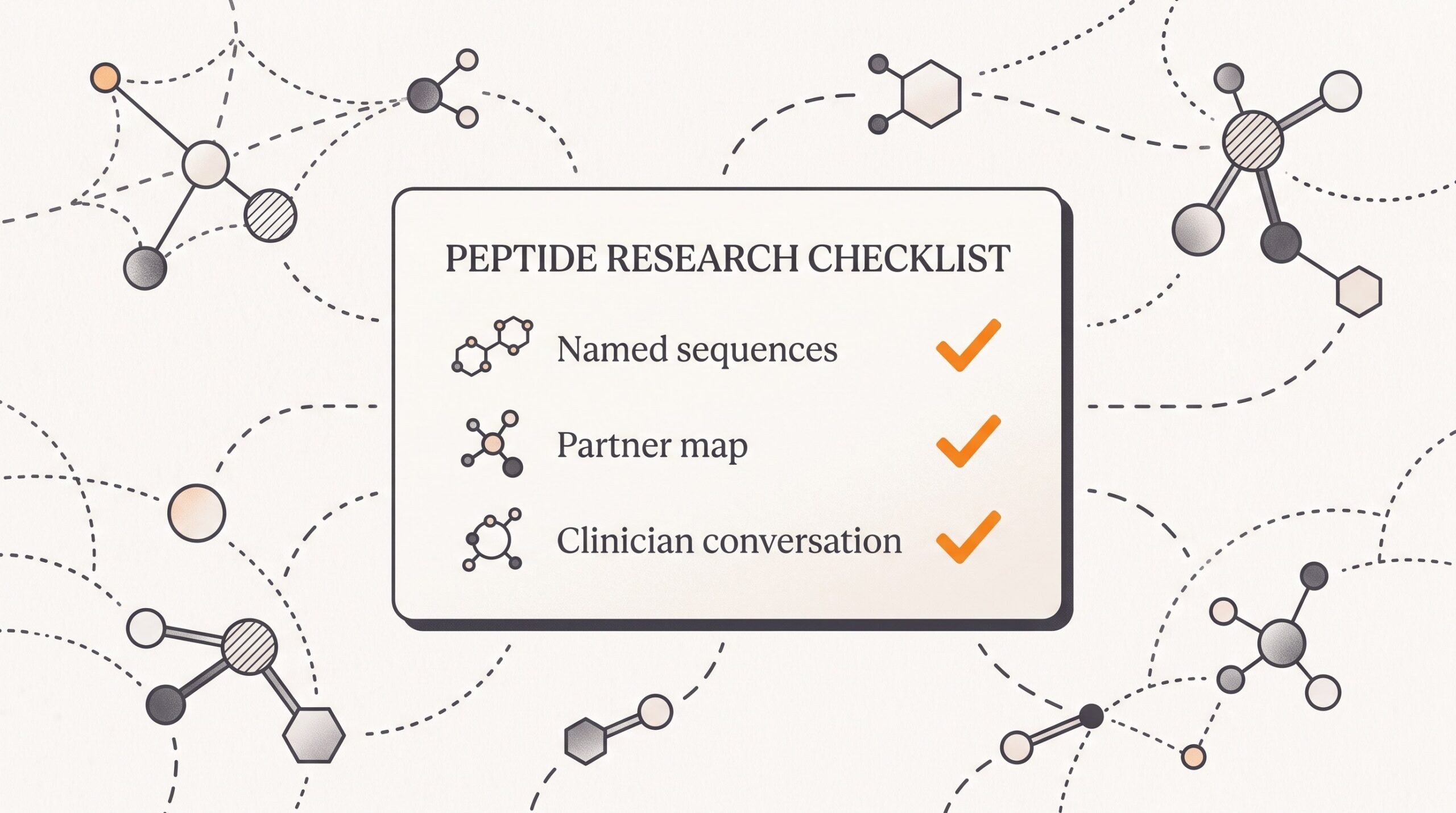
Free PDF
The Peptide Playbook
The research checklist Lee uses: named sequences, how to read a COA, and the questions to bring to your doctor. Free when you join Peptide Insider.






One Comment
Comments are closed.