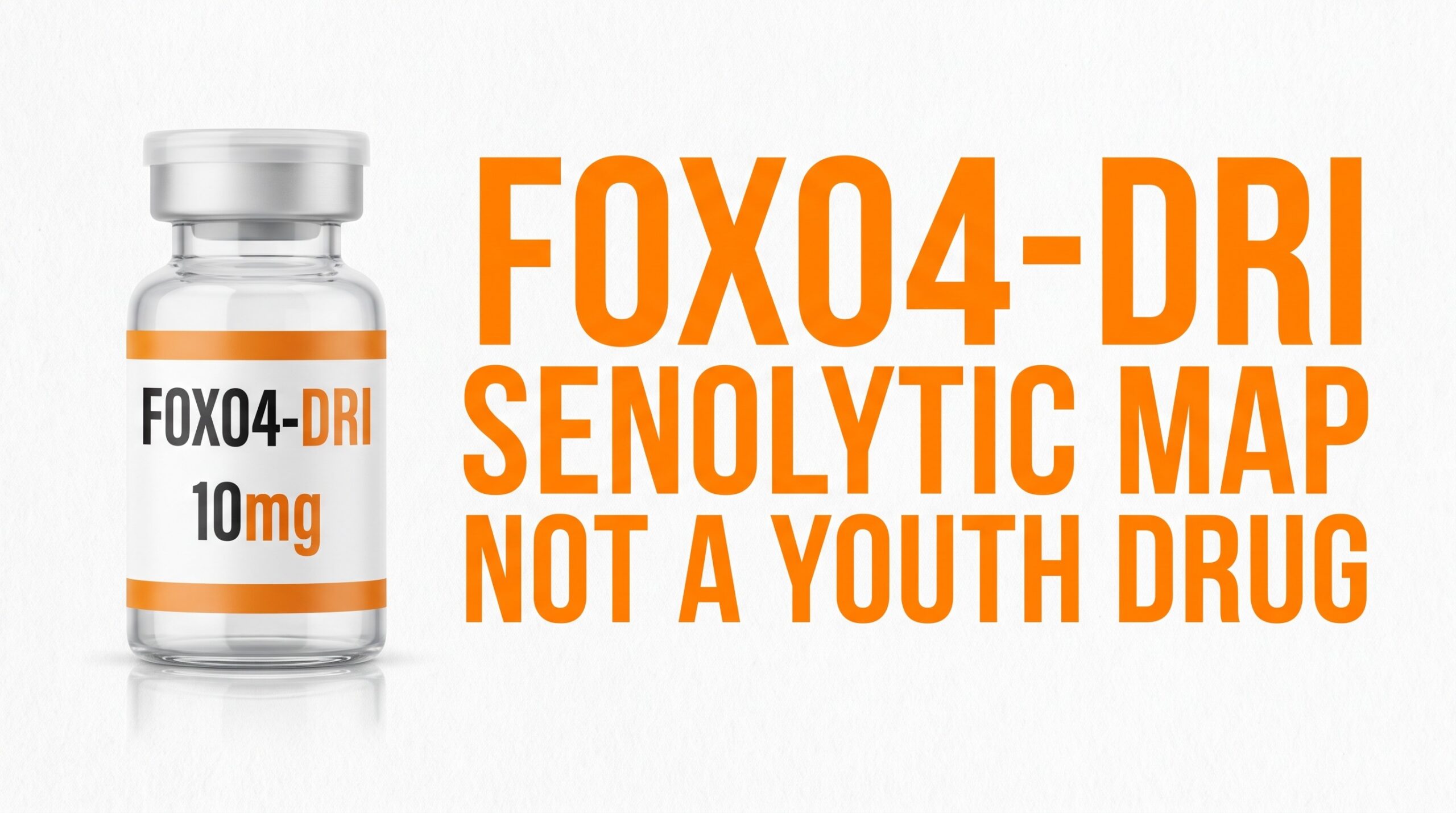
FOXO4-DRI: Senolytic Peptide Research Map (Not a Youth Drug)
Key takeaways
- Verdict: FOXO4-DRI is a sharp research map for “zombie cell” cleanup — not an FDA youth drug and not a catalog shortcut to Baar’s mouse results.
- Mechanism in one line: it competes with FOXO4 for p53 so some senescent cells can finish a cleanup call. That story is cell and mouse work.
- Your next step: read the map, keep foundations and a clinician first, and only treat partner vials as research SKUs with codes that fire.
Verdict up front: FOXO4-DRI is worth understanding. It is not worth treating like a youth prescription.
Cool paper file. Real partner shelves. No FDA label that says “get younger.”
Keep reading if you typed FOXO4-DRI, Proxofim, or senolytic and want the mechanism without the guru tax. Skip if you want a dosing table, a “kill all aging” protocol, or a reason to ignore sleep, protein, training, and a clinician. Those asks belong in Pro or a real clinic — not a free ranking page.
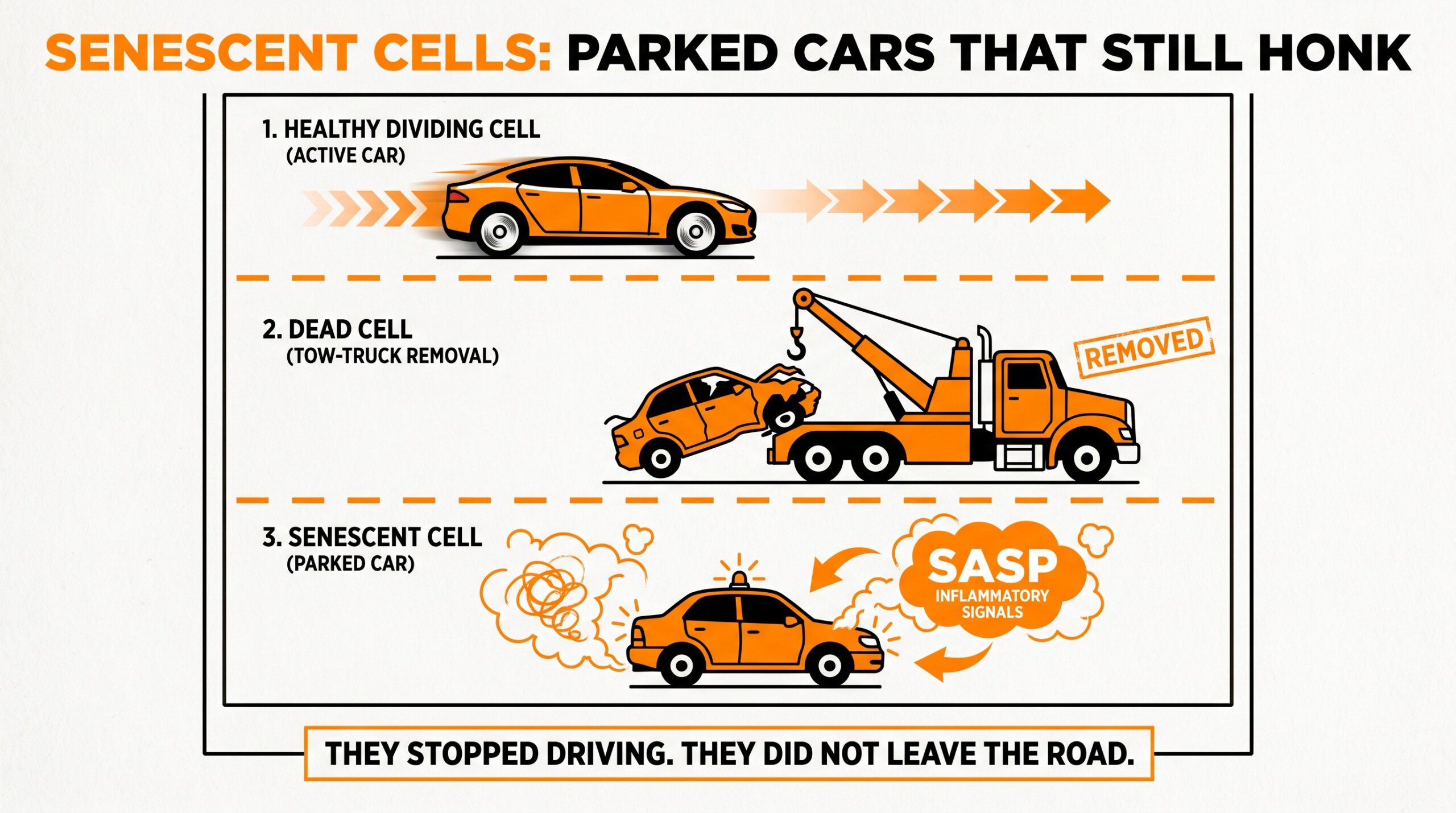
A senolytic is a compound studied for clearing senescent cells. Senescent cells stopped dividing after damage or aging signals. They did not leave. They keep chatting through inflammatory messages researchers call the SASP.
Day-one basics still live on Start Here and what are peptides. Adjacent longevity maps: Epitalon, Pinealon, SS-31, and NAD.
Education only. Not medical advice. A research-catalog FOXO4-DRI vial is not a treatment for aging, chemo side effects, kidney decline, or “I feel old.”
What is FOXO4-DRI?
FOXO4 is a forkhead transcription factor. Translation: a protein that helps turn certain genes on or off.
In some senescent cells, FOXO4 teams up with p53. p53 is the famous guardian protein that can push damaged cells toward repair or toward self-cleanup.
FOXO4-DRI is a lab-designed D-retro-inverso peptide. Translation: the sequence uses mirror-image amino acids so it lasts longer and can enter cells better than a plain copy.
The design goal was simple on paper. Compete with FOXO4 for p53 binding inside senescent cells.
The flagship paper is Baar and colleagues in Cell in 2017. They built the peptide. They showed it could nudge senescent cells toward apoptosis in their models. They tested it in mice after chemo stress and in aging models.
Why this matters: you are looking at a research tool aimed at one survival trick in stuck cells — not a certified fountain in a crimp cap.
So what for you: catalog names and Instagram captions are not the same object as a labeled drug.
The stuck-key mechanism (one analogy)
Here is the only picture I want stuck in your head.
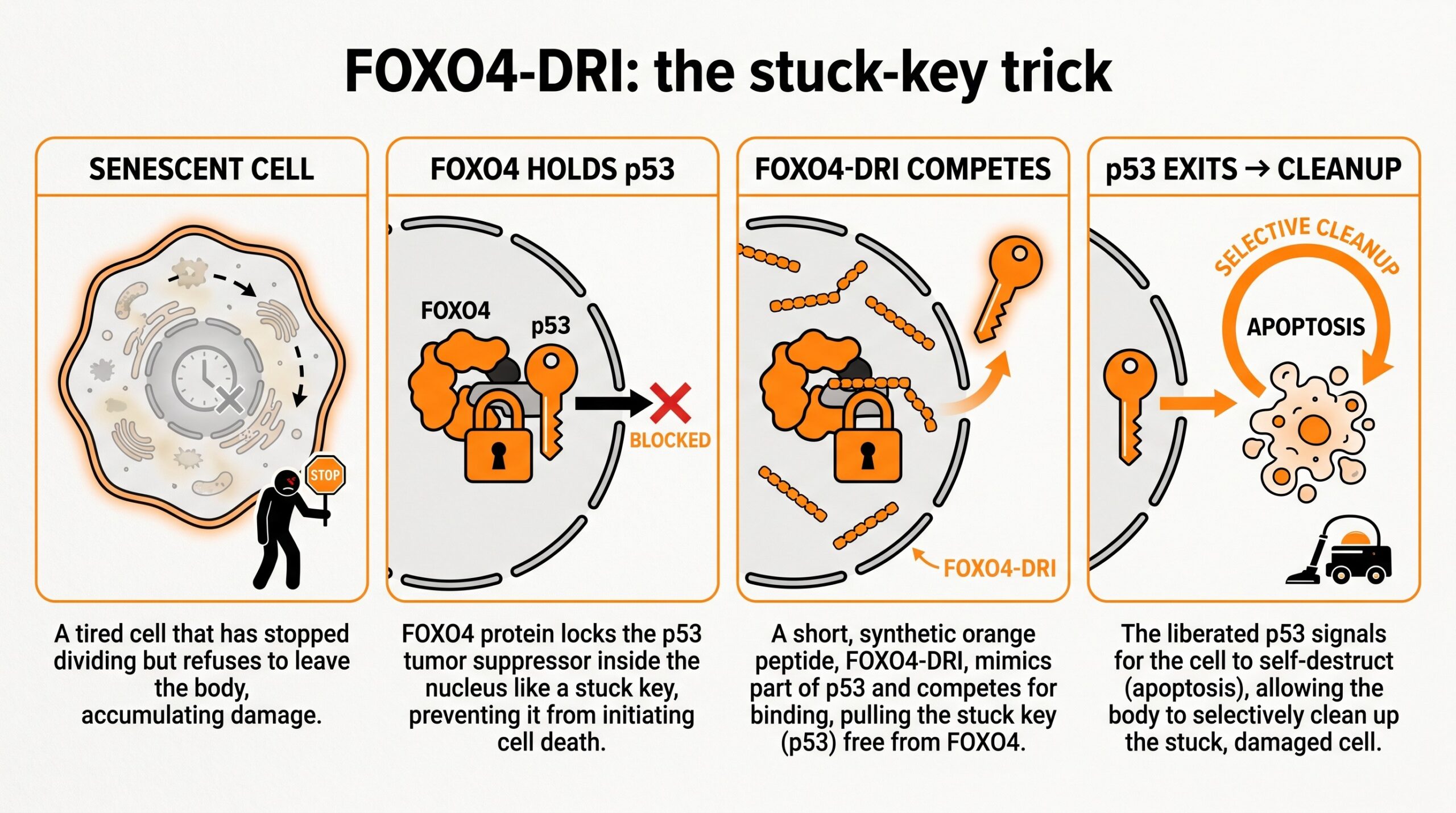
Think of p53 as a key that can open a cleanup door. In some senescent cells, FOXO4 acts like a stuck key-holder. It keeps p53 parked in the nucleus. Busy enough to keep the cell alive. Not free enough to finish the exit.
FOXO4-DRI is the competing key blank. It barges into that FOXO4–p53 handshake. In the Baar map, that competition can free active p53 toward caspase-driven apoptosis. That cleanup hit senescent cells harder than healthy neighbors in their models.
How sure should you be? Fairly sure about the design story and the mouse/cell data in that paper. Much less sure that a research vial equals those mouse outcomes.
Later structural papers keep mapping how FOXO4 and p53 touch. They also map how FOXO4-DRI fits that contact. That is mechanism homework. It is not a human dosing manual.
Why this matters: if a caption skips FOXO4, p53, and “mouse/cell,” it is selling vibes.
So what for you: ask for the mechanism in one sentence before you ask for a price.
The stop-you number (and what it is not)
Baker and colleagues showed in 2011 that clearing p16-positive senescent cells delayed aging-associated disorders in a mouse model. That made “zombie cell cleanup” a serious research lane.
Why this matters: the field had proof-of-concept that selective clearance can change aging features in animals — long before FOXO4-DRI had a product page.
Then Baar 2017. Under conditions they called well tolerated, FOXO4-DRI neutralized doxorubicin-related chemotoxicity signals in their models. It also restored fitness, fur density, and renal function in a fast-aging mouse line and in naturally aged mice.
Read that again. The paper argues you can sometimes restore function after decline has already started. In mice.
That is the stop-you line. It is also the trap. Mouse kidney and fur are not your birthday candles.
Why this matters: the exciting claim is restoration after decline — and the confidence level is still animal science, not a package insert.
So what for you: the number that matters is how far the evidence sits from a human label. Right now that gap is wide.
Research catalog vs clinic vs foundations
Three doors. Same molecule name online. Different jobs.
- Research catalog. FOXO4-DRI as a research sequence on partner shelves. Research-use framing. Not a treatment claim.
- Clinic / future Rx. Only if a real labeled product and a clinician exist for your case. Today this is not an FDA-approved aging drug.
- Foundations. Sleep, protein, training, metabolic basics, and labs with someone who knows your history. See how to sleep better and protein intake.
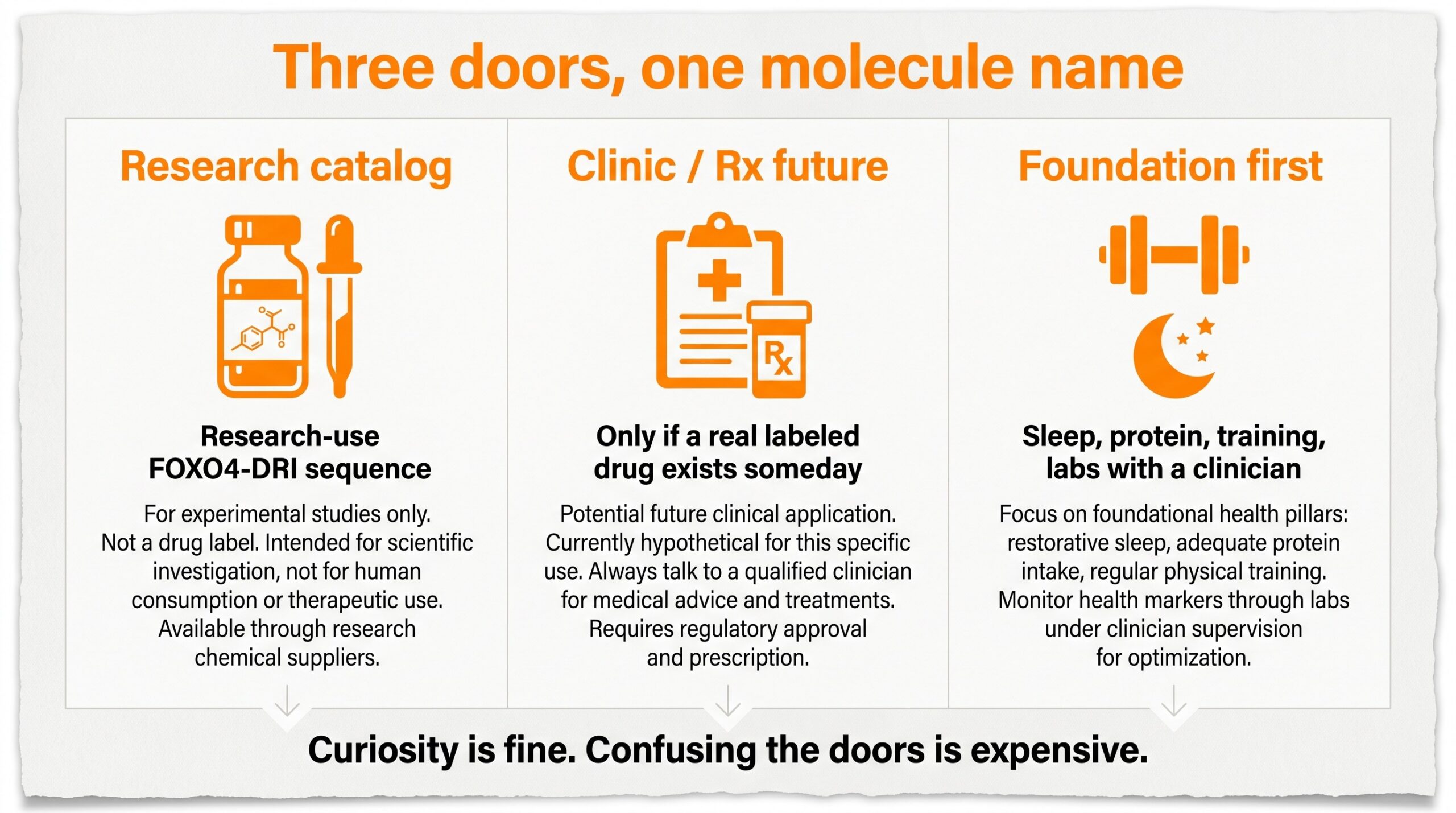
Why this matters: most money gets wasted when people buy Door 1 while wanting Door 2 outcomes.
So what for you: pick the door that matches your actual question before you open a cart.
Myths that burn money
- “Senescent equals useless.” Senescence also shows up in wound and cancer-biology contexts. Blanket kill-all talk is cartoon science.
- “Endogenous pathway = safe vial.” Your body using FOXO and p53 is not the same as injecting a DRI peptide from a catalog.
- “One Cell paper = human protocol.” Landmark map. Not a package insert.
- “If Limitless shows a page, guests can buy in stock.” Their FOXO4-DRI page is live but login-gated for professional pricing and schema-flagged out of stock on guest check. Chip, not hero.
Why this matters: the expensive mistake is buying a story you cannot falsify.
So what for you: keep a clinician in the loop for chemo history, kidney disease, or cancer risk. Do not argue with captions.
Where I look for a FOXO4-DRI research compound
Partner reality on today’s check: BioLongevity lists FOXO4-DRI 10 mg in stock (Drive url_id=98). Limitless has a FOXO4-DRI 10 mg page with guest OutOfStock / login-for-pricing — chip only. Paramount, Peptira, and S1 get home or shop chips only. I do not invent product hrefs.
Research-catalog SKU currently live on partner check (not a treatment recommendation).
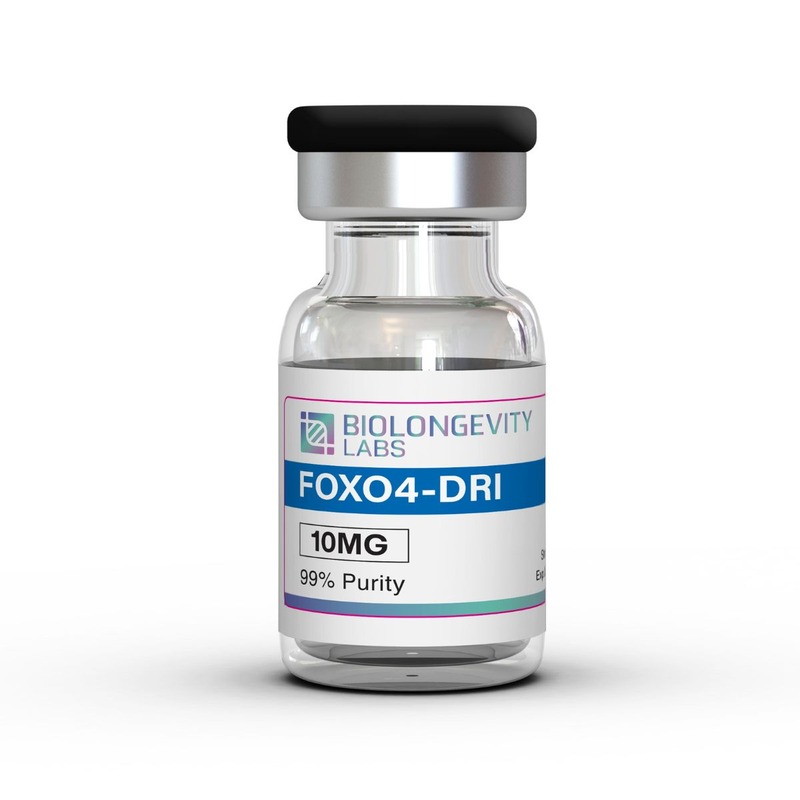 BioLongevity
FOXO4-DRI 10 mg
LEE15BioLongevity FOXO4-DRI 10 mg · LEE15Limitless FOXO4-DRI · LEE20BioLongevity home · LEE15Paramount home · LEE10Peptira home · LEES1 shop · LEE10
If you ever reconstitute a lyophilized research peptide, learn the math first on how to reconstitute peptides. That page is public education. It is not a FOXO4-DRI protocol.
Why this matters: one InStock hero card beats five mystery tabs when you are only browsing research options.
So what for you: match the SKU photo to the link. Codes only work when the tracking fires.
Evidence limits
Most FOXO4-DRI evidence is cell and animal. Partner catalogs are not selling a labeled aging medicine.
Newer papers keep probing structure, keloid fibroblasts, and endothelial senescence models. Interesting. Still not your green light to self-experiment like it is metformin.
If you have active cancer, chemo history, significant kidney disease, or unexplained weight loss, this is a clinician conversation. Not a research-cart conversation.
Why this matters: confidence framing protects your wallet and your risk file.
So what for you: use this page to get smarter. Use a clinician to get safer. Use Pro if you want protocol depth without random Discord screenshots.
Sources & Further Reading
- Baar MP, et al. Targeted apoptosis of senescent cells restores tissue homeostasis in response to chemotoxicity and aging. Cell. 2017. PubMed 28340339
- de Keizer PL. Rejuvenation by therapeutic elimination of senescent cells. Cell. 2017. PubMed 28340347
- Baker DJ, et al. Clearance of p16Ink4a-positive senescent cells delays ageing-associated disorders. Nature. 2011. PubMed 22048312
- Coppé JP, et al. The senescence-associated secretory phenotype: the dark side of tumor suppression. Annu Rev Pathol. 2010. PubMed 20078217
- Campisi J, d’Adda di Fagagna F. Cellular senescence: when bad things happen to good cells. Nat Rev Mol Cell Biol. 2007. PubMed 17667954
- Zhu Y, et al. The Achilles’ heel of senescent cells: from transcriptome to senolytic drugs. Aging Cell. 2015. PubMed 25754370
- Bourgeois B, et al. The disordered p53 transactivation domain is the target of FOXO4 and the senolytic compound FOXO4-DRI. Nat Commun. 2025. PubMed 40593617
- Structural plasticity of the FOXO-DBD:p53-TAD interaction. Nat Commun. 2025. PubMed 40425537
- Peptide inhibitors targeting FOXO4-p53 interactions… J Med Chem. 2025. PubMed 40739602
- FOXO4-DRI induces keloid senescent fibroblast apoptosis… Commun Biol. 2025. PubMed 39994346
- FOXO4-DRI regulates endothelial cell senescence via the P53 signaling pathway. Front Bioeng Biotechnol. 2025. PubMed 41625068
The bottom line
FOXO4-DRI is one of the cleaner mechanism stories in the senolytic peptide aisle. Stuck key. Competing peptide. Mouse and cell receipts. Partner SKUs exist.
It is still not a youth drug. Read Baar. Talk to a clinician about your actual risk file. Build foundations that do not require a crimp cap.
Want the deeper protocol library after that? Pro is the paid door. Want the free research PDF? Grab the Playbook below.
Free guide
Get The Peptide PlaybookEnter your email and we’ll send the research PDF. Education only — not medical advice.
I built Peptides & Pump so you can get this without a guru tax. Free Knowledge Base first if you are not ready to pay. Pro if you want the protocol library.
 Keep going on Peptides & Pump
Free is the peptide community. Pro is where you master it. Codes are the links. Click them so the discount fires.
Free
Knowledge Base
The peptide community · 2,500+
- 2,500+ member peptide community
- Sourcing questions before you buy anything random
- The basics, from people actually using peptides
Pro
Peptides & Pump Pro
$10/mo · 7-day trial
- Science-backed protocol library
- 1-on-1 support from Lee and Matt
- Step-by-step video, plus a monthly $500 drawing
LEE20 Limitless LEE15 BioLongevity LEE10 Paramount LEE Peptira LEE10 S1
Supplier footnote: Research suppliers I mention when people ask about FOXO4-DRI: BioLongevity FOXO4-DRI 10 mg (code LEE15). Limitless product page: Limitless FOXO4-DRI 10 mg (code LEE20). Paramount, Peptira, and S1 home/shop chips: Paramount (code LEE10), Peptira (code LEE), S1 shop (code LEE10), plus BioLongevity home (code LEE15). Match the product to the job. Do not collect bottles.
Disclaimer. This article is for educational and research purposes only. It is not medical advice. It is not intended to diagnose, treat, cure, or prevent any disease. FOXO4-DRI (also discussed online as Proxofim in some catalogs) is not an FDA-approved drug for aging, chemotoxicity, kidney function, skin aging, or any other indication. Research peptides discussed here are research sequences; a research-catalog vial is not a compounded prescription and is not a labeled drug. Most evidence discussed here includes cell and animal studies; none of that is a substitute for a clinician. Individual results vary. Always consult a qualified healthcare provider before starting any peptide, drug, supplement, or protocol, especially if you have a medical condition, cancer history, or take prescription medication. Peptides & Pump does not sell peptides.
Affiliate disclosure. Some links on this page are affiliate links. If you buy through them, I may earn a commission at no extra cost to you. Codes LEE15, LEE20, LEE, and LEE10 are the ones I actually use where a coupon fires. That commission is how I keep publishing free education. I only link suppliers I am willing to put my name on.