Survodutide: The GLP-1 + Glucagon Shot, Liver Fat, Side Effects & Evidence
Key takeaways
- Verdict: Survodutide is a weekly shot that turns on two hormone switches at once: GLP-1 and glucagon. Big trials in people show real weight loss and much less liver fat.
- Its edge is the liver. The glucagon switch works right on liver cells. Most GLP-1 drugs mainly work on appetite.
- The catch: stomach side effects are very common. Heart results and liver biopsy results from the big trials are still coming.
- Not FDA-approved. No filing has been announced. Education only. Not medical advice.
Verdict up front: If you typed survodutide into Google, here is the short answer. It is one of the most serious new fat-loss drugs in the pipeline. It is not hype. It has finished big Phase 3 trials, and the results ran in the New England Journal of Medicine and Nature Medicine.
But it is not a better semaglutide in every way. On the scale, it lands in the same zone as today’s best shots. Its real claim to fame is the liver.
Why this matters: about one in three adults carries extra fat in the liver. Most never know it. A drug built to clear that fat, and not just shrink appetite, is a different kind of bet.
Keep reading if you want the plain-English map: what survodutide is, how it works, what the trials really showed, how it stacks up against tirzepatide and retatrutide, and what the risks are. New to this world? Start with what peptides are, then peptides for weight loss.
Quick note. This page is education. It is not medical advice. It does not diagnose or treat anything. And it is not a how-to.
What is survodutide?
Survodutide is a lab-made peptide. A peptide is a short chain of amino acids, the small building blocks of protein.
In early papers it was called BI 456906. The German drug maker Boehringer Ingelheim runs the program. The Danish company Zealand Pharma helped invent it and licensed it to them.
It is given as a shot under the skin once a week. To make that work, the makers bolted a fatty tail onto the peptide. That tail grabs onto proteins in your blood. So the drug hangs around for days instead of minutes.
Here is the part that makes it special. Survodutide is a dual agonist. An agonist is something that turns a receptor on. A receptor is a lock on the outside of a cell that a hormone fits into. Dual means survodutide fits two locks.
- The GLP-1 lock. Same lock semaglutide uses. It calms appetite and helps you feel full.
- The glucagon lock. A lock found heavily on liver cells. It tells the liver to burn more fuel, including fat.
Why this matters: survodutide is not just another GLP-1 copy. It adds a second job aimed at the liver. That second job is the whole reason it exists.
Where the idea came from: a gut hormone found in 1982
This drug did not come out of nowhere. Its family tree goes back more than 40 years.
Glucagon itself was found in 1923, right after insulin. For decades, doctors saw it as insulin’s opposite. Its main job was to raise blood sugar when you are fasting.
Then, in 1982, a French team led by Dominique Bataille pulled a new hormone out of pig gut. It looked like glucagon with a short tail of eight extra pieces. They named it oxyntomodulin. Later work showed it could turn on both the GLP-1 lock and the glucagon lock.
Fast forward to 2005. A London team gave oxyntomodulin shots to overweight people before meals for four weeks. People ate about a quarter less at a test meal. They lost about 2.3 kg, roughly 5 pounds, compared with half a kilo on placebo.
The catch? Natural oxyntomodulin breaks down fast. You needed three shots a day.
So in 2009, two separate labs built long-lasting lab versions that hit both locks. In obese mice, these shots wiped out the extra fat. The mice ate less, and they also burned more energy.
Why this matters: survodutide is the grown-up version of that 1982 discovery. It is a long-acting, once-a-week take on a hormone your gut already makes.
How survodutide works: one key, two locks
Picture your metabolism as a house in winter. Your appetite is the front door, letting fuel in. Your liver is the furnace, deciding how much fuel to burn.
Most GLP-1 drugs work on the door. They close it a bit. You feel full sooner. Food leaves your stomach more slowly. Cravings get quieter.
Survodutide works the door and nudges the furnace. The glucagon side tells the liver to burn more fat and store less of it.
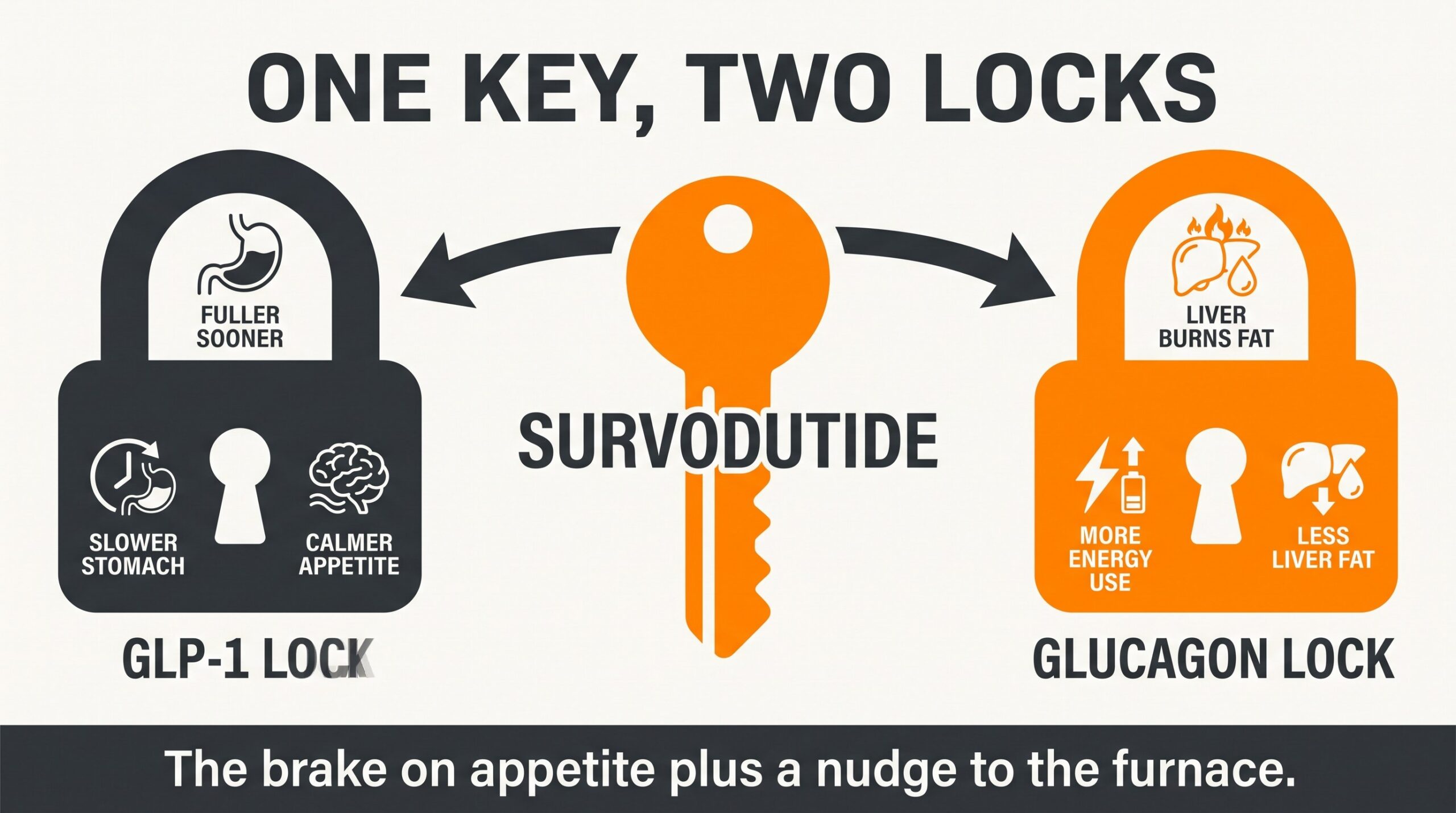
Here is the clever part. Glucagon alone raises blood sugar. That would be a bad trade for most people. GLP-1 helps the body release insulin when sugar is high. So the GLP-1 side keeps the glucagon side in check.
A small 2013 study in people showed this balance in action. Ten overweight volunteers got drips of glucagon, GLP-1, both, or placebo. Glucagon raised the calories they burned at rest. GLP-1 alone did not. When both ran together, calorie burn stayed up, and the sugar spike from glucagon shrank fast.
A 2026 mouse study added one more clue. Survodutide reached the brain’s appetite centers through spots that sit outside the normal brain barrier. The appetite effect looked like it came from the GLP-1 side. A glucagon-only drug did not quiet hunger, but it still cut body weight.
Why this matters: two locks means two different ways to lose fat. One side makes you eat less. The other side may help you burn more and clear liver fat. That is the theory. The trials are how we check it.
The stop-you number: 84 out of 100
In 2026, a Phase 3 trial called SYNCHRONIZE-MASLD tested survodutide in 216 adults. All had obesity and a fatty liver with signs of damage.
The goal was simple. Did liver fat drop by at least 30% on an MRI scan after 48 weeks?
Among people who stayed on the drug, 84 out of 100 hit that mark. On placebo, it was about 24 out of 100.
Counting everyone who started, even people who quit early, the numbers were 69 versus 29 out of 100. Still a huge gap.
Weight fell too. People on survodutide lost about 12% of their body weight, compared with about 1% on placebo, among those who stuck with it.
So what for you: this is a real result in people, not mice. But it is liver fat on a scan. It is not yet proof of fewer liver failures or longer lives. That proof takes bigger, longer trials.
What the weight-loss trials showed
Survodutide has now been tested in thousands of people. Here is the honest scoreboard, in plain words.
Phase 2, people without diabetes (2024). This was 387 adults over 46 weeks. Weight loss rose with dose. At the top dose, people lost about 15% of body weight on average. Placebo lost about 3%.
Phase 3, SYNCHRONIZE-1 (2026). This was 725 adults with obesity but no diabetes, followed for 76 weeks. That is about a year and a half. Counting everyone who started, people lost about 12% to 13% of their weight. Placebo lost about 5%.
Among people who stayed on the higher dose the whole way, the average loss was closer to 17%. The gap between those two numbers is mostly people who quit early.
Phase 3, SYNCHRONIZE-2 (2026). This was 752 adults with obesity and type 2 diabetes. They lost about 8% to 10% of their weight, versus about 4% on placebo. Their long-term blood sugar marker, called A1c, fell by close to a full point.
That smaller loss in diabetes is normal. Almost every weight-loss drug works a little less in people with type 2 diabetes.
A smaller 2024 study did compare survodutide with semaglutide in type 2 diabetes. It only lasted 16 weeks, and the semaglutide group knew what they were taking. Sugar control was about the same. Higher survodutide doses took off more weight.
Why this matters: survodutide clearly works on the scale. But it has not been shown to beat the best current options on weight alone. If it wins, it probably wins on the liver.
Why the liver is the real story
Fatty liver used to be called NAFLD. In 2023, liver doctors renamed it MASLD. The new name ties it to metabolism, things like belly fat, blood sugar, and blood pressure.
When that fat starts to inflame and scar the liver, it is called MASH. Scar tissue in the liver is called fibrosis. Too much scarring can lead to cirrhosis, which is a hard, failing liver.
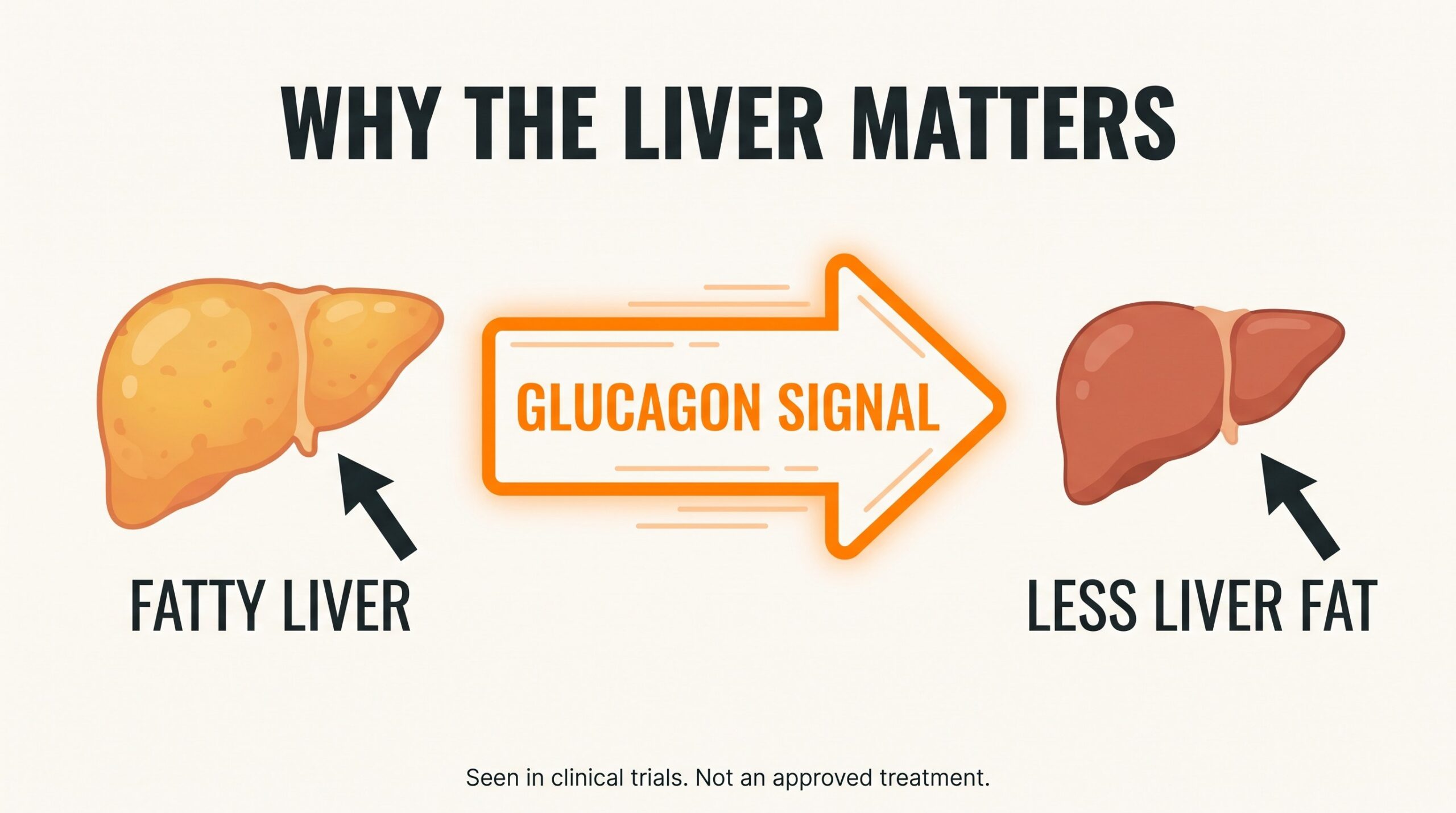
In 2024, a Phase 2 trial in the New England Journal of Medicine tested survodutide in 293 adults with MASH. Every one of them had a liver biopsy, a tiny tissue sample, to confirm it.
- Liver inflammation improved, without worse scarring, in 43% to 62% of people on survodutide. On placebo it was 14%.
- Scarring improved by at least one stage in about 34% to 36% on survodutide, versus 22% on placebo.
Then came a twist. A 2026 follow-up looked at how the liver got better. For inflammation, most of the gain tracked with weight loss. For scarring, most of the gain did not. That hints the glucagon side may be working on the liver directly.
An early safety study even included people with cirrhosis. The drug was handled about the same by their bodies, and liver markers moved the right way over 28 weeks. That was a small, open-label study, so treat it as a first look.
The FDA has given survodutide Breakthrough Therapy status for MASH with moderate to advanced scarring. That speeds up review. It is not an approval.
Why this matters: MASH has very few approved drugs. A shot that cuts weight and may calm liver scarring on its own would be a big deal. The large biopsy trials, called LIVERAGE, are still running.
Survodutide vs semaglutide, tirzepatide, retatrutide, and mazdutide
The simplest way to sort these drugs is by which locks they open.
- Semaglutide: GLP-1 only.
- Tirzepatide: GLP-1 plus GIP, another gut hormone.
- Survodutide: GLP-1 plus glucagon.
- Mazdutide: also GLP-1 plus glucagon. It is a close cousin, approved in China. See mazdutide vs retatrutide.
- Retatrutide: all three, GLP-1, GIP, and glucagon.
On weight, here is the rough picture from each drug’s main obesity trial. Semaglutide’s big trial showed about 15% over 68 weeks. Tirzepatide showed up to about 21% over 72 weeks. Retatrutide’s Phase 2 trial showed up to about 24% over 48 weeks.
Careful, though. These were different trials, with different people and different rules. Comparing them side by side is like comparing race times run on different tracks. Only a head-to-head trial can settle it.
Why this matters: survodutide is not the scale champion on paper. It is a liver-first design. If your interest is the liver side of metabolism, that is the lane it was built for. For the GLP-1 basics, read tirzepatide vs semaglutide.
Survodutide side effects: the honest catch
Here is the part the hype posts skip. Stomach side effects are the rule, not the exception.
- In SYNCHRONIZE-1, about 9 in 10 people on the higher dose had stomach symptoms at some point. On placebo, about half did.
- In the MASH trial, nausea hit 66% of people on the drug versus 23% on placebo. Vomiting hit 41% versus 4%.
- Most cases were mild to moderate. They showed up most while the dose was being raised.
Heart safety is the other open question. In one early study, 6 of 80 people quit because of heart or blood vessel side effects. That was a small, short study. But it is one reason a dedicated heart-safety trial, SYNCHRONIZE-CVOT, is running now.
There is also the muscle question. Fast weight loss from any drug can take some muscle with it. Strength training and enough protein matter here. See protein intake and creatine benefits.
Why this matters: side effects decide whether people stay on a drug. And a drug only works if you can stay on it. For the bigger picture, read peptide side effects and are peptides safe?
Is survodutide approved? Where it stands in 2026
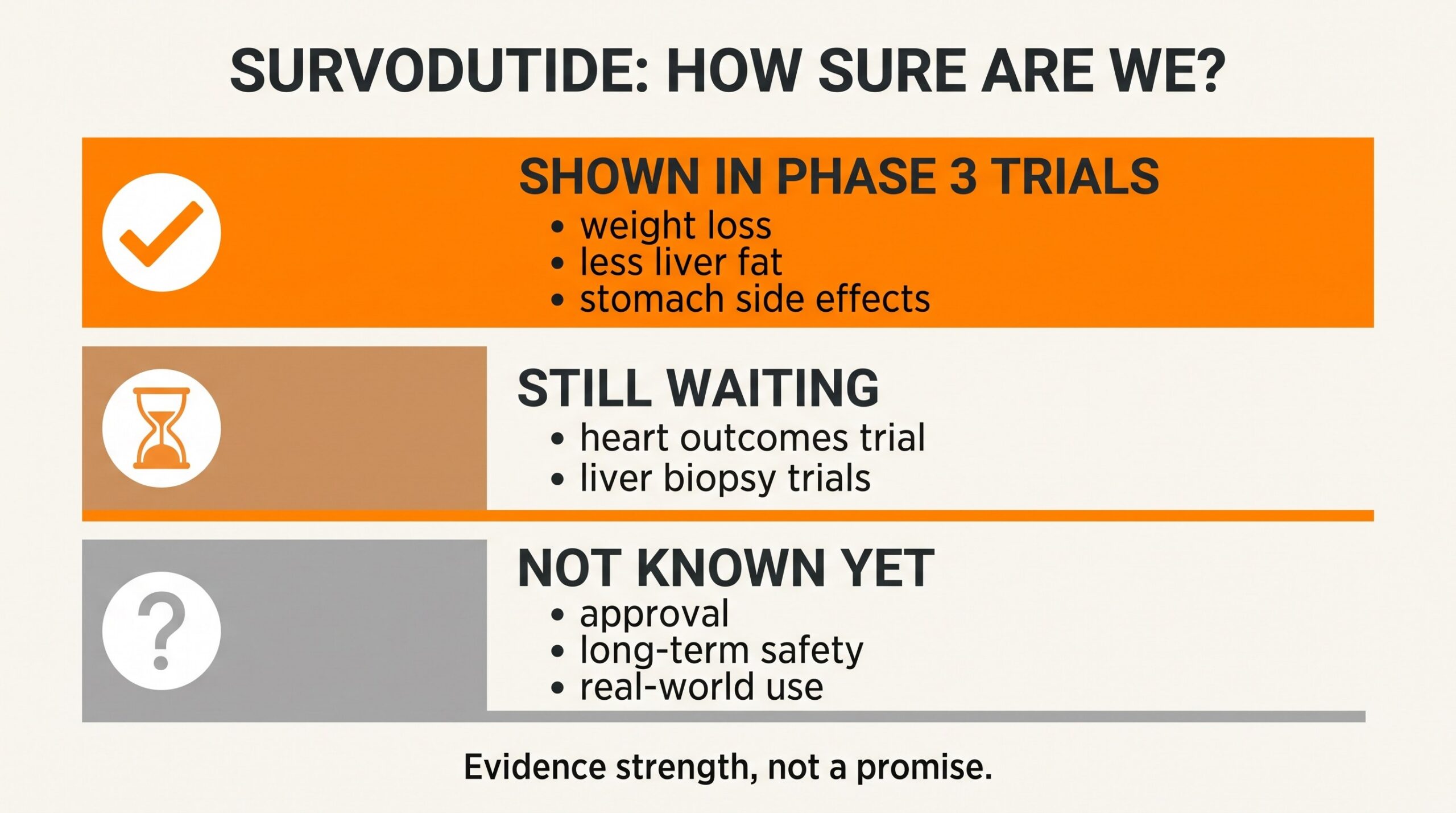
Short answer: no. As of October 2026, survodutide is not approved by the FDA or any major regulator. Boehringer has not announced a filing date.
Here is what is still coming:
- SYNCHRONIZE-CVOT, the heart-safety trial. Results are expected later in 2026.
- LIVERAGE, the large liver biopsy trials in MASH.
- More Phase 3 trials in China and Japan.
You may see survodutide listed by research-chemical shops. Those vials are not the trial drug. They are sold as lab research products, not for human use. Purity can vary. The FDA has also warned about unapproved GLP-1 products. Read FDA warnings on unapproved GLP-1 weight-loss drugs and how counterfeit peptides happen.
Why this matters: a strong trial is not the same as a drug you can get from a doctor. If you want help with weight or liver health today, approved options already exist. A clinician can walk you through them.
How a beginner should think about survodutide
Here is the simple order I would use with a friend at the gym.
1. Know your liver. Fatty liver is common and quiet. Basic blood work and, if needed, a scan can show where you stand. That is a doctor conversation.
2. Build the base. Lift weights. Eat enough protein. Walk daily. Sleep well. Cut back on alcohol and sugary drinks. These habits lower liver fat on their own. Start with Zone 2 training and how to sleep better.
3. Learn the receptor map. GLP-1. GIP. Glucagon. If you can say which drug opens which lock, you are ahead of most of the internet.
4. Follow the data, not the forum. Watch for the heart trial and the biopsy trials. Those will tell us more than any before-and-after photo.
Why this matters: the people who do best long-term usually fix the base first. Then any tool they add, approved or still in trials, has something to build on. For the bigger view, see peptides for fat loss, cagrilintide, and AOD-9604.
Survodutide FAQ
Is survodutide a peptide?
Yes. It is a lab-made peptide with a fatty tail added so it lasts all week.
Is survodutide the same as mazdutide?
No. Both open the GLP-1 and glucagon locks. But they are different molecules from different companies, with different trials.
Is survodutide better than tirzepatide?
Not on weight, based on current trials, and they have not gone head to head. Survodutide’s strongest case is liver fat and possibly liver scarring.
Does survodutide cause muscle loss?
Any fast weight loss can cost some muscle. Boehringer has said its scan data looked favorable, but the full lean-mass data still needs careful review. Lifting and protein are your best insurance.
When will survodutide be approved?
Nobody knows yet. No filing has been announced. The heart-safety results are the next big step.
What does survodutide do to the liver?
In trials, it cut liver fat a lot, and in a biopsy trial it improved inflammation and, for some, scarring. Those are trial results, not an approved use.
The bottom line
Survodutide is a once-a-week shot that opens two locks: GLP-1 for appetite and glucagon for the liver. It grew out of a gut hormone found in 1982.
The trials are real and large. Weight loss lands in the same zone as current top drugs. Liver fat drops a lot. Stomach side effects are very common.
It is not approved. Heart and biopsy results are still pending. Learn the map, build the base, and let the data finish the story.
Metabolic research maps from partners
Foundation first: protein, lifting, walking, and sleep do the heavy work on body fat and liver fat. If you are researching the metabolic lane after that, these are in-stock partner listings for the GLP-1 family and nearby energy-use compounds covered on this site. They are research-catalog products, not treatments, and not the trial drug.
After the foundation — metabolic research maps (InStock partners)
 S1 Research
R-GLP3
LEE10 Paramount
Triple Regulator
LEE10 S1 Research
T-GLP2
LEE10 Paramount
AOD-9604
LEE10 BioLongevity
MOTS-c 10 mg
LEE15 BioLongevity
5-Amino-1MQ
LEE15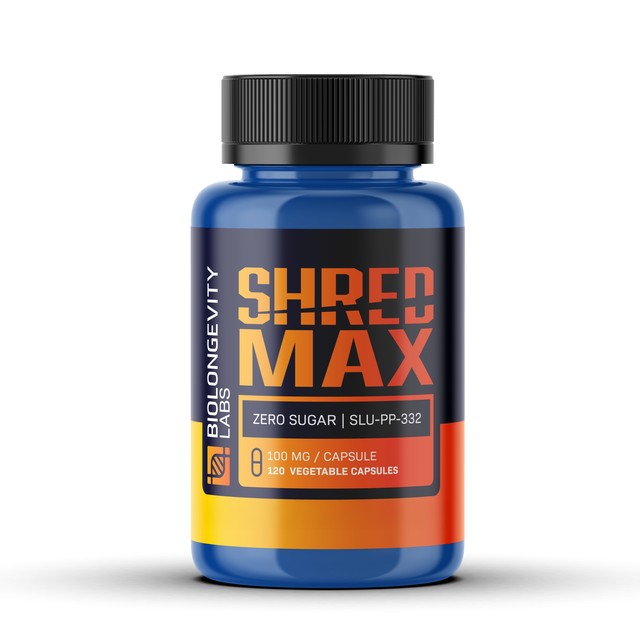 BioLongevity
ShredMAX (SLU-PP-332)
LEE15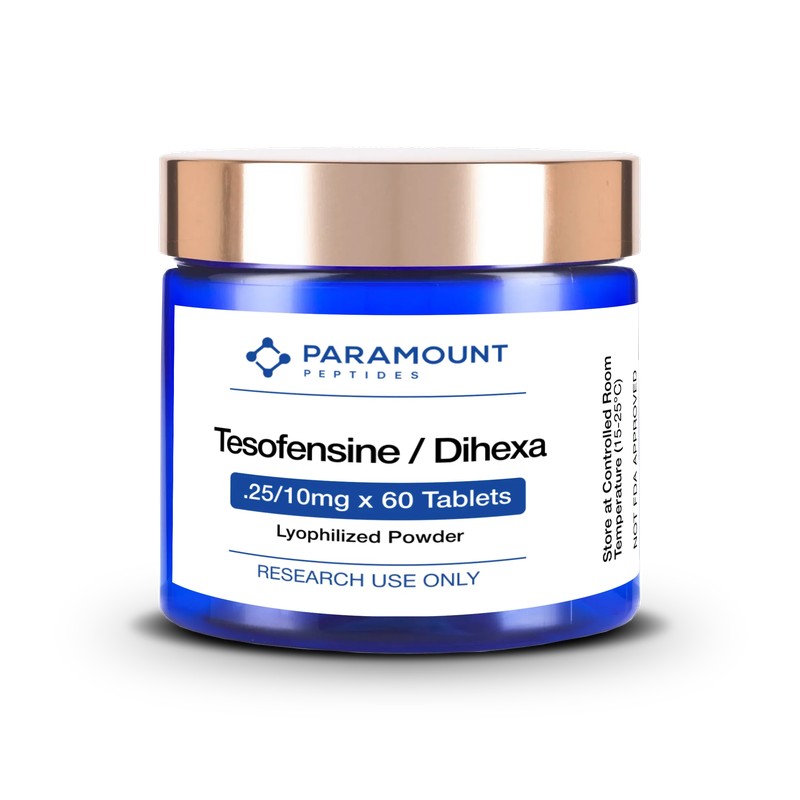 Paramount
Tesofensine / Dihexa
LEE10 Paramount
NAD+ 1000 mg
LEE10 Paramount
Recon Solution
LEE10Partner homes
S1 shop · LEE10 Peptira home · LEE Paramount home · LEE10 BioLongevity home · LEE15 Limitless home · LEE20 Their catalog needs a quick research-access sign-up before prices show. Use code LEE20 at checkout.
Adjacent research maps only. Codes live in the links. Education framing — not a treat-disease pitch.
Key takeaways (echo)
- Survodutide is a weekly lab-made peptide shot that opens two locks: GLP-1 for appetite and glucagon for the liver.
- It descends from oxyntomodulin, a gut hormone found in 1982 that hits both locks.
- Phase 3 trials showed about 12% to 13% weight loss over 76 weeks, and big drops in liver fat.
- Stomach side effects are very common. Heart-safety and liver biopsy results are still pending.
- Not FDA-approved, and no filing announced. Build the base first, and bring a clinician into any weight or liver decision.
Get the Peptide Playbook
Free email map for building the foundation first, then thinking clearly about peptides without the guru noise.
Related reads: Mazdutide vs retatrutide · Retatrutide · Tirzepatide · Semaglutide · Cagrilintide · Orforglipron · Liraglutide · Dulaglutide · Peptides for weight loss · MOTS-c · 5-Amino-1MQ · SLU-PP-332 · Start here · Community
Sources & Further Reading
- Bataille D, et al. Isolation of glucagon-37 (bioactive enteroglucagon/oxyntomodulin) from porcine jejuno-ileum. Characterization of the peptide. FEBS Lett. 1982. PMID 7140977
- Bataille D, et al. Bioactive enteroglucagon (oxyntomodulin): present knowledge on its chemical structure and its biological activities. Peptides. 1981. PMID 6283496
- de Herder WW, et al. One hundred years after the discovery of insulin and glucagon: the history of tumors and hyperplasias that hypersecrete these hormones. Endocr Relat Cancer. 2023. PMID 37310813
- Wynne K, et al. Subcutaneous oxyntomodulin reduces body weight in overweight and obese subjects: a double-blind, randomized, controlled trial. Diabetes. 2005. PMID 16046306
- Day JW, et al. A new glucagon and GLP-1 co-agonist eliminates obesity in rodents. Nat Chem Biol. 2009. PMID 19597507
- Pocai A, et al. Glucagon-like peptide 1/glucagon receptor dual agonism reverses obesity in mice. Diabetes. 2009. PMID 19602537
- Habegger KM, et al. The metabolic actions of glucagon revisited. Nat Rev Endocrinol. 2010. PMID 20957001
- Tan TM, et al. Coadministration of glucagon-like peptide-1 during glucagon infusion in humans results in increased energy expenditure and amelioration of hyperglycemia. Diabetes. 2013. PMID 23248172
- Cegla J, et al. Coinfusion of low-dose GLP-1 and glucagon in man results in a reduction in food intake. Diabetes. 2014. PMID 24939425
- Zimmermann T, et al. BI 456906: Discovery and preclinical pharmacology of a novel GCGR/GLP-1R dual agonist with robust anti-obesity efficacy. Mol Metab. 2022. PMID 36356832
- Jungnik A, et al. Phase I studies of the safety, tolerability, pharmacokinetics and pharmacodynamics of the dual glucagon receptor/glucagon-like peptide-1 receptor agonist BI 456906. Diabetes Obes Metab. 2023. PMID 36527386
- Zimmermann T, et al. Survodutide acts through circumventricular organs in the brain and activates neuronal regions associated with appetite regulation. Mol Metab. 2026. PMID 41638399
- le Roux CW, et al. Glucagon and GLP-1 receptor dual agonist survodutide for obesity: a randomised, double-blind, placebo-controlled, dose-finding phase 2 trial. Lancet Diabetes Endocrinol. 2024. PMID 38330987
- le Roux CW, et al. Survodutide Once Weekly for the Treatment of Adults with Obesity. N Engl J Med. 2026. PMID 42253238
- Wharton S, et al. Survodutide Once Weekly in Adults with Obesity and Type 2 Diabetes. N Engl J Med. 2026. PMID 42820639
- Blüher M, et al. Dose-response effects on HbA(1c) and bodyweight reduction of survodutide, a dual glucagon/GLP-1 receptor agonist, compared with placebo and open-label semaglutide in people with type 2 diabetes: a randomised clinical trial. Diabetologia. 2024. PMID 38095657
- Kaplan LM, et al. Survodutide in adults with obesity and metabolic dysfunction-associated steatotic liver disease: SYNCHRONIZE-MASLD, a randomized, double-blind, placebo-controlled phase 3 trial. Nat Med. 2026. PMID 42252333
- Sanyal AJ, et al. A Phase 2 Randomized Trial of Survodutide in MASH and Fibrosis. N Engl J Med. 2024. PMID 38847460
- Noureddin M, et al. Weight reduction-dependent/-independent effects of survodutide on liver endpoints: Mediation analysis of a phase 2 trial in MASH. Hepatology. 2026. PMID 42545725
- Lawitz EJ, et al. Efficacy, tolerability and pharmacokinetics of survodutide, a glucagon/glucagon-like peptide-1 receptor dual agonist, in cirrhosis. J Hepatol. 2024. PMID 38857788
- Wharton S, et al. Survodutide for treatment of obesity: rationale and design of two randomized phase 3 clinical trials (SYNCHRONIZE™-1 and -2). Obesity (Silver Spring). 2025. PMID 39495965
- Kosiborod MN, et al. Survodutide for the Treatment of Obesity: Rationale and Design of the SYNCHRONIZE Cardiovascular Outcomes Trial. JACC Heart Fail. 2024. PMID 39453356
- Ji L, et al. Survodutide for Obesity in Chinese Adults: Phase 3 Randomized Trial Design and Baseline Characteristics (SYNCHRONIZE™-CN). Diabetes Ther. 2026. PMID 42599381
- Yokote K, et al. Survodutide for the Treatment of Obesity Disease in Japanese Participants: Rationale, Design and Baseline Characteristics of the Phase 3 SYNCHRONIZE-JP Trial. Diabetes Obes Metab. 2026. PMID 42219222
- Amjad MM, et al. Efficacy and Safety of Dual GLP-1/Glucagon Receptor Agonism in Overweight and Obesity: A Class-Specific Systematic Review and Meta-Analysis. Diabetes Obes Metab. 2026. PMID 42811393
- Rinella ME, et al. A multisociety Delphi consensus statement on new fatty liver disease nomenclature. Hepatology. 2023. PMID 37363821
- Younossi ZM, et al. The global epidemiology of nonalcoholic fatty liver disease (NAFLD) and nonalcoholic steatohepatitis (NASH): a systematic review. Hepatology. 2023. PMID 36626630
- Wilding JPH, et al. Once-Weekly Semaglutide in Adults with Overweight or Obesity. N Engl J Med. 2021. PMID 33567185
- Jastreboff AM, et al. Tirzepatide Once Weekly for the Treatment of Obesity. N Engl J Med. 2022. PMID 35658024
- Jastreboff AM, et al. Triple-Hormone-Receptor Agonist Retatrutide for Obesity – A Phase 2 Trial. N Engl J Med. 2023. PMID 37366315
- Ji L, et al. Once-Weekly Mazdutide in Chinese Adults with Obesity or Overweight. N Engl J Med. 2025. PMID 40421736
- Boehringer Ingelheim. Survodutide Phase III SYNCHRONIZE-1 visceral fat, liver fat, and lean mass analysis; FDA Fast Track (2021) and Breakthrough Therapy (2024) designations for MASH. Press release, 2026. Newswire
- Cleveland Clinic Journal of Medicine. Survodutide substantially reduces weight and liver fat in adults with obesity, phase 3 SYNCHRONIZE studies show (ADA 2026 Scientific Sessions coverage, efficacy-estimand results). CCJM
- ClinicalTrials.gov. SYNCHRONIZE-1: survodutide in adults with obesity (NCT06066515). ClinicalTrials.gov
- U.S. Food and Drug Administration. FDA’s concerns with unapproved GLP-1 drugs used for weight loss. FDA.gov