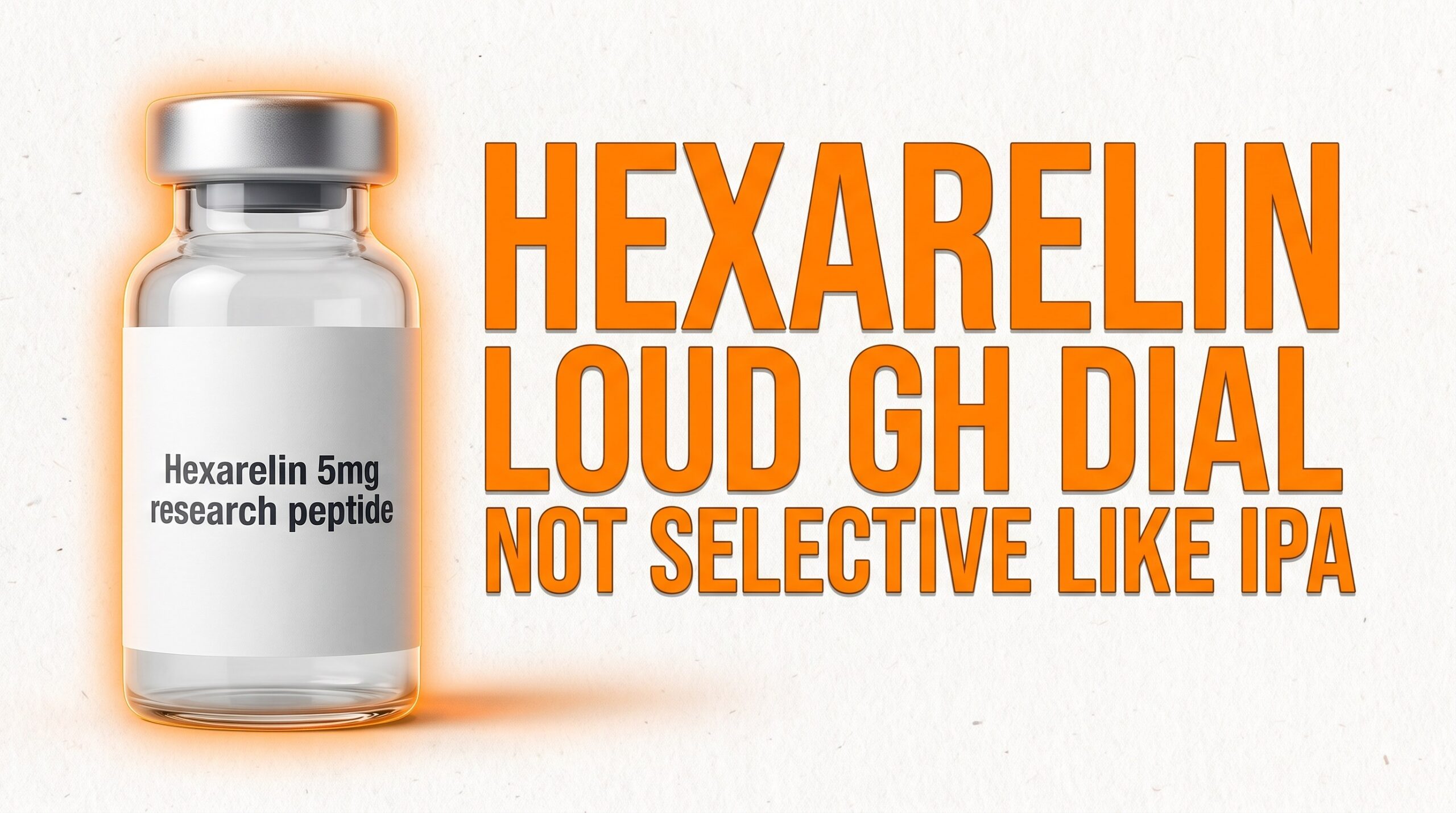
Hexarelin Peptide (GHRP / GHS-R1a): Research Map (Not an FDA GH Drug)
Key takeaways
- Verdict: Hexarelin is a loud classic GH secretagogue with real 1990s human pharmacology — not a selective ipamorelin twin and not an FDA growth-hormone drug.
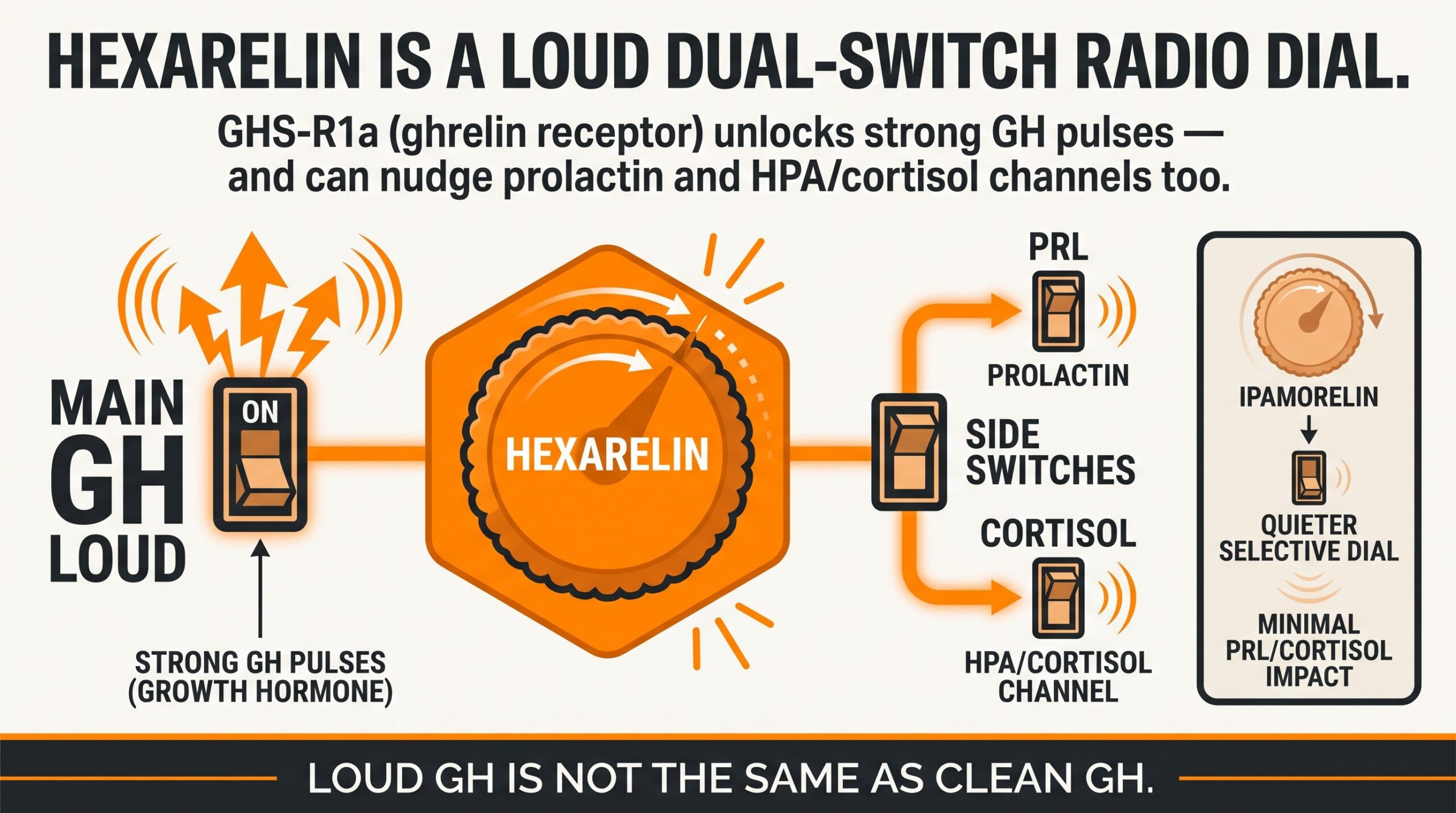
- Mechanism in one line: think of hexarelin as a dual-switch radio dial on GHS-R1a that punches GH hard and can also nudge prolactin and cortisol.
- Your next step: read the map, build sleep/protein/training foundations with a clinician first, and only treat partner vials as research SKUs with codes that fire.
Verdict up front: Hexarelin is worth understanding if you care about the old GHRP family. It is not worth treating like a quieter “GH-only” peptide just because the vial looks similar to ipamorelin.
Cool human pharmacology. Real partner shelves. No FDA label that says “raise GH yourself from a research cart.”
Keep reading if you typed hexarelin, HEX, GHRP, GHS-R1a, or “stronger than ipamorelin” and want the mechanism without the forum tax. Skip if you want a dosing table, a GH-deficiency self-protocol, a cortisol-blind stack, or a reason to ignore sleep, protein, and a clinician. Those asks belong in Pro or a real clinic — not a free ranking page.
Day-one basics still live on Start Here and what are peptides. Adjacent maps when you are done here: Ipamorelin, CJC-1295 / Ipamorelin, Sermorelin, Tesamorelin, MK-677, and how to sleep better.
Education only. Not medical advice. A research-catalog hexarelin vial is not a treatment for adult GH deficiency, sarcopenia, fat loss, heart failure, insomnia, or “my IGF-1 looks soft.”
What is hexarelin?
Hexarelin is a synthetic hexapeptide from the growth hormone–releasing peptide family.
It was designed as a GH secretagogue. That means it tells your pituitary to release more growth hormone rather than handing you exogenous GH itself.
In the mid-1990s, Ghigo and colleagues mapped how hexarelin works after intravenous, subcutaneous, intranasal, and even oral doses in healthy volunteers. That is older clinic pharmacology, not TikTok chemistry.
The receptor story got clearer later. Howard and colleagues in 1996 described a pituitary and hypothalamus receptor that GHS compounds use. Kojima and colleagues in 1999 then identified ghrelin as the natural stomach ligand for that same axis. Today you will usually hear GHS-R1a — the ghrelin receptor.
In plain English: hexarelin is a loud synthetic key for the ghrelin/GH secretagogue lock. It is not a quieter selective cousin like ipamorelin, and it is not FDA-approved human growth hormone.
Why this matters: people lump every “GH peptide” into one shopping cart caption. The receptor family is shared. The side-channel story is not.
So what for you: if a sales page never mentions prolactin, ACTH, or cortisol, it is selling vibes.
The dual-switch dial (one analogy)
Here is the only picture I want stuck in your head.
Think of hexarelin as a dual-switch radio dial on the GH axis. The main switch is GHS-R1a. When that dial turns hard, GH pulses get loud.
The second switch is the honesty tax. Classic GHRP-family compounds can also nudge prolactin and the HPA axis — ACTH and cortisol. Massoud and colleagues showed dose-related GH, prolactin, and cortisol responses to hexarelin in healthy men. Arvat and colleagues mapped how those GH, PRL, ACTH, and cortisol responses change across age groups.
Ipamorelin is the quieter selective dial people usually mean when they say “GH with less drama.” Hexarelin is older, louder, and less selective. Different tool. Same aisle name online.
How sure should you be? Fairly sure hexarelin is a potent human GH secretagogue with non-GH side channels in classic endocrine studies. Much less sure that a research-catalog vial recreates a carefully timed clinic infusion or that loud GH automatically equals better recovery for you.
Why this matters: if you cannot explain “loud GH dial with prolactin/cortisol side switches” in one sentence, you are not ready to open a cart.
So what for you: ask for the side-channel story before you ask for a price.
The stop-you number (and what it is not)
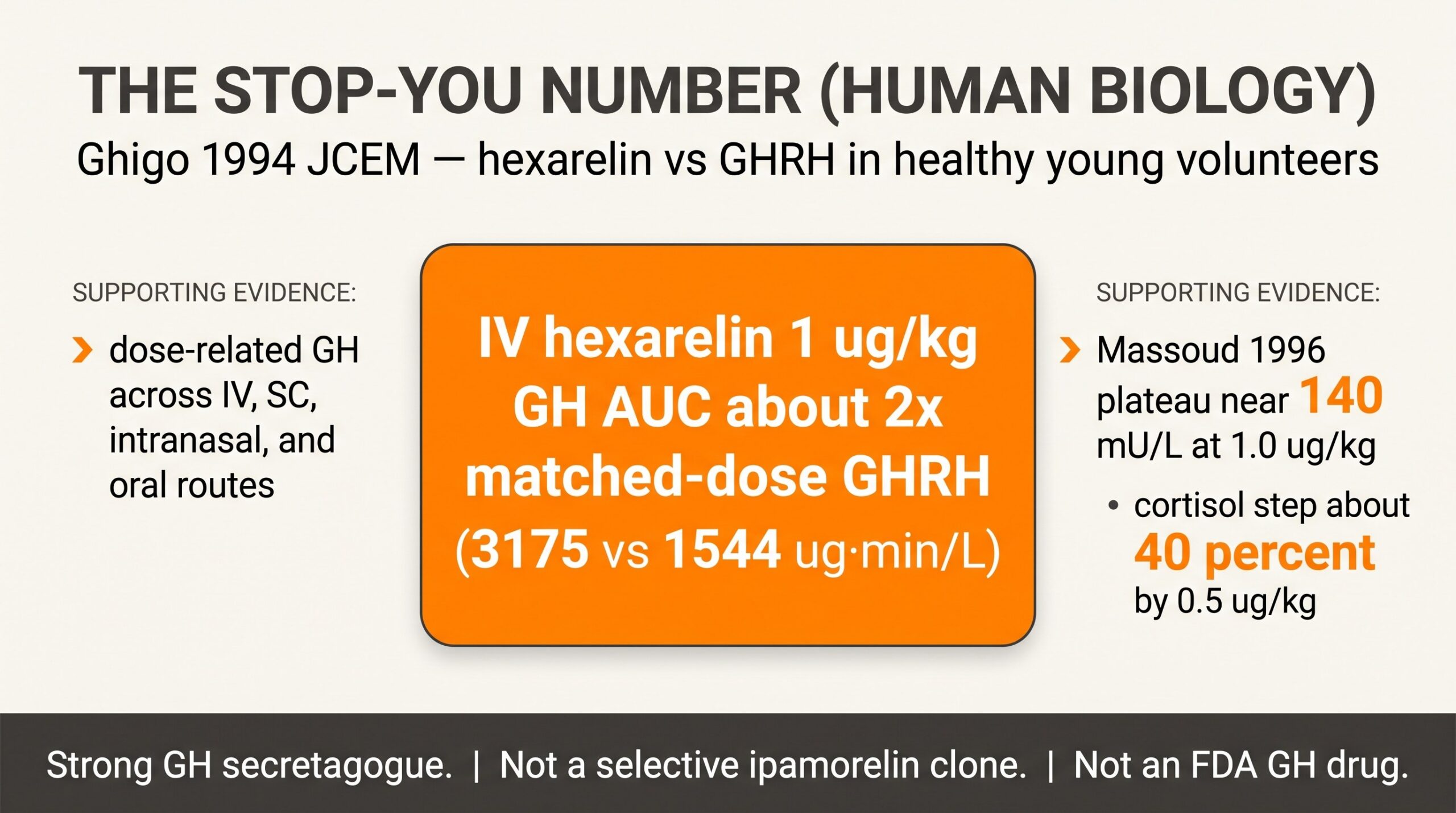
The cleanest “hexarelin is not a cartoon” human number for this page is not a wellness caption. It is a head-to-head GH comparison against GHRH.
Ghigo and colleagues published in JCEM in 1994. Healthy young volunteers got hexarelin and GHRH under controlled conditions.
After 1 µg/kg IV hexarelin, mean GH AUC was about 3175 µg·min/L. Matched-dose 1 µg/kg IV GHRH landed around 1544 µg·min/L.
That is roughly a 2× GH response versus GHRH at the same microgram-per-kilogram IV dose in that study. The paper also showed dose-related activity after subcutaneous, intranasal, and oral routes — with very different bioavailability across those doors.
Massoud 1996 adds the confidence frame. Their dose-response curve for GH plateaued near about 140 mU/L around 1.0 µg/kg, with an ED50 near 0.48 µg/kg. Cortisol showed a step increase near about 40% by 0.5 µg/kg. Low-dose hexarelin plus GHRH could still drive big GH with less cortisol drama in that design — another reminder that timing and dose context matter more than a vial caption.
That is Motley Fool confidence framing in one line: acute GH signal can be loud; selectivity is a different claim; research-cart dosing tables are not what those papers were writing.
Why this matters: the stop-you number is that roughly 2× GHRH IV GH AUC in Ghigo 1994 — and the confidence level for “hexarelin fixes my recovery from a research cart” is still “classic pharmacology map, not a free-site protocol.”
So what for you: be impressed by the human biology. Do not confuse that with a green light to self-treat GH deficiency, fat loss, or sleep from a research catalog.
Research catalog vs clinic history vs foundations
Three doors. Same molecule name online. Different jobs.
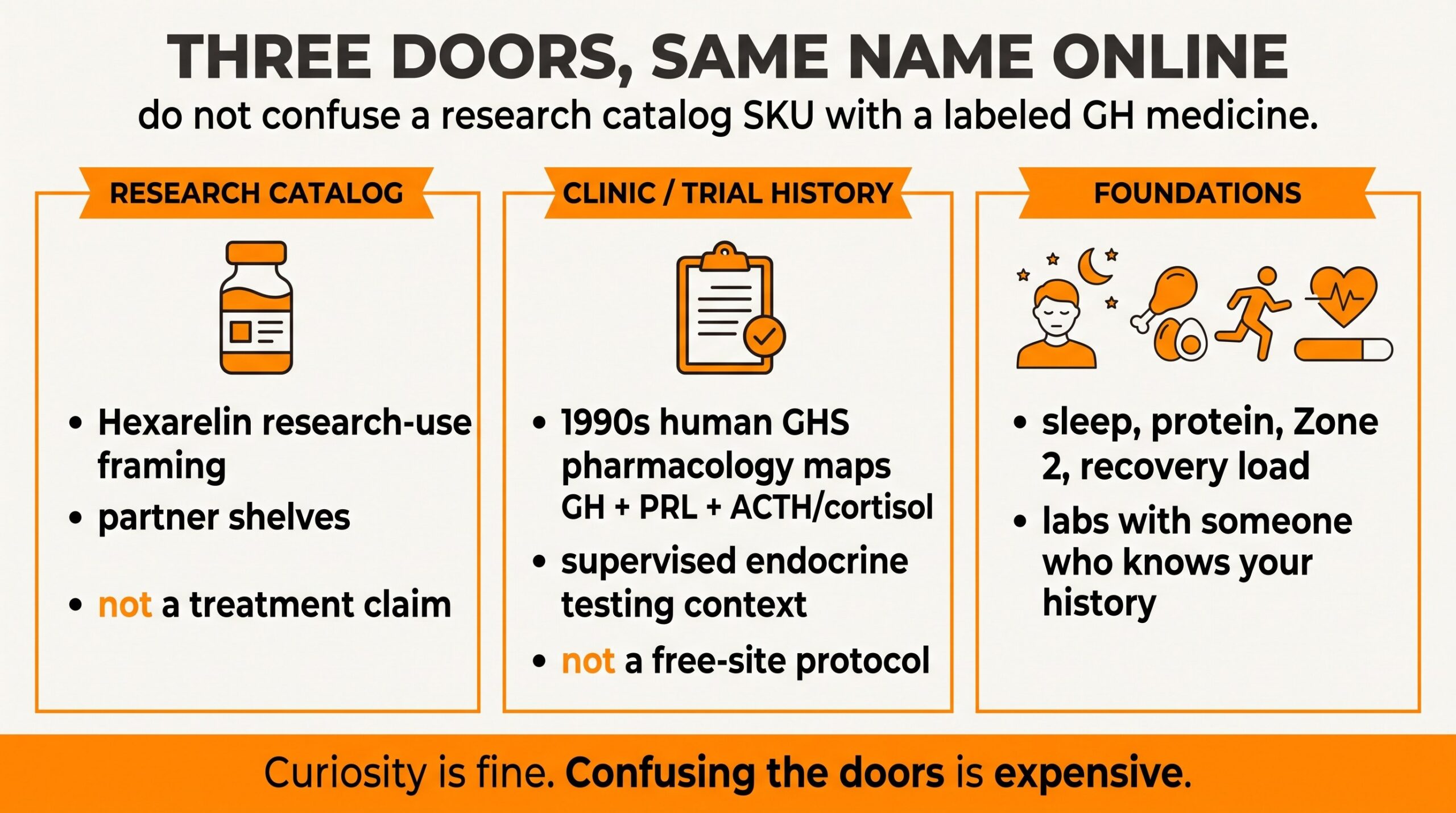
Door 1 — Research catalog. Partner shelves can list Hexarelin as a research sequence. That is a SKU and a certificate story. It is not a GH prescription, not a pediatric GHD protocol, and not FDA-approved human growth hormone.
Door 2 — Clinic / trial history. Human hexarelin work lives in endocrine pharmacology files from the 1990s onward: IV and SC schedules, route comparisons, age-related response maps, and HPA-axis probing. Those are supervised research maps. They are not package inserts for a research catalog.
Door 3 — Foundations. Sleep architecture, protein intake, Zone 2 / VO2 context, recovery load, and labs with someone who knows your history. If GH output is quiet because you are under-slept or under-fueled, a loud GHS dial does not fix the root cause.
Why this matters: people lose money and risk when they buy Door 1 while pretending it is Door 2.
So what for you: foundations and a clinician first. Research curiosity second. Pro if you want protocol depth later.
Hexarelin vs ipamorelin vs other GH-lane maps
Quick orientation, not a stack recipe.
Hexarelin: classic loud GHRP-family secretagogue. Strong GH signal in older human files. Side channels for prolactin and cortisol are part of the honest story.
Ipamorelin: usually pitched as the more selective GH secretagogue with less PRL/cortisol drama. See the Ipamorelin map and the CJC-1295 / Ipamorelin blend map.
Sermorelin / Tesamorelin / MK-677: different doors in the same broader GH conversation — GHRH analog, FDA-labeled visceral-fat context for tesamorelin in specific patients, and oral ghrelin-mimetic territory for MK-677. Separate ranking pages exist so you do not mash them into one Discord caption.
Why this matters: “GH peptide” is a marketing bucket. Mechanism and side-channel honesty are the real filters.
So what for you: pick the map that matches the question you actually have. Do not buy the loudest vial by default.
Who this page is (and is not) for
This page is for curious readers who want the hexarelin cascade explained cleanly and want partner SKUs labeled as research options.
This page is not for anyone trying to treat adult GH deficiency, childhood short stature, heart failure, sarcopenia, obesity, or insomnia with a crimp-cap vial from a research catalog.
GH-axis products are high YMYL. Education is fine. Disease hustle is how domains die.
Related foundation reads on this site: protein intake, sleep, Zone 2, VO2 max, HRV, and cold plunge as recovery context — never as “peptides that treat low GH.”
Why this matters: the expensive mistake is buying a story you cannot falsify.
So what for you: keep a clinician in the loop for suspected GH deficiency, unexplained low IGF-1, pituitary history, or any hormone workup. Do not argue with captions.
Where I look for a hexarelin research compound
Partner reality on today’s check: Paramount lists Hexarelin 5 mg InStock on a public product page. BioLongevity / Limitless / Peptira / S1 get home or shop chips only for this map unless a Drive-tracked hexarelin SKU is live. I do not invent product hrefs outside Lee’s Drive Affiliate Link Generators sheet.
Research-catalog SKU currently live on partner check (not a treatment recommendation).
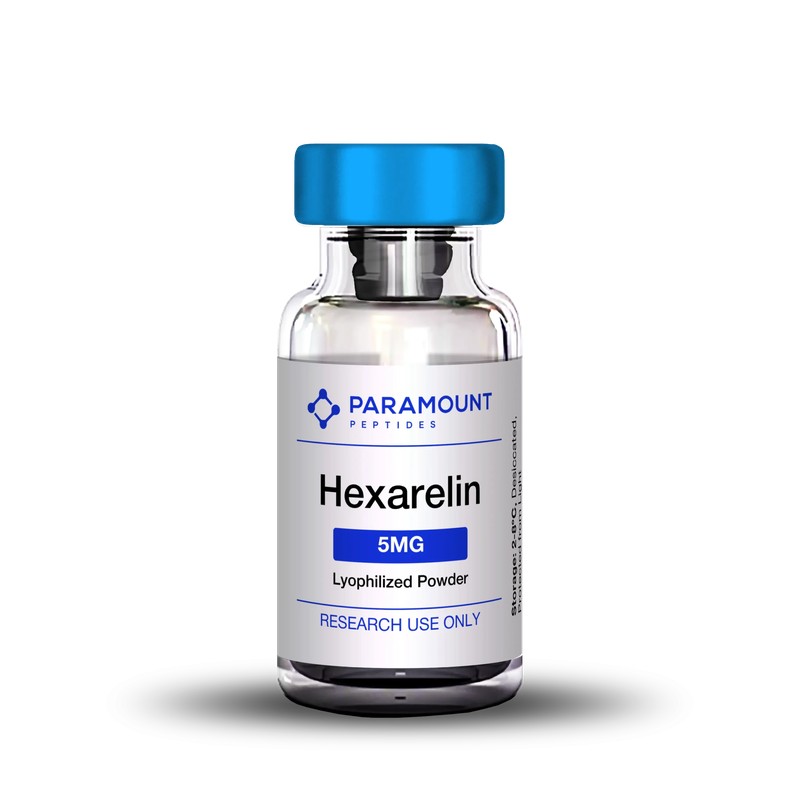 Paramount
Hexarelin 5 mg
LEE10Paramount Hexarelin 5 mg · LEE10Limitless home · LEE20BioLongevity home · LEE15Paramount home · LEE10Peptira home · LEES1 shop · LEE10
If you ever reconstitute a lyophilized research peptide, learn the math first on how to reconstitute peptides. That page is public education. It is not a hexarelin protocol.
Why this matters: one InStock hero card beats five mystery tabs when you are only browsing research options.
So what for you: match the SKU photo to the link. Codes only work when the tracking fires.
Related research maps (convert after foundations)
Foundation first. Then research curiosity. Never “peptides that treat low GH / fat loss / recovery” as a claim.
If you are mapping adjacent research shelves after the hexarelin story, these partner SKUs were InStock on today’s check:
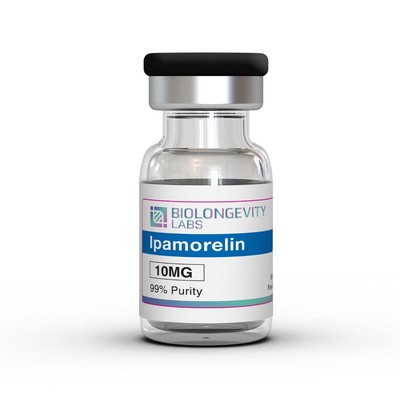 BioLongevity
Ipamorelin 10 mg
LEE15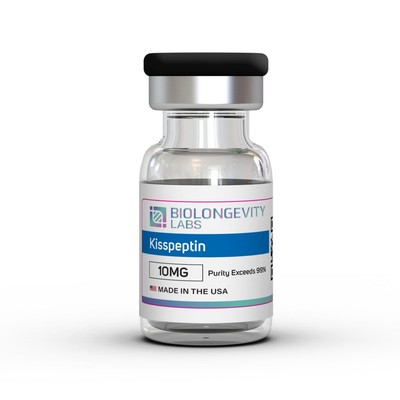 BioLongevity
Kisspeptin 10 mg
LEE15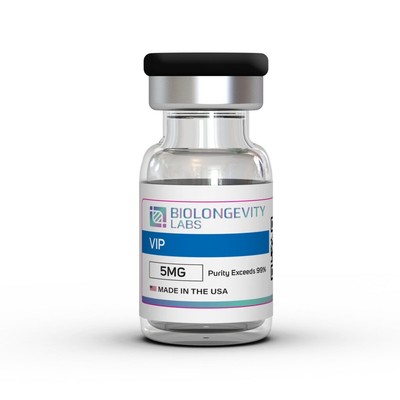 BioLongevity
VIP 5 mg
LEE15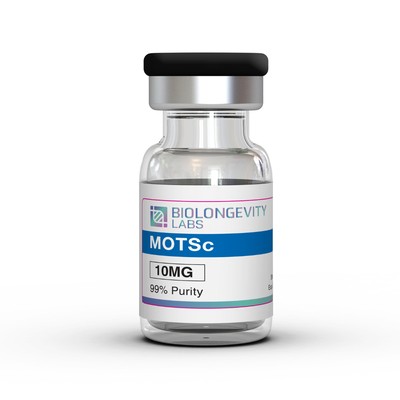 BioLongevity
MOTS-c 10 mg
LEE15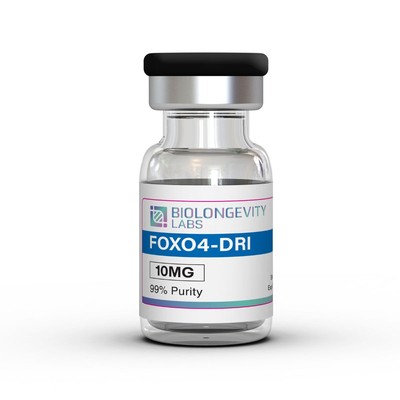 BioLongevity
FOXO4-DRI 10 mg
LEE15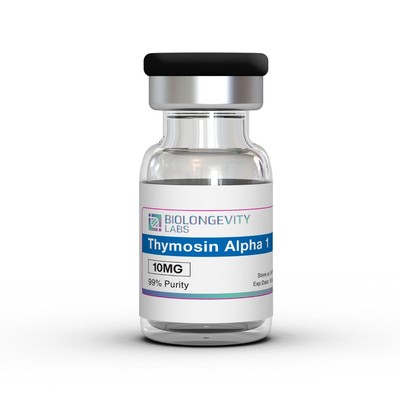 BioLongevity
Thymosin Alpha-1 10 mg
LEE15Deep-dive pages for the ones that already have ranking maps: Ipamorelin, Kisspeptin, VIP, MOTS-c, FOXO4-DRI, TA1, Sermorelin, Tesamorelin.
Evidence limits
Strongest clean human biology punch for a ranking reader is the Ghigo 1994 route/dose GH map plus the Massoud/Arvat honesty on prolactin and HPA side channels. Receptor papers lock the GHS-R1a / ghrelin axis importance.
Partner catalogs are not selling a labeled GH medicine. Hexarelin on a research shelf is not recombinant human GH, and neither is a DIY adult-GHD protocol.
If you have suspected GH deficiency, pituitary disease, unexplained low IGF-1, childhood growth concerns, or cardiac symptoms that worry you, this is a clinician conversation. Not a research-cart conversation.
Why this matters: confidence framing protects your wallet and your risk file.
So what for you: use this page to get smarter. Use a clinician to get safer. Use Pro if you want protocol depth without random Discord screenshots.
Sources & Further Reading
- Ghigo E, et al. Growth hormone-releasing activity of hexarelin, a new synthetic hexapeptide, after intravenous, subcutaneous, intranasal, and oral administration in man. J Clin Endocrinol Metab. 1994. PubMed 8126144
- Massoud AF, et al. Hexarelin-induced growth hormone, cortisol, and prolactin release: a dose-response study. J Clin Endocrinol Metab. 1996. PubMed 8954038
- Howard AD, et al. A receptor in pituitary and hypothalamus that functions in growth hormone release. Science. 1996. PubMed 8688086
- Arvat E, et al. Hexarelin, a synthetic growth-hormone releasing peptide, shows no interaction with corticotropin-releasing hormone and vasopressin on adrenocorticotropin and cortisol secretion in humans. Neuroendocrinology. 1997. PubMed 9430449
- Arvat E, et al. The GH, prolactin, ACTH and cortisol responses to Hexarelin, a synthetic hexapeptide, undergo different age-related variations. Eur J Endocrinol. 1997. PubMed 9437229
- Kojima M, et al. Ghrelin is a growth-hormone-releasing acylated peptide from stomach. Nature. 1999. PubMed 10604470
- Korbonits M, et al. The growth hormone secretagogue hexarelin stimulates the hypothalamo-pituitary-adrenal axis via arginine vasopressin. J Clin Endocrinol Metab. 1999. PubMed 10404825
- Frieboes RM, et al. Hexarelin decreases slow-wave sleep and stimulates the secretion of GH, ACTH, cortisol and prolactin during sleep in healthy volunteers. Neuropsychopharmacology. 2004. PubMed 15177700
The bottom line
Hexarelin is one of the cleaner classic GHRP-family stories in the research-peptide aisle. Loud GH dial. GHS-R1a lock. Hard human biology in Ghigo 1994. Partner SKUs exist.
It is still not a DIY GH drug. Read the prolactin/cortisol side-channel warning. Talk to a clinician about your actual risk file. Build foundations that do not require a crimp cap.
Want the deeper protocol library after that? Pro is the paid door. Want the free research PDF? Grab the Playbook below.
Free guide
Get The Peptide PlaybookEnter your email and we’ll send the research PDF. Education only — not medical advice.
I built Peptides & Pump so you can get this without a guru tax. Free Knowledge Base first if you are not ready to pay. Pro if you want the protocol library.
 Keep going on Peptides & Pump
Free is the peptide community. Pro is where you master it. Codes are the links. Click them so the discount fires.
Free
Knowledge Base
The peptide community · 2,500+
- 2,500+ member peptide community
- Sourcing questions before you buy anything random
- The basics, from people actually using peptides
Pro
Peptides & Pump Pro
$10/mo · 7-day trial
- Science-backed protocol library
- 1-on-1 support from Lee and Matt
- Step-by-step video, plus a monthly $500 drawing
LEE20 Limitless LEE15 BioLongevity LEE10 Paramount LEE Peptira LEE10 S1
Supplier footnote: Research suppliers I mention when people ask about hexarelin: Paramount Hexarelin 5 mg (code LEE10). Adjacent research maps on BioLongevity: Ipamorelin 10 mg, Kisspeptin 10 mg, VIP 5 mg, MOTS-c, FOXO4-DRI, Thymosin Alpha-1. Partner home/shop chips: Limitless (code LEE20), Paramount (code LEE10), Peptira (code LEE), S1 shop (code LEE10), plus BioLongevity home (code LEE15). Match the product to the job. Do not collect bottles.
Disclaimer. This article is for educational and research purposes only. It is not medical advice. It is not intended to diagnose, treat, cure, or prevent any disease. Hexarelin and other GH secretagogues are not presented here as FDA-approved treatments you should self-administer for adult growth hormone deficiency, childhood short stature, sarcopenia, obesity, heart failure, insomnia, or any other indication. Research peptides discussed here are research sequences; a research-catalog vial is not a compounded prescription and is not a labeled drug. Evidence discussed here includes controlled human pharmacology studies, receptor mapping, and endocrine reviews; none of that is a substitute for a clinician. Individual results vary. Always consult a qualified healthcare provider before starting any peptide, drug, supplement, or protocol, especially if you have a medical condition or take prescription medication. Peptides & Pump does not sell peptides.
Affiliate disclosure. Some links on this page are affiliate links. If you buy through them, I may earn a commission at no extra cost to you. Codes LEE15, LEE20, LEE, and LEE10 are the ones I actually use where a coupon fires. That commission is how I keep publishing free education. I only link suppliers I am willing to put my name on.