GHRP-2 Peptide: What It Does, vs GHRP-6, Side Effects & Evidence
Key takeaways
- Verdict: GHRP-2 is a tiny lab-made peptide that makes your own body release a big, short burst of growth hormone. That part is proven in people.
- It is the stronger cousin of GHRP-6. It still raises hunger, plus some cortisol and prolactin.
- In Japan it is a real hospital drug, but only as a one-time test for low growth hormone. It is not a muscle drug anywhere.
- Not FDA-approved. The FDA flagged it in 2023. Sports bodies ban it. Education only. Not medical advice.
Verdict up front: If you typed GHRP-2 into Google, here is the short answer. It is one of the strongest growth hormone peptides ever made. It hits the GH switch fast and hard, in a way you can see on a lab chart within minutes. But a big spike on a lab chart is not the same thing as more muscle in the mirror.
Here is the twist most people miss. GHRP-2 is the only GHRP that ever became a real, approved medicine. Its job? Helping doctors in Japan find out if a patient’s GH is too low, and that is it.
Why this matters: GHRP-2 has more human data than most peptides you see online. That gives us a rare, honest look at what this kind of peptide does in people, and what it does not.
Keep reading if you want the plain-English map: what GHRP-2 is, how it works, how it compares to GHRP-6 and ipamorelin, what the studies really show, and what the risks are. Brand new to peptides? Start with what peptides are. Want the whole growth hormone lane at once? See HGH peptides.
Quick note. This page is education. It is not medical advice. It does not diagnose or treat anything. And it is not a how-to.
What is GHRP-2?
GHRP-2 stands for growth hormone releasing peptide 2. That is a long name for a simple idea.
A peptide is a short chain of amino acids, which are the small building blocks of protein. GHRP-2 is a chain of just six of them.
It is not found in nature, because it was built in a lab.
Some of its pieces are “mirror image” versions of normal amino acids. One piece does not show up in normal food protein at all. Odd parts like these usually help a peptide resist breakdown in the body. They also make it harder to make cleanly, which matters later.
GHRP-2 has a few other names. You may see pralmorelin, KP-102, or GPA-748. They all point to the same six-piece peptide.
The main name behind it is Dr. Cyril Bowers at Tulane University. In 1984, his team made GHRP-6, the first peptide of this kind. Then they kept tweaking, and GHRP-1 came next, followed by GHRP-2.
By 1993, Bowers reported that each new version worked better in people than the last. GHRP-2 was the strongest of the three. All three beat the body’s own GH-releasing hormone in head-to-head tests. They even worked when swallowed, at high amounts.
A Japanese drug maker, Kaken, later picked up the rights. That is how GHRP-2 ended up in Japanese hospitals.
Why this matters: GHRP-2 does not hand you growth hormone. It asks your own pituitary to release its own GH. The pituitary is a pea-sized gland at the base of your brain. That is a big difference from an HGH shot. It is also why GHRP-2 is not a steroid. If that difference is fuzzy, read peptides vs steroids.
The stop-you number: about 3 times
In 1995, a team from Moscow and London ran a simple test. They used eight healthy young men. Each man got three separate tests on different days, in random order.
- One shot of the body’s own GH-releasing hormone, in its short lab form. That short form is basically sermorelin.
- One shot of GHRP-2 at the same weight-based amount.
- Both together.
Then they measured GH in the blood over the next 90 minutes.
GHRP-2 released about 3 times more GH than the natural-style signal. Same tiny amount, three times the wave.
Adding both together gave the biggest wave of all. In this study it looked like simple adding, not a true multiplier. Other teams did find a multiplier effect. We will get to that.
Another group saw the same pattern in elderly men. GHRP-2 gave close to 5 times more GH than the GHRH signal.
So what for you: GHRP-2 is not a weak peptide. In people, it is one of the strongest GH triggers on record. That is exactly why its safety questions matter so much.
How GHRP-2 works: two handles and a lock
Here is the easiest way to picture it.
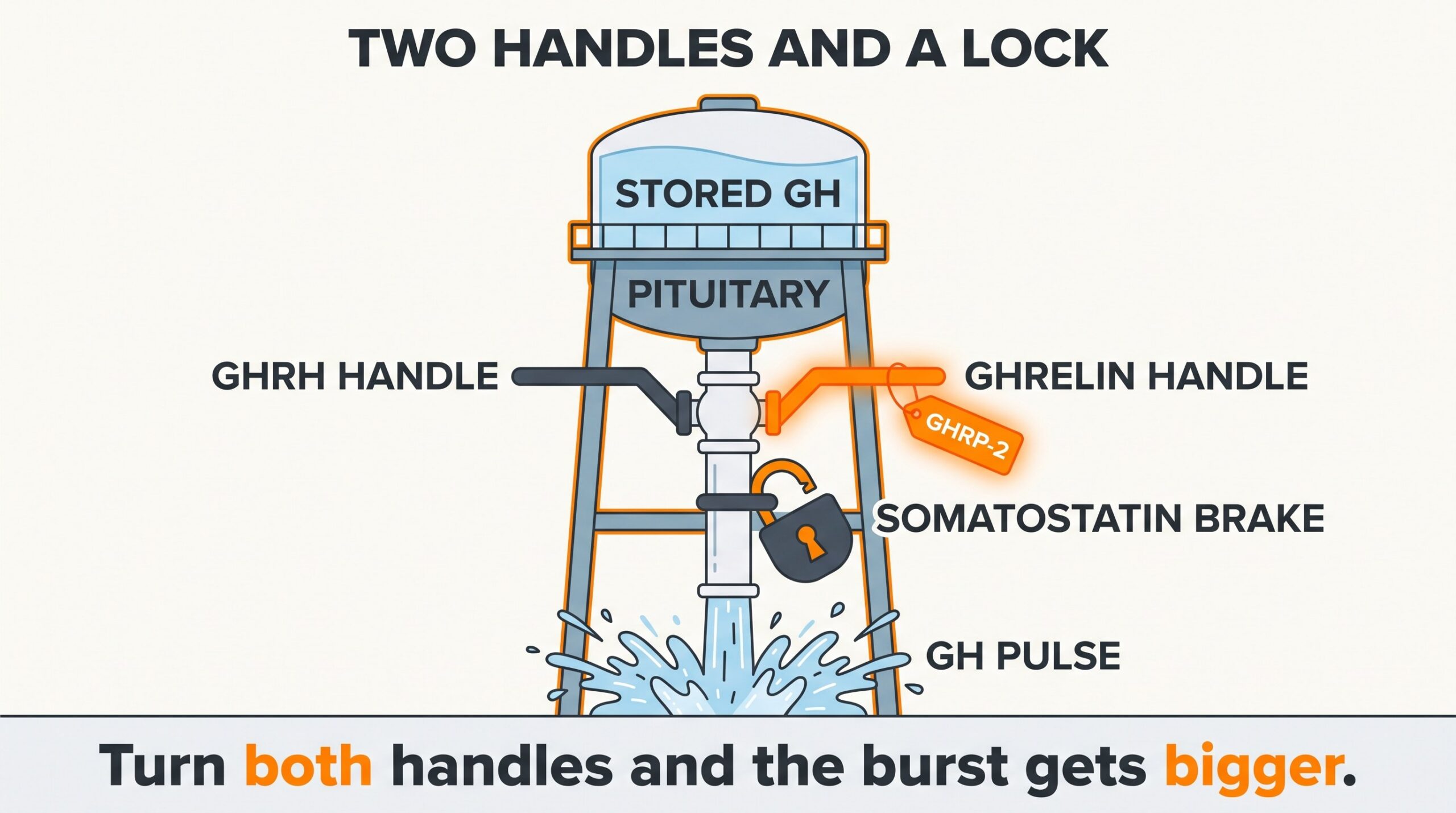
Your pituitary is a water tower, and the tank holds stored growth hormone. At the bottom is one valve with two handles. There is also a lock on the pipe that keeps the water from running all day.
- Handle one is GHRH. That is the GH-releasing hormone your brain makes. Peptides like sermorelin, tesamorelin, and CJC-1295 turn this handle.
- Handle two is ghrelin. Ghrelin is a hormone your stomach makes, and it is best known as the “I’m hungry” signal. GHRP-2 turns this handle.
- The lock is somatostatin. That is your body’s GH brake, and it keeps the tower from draining.
Now some proof for each piece.
GHRP-2 uses the ghrelin handle. In 1996, a Merck team found the receptor this peptide family presses. A receptor is a tiny lock on the outside of a cell that only certain keys fit. In 1999, Japanese scientists found the body’s own key for it, and that key was ghrelin. A 1997 Merck study showed GHRP-2 and GHRP-6 press the very same receptor, even though their shapes differ.
It does not use the GHRH handle. An Australian lab put the human GHRH receptor into cells. GHRH lit those cells up, but GHRP-2 did nothing to them.
But it works best when the GHRH handle works too. A Brazilian team studied people born with a broken GHRH receptor. In them, GHRP-2 raised GH about 4.5-fold, while in healthy people it raised GH about 79-fold. So GHRP-2 can work alone, but it works far better with both handles in play.
It shrugs off the brake a bit. In Kaken’s animal work, GHRP-2 kept working when the GH brake was strong. The body’s own GH-releasing hormone did not. In dogs, GHRH barely moved GH, while GHRP-2 still did.
Then there is the combo. When researchers gave GHRP-2 and GHRH together, the GH pulse often jumped more than the two added up. Scientists call that synergy, which means one plus one equals more than two. A Mayo Clinic study of 47 men found that synergy shrank with age and with more belly fat.
Why this matters: this is the real science behind pairing a “ghrelin handle” peptide with a “GHRH handle” peptide. It is the same idea behind CJC-1295 and ipamorelin. Real physiology is still not a protocol, though.
GHRP-2 vs GHRP-6 vs hexarelin vs ipamorelin
Once GHRP-6 proved the ghrelin handle worked, labs raced to build better keys. Here is the family in plain English.
- GHRP-6: the original from 1984. Strong GH pulse, and famous for hunger.
- GHRP-2: the more potent cousin. It takes less to get a big pulse, but it still raises cortisol, prolactin, and hunger.
- Hexarelin: another super-cousin. In an Italian study in young adults, GHRP-2 and hexarelin gave about the same strong GH pulse.
- Ipamorelin: the “picky” one. In a 1998 pig study, GHRP-2 and GHRP-6 raised stress hormones. Ipamorelin did not, even at over 200 times the amount it needed for GH.
- MK-677: not a peptide at all. It is a pill that turns the same ghrelin handle.
One nerdy detail is worth knowing. In that pig study, GHRP-2 was the most potent. That means it needed the smallest amount to get a GH response. But its top-end GH peak was a bit lower than GHRP-6. In other words, potent and powerful are not the same word.
The Italian study also checked the side hormones. GHRP-2 raised prolactin, a little. It raised ACTH and cortisol about as much as a standard stress-hormone test drug. ACTH is the signal that tells your adrenal glands to make cortisol.
So what for you: “GHRP-2 or GHRP-6?” is mostly a question of punch versus side effects. Neither one is a clean, GH-only switch. If clean is the goal, that is the whole reason ipamorelin exists.
The hunger number: 36% more food
If GHRP-2 turns the hunger hormone’s handle, you can guess what comes next.
In 2005, a New York team ran a clean little test. Seven lean, healthy men got a slow drip of GHRP-2 or salt water. After four and a half hours, they sat down to a buffet.
On GHRP-2, they ate about 36% more. Every single man ate more. What they chose to eat did not change. They simply ate more of it.
Kids tell a slightly different story. In a Chilean study, ten children with low GH took GHRP-2 by mouth for a year. Seven of ten said they felt hungrier, mostly in the first six months. Their weight-for-height did not change in a meaningful way.
There is also one striking case from Japan. A woman with severe, long-term anorexia used a GHRP-2 nose spray before meals. She felt hungrier and slowly gained weight. That is one person, though, and one case is a clue, not proof.
Why this matters: for most people chasing a lean look, extra hunger is a real cost. For researchers studying wasting and poor appetite, it is the interesting part. It is the same effect with two very different reactions.
The medical job GHRP-2 actually has
This is the part almost nobody online ever talks about.
Doctors sometimes need to know if an adult truly makes too little growth hormone. The classic test is rough, because it drops your blood sugar on purpose with insulin and then checks if GH rises. That can be risky for some patients.
Japan found a gentler path. A single dose of GHRP-2 is given in the clinic, and then GH is checked over the next hour or two.
In a 2007 Japanese study, healthy people’s GH peaked at about 85 on average. People with known GH deficiency peaked at about 1.4. That is a huge gap between the two groups, which is exactly what makes it a useful test.
Later Japanese work found a bonus, since GHRP-2 also nudges ACTH. So the same test can help flag a weak stress-hormone system, too.
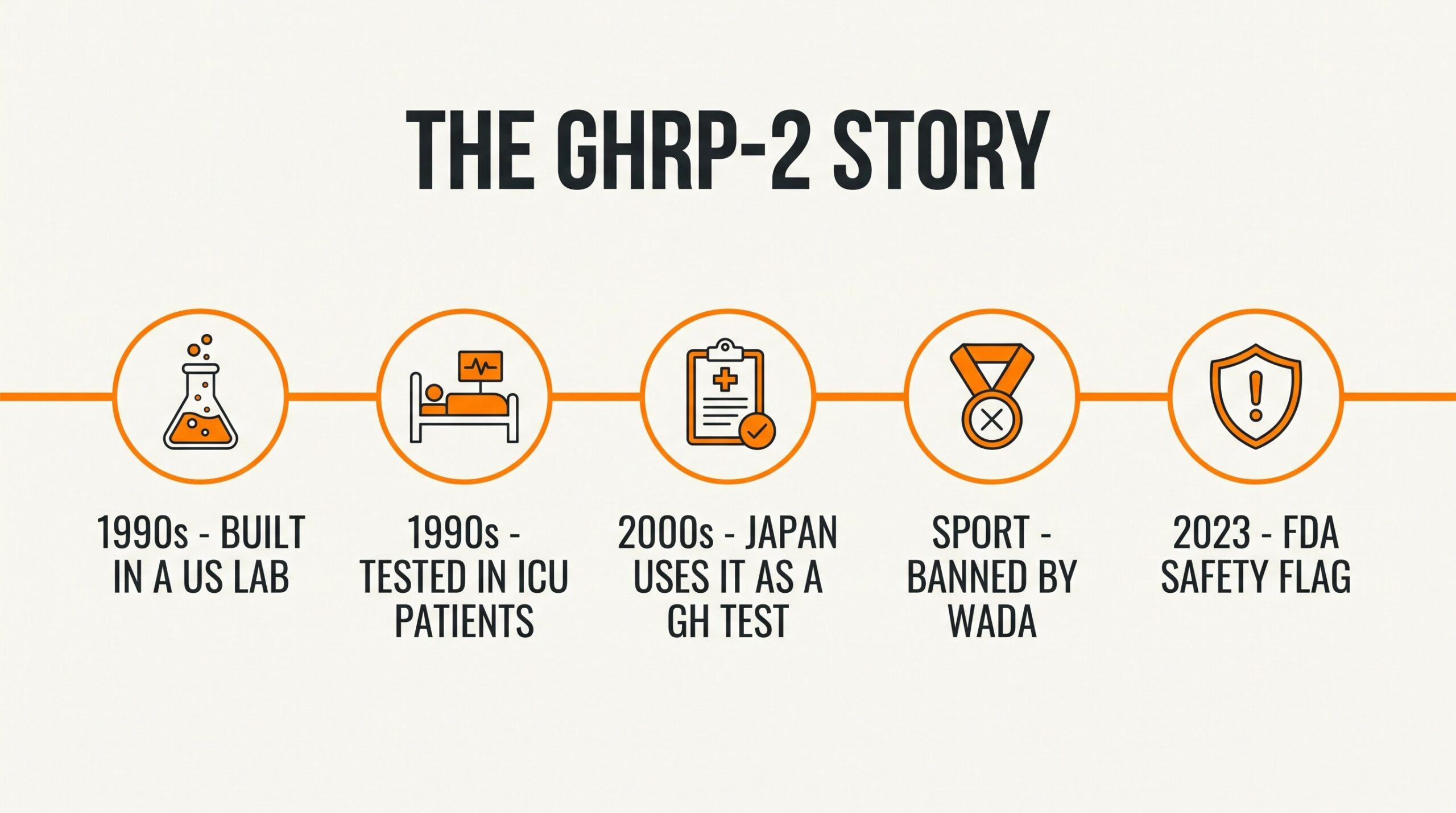
So what for you: the one approved use for GHRP-2 is a one-time test in a doctor’s office. It is not a treatment, and nobody approved it for muscle, fat loss, or aging.
The ICU studies: a lesson in caution
In the late 1990s, a Belgian team asked a bold question. Very sick ICU patients waste away, and their GH pulses get weak. Could GHRP-2 wake their GH system back up?
In one 1997 study, a day-long drip of GHRP-2 raised GH about 4 to 6 times in long-stay ICU patients. Their IGF-1 rose about 61% within a day. IGF-1 is the main growth signal your liver makes when GH goes up, so it is a good sign GH is doing something.
A 2002 follow-up tried GHRP-2 alone, or GHRP-2 paired with other brain hormones. GHRP-2 alone brought GH and IGF-1 back up. But it did not cut a key marker of protein breakdown. The combos did.
Here is why this matters so much. Around the same time, two big trials gave actual HGH to over 500 ICU patients. Deaths in the hospital about doubled with HGH. The FDA also notes reports of deaths among critically ill study patients who got GHRP-2, though it says cause was not proven.
Why this matters: a better hormone number is not the same as a better outcome. The ICU story is the clearest proof of that in this whole field.
Does GHRP-2 build muscle or burn fat?
Short answer: nobody has proven that in healthy adults.
Here is what the human studies actually measured, in plain English.
- Daily shots fade. A Dutch team gave nine healthy young men one GHRP-2 shot a day for five days. The GH peak dropped from about 83 to about 51 by day five. IGF-1 did not rise at all. One bone marker did go up.
- A steady pump did better. A 2004 study gave older adults GHRP-2 through a small under-skin pump for 30 days. GH stayed higher, and IGF-1 rose to a steady plateau. Safety labs stayed normal. But its headline results were hormone numbers, not muscle or fat.
- Kids grew a bit faster. In small studies of short children, GHRP-2 by nose spray or shot sped up growth modestly. IGF-1 often did not budge. The GH effect from shots was short.
- A quick fat signal. In elderly men, free fatty acids rose about 60% soon after a dose. Those are fats released into the blood. That hints fat was being freed up. It is not the same as losing fat.
The muscle story mostly lives in rats. In rats given a steroid drug or a bad burn, GHRP-2 calmed the genes that break muscle down. In arthritic rats, it lowered swelling and an inflammation signal. Those are interesting clues, but they are not human results.
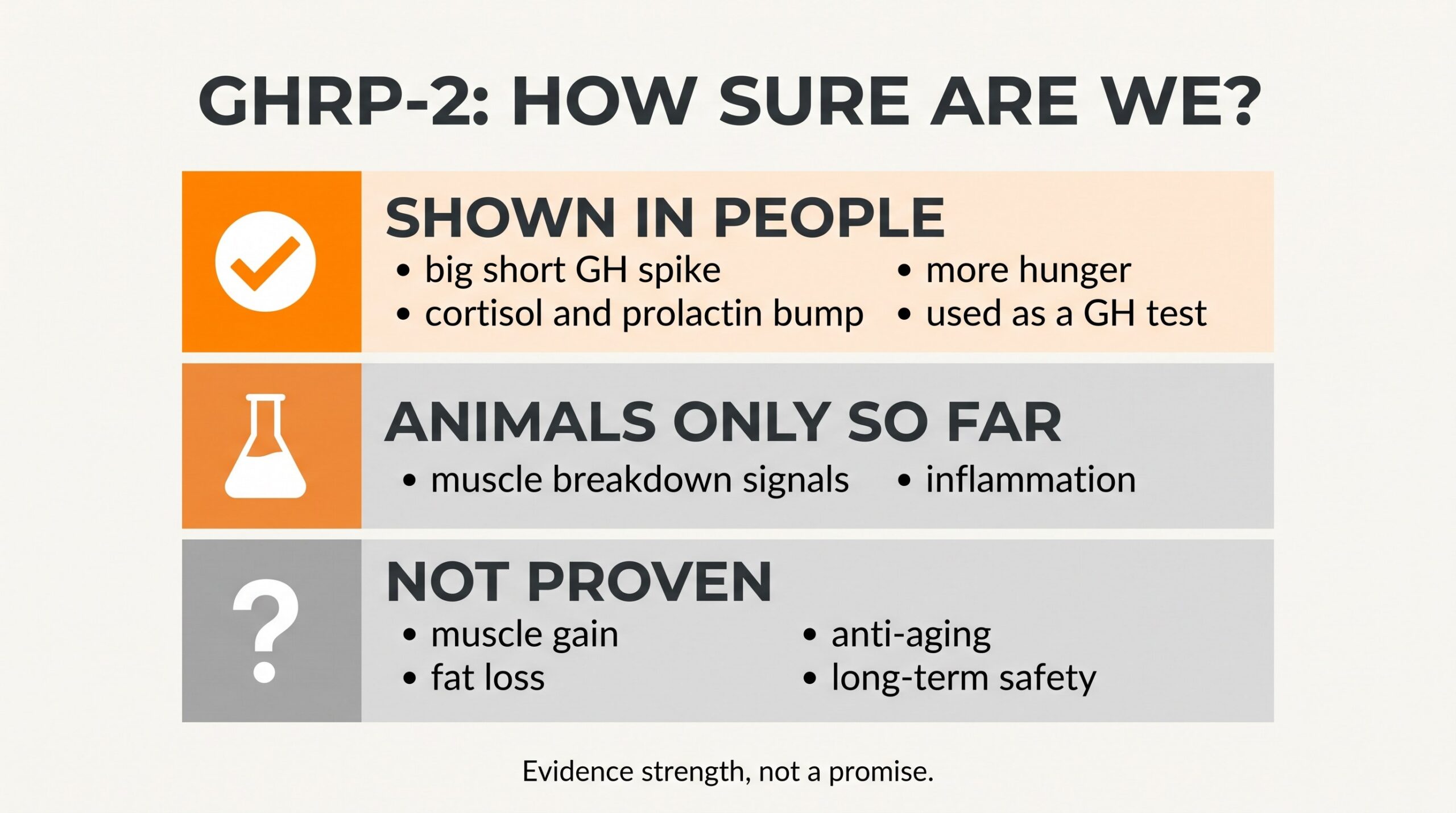
So what for you: GHRP-2 reliably moves GH in people. It has not been shown to change muscle, fat, or aging in healthy people. Anyone who promises those results is selling past the science. For the bigger picture, see peptides for bodybuilding.
GHRP-2 side effects and safety flags
Here is the plain list of what the research and the FDA flag.
- Hunger. Often noticeable, since it is the ghrelin handle, after all.
- Cortisol, ACTH, and prolactin bumps. Seen in human studies. Cortisol is your main stress hormone. Prolactin is best known as the milk hormone.
- Blood sugar. The FDA cites reports of patients needing more insulin to control blood sugar. Reviews of this whole family flag the same concern.
- The response fades. With daily shots, the GH pulse got smaller within days.
- Immune reactions and impurities. In 2023, the FDA put GHRP-2 shots and nose sprays on its list of compounding substances that may carry significant safety risks. It cited clumped peptide, impurities, and that odd amino acid that makes GHRP-2 hard to check.
- Other reports. The FDA also lists infection and pancreatitis among reported serious events. It says cause was not proven.
- Unknown long-term effects. GH and IGF-1 are growth signals. Nobody has run the long studies needed to rule out problems over years.
A 2026 review of this peptide class adds the street-level list. Think water retention, achy joints and muscles, and injection-site reactions. Its authors also point out that nobody really knows what is in many online vials.
Some people should not treat this as a curiosity at all. That includes anyone pregnant or breastfeeding, anyone under 18, anyone with diabetes or prediabetes, and anyone with a past or current cancer. If that is you, this is a talk-to-your-doctor topic, full stop.
Why this matters: side effects here are mostly hormone side effects. You cannot feel your blood sugar or prolactin creeping up, and only labs can show it. For the wider list, read peptide side effects and are peptides safe?
Is GHRP-2 legal? And will it show up on a test?
Short answer: it is complicated, and it is not a green light.
In the U.S., GHRP-2 is not FDA-approved for any use. There is no approved label, dose, or product. Compounding pharmacies are restricted from making it. Online, it is usually sold as a “research peptide” labeled not for human use.
Japan is the exception. There, it is approved as a diagnostic test drug, which is a narrow medical use, not a wellness one.
Sport is simple. The World Anti-Doping Agency bans it, and labs can find it.
- A Tokyo anti-doping lab built a urine test that found GHRP-2 in all ten men given a dose.
- A Moscow lab found GHRP-2 and its breakdown pieces in urine up to about 47 hours after one nasal dose.
- A German lab found GHRP-2 hidden in tablets sold as an over-the-counter supplement.
- Polish and German labs have found tweaked “designer” versions of GHRP-2 in seized vials. Someone added one extra amino acid, likely to dodge tests.
So what for you: labels on this market do not always match what is in the vial. Read counterfeit research peptides, are peptides legal, and what research peptides really are before you form an opinion. Rules differ by country and can change.
How a beginner should think about GHRP-2
Start with the question you want answered, not the vial.
1. Build the base first. Your biggest natural GH pulse comes in deep sleep. Lifting and enough protein give that GH something to work with. If those are shaky, start with how to sleep better and how much protein you need. That is where most of the return is.
2. Name the handle. Is the peptide you are reading about a GHRH-handle peptide or a ghrelin-handle peptide? GHRP-2 is ghrelin. Sermorelin and CJC-1295 are GHRH. If you cannot say which, you are not ready to judge it.
3. Ask what was measured. A GH spike on a chart is a lab number. More muscle, less fat, or better sleep are real-life results. GHRP-2 has strong data on the first. It has almost no human data on the rest.
4. Know your numbers. Hormone peptides touch blood sugar, cortisol, and prolactin. A clinician can check baseline labs like fasting glucose, HbA1c, and IGF-1. That talk is worth more than any forum thread.
5. Skip the copy-paste stack. We do not post dosing or cycles on public pages. That depth lives in Peptides & Pump Pro, with the context it needs. If a vial is ever on the table, at least learn the basics in how to reconstitute peptides and bacteriostatic water.
New here? Start Here. Want the deeper library and a group of people doing the same work? Join the community.
Why this matters: people who jump straight to a hormone peptide usually skip the cheap stuff that works. Build the base, then get curious.
GHRP-2 FAQ
Is GHRP-2 the same as pralmorelin?
Yes. Pralmorelin is the drug name for GHRP-2. KP-102 and GPA-748 are older lab code names for the same peptide.
Is GHRP-2 stronger than GHRP-6?
Per dose, yes. It takes less GHRP-2 to get a big GH pulse. In one animal study, though, GHRP-6 reached a slightly higher top peak. Both bring hunger and stress-hormone bumps. Compare them on our GHRP-6 page.
GHRP-2 or ipamorelin: which is “cleaner”?
In animal work, ipamorelin released GH without the cortisol bump seen with GHRP-2. That is why people call it the more selective one. Neither is FDA-approved, and neither has long-term outcome trials. See ipamorelin.
Is GHRP-2 the same as HGH?
No. HGH is the growth hormone itself. GHRP-2 asks your pituitary to release its own GH in a short pulse, and your body’s brakes still apply.
How long does GHRP-2 last?
Not long. In a small study of children, half of it was gone from the blood in about 33 minutes after a dose into a vein. GH peaked about 25 minutes after the dose. That fast in, fast out pattern may help explain why a steady pump moved IGF-1 in studies while daily shots did not.
Does GHRP-2 work as a pill?
In studies, it did raise GH when swallowed. It took far more peptide by mouth than by shot, though. If you want the oral ghrelin-handle story, that is MK-677.
Is GHRP-2 a steroid?
No. Steroids are built on a cholesterol backbone, while GHRP-2 is a short chain of amino acids. It nudges your own gland to release GH. It does not act on testosterone receptors.
The bottom line
GHRP-2 is the stronger cousin of GHRP-6. It reliably makes your body release a big, fast pulse of growth hormone. It works even better with the GHRH handle in play. It also brings hunger, plus cortisol and prolactin along for the ride.
It earned one real medical job: a GH test in Japan. The ICU studies showed better hormone numbers, not proven better outcomes. Muscle, fat loss, and anti-aging claims are not proven in people. In the U.S., it is not FDA-approved, and the FDA has flagged safety concerns.
Learn the handles. Build the base, and bring a clinician into any hormone decision. That is how you stay curious without getting burned.
GH-axis research maps from partners
Foundation first: sleep, protein, and lifting do the heavy work. If you are researching the GH lane after that, these are in-stock partner listings for the ghrelin-handle and GHRH-handle peptides covered on this site, plus a few common neighbors. They are research-catalog products, not treatments.
After the foundation — GH-axis research maps (InStock partners)
 BioLongevity
CJC / Ipamorelin
LEE15 Paramount
CJC / Ipamorelin
LEE10 BioLongevity
Ipamorelin
LEE15 Paramount
Hexarelin 5 mg
LEE10 BioLongevity
BPC-157
LEE15 BioLongevity
TB-500
LEE15 BioLongevity
Wolverine Blend
LEE15 Paramount
Wolverine Blend
LEE10 Paramount
GHK-Cu
LEE10 Paramount
Recon Solution
LEE10Partner homes
S1 shop · LEE10 Peptira home · LEE Paramount home · LEE10 BioLongevity home · LEE15 Limitless home · LEE20 Their catalog needs a quick research-access sign-up before prices show. Use code LEE20 at checkout.
Adjacent research maps only. Codes live in the links. Education framing — not a treat-disease pitch.
Key takeaways (echo)
- GHRP-2 is a six-piece lab peptide from the GHRP family. It makes your own pituitary release a big, short GH pulse.
- It turns the ghrelin (hunger hormone) handle. Hunger, plus some cortisol, ACTH, and prolactin, come along.
- It works best with the GHRH handle also working. That two-handle synergy is real physiology, not a protocol.
- Its one approved job is a GH test in Japan. Muscle, fat loss, and anti-aging are not proven in people.
- Not FDA-approved. FDA safety flags. WADA-banned. Build the base first, and bring a clinician into hormone decisions.
Get the Peptide Playbook
Free email map for building the foundation first, then thinking clearly about peptides without the guru noise.
Related reads: GHRP-6 · Hexarelin · Ipamorelin · MK-677 · CJC-1295 + ipamorelin · Sermorelin · Tesamorelin · HGH peptides · IGF-1 LR3 · Are peptides safe?
Sources & Further Reading
- Bowers CY, et al. On the in vitro and in vivo activity of a new synthetic hexapeptide that acts on the pituitary to specifically release growth hormone. Endocrinology. 1984. PMID 6714155
- Bowers CY. GH releasing peptides–structure and kinetics. J Pediatr Endocrinol. 1993. PMID 8374685
- Anonymous. Pralmorelin: GHRP 2, GPA 748, growth hormone-releasing peptide 2, KP-102 D, KP-102 LN, KP-102D, KP-102LN. Drugs R D. 2004. PMID 15230633
- Doi N, et al. Pharmacological characteristics of KP-102 (GHRP-2), a potent growth hormone-releasing peptide. Arzneimittelforschung. 2004. PMID 15646370
- Howard AD, et al. A receptor in pituitary and hypothalamus that functions in growth hormone release. Science. 1996. PMID 8688086
- Kojima M, et al. Ghrelin is a growth-hormone-releasing acylated peptide from stomach. Nature. 1999. PMID 10604470
- Cheng J, et al. Growth hormone releasing peptides: a comparison of the growth hormone releasing activities of GHRP-2 and GHRP-6 in rat primary pituitary cells. Life Sci. 1997. PMID 9096259
- Chen C, et al. Growth hormone-releasing peptide-2 (GHRP-2) does not act via the human growth hormone-releasing factor receptor in GC cells. Endocrine. 1998. PMID 9798733
- Gondo RG, et al. Growth hormone-releasing peptide-2 stimulates GH secretion in GH-deficient patients with mutated GH-releasing hormone receptor. J Clin Endocrinol Metab. 2001. PMID 11443201
- Tiulpakov AN, et al. GH responses to intravenous bolus infusions of GH releasing hormone and GH releasing peptide 2 separately and in combination in adult volunteers. Clin Endocrinol (Oxf). 1995. PMID 7586605
- Van Dam PS, et al. Reduction of free fatty acids by acipimox enhances the growth hormone (GH) responses to GH-releasing peptide 2 in elderly men. J Clin Endocrinol Metab. 2000. PMID 11134132
- Veldhuis JD, et al. Determinants of GH-releasing hormone and GH-releasing peptide synergy in men. Am J Physiol Endocrinol Metab. 2009. PMID 19240251
- Bowers CY, et al. Sustained elevation of pulsatile growth hormone (GH) secretion and insulin-like growth factor I (IGF-I), IGF-binding protein-3 (IGFBP-3), and IGFBP-5 concentrations during 30-day continuous subcutaneous infusion of GH-releasing peptide-2 in older men and women. J Clin Endocrinol Metab. 2004. PMID 15126555
- Bowers CY, et al. GHRP-2, GHRH and SRIF interrelationships during chronic administration of GHRP-2 to humans. J Pediatr Endocrinol Metab. 1996. PMID 8887169
- Arvat E, et al. Effects of GHRP-2 and hexarelin, two synthetic GH-releasing peptides, on GH, prolactin, ACTH and cortisol levels in man. Comparison with the effects of GHRH, TRH and hCRH. Peptides. 1997. PMID 9285939
- Raun K, et al. Ipamorelin, the first selective growth hormone secretagogue. Eur J Endocrinol. 1998. PMID 9849822
- Laferrère B, et al. Growth hormone releasing peptide-2 (GHRP-2), like ghrelin, increases food intake in healthy men. J Clin Endocrinol Metab. 2005. PMID 15699539
- Mericq V, et al. Changes in appetite and body weight in response to long-term oral administration of the ghrelin agonist GHRP-2 in growth hormone deficient children. J Pediatr Endocrinol Metab. 2003. PMID 14513874
- Haruta I, et al. One-year intranasal application of growth hormone releasing peptide-2 improves body weight and hypoglycemia in a severely emaciated anorexia nervosa patient. J Cachexia Sarcopenia Muscle. 2015. PMID 26401470
- Chihara K, et al. A simple diagnostic test using GH-releasing peptide-2 in adult GH deficiency. Eur J Endocrinol. 2007. PMID 17609397
- Kageyama K, et al. Diagnostic usefulness of the growth hormone-releasing peptide-2 test as a substitute for the insulin tolerance test in hypopituitarism. Endocr J. 2008. PMID 18493103
- Suzuki S, et al. Clinical Usefulness of the Growth Hormone-Releasing Peptide-2 Test for Hypothalamic-Pituitary Disorder. J Endocr Soc. 2022. PMID 35795807
- Van den Berghe G, et al. The somatotropic axis in critical illness: effect of continuous growth hormone (GH)-releasing hormone and GH-releasing peptide-2 infusion. J Clin Endocrinol Metab. 1997. PMID 9024260
- Van den Berghe G, et al. The combined administration of GH-releasing peptide-2 (GHRP-2), TRH and GnRH to men with prolonged critical illness evokes superior endocrine and metabolic effects compared to treatment with GHRP-2 alone. Clin Endocrinol (Oxf). 2002. PMID 12030918
- Takala J, et al. Increased mortality associated with growth hormone treatment in critically ill adults. N Engl J Med. 1999. PMID 10477776
- Nijland EA, et al. A five day treatment with daily subcutaneous injections of growth hormone-releasing peptide-2 causes response attenuation and does not stimulate insulin-like growth factor-I secretion in healthy young men. Eur J Endocrinol. 1998. PMID 9820615
- Mericq V, et al. Effects of eight months treatment with graded doses of a growth hormone (GH)-releasing peptide in GH-deficient children. J Clin Endocrinol Metab. 1998. PMID 9661608
- Pihoker C, et al. Treatment effects of intranasal growth hormone releasing peptide-2 in children with short stature. J Endocrinol. 1997. PMID 9390009
- Pihoker C, et al. Pharmacokinetics and pharmacodynamics of growth hormone-releasing peptide-2: a phase I study in children. J Clin Endocrinol Metab. 1998. PMID 9543135
- Yamamoto D, et al. GHRP-2, a GHS-R agonist, directly acts on myocytes to attenuate the dexamethasone-induced expressions of muscle-specific ubiquitin ligases, Atrogin-1 and MuRF1. Life Sci. 2008. PMID 18191156
- Sheriff S, et al. Ghrelin receptor agonist, GHRP-2, attenuates burn injury-induced MuRF-1 and MAFbx expression and muscle proteolysis in rats. Peptides. 2009. PMID 19577604
- Granado M, et al. Anti-inflammatory effect of the ghrelin agonist growth hormone-releasing peptide-2 (GHRP-2) in arthritic rats. Am J Physiol Endocrinol Metab. 2005. PMID 15507538
- Okano M, et al. Determination of growth hormone secretagogue pralmorelin (GHRP-2) and its metabolite in human urine by liquid chromatography/electrospray ionization tandem mass spectrometry. Rapid Commun Mass Spectrom. 2010. PMID 20552695
- Semenistaya E, et al. Determination of growth hormone releasing peptides metabolites in human urine after nasal administration of GHRP-1, GHRP-2, GHRP-6, Hexarelin, and Ipamorelin. Drug Test Anal. 2015. PMID 25869809
- Thomas A, et al. Identification of the growth-hormone-releasing peptide-2 (GHRP-2) in a nutritional supplement. Drug Test Anal. 2010. PMID 20878896
- Popławska M, et al. Identification of a novel growth hormone releasing peptide (a glycine analogue of GHRP-2) in a seized injection vial. Drug Test Anal. 2019. PMID 30051972
- Krug O, et al. Analysis of new growth promoting black market products. Growth Horm IGF Res. 2018. PMID 29864719
- Sigalos JT, et al. The Safety and Efficacy of Growth Hormone Secretagogues. Sex Med Rev. 2018. PMID 28400207
- Dominikowski A, et al. The emerging landscape of performance-enhancing peptides modulating GH-IGF1 axis: bridging the gap between clinical evidence and patient self-administration. Front Endocrinol (Lausanne). 2026. PMID 42395176
- U.S. Food and Drug Administration. Certain bulk drug substances for use in compounding that may present significant safety risks (GHRP-2 entry, injectable and nasal routes, 503B category 2, added Sept 29, 2023). FDA.gov
- World Anti-Doping Agency. The Prohibited List (S2: peptide hormones, growth factors, related substances and mimetics). WADA