GHRP-6 Peptide: What It Does, Hunger, Side Effects & Evidence
Key takeaways
- Verdict: GHRP-6 is a tiny lab-made peptide that makes your body release a big, short burst of growth hormone. That part is proven in people.
- It rings the same “doorbell” as ghrelin, your hunger hormone. That is why hunger is its calling card.
- Muscle, fat loss, and anti-aging claims are not proven in people. The heart and healing studies are mostly in animals.
- It is not FDA-approved. The FDA has flagged safety concerns. Sports bodies ban it. Education only. Not medical advice.
Verdict up front: If you typed GHRP-6 into Google, here is the short answer. It is one of the oldest growth hormone peptides around. It works on the GH switch fast and hard. But a big hormone spike on a lab chart is not the same thing as more muscle in the mirror.
Here is the fun part. GHRP-6 was built in the early 1980s, years before anyone knew what it was plugging into. Scientists cut the key before they ever found the lock.
Why this matters: GHRP-6 is the grandpa of a whole family. Ipamorelin, hexarelin, and the pill MK-677 all trace back to it. Understand this one and the rest of the family gets easy.
Keep reading if you want the plain-English map: what GHRP-6 is, how it works, why it makes people hungry, how it stacks up to its cousins, what the studies really show, and what the risks are. Brand new to peptides? Start with what peptides are first. Want the whole growth hormone lane at once? See HGH peptides.
Quick note. This page is education. It is not medical advice. It does not diagnose or treat anything. And it is not a how-to.
What is GHRP-6?
GHRP-6 stands for growth hormone releasing peptide 6. That is a long name for a simple idea.
A peptide is a short chain of amino acids. Amino acids are the small building blocks that make up protein. GHRP-6 is a chain of just six of them. That is where the “6” comes from.
It is not found in nature. It was designed in a lab.
The main name behind it is Dr. Cyril Bowers at Tulane University. In 1984, his team reported a new six-piece peptide that made the pituitary release growth hormone. The pituitary is a pea-sized gland at the base of your brain. It is the main factory for growth hormone, or GH.
The team used early computer modeling to shape the chain. They tweaked it piece by piece until it fit.
In rats, GH rose within about two minutes of a shot. It peaked in 10 to 20 minutes. It was mostly back to normal within two hours.
That is the GHRP-6 personality in one line: fast up, fast down.
Why this matters: GHRP-6 does not hand you growth hormone. It asks your own gland to release its own GH. That is a big difference from an HGH shot. It is also why it is not a steroid. If that difference is fuzzy, read peptides vs steroids.
The stop-you number: about 57 times
In 1990, Bowers and his team tested GHRP-6 in 18 healthy young men. They gave a single shot into a vein at three small doses. Then they compared it to a placebo.
On placebo, the average GH peak was about 1.2 units. At the top dose, the average peak was about 68.7 units.
That is roughly 57 times higher than placebo, from a dose that weighs about as much as one grain of salt.
Then it faded. GH spikes from GHRP-6 are short. Think of a big wave that rolls in and rolls back out.
The same study found something even more important. When they gave GHRP-6 together with the body’s own GH-releasing hormone, the two worked better together than either one alone. Scientists call that synergy. It means one plus one equals more than two.
So what for you: GHRP-6 is not weak. It is a real, strong GH trigger in people. That is exactly why the questions about safety and long-term effects matter so much.
How GHRP-6 works: two doorbells on one gland
Here is the easiest way to picture it.
Your pituitary gland is a house. The house has two doorbells. When either bell rings, the house sends out a pulse of growth hormone.
- Doorbell one belongs to GHRH. That is the GH-releasing hormone your brain makes. Peptides like sermorelin, tesamorelin, and CJC-1295 ring this bell.
- Doorbell two belongs to ghrelin. Ghrelin is a hormone your stomach makes, and it is best known as the “I’m hungry” signal. GHRP-6 rings this bell.
Now the twist. When GHRP-6 was built, nobody knew doorbell two existed.
In 1996, a team at Merck finally found the receptor that GHRP-6 was pressing. A receptor is a tiny lock on the outside of a cell. They called it the growth hormone secretagogue receptor. A secretagogue is just something that makes a gland release a hormone.
Then in 1999, Japanese scientists found the body’s own key for that lock. It came from the stomach. They named it ghrelin.
So the order went like this. First the copied key (GHRP-6, 1984). Then the lock (1996). Then the original key (ghrelin, 1999). Science does not always go in a straight line.
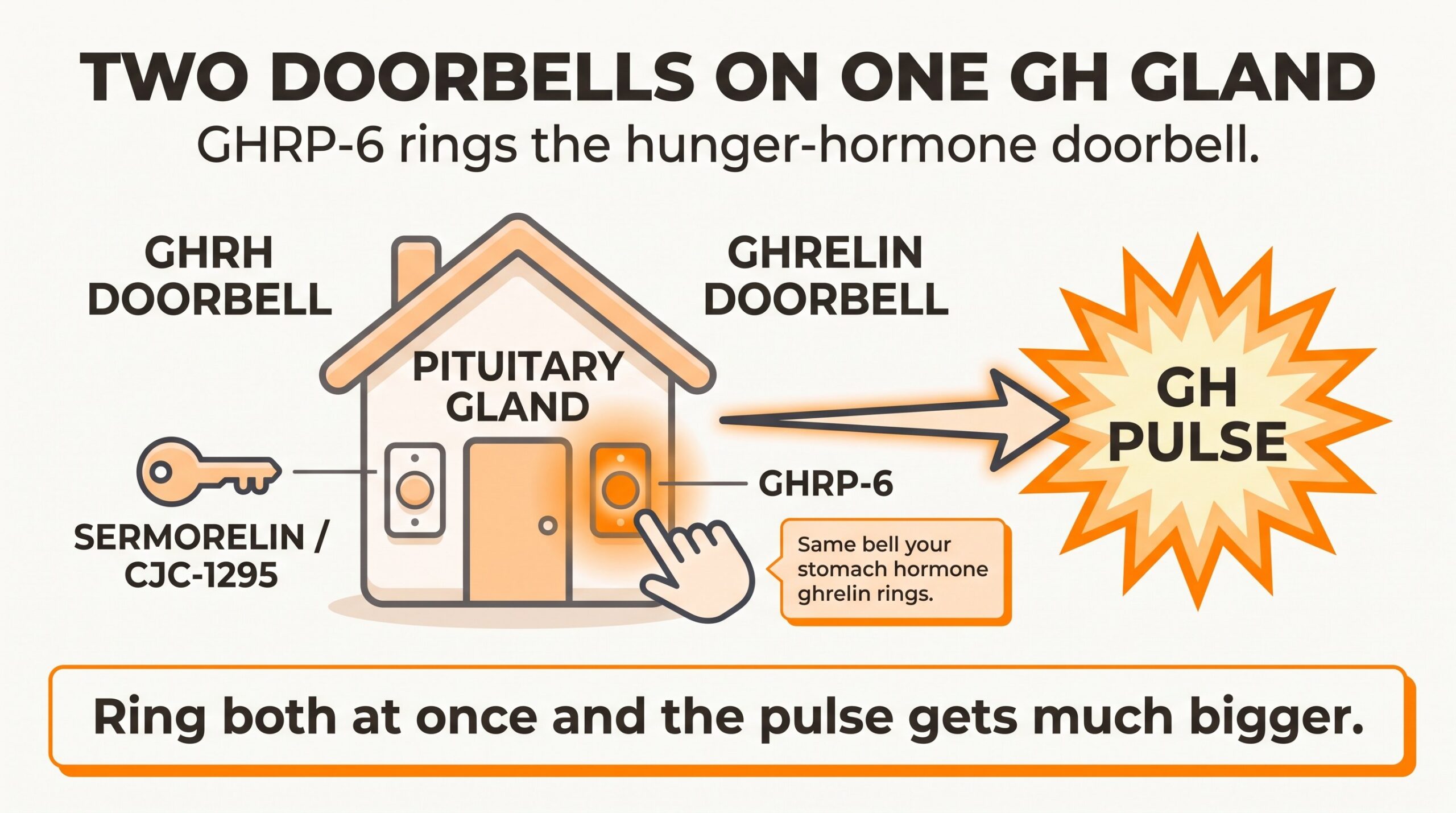
One more detail matters a lot. GHRP-6 needs doorbell one to be working, too.
In a 1998 study, researchers blocked the body’s own GHRH in nine healthy men. Then they gave GHRP-6. The GH rise dropped by roughly 80%.
Another team studied people whose brain-to-pituitary connection was damaged. In them, GHRP-6 barely worked at all. In healthy people, the combo of both bells gave a GH pulse bigger than the two added together.
Why this matters: this is why people talk about pairing a “ghrelin bell” peptide with a “GHRH bell” peptide. The two-bell idea is real science. It is the same idea behind CJC-1295 and ipamorelin. Real physiology is still not a protocol, though.
The hunger problem
If GHRP-6 rings the hunger hormone’s doorbell, you can guess what comes next.
In 2001, a London team gave ghrelin or salt water to nine healthy people. Then they let them eat from a buffet. On ghrelin, every single person ate more. On average, they ate about 28% more.
That study used ghrelin, not GHRP-6. But GHRP-6 presses the same lock. Hunger is the side effect people mention most with GHRP-6. Animal studies point the same way.
For some people, that is a dealbreaker. For a person trying to gain weight, it can sound like a feature. Either way, it is not a small thing.
GHRP-6 can also nudge other hormones. In the 1990 study, the top dose roughly doubled cortisol and prolactin for a short time. Cortisol is your main stress hormone. Prolactin is the milk hormone, and it does other jobs too.
A German sleep lab also tested GHRP-6 at night in healthy men. It raised GH, but it also raised cortisol and ACTH, the hormone that tells your adrenal glands to make cortisol. It added light sleep. It did not add deep sleep. A later study showed the effect changed a lot by route: a shot, a nose spray, or a capsule.
So what for you: GHRP-6 is not a clean “GH only” switch. It pulls on hunger and stress hormones too. That is the main reason newer cousins were built.
GHRP-6 vs GHRP-2 vs hexarelin vs ipamorelin
Once GHRP-6 proved the ghrelin doorbell worked, drug makers raced to build better keys. Here is the family in plain English.
- GHRP-6: the original. Strong GH pulse. Best known for hunger. Some cortisol and prolactin bump.
- GHRP-2: a more potent cousin. Big GH pulse. Still nudges cortisol and prolactin.
- Hexarelin: a GHRP-6 cousin with one tweaked piece. Loud GH pulse. Also raises cortisol and prolactin.
- Ipamorelin: the “picky” one. In a 1998 animal study, GHRP-6 and GHRP-2 raised stress hormones. Ipamorelin did not, even at doses over 200 times what it needed for GH.
- MK-677: not a peptide at all. It is a pill that rings the same ghrelin doorbell.
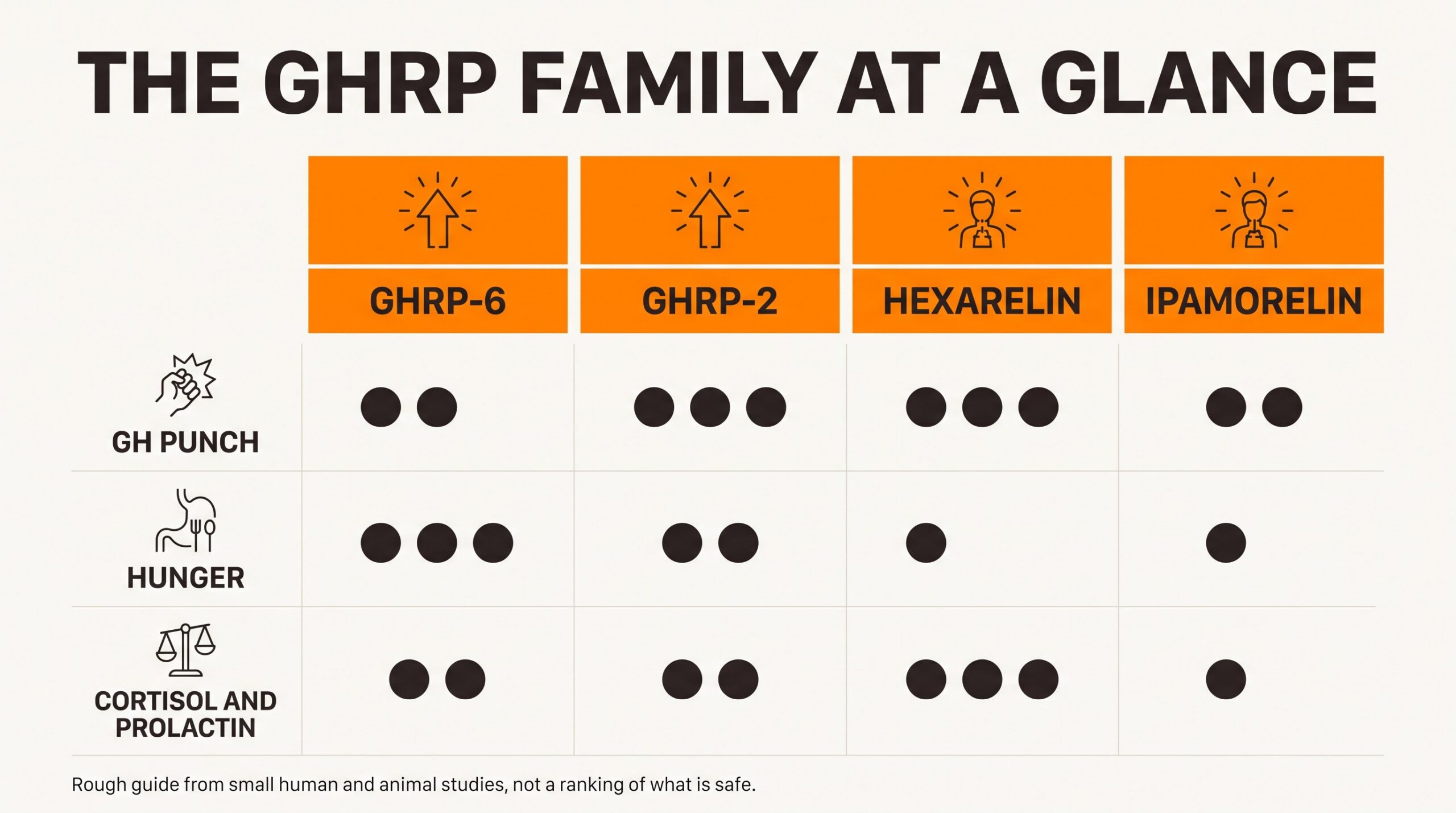
Treat that chart as a rough sketch. Most of these comparisons come from small human studies and animal work, not big head-to-head trials.
Meet the stronger cousin: GHRP-2 packs more GH punch per dose and is the only GHRP that became an approved medicine, as a GH test in Japan. The plain-English story is in GHRP-2 explained.
The family also includes a real drug. A ghrelin-doorbell pill called anamorelin went through two large Phase 3 trials in people with lung cancer and weight loss. It added about a kilogram of lean mass over 12 weeks. Grip strength did not improve. It is approved in Japan for cancer-related weight loss.
Why this matters: that is what the best evidence for this whole doorbell looks like. Even with nearly 1,000 patients, the payoff was some lean mass, not more strength. Keep that in mind any time someone sells GHRP-6 as a muscle machine.
What GHRP-6 does in older and heavier people
Your GH output drops as you age. It also tends to run low in people carrying extra body fat. For years, many assumed the factory was just worn out.
GHRP-6 helped test that idea.
In a 1995 study from Belgrade, researchers compared young adults (average age 22) with older adults (average age about 60). The older group responded less to GHRH. But their response to GHRP-6 was about the same as the young group’s.
A Spanish team saw something similar in people with obesity. Their GH response to GHRP-6 was almost twice their response to GHRH. When the two were given together, GH output was described as a “massive discharge.”
Both teams reached the same conclusion. Low GH with age or extra weight looks more like a switch that is turned down than a machine that is broken.
So what for you: that is an interesting finding about how your body works. It is not proof that turning the switch back up makes you healthier, leaner, or younger. Those are different questions, and the studies above did not test them.
The medical job GHRP-6 actually had
GHRP-6 never became a prescription drug in the US. But it did real work in medicine.
Its main job was as a test. Doctors sometimes need to know if an adult truly makes too little growth hormone. The classic test drops blood sugar on purpose with insulin, which can be risky for some people.
In a 2002 study of 20 patients in Germany, a GHRP-6 test sorted people as well as the insulin test did. The only side effect seen with GHRP-6 was brief flushing.
Then there is Cuba. A government biotech center in Havana has studied GHRP-6 for nearly 20 years. Their work is some of the most interesting on this peptide.
- They measured how fast GHRP-6 leaves the blood in nine healthy men. The elimination half-life was about 2.5 hours.
- In pigs given a heart attack in the lab, GHRP-6 cut the size of the damaged heart area by about 78%.
- In rats given a harsh cancer drug that damages the heart, GHRP-6 helped protect the heart and other organs.
- As a gel on skin wounds in rats and rabbits, it sped healing and reduced thick, raised scars.
Part of this may run through a second receptor called CD36. A 2002 study found that GHRP-type peptides act on the heart through CD36, not only through the ghrelin doorbell.
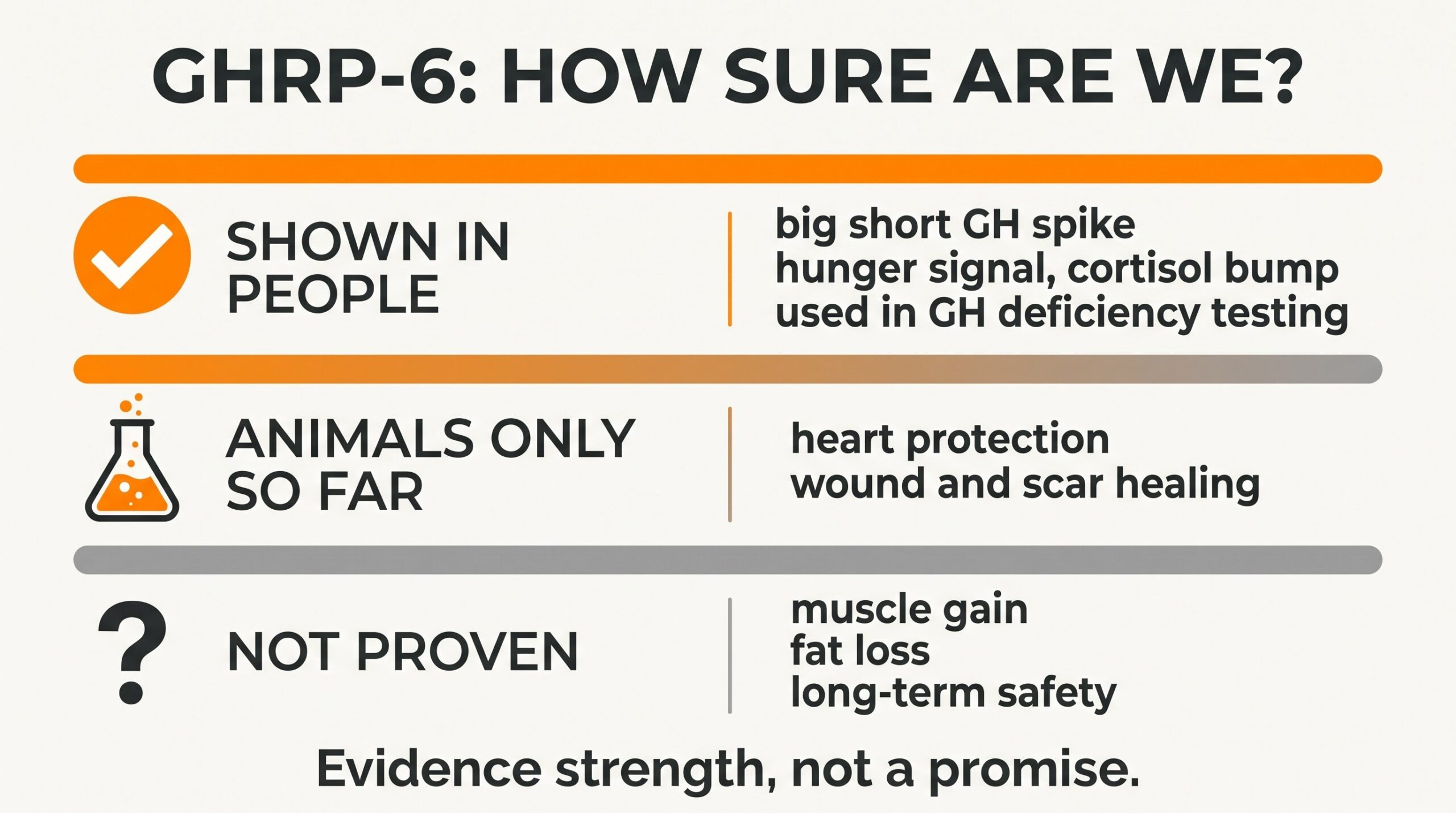
Why this matters: the heart and healing results are exciting. But they are animal studies. Plenty of things that work in pigs and rats never pan out in people. Treat this as “worth watching,” not “proven.” If healing is your real interest, our peptides for healing map covers the bigger research picture.
What GHRP-6 has not shown
Here is the honest gap. There are no solid long-term human trials showing GHRP-6 builds muscle, burns fat, improves recovery, or slows aging.
The best long-term data for the whole ghrelin-doorbell family comes from MK-677, the pill version. In a two-year trial in 65 healthy adults aged 60 to 81, it raised GH and IGF-1 to young-adult levels. IGF-1 is the growth signal your liver makes when GH goes up. Fat-free mass went up about 1.1 kilograms.
Now the fine print. Strength and daily function did not improve. Fasting blood sugar went up. Insulin sensitivity went down. Cortisol went up a bit. Appetite rose, and some people had mild swelling and muscle aches.
A 2018 review of these GH-boosting compounds said they look well tolerated in short studies. It also said there are few long-term, well-run studies, and flagged blood sugar as a real concern.
A 2026 review went further. It looked at GH-axis peptides people buy online, GHRP-6 included. It listed reported problems such as cortisol and prolactin changes, appetite swings, blood sugar issues, fluid retention, joint and muscle aches, and injection-site reactions. It also warned that what is actually in these vials is often uncertain.
So what for you: “It raises GH” is true. “So it builds muscle” is a leap the research has not made. For the bigger muscle picture, see peptides for muscle growth.
GHRP-6 side effects and safety flags
Here is the plain list of what the research and the FDA flag.
- Hunger. Often strong. It is the ghrelin doorbell, after all.
- Cortisol and prolactin bumps. Seen in human studies, mostly at higher doses.
- Blood sugar. The FDA notes a possible rise in blood sugar from lower insulin sensitivity. That matches what MK-677 showed over a longer stretch.
- Flushing, water retention, and achy joints. Reported across this family.
- Immune reactions and impurities. In 2023, the FDA put GHRP-6 on its list of compounding substances that may carry significant safety risks. It cited possible immune reactions from clumped peptide and impurities.
- Unknown long-term effects. GH and IGF-1 are growth signals. Nobody has run the long studies needed to rule out problems over years.
Some people should not treat this as a curiosity at all. That includes anyone pregnant or breastfeeding, anyone under 18, anyone with diabetes or prediabetes, and anyone with a past or current cancer. If that is you, this is a talk-to-your-doctor topic, full stop.
Tested athletes have another problem. The World Anti-Doping Agency bans GHRPs. A lab in Moscow showed that GHRP-6 can be found in urine for about a day after a single nasal dose. A German lab built similar tests years earlier.
Why this matters: side effects with this family are mostly hormone side effects. You cannot feel your blood sugar or prolactin creeping up. Only labs can show it. For the wider list, read peptide side effects.
Is GHRP-6 legal?
Short answer: it is complicated, and it is not a green light.
GHRP-6 is not FDA-approved for any use. There is no approved label, no approved dose, and no approved product. Compounding pharmacies are restricted from making it. Online, it is usually sold as a “research peptide” that is labeled not for human use.
That label exists for a reason. Research-grade vials do not go through the same checks as real medicine. Purity, dose, and even the actual contents can vary. Fake and mislabeled vials are a real problem, as we cover in counterfeit research peptides.
So what for you: read are peptides legal and what research peptides really are before you form an opinion. The rules differ by country and can change.
How a beginner should think about GHRP-6
Start with the question, not the vial.
1. Build the base first. Your biggest natural GH pulse comes in deep sleep. Lifting and enough protein give that GH something to work with. If those are shaky, start with how to sleep better and how much protein you need. That is where most of the return is.
2. Name the doorbell. Is the peptide you are reading about a GHRH-bell peptide or a ghrelin-bell peptide? If you cannot say which, you are not ready to judge it.
3. Ask what was measured. A GH spike on a chart is a lab number. More muscle, less fat, or better sleep are real-life results. GHRP-6 has strong data on the first. It has little human data on the rest.
4. Know your numbers. Hormone peptides touch blood sugar, cortisol, and prolactin. A clinician can check baseline labs like fasting glucose, HbA1c, and IGF-1. That conversation is worth more than any forum thread.
5. Skip the copy-paste stack. We do not post dosing or cycles on public pages. That depth lives in Peptides & Pump Pro, with the context it needs. If a vial is ever on the table, at least learn the basics in how to reconstitute peptides and bacteriostatic water.
New here? Start Here. Want the deeper library and a group of people doing the same work? Join the community.
Why this matters: people who jump straight to a hormone peptide usually skip the cheap stuff that works. Build the base, then get curious.
GHRP-6 FAQ
Is GHRP-6 a steroid?
No. Steroids are built from a cholesterol backbone. GHRP-6 is a short chain of amino acids. It nudges your own gland to release GH. It does not act on testosterone receptors.
Is GHRP-6 the same as HGH?
No. HGH is the growth hormone itself. GHRP-6 asks your pituitary to release its own GH in a short pulse. Your body’s brakes, like the feedback that slows GH release, still apply.
Why does GHRP-6 make you so hungry?
It presses the same lock as ghrelin, your hunger hormone. In people, ghrelin itself made everyone in one study eat more, about 28% more on average.
GHRP-6 or ipamorelin: which is “cleaner”?
In animal work, ipamorelin released GH without the cortisol bump seen with GHRP-6. That is why many people call it the more selective one. Neither is FDA-approved, and neither has long-term human outcome trials. Compare them on our ipamorelin page.
How long does GHRP-6 last in the body?
The GH spike is short, often peaking within the first half hour. In nine healthy men, the peptide itself had an elimination half-life of about 2.5 hours.
Does GHRP-6 work as a pill?
Not well. Some older studies used very large oral doses. In a 1999 sleep study, a capsule did not change GH at all, while a nasal dose did. If you want the oral ghrelin-doorbell story, that is MK-677.
Will GHRP-6 show up on a drug test?
On a sports anti-doping test, yes, it can. WADA bans it, and labs have built tests that find it in urine.
The bottom line
GHRP-6 is the original ghrelin-doorbell peptide. It reliably makes your body release a big, fast pulse of growth hormone. It works even better paired with the GHRH bell. It also brings hunger, plus some cortisol and prolactin along for the ride.
The heart and healing work is fascinating, but it is mostly in animals. Muscle, fat loss, and anti-aging claims are not proven in people. It is not FDA-approved, and the FDA has flagged safety concerns.
Learn the doorbells. Build the base. Bring a clinician into any hormone decision. That is how you stay curious without getting burned.
GH-axis research maps from partners
Foundation first: sleep, protein, and lifting do the heavy work. If you are researching the GH lane after that, these are in-stock partner listings for the ghrelin-bell and GHRH-bell peptides covered on this site, plus a few common neighbors. They are research-catalog products, not treatments.
After the foundation — GH-axis research maps (InStock partners)
 BioLongevity
CJC / Ipamorelin
LEE15 Paramount
Hexarelin 5 mg
LEE10 Paramount
CJC / Ipamorelin
LEE10 BioLongevity
Ipamorelin
LEE15 Paramount
AOD-9604
LEE10 BioLongevity
BPC-157
LEE15 BioLongevity
TB-500
LEE15 BioLongevity
Wolverine Blend
LEE15 Paramount
Wolverine Blend
LEE10 Paramount
GHK-Cu
LEE10 Paramount
Recon Solution
LEE10Partner homes
S1 shop · LEE10 Peptira home · LEE Paramount home · LEE10 BioLongevity home · LEE15 Limitless home · LEE20 Their catalog needs a quick research-access sign-up before prices show. Use code LEE20 at checkout.
Adjacent research maps only. Codes live in the links. Education framing — not a treat-disease pitch.
Key takeaways (echo)
- GHRP-6 is a six-piece lab peptide from the 1980s. It makes your own pituitary release a big, short GH pulse.
- It rings the ghrelin (hunger hormone) doorbell. Hunger, plus some cortisol and prolactin, come along.
- It works best with the GHRH doorbell also working. That two-bell synergy is real physiology, not a protocol.
- Heart and healing results are mostly animal studies. Muscle, fat loss, and anti-aging are not proven in people.
- Not FDA-approved. FDA safety flags. WADA-banned. Build the base first, and bring a clinician into hormone decisions.
Get the Peptide Playbook
Free email map for building the foundation first, then thinking clearly about peptides without the guru noise.
Related reads: Ipamorelin · Hexarelin · MK-677 · CJC-1295 + ipamorelin · Sermorelin · Tesamorelin · HGH peptides · Peptides for bodybuilding · Are peptides safe?
Sources & Further Reading
- Bowers CY, et al. On the in vitro and in vivo activity of a new synthetic hexapeptide that acts on the pituitary to specifically release growth hormone. Endocrinology. 1984. PMID 6714155
- Momany FA, et al. Conformational energy studies and in vitro and in vivo activity data on growth hormone-releasing peptides. Endocrinology. 1984. PMID 6425039
- Bowers CY, et al. Growth hormone (GH)-releasing peptide stimulates GH release in normal men and acts synergistically with GH-releasing hormone. J Clin Endocrinol Metab. 1990. PMID 2108187
- Bowers CY. Growth hormone-releasing peptide (GHRP). Cell Mol Life Sci. 1998. PMID 9893708
- Howard AD, et al. A receptor in pituitary and hypothalamus that functions in growth hormone release. Science. 1996. PMID 8688086
- Kojima M, et al. Ghrelin is a growth-hormone-releasing acylated peptide from stomach. Nature. 1999. PMID 10604470
- Pandya N, et al. Growth hormone (GH)-releasing peptide-6 requires endogenous hypothalamic GH-releasing hormone for maximal GH stimulation. J Clin Endocrinol Metab. 1998. PMID 9543138
- Popovic V, et al. Blocked growth hormone-releasing peptide (GHRP-6)-induced GH secretion and absence of the synergic action of GHRP-6 plus GH-releasing hormone in patients with hypothalamopituitary disconnection: evidence that GHRP-6 main action is exerted at the hypothalamic level. J Clin Endocrinol Metab. 1995. PMID 7883854
- Wren AM, et al. Ghrelin enhances appetite and increases food intake in humans. J Clin Endocrinol Metab. 2001. PMID 11739476
- Frieboes RM, et al. Growth hormone-releasing peptide-6 stimulates sleep, growth hormone, ACTH and cortisol release in normal man. Neuroendocrinology. 1995. PMID 7617137
- Frieboes RM, et al. Effects of growth hormone-releasing peptide-6 on the nocturnal secretion of GH, ACTH and cortisol and on the sleep EEG in man: role of routes of administration. J Neuroendocrinol. 1999. PMID 10336729
- Raun K, et al. Ipamorelin, the first selective growth hormone secretagogue. Eur J Endocrinol. 1998. PMID 9849822
- Arvat E, et al. Effects of GHRP-2 and hexarelin, two synthetic GH-releasing peptides, on GH, prolactin, ACTH and cortisol levels in man. Comparison with the effects of GHRH, TRH and hCRH. Peptides. 1997. PMID 9285939
- Temel JS, et al. Anamorelin in patients with non-small-cell lung cancer and cachexia (ROMANA 1 and ROMANA 2): results from two randomised, double-blind, phase 3 trials. Lancet Oncol. 2016. PMID 26906526
- Micic D, et al. Growth hormone secretion after the administration of GHRP-6 or GHRH combined with GHRP-6 does not decline in late adulthood. Clin Endocrinol (Oxf). 1995. PMID 7734029
- Cordido F, et al. Massive growth hormone (GH) discharge in obese subjects after the combined administration of GH-releasing hormone and GHRP-6: evidence for a marked somatotroph secretory capability in obesity. J Clin Endocrinol Metab. 1993. PMID 8473389
- Ghigo E, et al. Arginine enhances the growth hormone-releasing activity of a synthetic hexapeptide (GHRP-6) in elderly but not in young subjects after oral administration. J Endocrinol Invest. 1994. PMID 8051337
- Petersenn S, et al. Diagnosis of growth hormone deficiency in adults by testing with GHRP-6 alone or in combination with GHRH: comparison with the insulin tolerance test. Eur J Endocrinol. 2002. PMID 11980622
- Cabrales A, et al. Pharmacokinetic study of Growth Hormone-Releasing Peptide 6 (GHRP-6) in nine male healthy volunteers. Eur J Pharm Sci. 2013. PMID 23099431
- Berlanga J, et al. Growth-hormone-releasing peptide 6 (GHRP6) prevents oxidant cytotoxicity and reduces myocardial necrosis in a model of acute myocardial infarction. Clin Sci (Lond). 2007. PMID 16989643
- Berlanga-Acosta J, et al. Growth hormone releasing peptide-6 (GHRP-6) prevents doxorubicin-induced myocardial and extra-myocardial damages by activating prosurvival mechanisms. Front Pharmacol. 2024. PMID 38873418
- Mendoza Marí Y, et al. Growth Hormone-Releasing Peptide 6 Enhances the Healing Process and Improves the Esthetic Outcome of the Wounds. Plast Surg Int. 2016. PMID 27200188
- Fernández-Mayola M, et al. Growth hormone-releasing peptide 6 prevents cutaneous hypertrophic scarring: early mechanistic data from a proteome study. Int Wound J. 2018. PMID 29464859
- Bodart V, et al. CD36 mediates the cardiovascular action of growth hormone-releasing peptides in the heart. Circ Res. 2002. PMID 11988484
- Nass R, et al. Effects of an oral ghrelin mimetic on body composition and clinical outcomes in healthy older adults: a randomized trial. Ann Intern Med. 2008. PMID 18981485
- Sigalos JT, et al. The Safety and Efficacy of Growth Hormone Secretagogues. Sex Med Rev. 2018. PMID 28400207
- Dominikowski A, et al. The emerging landscape of performance-enhancing peptides modulating GH-IGF1 axis: bridging the gap between clinical evidence and patient self-administration. Front Endocrinol (Lausanne). 2026. PMID 42395176
- Semenistaya E, et al. Determination of growth hormone releasing peptides metabolites in human urine after nasal administration of GHRP-1, GHRP-2, GHRP-6, Hexarelin, and Ipamorelin. Drug Test Anal. 2015. PMID 25869809
- Thomas A, et al. Determination of growth hormone releasing peptides (GHRP) and their major metabolites in human urine for doping controls by means of liquid chromatography mass spectrometry. Anal Bioanal Chem. 2011. PMID 21298258
- U.S. Food and Drug Administration. Certain bulk drug substances for use in compounding that may present significant safety risks (GHRP-6 entry, added Sept 29, 2023). FDA.gov
- World Anti-Doping Agency. The Prohibited List (S2: peptide hormones, growth factors, related substances and mimetics). WADA