Peptides for Healing: BPC-157, TB-500, Wolverine Map
Key takeaways
- Verdict: “Peptides for healing” is a map, not one magic vial. Most people mean BPC-157, TB-500, or a Wolverine-style blend. Animal repair files are thick. Honest human proof is still thin.
- How it works in one line: Think jobsite radios. Some peptides talk to local repair crews. Others help cells move. That is not Marvel regen in a bottle.
- Your next step: fix sleep, protein, and load first. Get a real diagnosis when pain is weird. Use this page to learn research maps. No public dose chart here.
Verdict up front: peptides for healing are worth studying if you keep seeing BPC-157, TB-500, Wolverine, or “recovery peptides” in the same search. They are not worth treating a research catalog like a rehab clinic with a comic-book label.
There is a serious animal file for some of these tools. There is also a lot of forum mash-up. This free page will not hand you a public injectable healing protocol.
Keep reading if you typed peptides for healing, BPC-157, TB-500, Wolverine stack, or recovery peptides and want the map without guru noise. Skip if you want a public dose chart. Skip if you want a claim that a research product treats tears, ulcers, or pain like a drug. Skip if you want a reason to skip PT, sleep, or a doctor. Those asks belong in Pro or a real clinician visit.
Day-one basics live on Start Here and what are peptides. Nearby maps: BPC-157, oral BPC-157, TB-500, Wolverine stack, how long healing peptides take, how to reconstitute peptides, GHK-Cu, peptides for skin, peptides for muscle growth, LL-37, protein intake, and how to sleep better.
This page is teaching only, not medical advice. A research-shelf healing peptide is not an FDA-approved drug claim here. This map will not tell you to skip a doctor, PT, or imaging when those fit.
What people mean by peptides for healing
Start with the plain search. Peptides for healing usually means short chains of amino acids people study for repair talk. A peptide is a short protein scrap. Some tissues can read those scraps like tiny messages.
People mash four aisles into one keyword. BPC-157 gut and tendon curiosity. TB-500 or thymosin beta-4 cell-movement talk. Wolverine-style blends that put both in one vial. Collagen powders and copper-peptide skin maps parked next door. Same search box. Different jobs.
It is not a cast. It is not PRP. It is not physical therapy. Those can be real tools. This page is the research-map lane for the peptide names that dominate Google.
Why this matters: if you buy the wrong aisle, you will judge the wrong tool and then blame “peptides” as a whole.
So what for you: name the molecule before you name the brand.
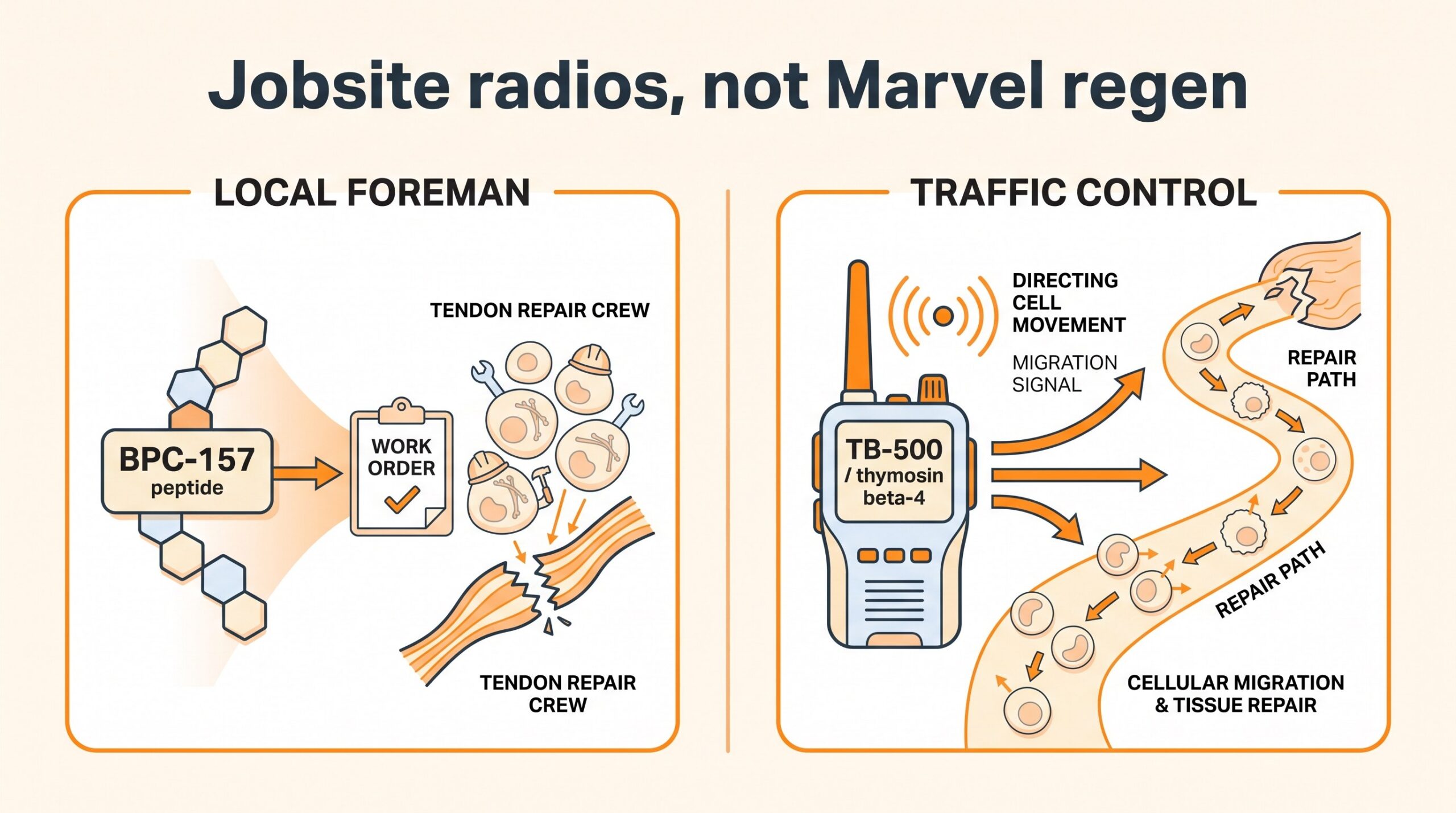
The jobsite-radio analogy (one mechanism picture)
Here is the only picture I want stuck in your head.
Think of injured tissue like a jobsite after a storm. Some crews rebuild local structure. Some crews control traffic so workers can get in and out.
BPC-157 shows up in animal work as a local foreman signal. Short peptide. Lots of rat tendon and soft-tissue papers. The story is repair messaging in the neighborhood of injury.
TB-500 is the research nickname people use for thymosin beta-4 fragments. Thymosin beta-4 helps hold and release actin. Actin is the cell’s scaffolding protein. In plain words: it helps cells move and reorganize. Think traffic control on the jobsite, not a magic bone printer.
How sure are we? Pretty sure the animal repair file for BPC-157 is thick. Pretty sure thymosin beta-4 has real biology around cell movement and wound models. Less sure that every Wolverine blend listing matches a published human trial under that blend name. Not sure at all that a research vial equals a sports-medicine protocol.
Why this matters: if you cannot explain foreman vs traffic control vs basics-first in one line, do not open a cart yet.
So what for you: ask what job you think the peptide is doing before you ask for a discount code.
The stop-you number (and what it is not)
The cleanest stop-you line is not a before-and-after selfie. It is how slow some human tissue really turns over.
Adult Achilles tendon shows almost no healthy tissue renewal over decades in carbon-14 “bomb pulse” dating work. Say that in plain words: a healthy adult Achilles is not a fast-rebuild part. That is why rehab timelines feel long. That is also why “healed in seven days” marketing should make you squint.
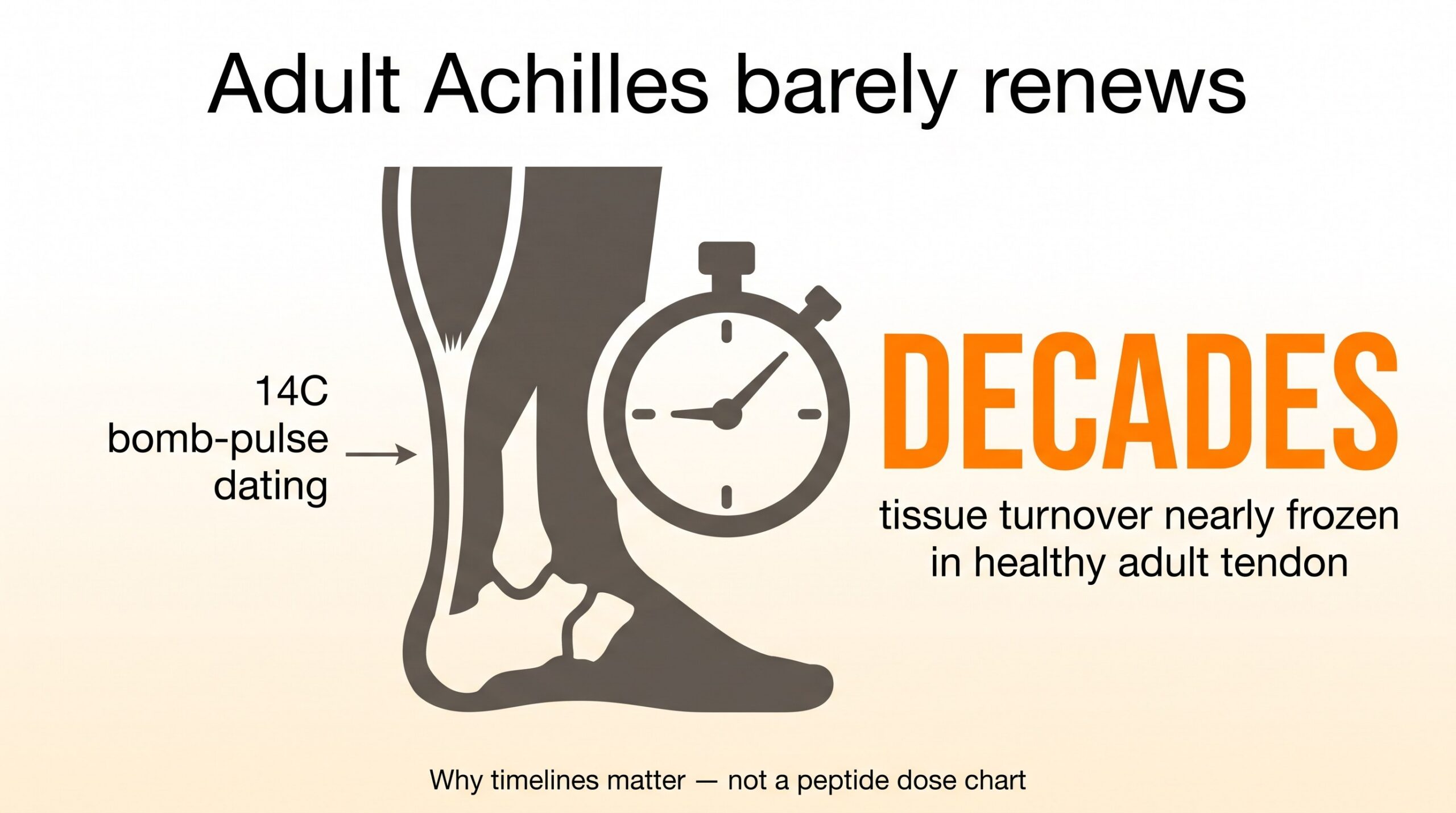
Now hold the peptide evidence floor next to that clock. BPC-157 has a large animal soft-tissue file. A 2025 sports-medicine style review still flags the human clinical gap. Thymosin beta-4 has stronger human trial history in eye surface disease than in weekend-warrior tendon tears. Different doors. Same keyword soup online.
Why this matters: the stop-you detail is that healing curiosity is rational because tissue can be slow. The confidence for “my catalog vial is FDA sports medicine” is still zero on this free site.
So what for you: be impressed by the map. Do not confuse a chemical tool with a prescription pad.
Evidence limits (say this out loud)
Most honest teaching for healing peptides rests on animal models, mechanism reviews, and a thin human stack. Injectable research-shelf stories for sports injuries are thinner than social media implies.
BPC-157 animal tendon and soft-tissue papers are real. Human randomized proof for common gym injuries is still not the same mountain. TB-500 / thymosin beta-4 biology is real. Eye-surface trials are not the same as a public Achilles protocol. Wolverine blends are convenience maps. A blend name is not a peer-reviewed molecule by itself.
Also hold the shelf-vs-paper gap. Forums sell “same as the rat tendon paper in a vial.” PubMed studies are supervised lab arms. Same family of curiosity. Different sales story.
Why this matters: health pages get punished when they blur “interesting research chemical” into “treat your tear from Instagram.”
So what for you: if someone has a sudden pop, locked joint, fever, open wound, numbness, or odd swelling, this page is not the tool. Get human help.
Three doors: basics vs clinic vs research map
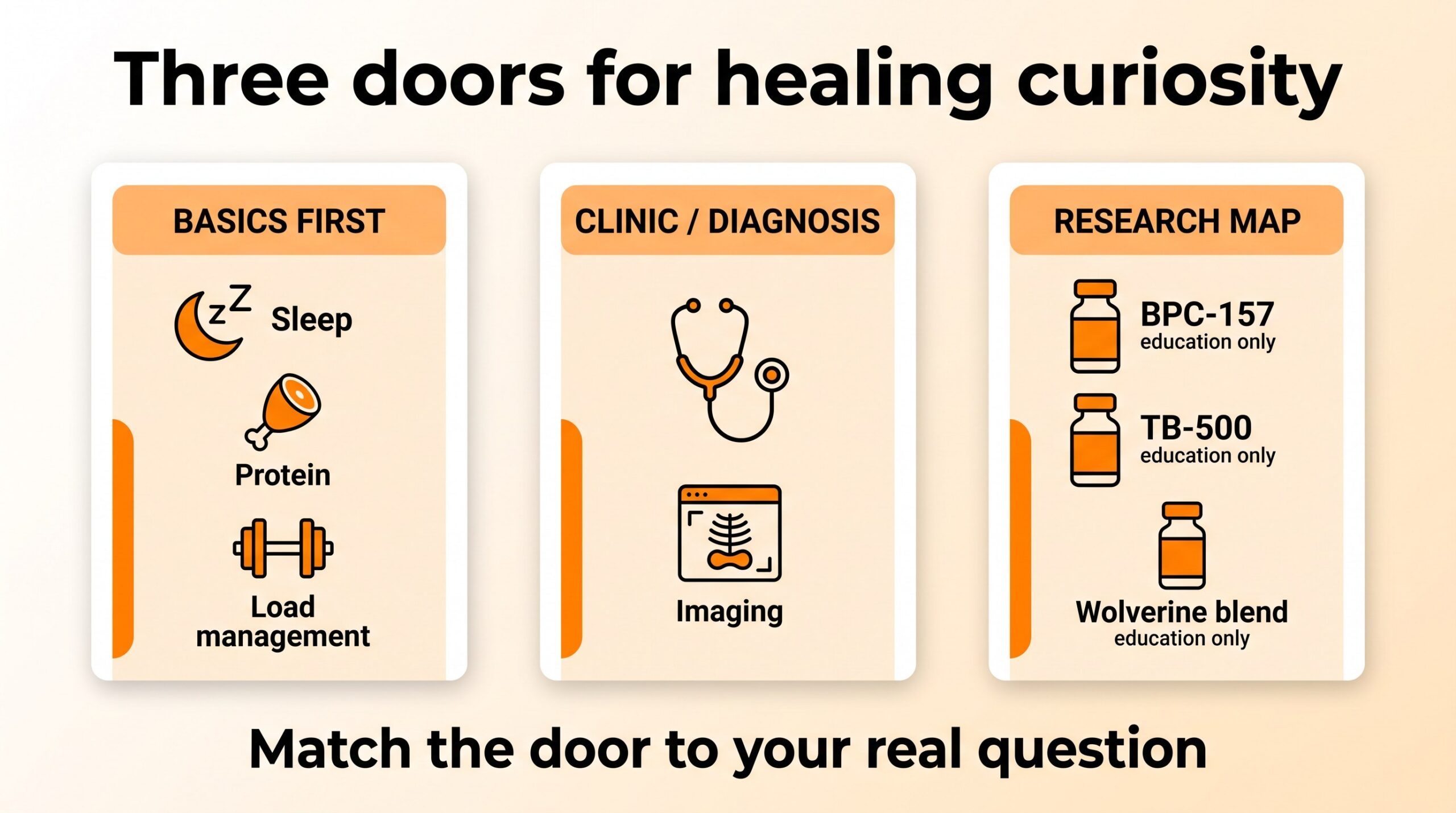
There are three doors for the same curiosity online, and each door does a different job.
Door 1 is basics first. Sleep. Protein. Smart loading. Time. PT when it fits. Boring wins more healing battles than a mystery vial.
Door 2 is clinic and diagnosis. Imaging. Differential diagnosis. Infection rules. Surgery decisions. Real clinicians own this door.
Door 3 is research map. BPC-157, TB-500, Wolverine-style blends, nearby GHK-Cu and LL-37 curiosity. Education and research framing only on this free site. Not a public dose chart.
Why this matters: people lose money when they buy Door 3 while their real problem was Door 1 or Door 2.
So what for you: write your real goal in one sentence, then pick a door.
Map the common names without the mash-up
BPC-157 is the body-protection-compound map. Deepest teaching page on this site for that molecule. Start there if BPC is your question.
Oral BPC-157 is a different delivery story than a vial map. Keep the link. Do not mash the forms.
TB-500 is the research nickname lane tied to thymosin beta-4 fragment talk. Read labels. Fragments are not always the full protein story.
Wolverine usually means a BPC plus TB-style blend people shop for convenience. A blend is two jobs in one bottle. Read both.
GHK-Cu / peptides for skin are nearby repair-and-looks maps. Different primary story than tendon talk.
LL-37 is an antimicrobial peptide map people park next to healing curiosity. Nearby. Not a BPC twin.
Why this matters: one keyword should not erase five different molecules.
So what for you: open the single-compound page when you are ready for depth.
Myths that waste money
- “Peptides replace PT and sleep.” No. Door 1 still pays the bills.
- “Animal tendon paper = human proof.” No. Species gap is real.
- “Wolverine blend is one published drug.” No. It is a shop label for a combo map.
- “TB-500 eye trials prove gym tendon protocols.” No. Different tissue. Different trial job.
- “If it is for sale, it is FDA-approved for injuries.” No. Research-shelf listings are not sports-medicine approvals on this free site.
Why this matters: myth stacks are how health pages get people hurt and domains get punished.
So what for you: keep the curiosity. Kill the Marvel script.
Partner research options (codes in the links)
Education first. You already got the map. Limitless VIP-login and out-of-stock healing SKUs are not the hero this pass. Below are InStock public options with codes that fire. Healing-adjacent research maps. Research-use and education framing only. Not a treatment claim.
Public InStock healing-adjacent maps
 BioLongevity
BPC-157
LEE15 BioLongevity
TB-500
LEE15 BioLongevity
BPC / TB Blend
LEE15 Peptira
BPC-157
LEE Paramount
Wolverine Blend
LEE10BPC-157 · LEE15 TB-500 · LEE15 BPC / TB Blend · LEE15 Peptira BPC-157 · LEE Wolverine Blend · LEE10
No Limitless VIP healing SKU is heroed here while those listings stay login or out of stock. Keep tracked homes handy: Limitless LEE20, Paramount LEE10, Peptira LEE, S1 LEE10, and BioLongevity LEE15.
How to think about next steps
If your real goal is feeling less stuck after an overuse flare, start with Door 1. Sleep and load management beat a bottle you cannot explain. If your real goal is knowing what got hurt, Door 2 comes first. If your real goal is the research map of BPC-157, TB-500, or Wolverine blends, Door 3 literacy comes after the jobsite-radio story makes sense.
Pro goes deeper on stacks, timing frameworks, and how to read a COA without getting conned by a sales page. The free page’s job is still the map.
Why this matters: next steps that match the door save money and cut health-page risk.
So what for you: write down your actual question in one sentence before you click a code.
Key takeaways (echo)
- Peptides for healing are a map, not one miracle bottle.
- The best one-line picture is jobsite radios: local repair talk versus cell-movement talk.
- Tissue can be slow. Animal files can be thick. Human sports proof is still thinner than the ads. Basics still beat hype vials for most readers.
Get the Peptide Playbook
Free email map for how to think about research peptides without the guru noise. No naked PDF dump — just the Playbook form.
Sources & Further Reading
- Heinemeier KM, et al. Lack of tissue renewal in human adult Achilles tendon is revealed by nuclear bomb 14C. FASEB J. 2013. PMID 23401563
- Sikiric P, et al. Gastric pentadecapeptide BPC 157 accelerates healing of transected rat Achilles tendon and in vitro stimulates tendocytes growth. J Orthop Res. 2003. PMID 14554208
- Chang CH, et al. The promoting effect of pentadecapeptide BPC 157 on tendon healing involves tendon outgrowth, cell survival, and cell migration. J Appl Physiol. 2011. PMID 21030672
- Gwyer D, et al. Gastric pentadecapeptide body protection compound BPC 157 and its role in accelerating musculoskeletal soft tissue healing. Cell Tissue Res. 2019. PMID 30915550
- DeFoor MT, et al. Emerging Use of BPC-157 in Orthopaedic Sports Medicine: A Systematic Review. HSS J. 2025. PMID 40756949
- Malinda KM, et al. Thymosin beta4 accelerates wound healing. J Invest Dermatol. 1999. PMID 10469335
- Goldstein AL, et al. Thymosin beta4: actin-sequestering protein moonlights to repair injured tissues. Trends Mol Med. 2005. PMID 16099219
- Sosne G, et al. Thymosin β4 significantly improves signs and symptoms of severe dry eye in a phase 2 randomized trial. Cornea. 2015. PMID 25826322
- Hainline T, et al. Safety and Efficacy of Approved and Unapproved Peptide Therapies for Musculoskeletal Injuries and Athletic Performance. Sports Med. 2026. PMID 41966639
Educational research map only. Not medical advice. Not FDA-approved treatment claims. Partner links may earn a commission. Codes live in the links.