
ARA-290 (Cibinetide): Innate Repair Receptor Research Map (Not an FDA Drug)
Key takeaways
- Verdict: ARA-290 (cibinetide) is a real Phase 2 research map for innate repair signaling — not an FDA neuropathy drug and not a catalog shortcut to Culver’s trial results.
- Mechanism in one line: it was cut from EPO’s repair story so it can knock on the innate repair receptor without flipping the red-blood-cell factory on.
- Your next step: read the map, keep foundations and a clinician first, and only treat partner vials as research SKUs with codes that fire.
Verdict up front: ARA-290 is worth understanding. It is not worth treating like a nerve prescription.
Cool trial file. Real partner shelves. No FDA label that says “fix your neuropathy.”
Keep reading if you typed ARA-290, cibinetide, or “EPO without the hematocrit” and want the mechanism without the guru tax. Skip if you want a dosing table, a sarcoidosis self-protocol, or a reason to ignore sleep, protein, training, and a clinician. Those asks belong in Pro or a real clinic — not a free ranking page.
Day-one basics still live on Start Here and what are peptides. Adjacent maps when you are done here: LL-37, Thymosin Alpha-1, BPC-157, TB-500, and SS-31.
Education only. Not medical advice. A research-catalog ARA-290 vial is not a treatment for small-fiber neuropathy, diabetes nerve pain, sarcoidosis, macular edema, or “nerves feel fried.”
What is ARA-290 (cibinetide)?
ARA-290 is a lab-made 11-amino-acid peptide. The international nonproprietary name is cibinetide.
It was engineered from a surface region of erythropoietin. Erythropoietin is the hormone most people know for telling bone marrow to make more red blood cells.
Researchers noticed EPO also carries a tissue-protection story. The problem is the RBC boost rides along. ARA-290 was designed to keep the repair conversation and drop the hematocrit push.
In plain English: it is an EPO cousin built for the innate repair receptor, not for blood doping cosplay.
Why this matters: a lot of marketing still says “EPO benefits without EPO risks.” That is a design goal from papers — not a guarantee that a research vial equals those trials.
So what for you: if a caption never says cibinetide, innate repair receptor, or Phase 2, it is selling vibes.
The cut-key mechanism (one analogy)
Here is the only picture I want stuck in your head.
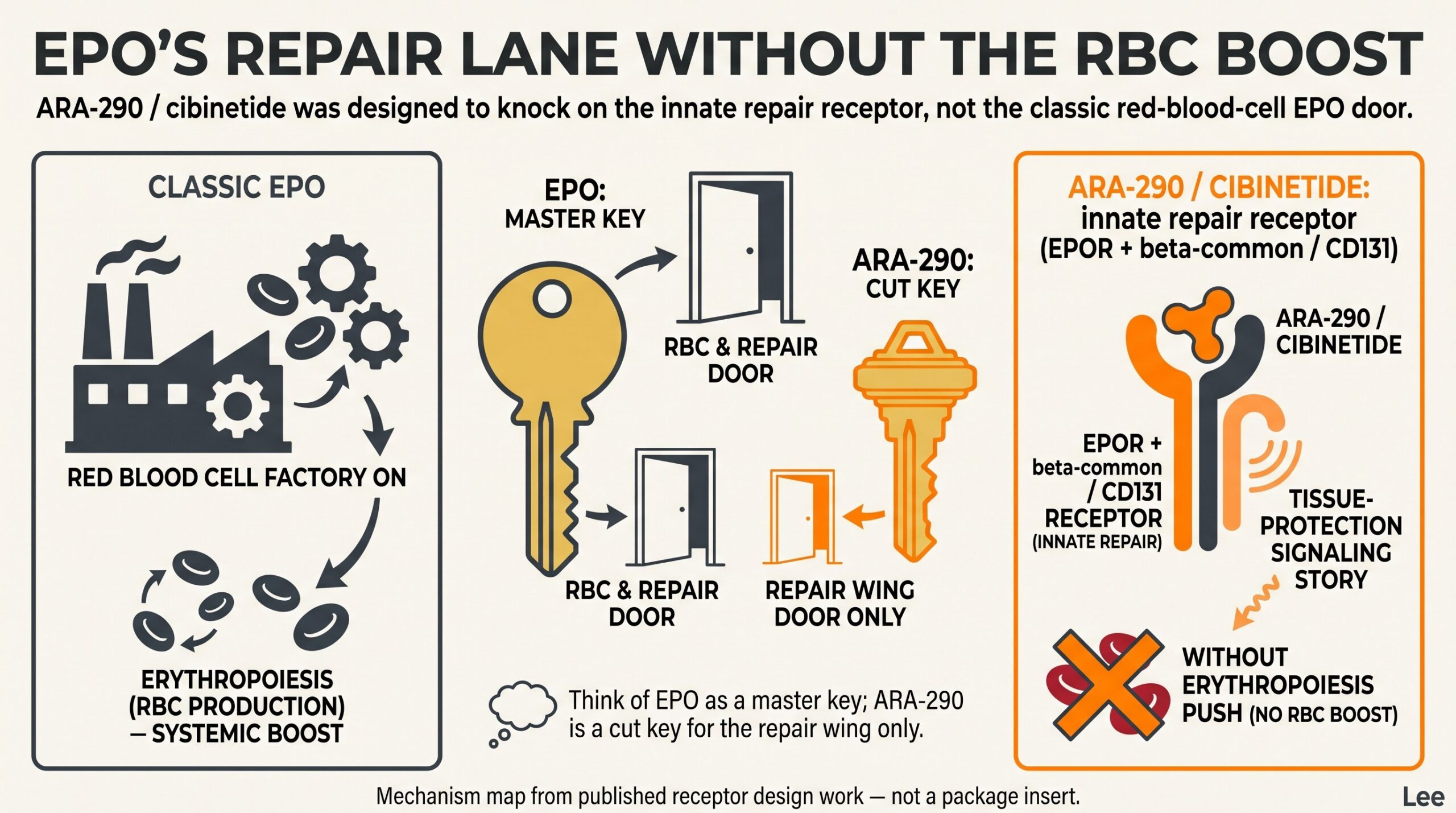
Think of classic EPO as a master key to a building. One wing is the red-blood-cell factory. Another wing is tissue-protection and repair signaling.
ARA-290 is a cut key. It was shaped to knock on the innate repair receptor — a pairing often described as the EPO receptor plus the beta-common receptor (CD131) — without throwing open the marrow wing.
That design story traces to Brines and colleagues in PNAS in 2008. They mapped non-erythropoietic, tissue-protective peptides from EPO’s tertiary structure.
How sure should you be? Fairly sure about the design intent and the published receptor framing. Much less sure that a crimp-cap research SKU recreates a sponsored Phase 2 clinic day.
Why this matters: if you cannot explain “repair receptor, not RBC factory” in one sentence, you are not ready to open a cart.
So what for you: ask for the cut-key story before you ask for a price.
The stop-you number (and what it is not)
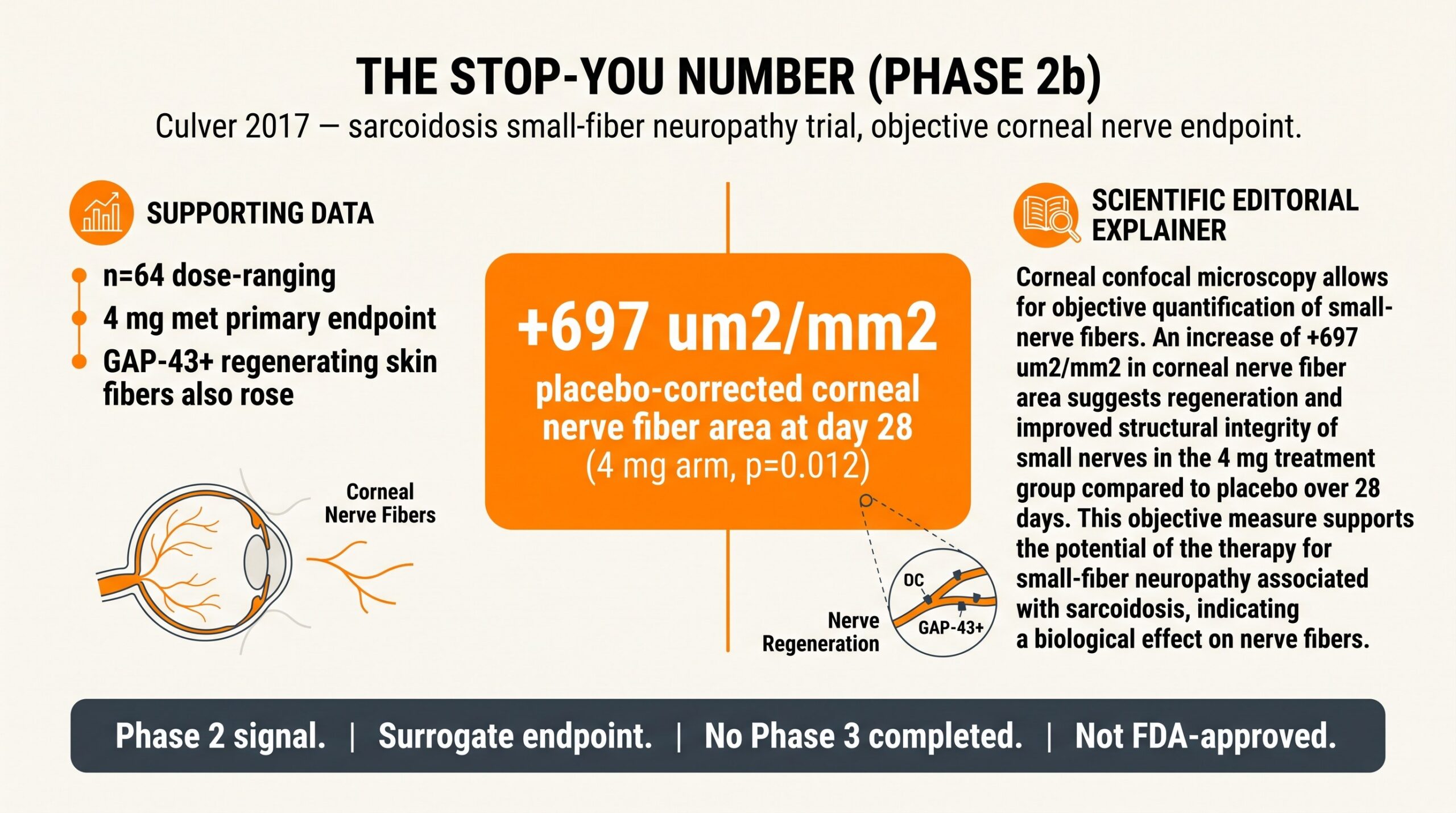
The cleanest objective signal in the human file is Culver and colleagues in 2017. A Phase 2b dose-ranging trial in sarcoidosis-associated small-fiber neuropathy. Sixty-four patients. Twenty-eight days.
The 4 mg cibinetide arm showed a placebo-corrected mean increase in corneal nerve fiber area of about 697 μm²/mm² at day 28. That primary endpoint hit with p = 0.012. Regenerating GAP-43-positive skin fibers also rose.
Read that again. An objective imaging endpoint moved in a placebo-controlled Phase 2b. That is rare air in the gray-market peptide aisle.
It is also the trap. Corneal confocal microscopy is a surrogate. The trial was not Phase 3. Pain signals were messier than the nerve-fiber map. A later diabetic macular edema Phase 2 was a different question and did not crown ARA-290 as an eye drug.
Earlier human work sits under that headline. A 2012 pilot and a 2013 Molecular Medicine study in sarcoidosis SFN reported symptom and corneal-nerve signals with daily subcutaneous ARA-290. A 2015 Molecular Medicine paper explored metabolic and neuropathic symptoms in type 2 diabetes. Those are Phase 2-scale maps. Not package inserts.
Why this matters: the stop-you number is +697 on a pre-specified nerve-fiber endpoint — and the confidence level is still “promising Phase 2, no completed Phase 3, no FDA approval.”
So what for you: be impressed by the trial craft. Do not confuse that with a green light to self-treat neuropathy from a research catalog.
Research catalog vs clinic vs foundations
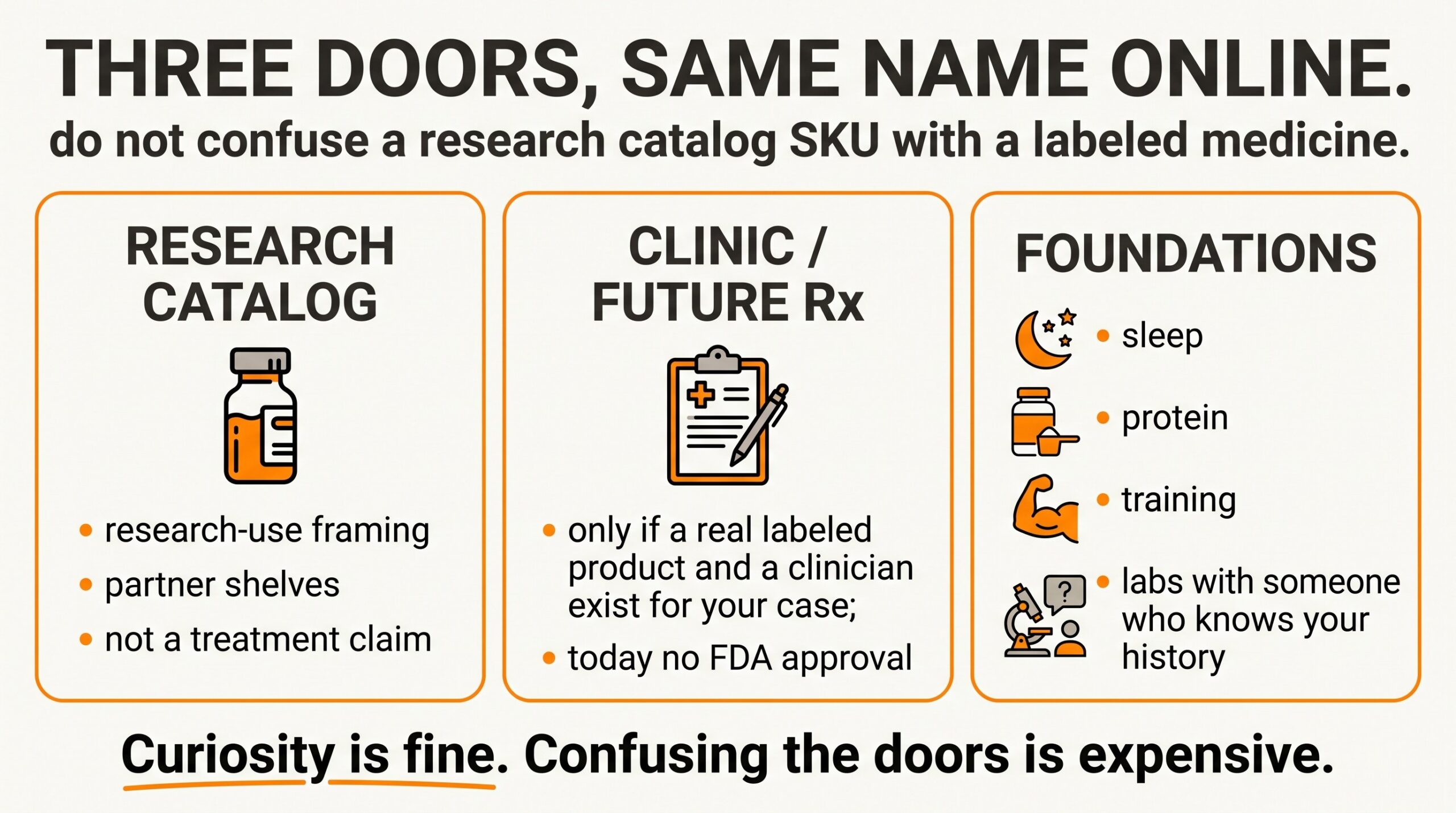
Three doors. Same molecule name online. Different jobs.
- Research catalog. ARA-290 / cibinetide as a research sequence on partner shelves. Research-use framing. Not a treatment claim.
- Clinic / future Rx. Only if a real labeled product and a clinician exist for your case. Today this is not an FDA-approved neuropathy drug. Orphan and Fast Track history are development incentives, not approvals.
- Foundations. Sleep, protein, training, metabolic basics, and labs with someone who knows your history. See how to sleep better and protein intake.
Why this matters: most money gets wasted when people buy Door 1 while wanting Door 2 outcomes.
So what for you: pick the door that matches your actual question before you open a cart.
Myths that burn money
- “Non-erythropoietic means risk-free.” Design goal from papers. Not a personal safety certificate for your stack.
- “Phase 2 primary endpoint = approved drug.” Culver 2017 is a real signal. It is still Phase 2. No completed Phase 3. No FDA label.
- “If a lab sells 15 mg, that equals the 4 mg trial arm.” Catalog size is inventory. Trial arms were clinical protocols under medical supervision.
- “ARA-290 treats diabetes / sarcoidosis / eye disease.” Those were research questions in specific trials. A research vial is not a disease treatment.
- “Limitless shows a page, so guests can buy in stock.” Their ARA-290 page can be live while schema-flagged out of stock on guest check. Chip, not hero.
Why this matters: the expensive mistake is buying a story you cannot falsify.
So what for you: keep a clinician in the loop for neuropathy, sarcoidosis, diabetes complications, eye disease, or unexplained pain. Do not argue with captions.
Where I look for an ARA-290 research compound
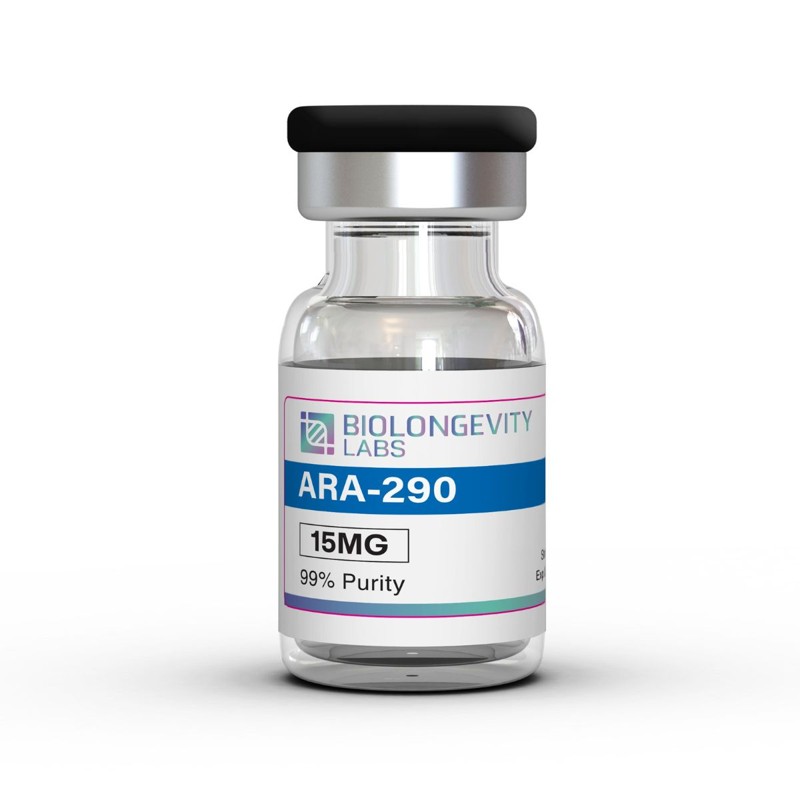
Partner reality on today’s check: BioLongevity lists ARA-290 15 mg in stock on today’s check. Limitless has an ARA-290 product page with guest OutOfStock on check — home chip only, not a hero. Paramount, Peptira, and S1 get home or shop chips only. I do not invent product hrefs.
Research-catalog SKU currently live on partner check (not a treatment recommendation).
 BioLongevity
ARA-290 15 mg
LEE15BioLongevity ARA-290 15 mg · LEE15Limitless home · LEE20BioLongevity home · LEE15Paramount home · LEE10Peptira home · LEES1 shop · LEE10
If you ever reconstitute a lyophilized research peptide, learn the math first on how to reconstitute peptides. That page is public education. It is not an ARA-290 protocol.
Why this matters: one InStock hero card beats five mystery tabs when you are only browsing research options.
So what for you: match the SKU photo to the link. Codes only work when the tracking fires.
Related research maps (convert after foundations)
Foundation first. Then research curiosity. Never “peptides that treat neuropathy” as a claim.
If you are mapping adjacent research shelves after the ARA-290 story, these partner SKUs were InStock on today’s check:
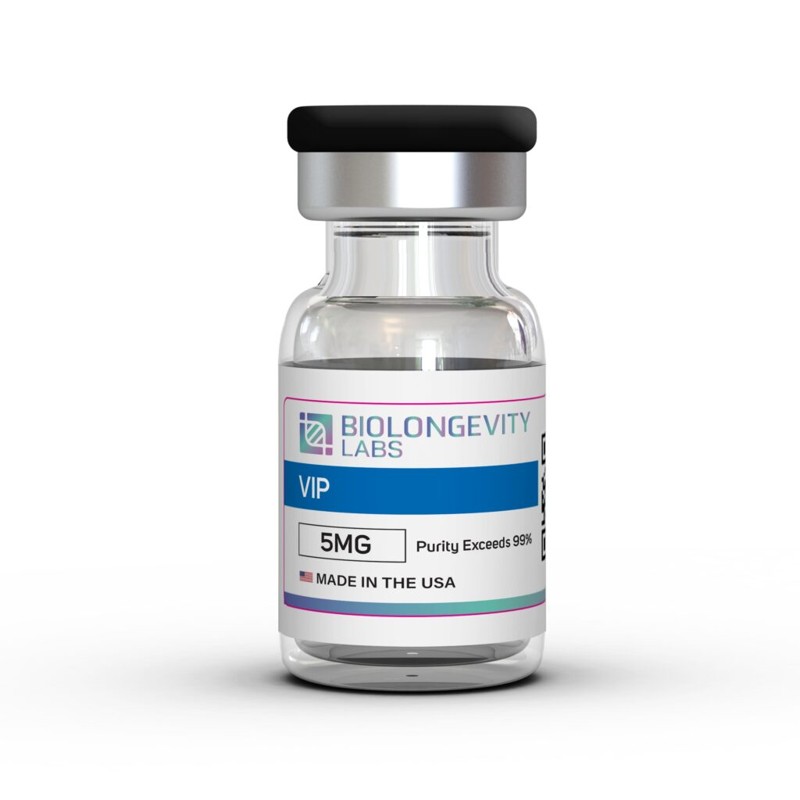 BioLongevity
VIP 5 mg
LEE15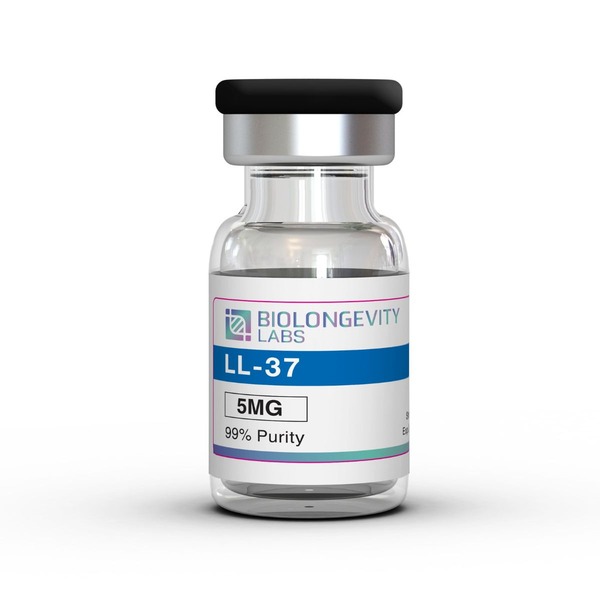 BioLongevity
LL-37 5 mg
LEE15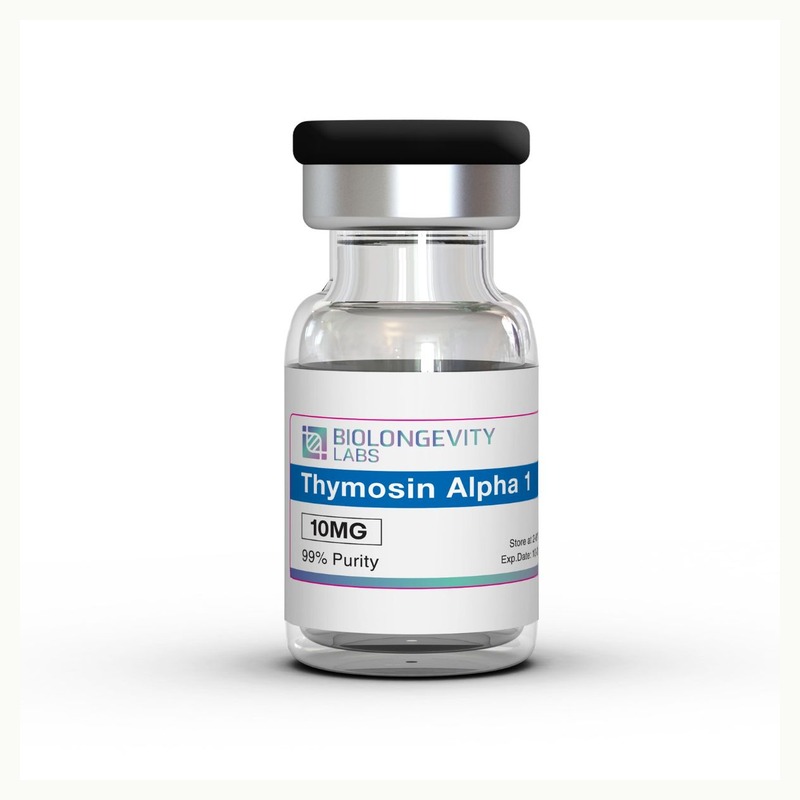 BioLongevity
Thymosin Alpha-1 10 mg
LEE15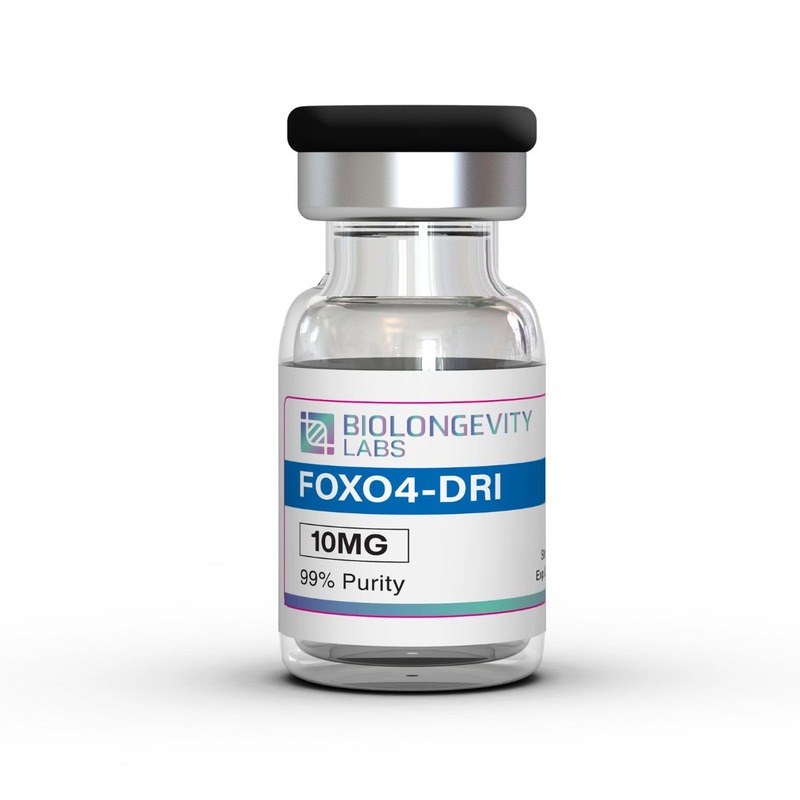 BioLongevity
FOXO4-DRI 10 mg
LEE15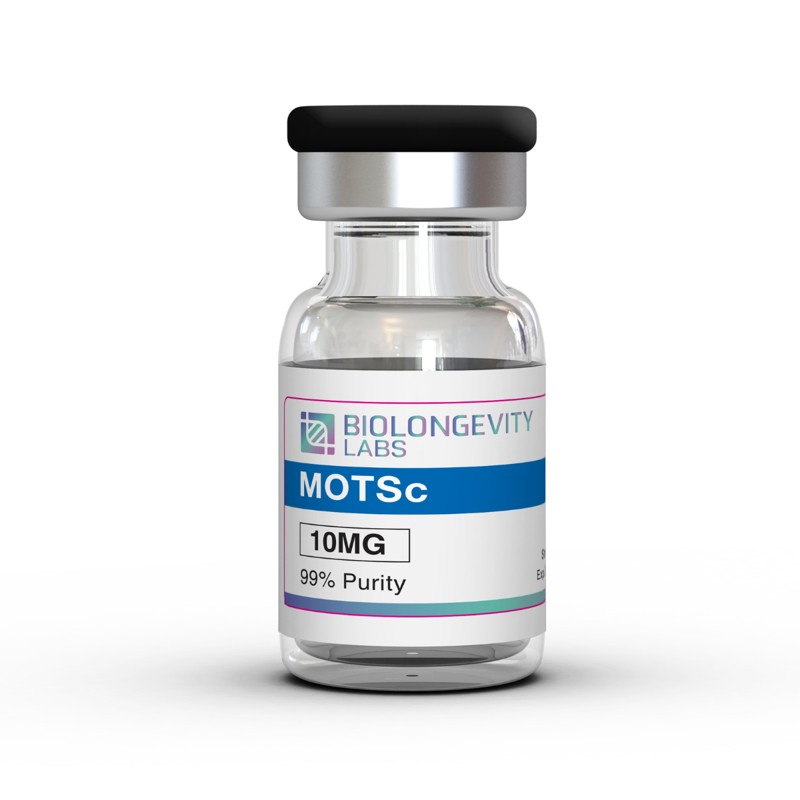 BioLongevity
MOTS-c 10 mg
LEE15Deep-dive pages for the ones that already have ranking maps: LL-37, TA1, FOXO4-DRI, MOTS-c. VIP stays a convert SKU here until its own empty URL ships.
Evidence limits
Strongest human evidence is Phase 2 in sarcoidosis-associated small-fiber neuropathy, plus smaller diabetes and pilot work. Animal and cell papers fill mechanism gaps. Partner catalogs are not selling a labeled nerve medicine.
Araim Pharmaceuticals developed the compound through Phase 2. As of recent public summaries, that sponsor path stalled before a completed Phase 3 and approval package. Orphan or Fast Track history does not equal a pharmacy bottle.
If you have active sarcoidosis, diabetic neuropathy, macular disease, unexplained weight loss, or progressive neurologic symptoms, this is a clinician conversation. Not a research-cart conversation.
Why this matters: confidence framing protects your wallet and your risk file.
So what for you: use this page to get smarter. Use a clinician to get safer. Use Pro if you want protocol depth without random Discord screenshots.
Sources & Further Reading
- Brines M, et al. Nonerythropoietic, tissue-protective peptides derived from the tertiary structure of erythropoietin. Proc Natl Acad Sci U S A. 2008. PubMed 18676614
- Heij L, et al. Safety and efficacy of ARA 290 in sarcoidosis patients with symptoms of small fiber neuropathy: a randomized, double-blind pilot study. Mol Med. 2012. PubMed 23168581
- Dahan A, et al. ARA 290 improves symptoms in patients with sarcoidosis-associated small nerve fiber loss and increases corneal nerve fiber density. Mol Med. 2013. PubMed 24136731
- Culver DA, et al. Cibinetide Improves Corneal Nerve Fiber Abundance in Patients With Sarcoidosis-Associated Small Nerve Fiber Loss and Neuropathic Pain. Invest Ophthalmol Vis Sci. 2017. PubMed 28475703
- Brines M, et al. ARA 290, a nonerythropoietic peptide engineered from erythropoietin, improves metabolic control and neuropathic symptoms in patients with type 2 diabetes. Mol Med. 2015. PubMed 25387363
- van Velzen M, et al. ARA 290 for treatment of small fiber neuropathy in sarcoidosis. Expert Opin Investig Drugs. 2014. PubMed 24555851
- Swartjes M, et al. ARA 290, a peptide derived from the tertiary structure of erythropoietin, produces long-term relief of neuropathic pain… Mol Pain. 2014. PubMed 24529189
- Phase 2 diabetic macular edema trial with cibinetide. Ophthalmol Retina / related. PubMed 32674280
- Cibinetide dampens innate immune cell functions… experimental colitis. J Crohns Colitis. 2017. PubMed 29026145
- Activation of the EPOR-β common receptor complex by cibinetide… wound healing in diabetic mice. Diabetes. 2018. PubMed 29223734
The bottom line
ARA-290 / cibinetide is one of the cleaner Phase 2 stories in the research-peptide aisle. Cut key for the repair wing. Objective corneal-nerve signal in Culver 2017. Partner SKUs exist.
It is still not a neuropathy drug. Read Culver. Talk to a clinician about your actual risk file. Build foundations that do not require a crimp cap.
Want the deeper protocol library after that? Pro is the paid door. Want the free research PDF? Grab the Playbook below.
Free guide
Get The Peptide PlaybookEnter your email and we’ll send the research PDF. Education only — not medical advice.
I built Peptides & Pump so you can get this without a guru tax. Free Knowledge Base first if you are not ready to pay. Pro if you want the protocol library.
 Keep going on Peptides & Pump
Free is the peptide community. Pro is where you master it. Codes are the links. Click them so the discount fires.
Free
Knowledge Base
The peptide community · 2,500+
- 2,500+ member peptide community
- Sourcing questions before you buy anything random
- The basics, from people actually using peptides
Pro
Peptides & Pump Pro
$10/mo · 7-day trial
- Science-backed protocol library
- 1-on-1 support from Lee and Matt
- Step-by-step video, plus a monthly $500 drawing
LEE20 Limitless LEE15 BioLongevity LEE10 Paramount LEE Peptira LEE10 S1
Supplier footnote: Research suppliers I mention when people ask about ARA-290: BioLongevity ARA-290 15 mg (code LEE15). Adjacent research maps on BioLongevity: VIP 5 mg, LL-37, Thymosin Alpha-1, FOXO4-DRI, MOTS-c. Partner home/shop chips: Limitless (code LEE20), Paramount (code LEE10), Peptira (code LEE), S1 shop (code LEE10), plus BioLongevity home (code LEE15). Match the product to the job. Do not collect bottles.
Disclaimer. This article is for educational and research purposes only. It is not medical advice. It is not intended to diagnose, treat, cure, or prevent any disease. ARA-290 (cibinetide) is not an FDA-approved drug for small-fiber neuropathy, sarcoidosis, diabetic neuropathy, macular edema, pain, or any other indication. Research peptides discussed here are research sequences; a research-catalog vial is not a compounded prescription and is not a labeled drug. Evidence discussed here includes Phase 2 clinical trials, reviews, and preclinical work; none of that is a substitute for a clinician. Individual results vary. Always consult a qualified healthcare provider before starting any peptide, drug, supplement, or protocol, especially if you have a medical condition or take prescription medication. Peptides & Pump does not sell peptides.
Affiliate disclosure. Some links on this page are affiliate links. If you buy through them, I may earn a commission at no extra cost to you. Codes LEE15, LEE20, LEE, and LEE10 are the ones I actually use where a coupon fires. That commission is how I keep publishing free education. I only link suppliers I am willing to put my name on.


One Comment
Comments are closed.