Vesugen (KED): Vascular Bioregulator Research Map (Not a Vessel Drug)
Key takeaways
- Verdict: Vesugen is a three-amino-acid vascular bioregulator research map — Lys-Glu-Asp, also written KED — not an FDA vessel drug and not a stent in a crimp cap.
- Mechanism in one line: the papers pitch a short peptide that can dock near lining-cell renewal genes and nudge markers like Ki-67 in cell work. That story is still mostly cells, rodents, and originating-group clinical reports.
- Your next step: read the map, keep blood-pressure basics and a clinician first, and only treat partner vials as research SKUs with codes that fire.
Verdict up front: Vesugen is worth understanding if you care about vascular-peptide lore. It is not worth treating like a prescription for clogged pipes.
Three amino acids. A loud Russian bioregulator file. Real partner shelves. No FDA label that says “fix your endothelium.”
Keep reading if you typed Vesugen, KED peptide, Lys-Glu-Asp, or vascular bioregulator and want the mechanism without the guru tax. Skip if you want a dosing table, an atherosclerosis cure protocol, or a reason to ignore walking, sleep, blood pressure, and a clinician. Those asks belong in Pro or a real clinic — not a free ranking page.
A bioregulator, in this aisle, is a short synthetic peptide studied as a tissue-selective gene nudge. Vesugen sits in the vessel-lining lane of the Khavinson cytogen family. Same neighborhood as Epitalon and Pinealon. Different residues. Different job in the papers.
Day-one basics still live on Start Here and what are peptides. Adjacent maps: SS-31, NAD, and FOXO4-DRI if you are browsing longevity catalogs.
Education only. Not medical advice. A research-catalog Vesugen vial is not a treatment for atherosclerosis, peripheral artery disease, erectile dysfunction, Alzheimer’s, or “I feel old in my vessels.”
What is Vesugen?
Vesugen is a synthetic tripeptide. Translation: three amino acids hooked together on purpose.
The sequence is lysine, glutamic acid, aspartic acid. Catalogs write Lys-Glu-Asp or KED. Same molecule idea. Older program notes sometimes call it T-38.
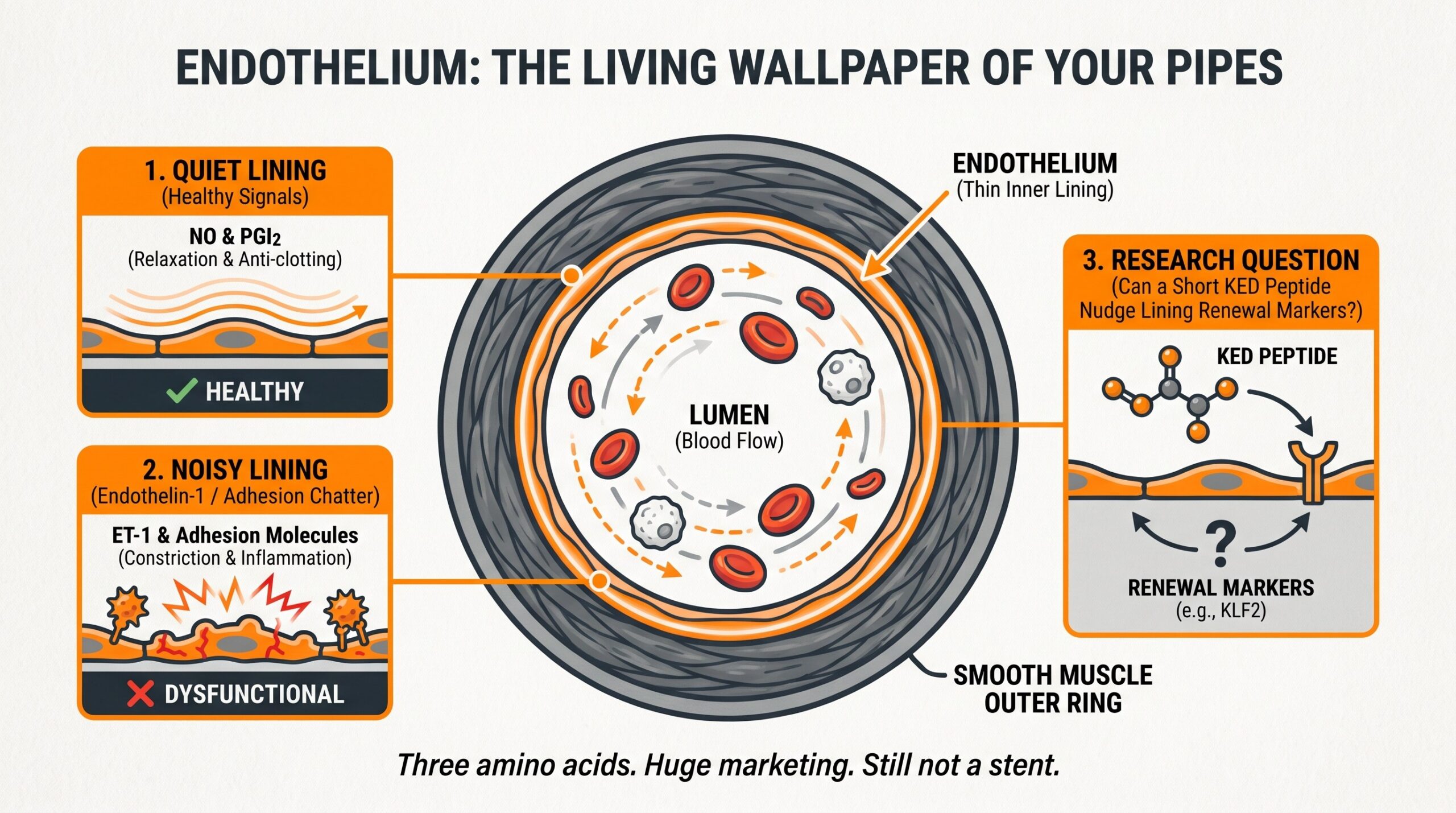
It sits in the Khavinson vascular bioregulator line. The research intent is the endothelium, the thin cell layer that lines blood vessels. Think living wallpaper inside your pipes, not the pipe wall itself.
How sure should you be of even that much? The sequence is not in dispute. KED is a real tripeptide. The jump from “named sequence with papers” to “this vial will unclog your legs” is where captions go to work. This page refuses that jump.
Why this matters: you are looking at a short research peptide aimed at vessel-lining biology — not a certified cardiology drug in a crimp cap.
So what for you: catalog names and Instagram captions are not the same object as a labeled medicine.
The sticky-note mechanism (one analogy)
Here is the only picture I want stuck in your head.
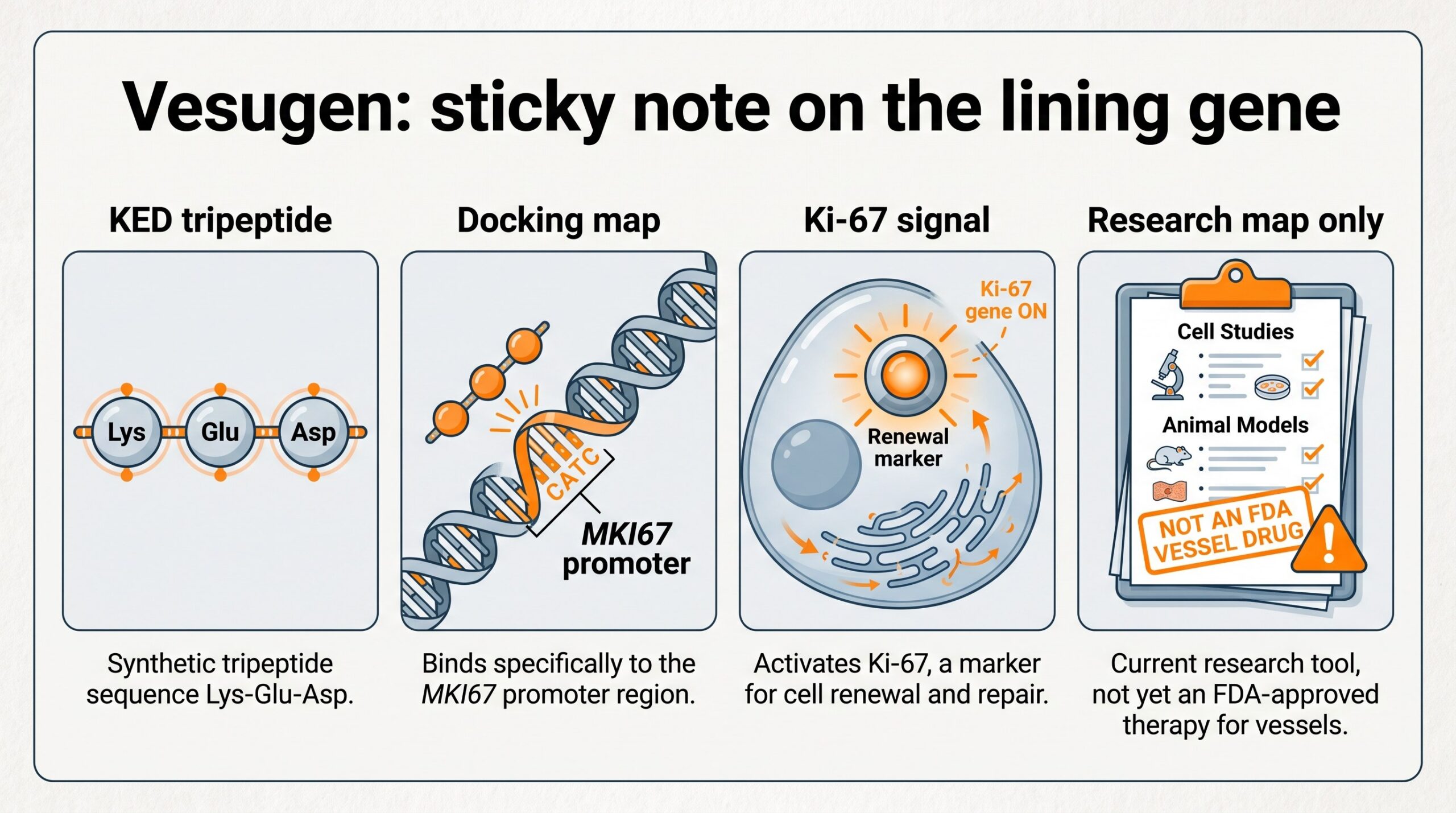
Think of the MKI67 gene as a renewal switch for lining cells. Ki-67 is the protein marker researchers watch when cells are gearing up to divide. In aging endothelial cultures, that renewal signal often looks quieter.
Vesugen, in the docking story, is a sticky note near that switch. Molecular modeling papers argue KED can contact CATC stretches in the MKI67 promoter region. Translation: the short peptide is proposed to sit near the DNA control panel that helps turn Ki-67 expression up.
In tissue and cell work from that program, Vesugen and related short peptides were reported to raise Ki-67 signals in aging vascular cultures. That is the mechanism homework. It is not a human dosing manual.
Later papers keep KED in neurogenesis and Alzheimer-model conversations too. Same three residues. Broader research curiosity. Still not your green light to self-experiment like it is a statin.
Why this matters: if a caption skips KED, endothelium, and “cell/animal,” it is selling vibes.
So what for you: ask for the mechanism in one sentence before you ask for a price.
The stop-you number (and what it is not)
In aging vascular endothelial cultures, the originating group reported Ki-67 expression rising nearly twofold after Vesugen exposure in their models. Young cultures moved less. Old cultures moved more.
Read that again. The stop-you line is that a three-residue peptide can swing a proliferation marker hard in senescent lining-cell systems. In a dish.
That is also the trap. A culture dish is not your femoral artery. A Russian gerontology report is not a U.S. package insert.
Why this matters: the exciting claim is renewal-marker rescue in aging vessel cells — and the confidence level is still preclinical plus originating-group literature, not a Western multi-center RCT.
Separate clinical-style reports from the same research neighborhood talk about vessel symptoms in older adults with chronic arterial insufficiency of the legs. Interesting as program history. Weak as modern trial evidence. Hold that distinction or the caption will hold your wallet.
So what for you: the number that matters is how far the evidence sits from a human drug label. Right now that gap is wide.
Research catalog vs clinic vs foundations
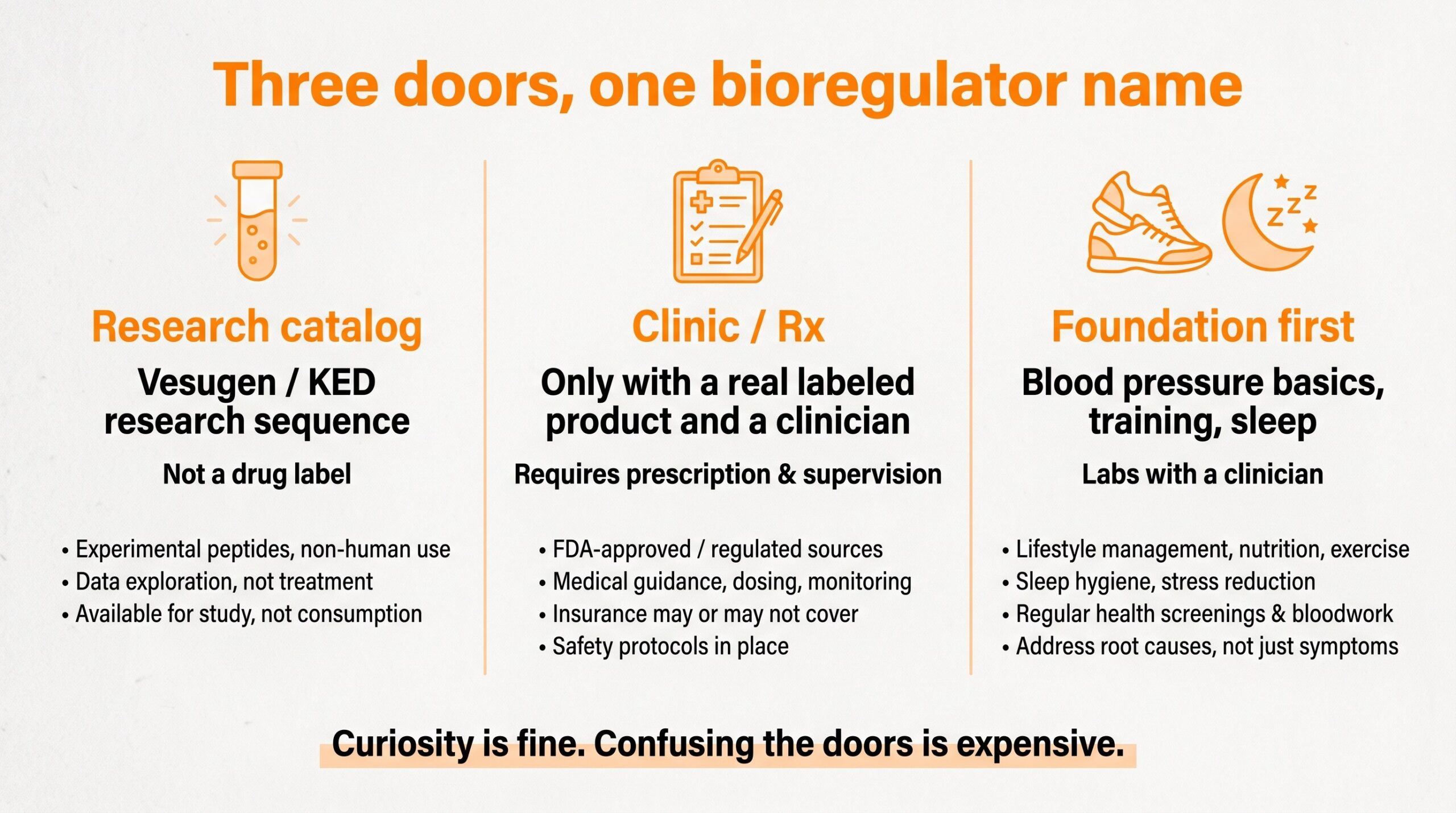
Three doors. Same molecule name online. Different jobs.
- Research catalog. Vesugen as a research sequence on partner shelves. Research-use framing. Not a treatment claim.
- Clinic / future Rx. Only if a real labeled product and a clinician exist for your case. Today this is not an FDA-approved vascular drug in the U.S.
- Foundations. Walking, blood-pressure basics, sleep, protein, training, and labs with someone who knows your history. See how to sleep better and protein intake.
Why this matters: most money gets wasted when people buy Door 1 while wanting Door 2 outcomes.
So what for you: pick the door that matches your actual question before you open a cart.
Myths that burn money
- “Three amino acids = harmless.” Short is not the same as risk-free. Endogenous peptides and catalog vials are not identical objects.
- “Vascular bioregulator = stent replacement.” Marketing poetry. Not interventional cardiology.
- “Same family as Epitalon means same job.” Epitalon is four residues. Pinealon is EDR. Vesugen is KED. Shared neighborhood. Different chains.
- “If Limitless has no Vesugen page, invent a product URL.” No. Guest search found no Limitless Vesugen SKU today. Home chip only. I do not invent product hrefs.
Why this matters: the expensive mistake is buying a story you cannot falsify.
So what for you: keep a clinician in the loop for known vascular disease, clotting risk, active cancer, or unexplained chest pain. Do not argue with captions.
Where I look for a Vesugen research compound
Partner reality on today’s check: BioLongevity lists Vesugen 20 mg in stock (Drive url_id=5 — historically Vesugen, not BioGutPro). Limitless has no Vesugen product page on guest check — home chip only. Paramount, Peptira, and S1 get home or shop chips only. I do not invent product hrefs.
Research-catalog SKU currently live on partner check (not a treatment recommendation).
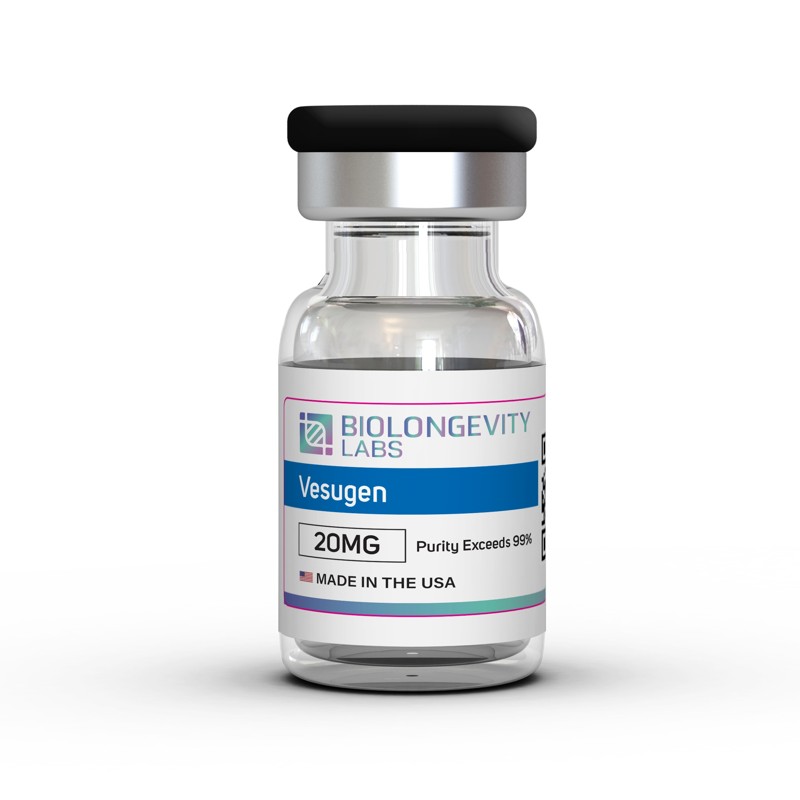 BioLongevity
Vesugen 20 mg
LEE15BioLongevity Vesugen 20 mg · LEE15Limitless home · LEE20BioLongevity home · LEE15Paramount home · LEE10Peptira home · LEES1 shop · LEE10
If you ever reconstitute a lyophilized research peptide, learn the math first on how to reconstitute peptides. That page is public education. It is not a Vesugen protocol.
Why this matters: one InStock hero card beats five mystery tabs when you are only browsing research options.
So what for you: match the SKU photo to the link. Codes only work when the tracking fires.
Evidence limits
Most Vesugen evidence is cell culture, rodent models, molecular docking, and program literature from the originating group. Partner catalogs are not selling a labeled vascular medicine.
Newer papers keep probing KED in neurogenesis, Alzheimer-model spines, cardiovascular senescence chatter, and short-peptide aging maps. Interesting. Still not your green light to self-experiment like it is metformin.
If you have known coronary disease, clotting problems, active cancer, unexplained chest pain, or recent vascular procedures, this is a clinician conversation. Not a research-cart conversation.
Why this matters: confidence framing protects your wallet and your risk file.
So what for you: use this page to get smarter. Use a clinician to get safer. Use Pro if you want protocol depth without random Discord screenshots.
Sources & Further Reading
- Khavinson V, et al. Neuroprotective Effects of Tripeptides—Epigenetic Regulators in Mouse Model of Alzheimer’s Disease. Pharmaceuticals. 2021. PubMed 34071923
- Peptide KED: Molecular-Genetic Aspects of Neurogenesis Regulation in Alzheimer’s Disease. Bull Exp Biol Med. 2021. PubMed 34173097
- Molecular aspects of vasoprotective peptide KED activity during atherosclerosis and restenosis. Adv Gerontol. 2016. PubMed 28539025
- Epigenetic aspects of peptidergic regulation of vascular endothelial cell proliferation during aging. Adv Gerontol. 2014. PubMed 25051766
- Molecular aspects of anti-atherosclerotic effects of short peptides. Bull Exp Biol Med. 2014. PubMed 25408528
- Effect of tripeptide Lys-Glu-Asp on physiological activity of neuroimmunoendocrine system cells. Bull Exp Biol Med. 2012. PubMed 22977872
- The efficacy of peptide bioregulators of vessels in lower limbs chronic arterial insufficiency treatment in old and elderly people. Adv Gerontol. 2014. PubMed 25051774
- Senescence-Associated Secretory Phenotype of Cardiovascular System Cells and Inflammaging: Perspectives of Peptide Regulation. Cells. 2022. PubMed 36611900
- Tripeptides Restore the Number of Neuronal Spines under Conditions of In Vitro Modeled Alzheimer’s Disease. Bull Exp Biol Med. 2017. PubMed 28853087
- Peptide Regulation of Skin Fibroblast Functions during Their Aging In Vitro. Bull Exp Biol Med. 2016. PubMed 27259496
- Short Peptides Protect Fibroblast-Derived Induced Neurons from Age-Related Changes. Int J Mol Sci. 2024. PubMed 39518916
- Peptide Regulation of Cell Differentiation. Stem Cell Rev Rep. 2020. PubMed 31808038
The bottom line
Vesugen is one of the cleaner mechanism stories in the vascular bioregulator aisle. Three residues. Sticky note on a lining gene. Cell and program receipts. Partner SKUs exist.
It is still not a vessel drug. Read the KED papers. Talk to a clinician about your actual risk file. Build foundations that do not require a crimp cap.
Want the deeper protocol library after that? Pro is the paid door. Want the free research PDF? Grab the Playbook below.
Free guide
Get The Peptide PlaybookEnter your email and we’ll send the research PDF. Education only — not medical advice.
I built Peptides & Pump so you can get this without a guru tax. Free Knowledge Base first if you are not ready to pay. Pro if you want the protocol library.
 Keep going on Peptides & Pump
Free is the peptide community. Pro is where you master it. Codes are the links. Click them so the discount fires.
Free
Knowledge Base
The peptide community · 2,500+
- 2,500+ member peptide community
- Sourcing questions before you buy anything random
- The basics, from people actually using peptides
Pro
Peptides & Pump Pro
$10/mo · 7-day trial
- Science-backed protocol library
- 1-on-1 support from Lee and Matt
- Step-by-step video, plus a monthly $500 drawing
LEE20 Limitless LEE15 BioLongevity LEE10 Paramount LEE Peptira LEE10 S1
Supplier footnote: Research suppliers I mention when people ask about Vesugen: BioLongevity Vesugen 20 mg (code LEE15). Limitless has no Vesugen product SKU on today’s guest check — use Limitless home (code LEE20). Paramount, Peptira, and S1 home/shop chips: Paramount (code LEE10), Peptira (code LEE), S1 shop (code LEE10), plus BioLongevity home (code LEE15). Match the product to the job. Do not collect bottles.
Disclaimer. This article is for educational and research purposes only. It is not medical advice. It is not intended to diagnose, treat, cure, or prevent any disease. Vesugen (Lys-Glu-Asp / KED) is not an FDA-approved drug for atherosclerosis, peripheral artery disease, endothelial dysfunction, Alzheimer’s, erectile dysfunction, or any other indication. Research peptides discussed here are research sequences; a research-catalog vial is not a compounded prescription and is not a labeled drug. Most evidence discussed here includes cell, animal, docking, and originating-group studies; none of that is a substitute for a clinician. Individual results vary. Always consult a qualified healthcare provider before starting any peptide, drug, supplement, or protocol, especially if you have a medical condition, vascular disease, cancer history, or take prescription medication. Peptides & Pump does not sell peptides.
Affiliate disclosure. Some links on this page are affiliate links. If you buy through them, I may earn a commission at no extra cost to you. Codes LEE15, LEE20, LEE, and LEE10 are the ones I actually use where a coupon fires. That commission is how I keep publishing free education. I only link suppliers I am willing to put my name on.


One Comment
Comments are closed.