Dihexa: Angiotensin IV Analog Research Map (Not a Brain Drug)
Key takeaways
- Dihexa is a chemically modified scrap of angiotensin IV. Catalogs also stamp PNB-0408. It is not an FDA-approved drug for memory, dementia, or “brain repair.”
- The 2013 paper that introduced the oral analog still carries a 2021 Expression of Concern. Two later papers that taught the HGF door story were retracted in April 2025.
- Fosgonimeton is a different molecule from the same research neighborhood. Its Phase 2/3 Alzheimer trial missed the primary endpoint. That miss is not a Dihexa human trial.
- Later animal papers go both ways. A 2021 mouse paper looked warmer. A 2024 Huntington-model rat paper said it did not protect.
- Education, not a treatment. Full protocols stay in Peptides & Pump Pro ($10/mo, 7-day trial).
People type Dihexa like they found a memory pill with a scientific last name.
They found a rebuilt scrap of angiotensin IV and a caption that got out over its skis.
Dihexa is N-hexanoic-Tyr-Ile-(6) aminohexanoic amide. That is a long chemical name for a short, fat-tailed analog of angiotensin IV. Angiotensin IV is a six-residue fragment of a blood-pressure family. Researchers at Washington State University rebuilt three of those residues so the chain would last longer in the gut and maybe cross into the brain. Then catalogs printed “brain peptide” on a tablet bottle. That is a lab history. It is not a U.S. cognitive-drug label.
Why this matters right now: search volume is real. Partner shelves are real. The paper file is not the caption. Stay here if you typed Dihexa, PNB-0408, or “the Alzheimer peptide” and want the map before you spend money. If peptides are not day one, start with Start Here or what are peptides. If the actual job is a cognitive research map that already has a cleaner human file, read Semax and Selank first. Those are different chains. Do not mash them because a podcast said brain.
This is education. It is not medical advice. A research-catalog tablet is not a treatment for memory loss, dementia, Parkinson, Huntington, or “I feel foggy.”
What is Dihexa?
A peptide is a short chain of amino acids. Insulin is a peptide. Semaglutide is a peptide. Dihexa is a peptide analog. Naming the format does not name the job.
Start with the parent. Angiotensin IV is VYIHPF. Six residues. For years, labs studied that fragment as a learning and memory signal in animals. The problem was practical. The chain broke down fast. It did not like the gut. It did not like the blood-brain barrier. The blood-brain barrier is the tight gate that keeps most blood chemicals out of brain tissue.
McCoy, Benoist, Wright, Kawas, Harding, and colleagues reported in 2013 that they had rebuilt the useful scrap. They started from Nle-Tyr-Ile, then added a hexanoic tail and a six-carbon amide. The product was N-hexanoic-Tyr-Ile-(6) aminohexanoic amide. Catalogs call it Dihexa. Some stamps say PNB-0408. In that paper the analog reversed scopolamine deficits in a rat water maze and showed activity in aged rats. The authors also reported hippocampal synaptogenesis talk. Synaptogenesis means new contact points between nerve cells in that animal file. They floated Alzheimer-model language as a future hope, not as a finished drug (PubMed 23055539).
So what is Dihexa, in the way a beginner should hold it? An oral research analog of angiotensin IV. Not Semax. Not Selank. Not Pinealon. Not an FDA-approved dementia medicine.
How sure are we of even that much? The chemical name is not in dispute. The 2013 characterization paper is still indexed. It also carries a 2021 Expression of Concern from the same journal (PubMed 34551989). An Expression of Concern is a public flag. The editors are telling you the paper is not a clean trophy. It has not been retracted as of this writing. Treat it as a named analog with a flagged origin paper. Do not treat it as a proven brain drug.
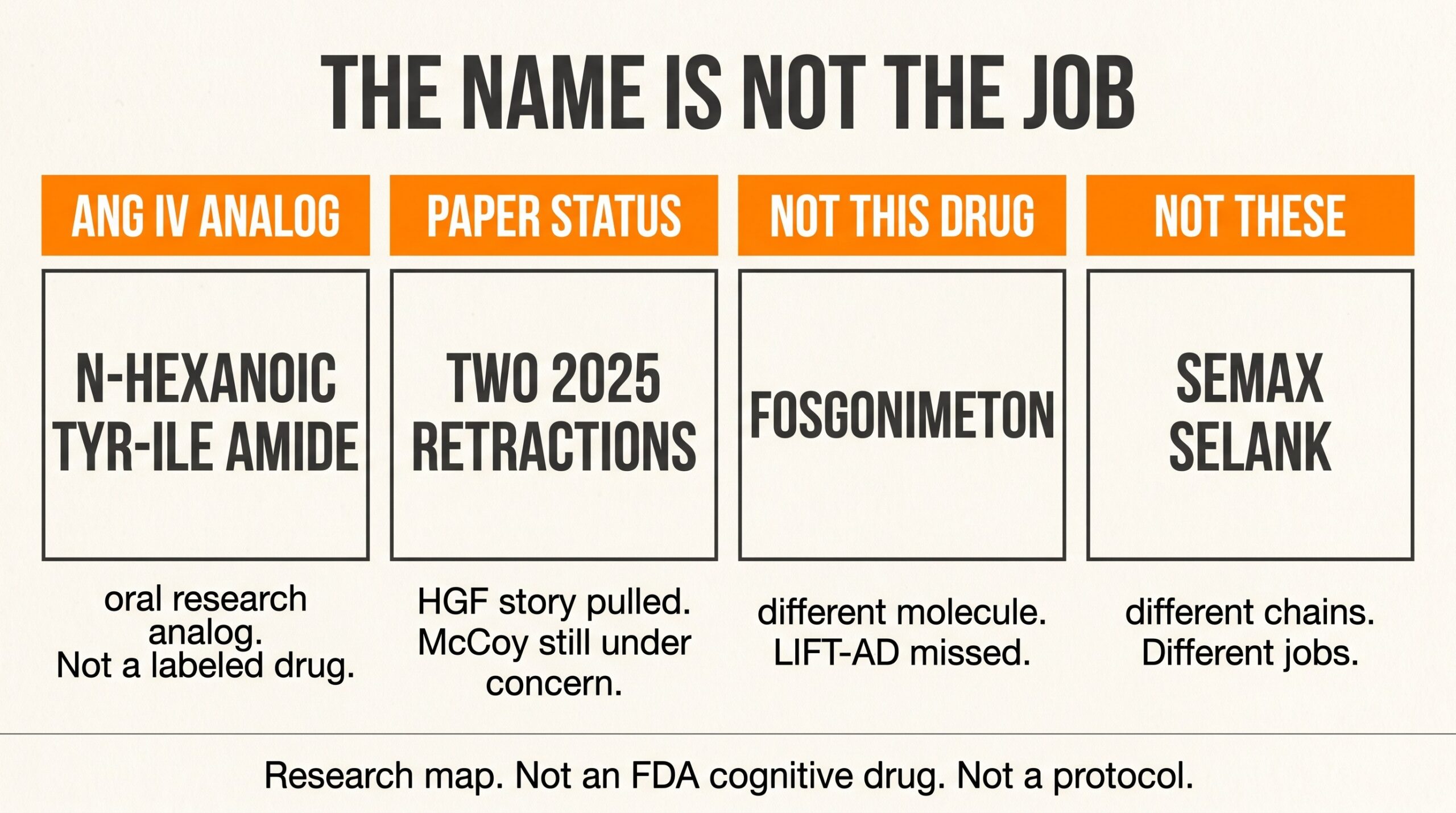
Dihexa vs fosgonimeton vs Semax vs a clinician visit
You do not need a neurology degree. You need four names and four jobs. Why should you care? Because the mash-up is how people spend money on the wrong bottle and then blame the molecule.
| Lane | What it actually is | What the evidence conversation is | What it is not |
|---|---|---|---|
| Dihexa | N-hexanoic-Tyr-Ile analog of angiotensin IV. Catalog spelling: Dihexa / PNB-0408. Often sold as a research tablet. | 2013 McCoy characterization, still under a 2021 Expression of Concern. Two 2025 JPET retractions on the HGF door story. Mixed later animal papers. No completed human Dihexa registration trial on this page. | Not an FDA cognitive drug. Not fosgonimeton. Not a clinician visit. |
| Fosgonimeton | A different small-molecule HGF-modulator candidate from the same research neighborhood. Athira ran it as a daily shot in Alzheimer trials. | LIFT-AD, a Phase 2/3 study, missed its primary endpoint at 26 weeks. Published 2025. That is a different molecule and a different regulatory object. | Not the tablet on a research catalog. Do not launder a missed trial into a Dihexa win or a Dihexa kill shot without naming the drug. |
| Semax / Selank | Russian nootropic research peptides. Different residue counts. Different literature. Maps on /semax/ and /selank/. | A different research neighborhood. Some human work exists in that cluster. Still not U.S. labeled cognitive drugs. | Not Dihexa. Same “brain” word in the caption. Different chain. |
| Pinealon / Epitalon | Short pineal / cortex bioregulator peptides. Three residues vs four. Maps on /pinealon/ and /epitalon/. | A different research neighborhood. Do not stack them because a podcast said brain or pineal. | Not Dihexa. Same biohacker aisle energy. Different residue count. |
| Clinician workup | History, meds, sleep, mood, B12, thyroid, imaging when it belongs. The boring map that actually catches treatable fog. | Standard of care. Not a peptide. Cheap relative to a mystery bottle. | Not a research analog. Memory loss, sudden confusion, or a new neuro deficit belongs with a clinician. |
You can be interested in all of them. You cannot mash Dihexa, fosgonimeton, Semax, and a pineal tripeptide into one Reddit protocol and call a catalog tablet an Alzheimer-clinic result.
Mechanism map
Search volume is not a protocol. Neither is a caption that says “the synaptogenesis peptide.”
Here is the beginner translation of what the literature actually is. I will tell you the so-what before I dump the detail. Then I will tell you how sure we should be.
The rebuilt key. They took a three-residue scrap of angiotensin IV and put a fat tail on it so it would last longer. Think of a paper library card that used to dissolve in the rain. They laminated it. The lamination is real chemistry. The claim that the laminated card opens a specific brain door is the part that later got ugly.
Wright and Harding reviewed that hope in 2015. They described Dihexa as orally active and blood-brain-barrier permeant in their animal file. They floated the brain HGF / c-Met system as a target. HGF is hepatocyte growth factor. It is a repair signal first mapped in liver work. c-Met is the receptor that HGF talks to. The review treated that axis as a possible Alzheimer target and named Dihexa as a first-in-class analog in that story (PubMed 25649658). A second 2015 review from the same group walked the angiotensin-IV analog path for Alzheimer and Parkinson models. It also noted a live fight over what the old AT4 receptor even is (PubMed 25455861). So what: friendly reviews from the originating lab are not independent replication. They are the lab telling you their map.
The stop-you stat. In April 2025, the Journal of Pharmacology and Experimental Therapeutics retracted two of the papers that taught the internet Dihexa’s HGF door story. One was Kawas, McCoy, Yamamoto, Wright, and Harding 2012, on angiotensin-IV analogs as HGF / Met modifiers (PubMed 22129598; retraction 40312092). The other was Benoist, Kawas, Zhu, and colleagues 2014. That paper said the memory and synapse effects of those peptides depend on HGF / c-Met activation (PubMed 25187433; retraction 40312093). Both papers had already been flagged with Expressions of Concern in September 2021, in the same bundle as the McCoy 2013 paper (PubMed 34551990; 34551987; 34551989). That is not a forum rumor. That is the journal pulling two filings. If someone tells you Dihexa is a proven HGF / c-Met brain-repair key, they are selling past the retraction notices.
I am not dunking the molecule. The analog is a real chemical. The 2013 characterization still exists, with a public flag on it. Some later animal work exists outside that originating cluster. This page refuses to crown a caption — and refuses to pretend retracted mechanism papers are still the mechanism.
There is an old receptor fight worth one paragraph. One camp mapped angiotensin IV to IRAP. IRAP is insulin-regulated aminopeptidase, an enzyme that clips other peptides. Another camp mapped the same neighborhood onto HGF / c-Met. Wright, Kawas, and Harding said that fight out loud in 2015. After the 2025 retractions, you should not pick a winner from a product page. You should notice the fight, notice the pulled papers, and keep your confidence haircut.
Evidence limits, stated plainly: the origin file is one lab, one journal family, and now two retractions plus a still-standing Expression of Concern on the characterization paper. Independent animal work exists and is mixed. There is no completed, peer-reviewed human Dihexa registration trial on this page. That concentration is not a conspiracy. It is a confidence haircut.
WADA and sport: if you compete, check the current prohibited list yourself. Peptide research chemicals are not a free pass because a catalog said “research use only.”
The animal file is mixed. Read both sides.
Why this matters: forums quote the warm papers and bury the cooler ones. A Foolish reader wants both.
Warm side, originating lab. McCoy 2013 reported that the analog reversed scopolamine water-maze deficits and showed activity in aged rats, with synaptogenesis talk attached. Hold that next to the 2021 Expression of Concern. Do not delete the paper. Do not pretend the flag is invisible.
Warm side, later and outside that lab. Sun, Deng, Fu, Wang, Duan, and Zhang at China Pharmaceutical University reported in 2021 that oral Dihexa restored water-maze performance in APP/PS1 mice. APP/PS1 is a common Alzheimer-model mouse line. They reported more Nissl-stained neurons, more SYP protein, less glial activation, and a PI3K / AKT story. A PI3K inhibitor reversed the anti-inflammatory and anti-apoptotic signals in that file (PubMed 34827486). How sure should you be? Mice. One paper. A different signaling caption than the retracted HGF door. A mouse water maze is not a memory clinic.
Cooler side, also later. Wells, Azzam, Hiller, and Sardinia tested PNB-0408 in a 3-NP rat model meant to mimic Huntington-like injury. Forty male Wistar rats. Chronic toxin. The analog did not protect body weight, motor scores, or spatial learning in that design. Their conclusion was plain: it may not be efficacious in that model (PubMed 38489193). So what: even inside animal work, Dihexa is not a universal neuroprotective stamp. One mouse paper looking warmer does not cancel a rat paper looking cooler. Neither one is a human label.
A 2018 systematic review by Ho and Nation looked at experimental angiotensin IV and angiotensin-(1-7) cognition studies. Of 450 hits, 32 papers met their cut. In deficit models, eight of nine studies found angiotensin IV or its analogs, including Dihexa, improved a spatial or avoidance task. Most of that file is acute. Most of it is not oral. A lot of it is injected into brain fluid. The authors said the peptides looked most useful close to learning, often by that brain-fluid route (PubMed 29733881). So what: a systematic review of animal work can be real and still be the wrong object for a human catalog tablet. It also predates the 2025 retractions. Read it as a map of experimental angiotensin IV, not as a shopping receipt.
Route matters. McCoy sold oral and barrier-permeant as the whole point. Ho and Nation found a lot of brain-fluid timing in the older analog file. A lyophilized research cake you reconstitute at home is not a 2013 rat gavage. A Paramount tablet is not a 2021 mouse chow protocol. I will not launder one into the other.
Fosgonimeton is not Dihexa. Say it twice.
Why this matters: people see “HGF modulator, Alzheimer, Washington State spinout” and glue the catalog tablet to a Nasdaq ticker. That glue is how captions get people hurt.
Fosgonimeton is a different small molecule. Athira studied it as a daily subcutaneous shot. LIFT-AD was a randomized, placebo-controlled Phase 2/3 trial in mild-to-moderate Alzheimer disease. Primary analysis: 287 people not on cholinesterase inhibitors, 40 mg fosgonimeton versus placebo, 26 weeks. The primary endpoint was a Global Statistical Test that mixed a cognition score and a daily-function score. It missed. GST difference -0.08, p = 0.70. ADAS-Cog11 difference -0.70, p = 0.35. ADCS-ADL23 difference +0.67, p = 0.61. Small numbers leaned toward the drug. They were not statistically significant. More people quit fosgonimeton for side effects, mostly injection-site reactions, 14.2% versus 4.6%. Serious events were not higher on drug. The 2025 paper said the trial did not achieve its primary or secondary endpoints (PubMed 41393340; NCT04488419).
That is the so-what. A related-neighborhood clinical candidate missed a Phase 2/3 Alzheimer trial. That is not a Dihexa human study. It is also not proof that every HGF story is fake. It is a reason you do not get to print “the Alzheimer peptide” on a research tablet and call it a clinic result. If memory change is the actual job, that is a clinician conversation. Done-pezil, memantine, lecanemab, and donanemab are different regulatory objects. None of them is Dihexa.
Research catalog vs compounding vs FDA drugs
Three lanes. Keep them. Why this matters: the coupon code does not change the lane.
FDA-approved cognitive drugs have an application, a label, an indication, and manufacturing the agency inspects for that product. There is no Dihexa dementia tablet in that U.S. drawer. Cholinesterase inhibitors, memantine, and the amyloid antibodies live in that drawer when they do. None of them is your research analog.
Compounding is a pharmacy lane. A 503A pharmacy compounds for a patient with a prescription. That lane has its own FDA bulk-substance fights and state-board rules. A compounded Dihexa script, if a clinic even offers one, is still not an approved dementia drug. It is a different object from a research catalog with a coupon code.
Research catalogs sell named sequences for research use. COA if you are lucky. “Not for human consumption” on the page. Forums treat that disclaimer as a wink. I do not. A research-use Dihexa tablet is a catalog SKU. It is not a compounding script. It is not a labeled drug. Pretending otherwise is how people get hurt and how this page would get stupid.
I am not going to tell you a research catalog is a back door to a neurology clinic. I am going to tell you to name the lane before you name the SKU.
Tablets, cakes, and reconstitution notes
Partner shelves for this analog are often tablets, not a lyophilized cake. Read the label. A tablet is a different object from a powder you mix yourself. Do not assume tablet milligrams equal a 2013 rat oral protocol. Do not assume either one equals a brain-fluid analog from older angiotensin-IV work.
If a lyophilized cake is even on the table, learn the math before you invent a protocol. How to reconstitute peptides is the public page for bacteriostatic water, U-100 insulin-syringe ticks, and not wasting 10% of the vial on foam and dead volume.
I will not dump a Dihexa milligrams-and-days schedule on a public page. That is Pro on purpose.
Who this page is for — and who it is not
Start with the question, not the bottle.
This page is for you if you typed Dihexa, PNB-0408, or “the synaptogenesis peptide” and want the research map before you spend money. Or if a podcast stacked Dihexa next to Semax and you need the residue count separated.
This page is not for you if you want a diagnosis for memory loss, dementia, Parkinson, Huntington, or sudden confusion from a blog. Those are clinician conversations. A research tablet does not replace that visit. New weakness, a first seizure, or a sudden change in speech belongs with emergency care — not a catalog.
Here is the order I give beginners.
1. Read first. If the job is fog, start with sleep, meds, alcohol, B12, thyroid, and mood before you name a peptide. A lot of “brain” searches are sleep debt wearing a lab coat. We already mapped hygiene on how to sleep better.
2. Name the peptide. Dihexa is an angiotensin-IV analog. If the bottle also says tesofensine, BPC-157, or a blend, read every name on the label. A blend is not a solo analog.
3. Do not crown the caption. “Procognitive / antidementia analog” won a 2013 title. It did not win a U.S. label. It did not survive two 2025 retractions without a haircut.
4. If a research SKU is even on the table, stop at the map. Protocol depth lives in Peptides & Pump Pro. Ten dollars a month. Seven-day trial.
Where I actually look when the job is a Dihexa research compound
Education first. You already got the map. This block is the labs I will put my name on, with the codes that fire. Research-use catalog pages. Not a treatment claim. Not a clinic substitute.
Partner reality on today’s audit: Paramount lists Dihexa 30 mg tablets, 30 count, in stock. Two Paramount blends that also contain Dihexa are in stock too. Those blends are different objects, so they get chips, not the hero card. Limitless, BioLongevity, Peptira, and S1 get home or shop chips only. I do not invent product hrefs.
Research-catalog SKU currently live on partner audit (not a treatment recommendation).
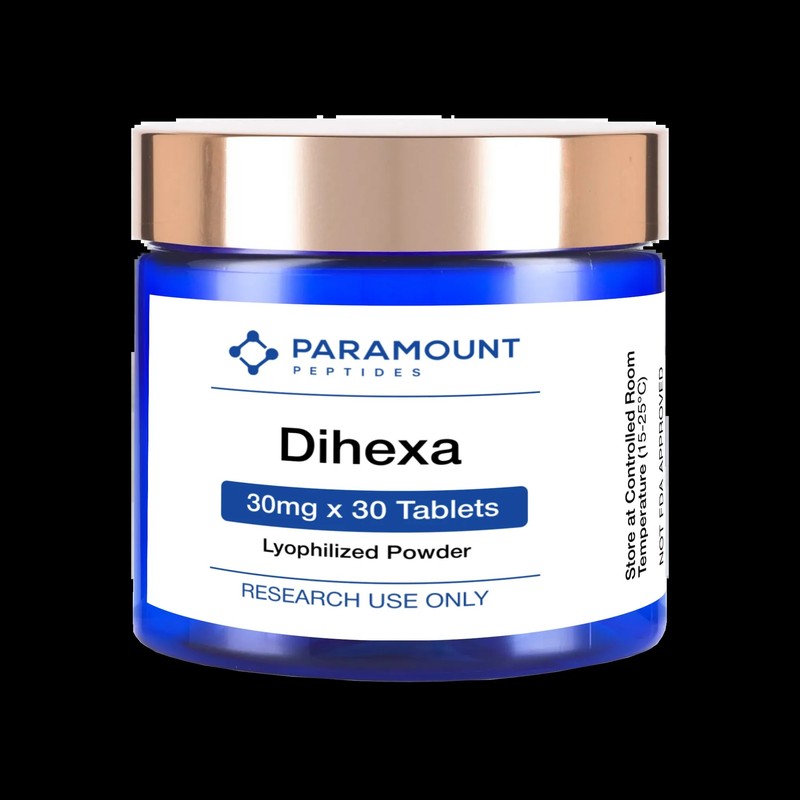 Paramount
Dihexa 30 mg tablets × 30
LEE10Paramount Dihexa 30 mg × 30 · LEE10Paramount Tesofensine / Dihexa blend · LEE10Paramount Dihexa / Tesofensine / BPC blend · LEE10Limitless home · LEE20BioLongevity home · LEE15Peptira home · LEES1 shop · LEE10
Match the product to the job. Do not collect bottles. A tesofensine blend is not solo Dihexa. Do not use a research catalog as a back door to a memory diagnosis.
Frequently asked questions about Dihexa
Is Dihexa a proven brain drug?
No. Dihexa is not an FDA-approved drug to treat memory loss, Alzheimer disease, Parkinson disease, Huntington disease, or “brain fog.” The analog is real chemistry. The 2013 origin paper is flagged. Two later mechanism papers were retracted in 2025. That is a map, not a label.
Is Dihexa the same as fosgonimeton?
No. Fosgonimeton is a different molecule that Athira studied as a daily shot. LIFT-AD missed its primary endpoint. That miss does not make a catalog Dihexa tablet into a failed drug, and it does not make it into a successful one. Different objects.
Is Dihexa the same as Semax or Selank?
No. Semax and Selank are different research peptides with different residue counts and a different literature. Read the Semax research map or the Selank research map if that is the molecule you actually typed.
Did human studies show Dihexa works?
Not in a completed registration trial I can put on this page. The warm file is animal work, some of it flagged or retracted. The clinical miss people quote is fosgonimeton, which is not Dihexa. Talk to a clinician if this is a medical question.
Can I just run a Dihexa protocol from a forum?
You can do a lot of unwise things. I would not. Name the sequence. Name whether you are holding a research catalog, a compounded script, or a fantasy. Protocol depth lives in Pro on purpose. This public page is the map, not the marching orders.
Does a retraction mean the analog does not exist?
No. A retraction means those papers are no longer a reliable source for the claims they made. The chemical can still be synthesized. Animal work can still be mixed. Drop the pulled HGF door story. Keep the Expression of Concern on McCoy 2013 in view. Stop treating a caption as a clinic.
Selected references
These are starting points for the published file — not a protocol, not a drug label, not an endorsement to self-treat. I am not inventing citations. Every ID below was verified against PubMed before publish.
- Characterization of the oral analog N-hexanoic-Tyr-Ile-(6) aminohexanoic amide in scopolamine and aged-rat models — PubMed 23055539.
- Expression of Concern on that 2013 paper — PubMed 34551989.
- Retracted 2012 HGF / Met modifier paper — PubMed 22129598; retraction notice 40312092; Expression of Concern 34551990.
- Retracted 2014 HGF / c-Met dependence paper — PubMed 25187433; retraction notice 40312093; Expression of Concern 34551987.
- 2015 review: brain HGF / c-Met as an Alzheimer-target story, naming Dihexa — PubMed 25649658.
- 2015 analog-development review, including the AT4 identity fight — PubMed 25455861.
- Systematic review of experimental angiotensin IV and angiotensin-(1-7) cognition studies — PubMed 29733881.
- APP/PS1 mouse paper, PI3K / AKT story — PubMed 34827486.
- 3-NP Huntington-like rat paper: PNB-0408 did not protect — PubMed 38489193.
- LIFT-AD fosgonimeton Phase 2/3 paper, different molecule, missed primary endpoint — PubMed 41393340.
Read primary sources. Do not treat a PubMed ID as a shopping list. Do not cite a retracted paper as if it still holds the mechanism.
The bottom line
Dihexa is an angiotensin-IV analog with a 2013 origin paper and a 2021 public flag on that paper. Real chemistry. Not an FDA-approved brain drug.
It is not fosgonimeton. It is not Semax. It is not a clinician visit. Keep the lanes. Read the 2025 retractions next to the warm mouse paper and the cooler rat paper. Do not buy a catalog tablet because a caption told you it was a labeled dementia medicine.
If you need the beginner on-ramp, use Start Here and what are peptides. If the job is fog, start with how to sleep better and a clinician, not a mystery analog. Reconstitution math, when a lyophilized cake is even on the table, is on how to reconstitute peptides. Want the free field guide before you spend another dollar on a bottle? Grab the Peptide Playbook — the short form on that page is how it ships. Adjacent reading already live: Semax, Selank, Pinealon, Epitalon, and NAD.
Free guide
Get The Peptide PlaybookEnter your email and we’ll send the research PDF. Education only — not medical advice.
I built Peptides & Pump so you can get this without a guru tax. If you want the protocol library, member discussions, and a place to think out loud before you spend money, that is Pro. If you are not ready to pay, use the free Knowledge Base first. Then come back and argue with me when you have read more than a caption.
 Keep going on Peptides & Pump
Free is the peptide community. Pro is where you master it. Codes are the links. Click them so the discount fires.
Free
Knowledge Base
The peptide community · 2,500+
- 2,500+ member peptide community
- Sourcing questions before you buy anything random
- The basics, from people actually using peptides
Pro
Peptides & Pump Pro
$10/mo · 7-day trial
- Science-backed protocol library
- 1-on-1 support from Lee and Matt
- Step-by-step video, plus a monthly $500 drawing
LEE20 Limitless LEE15 BioLongevity LEE10 Paramount LEE Peptira LEE10 S1
Supplier footnote: Research suppliers I mention when people ask about Dihexa: Paramount Dihexa 30 mg tablets (code LEE10). Paramount also lists a Tesofensine / Dihexa blend and a Dihexa / Tesofensine / BPC blend (code LEE10). Limitless, BioLongevity, Peptira, and S1 had no boxed product URL — use Limitless home (code LEE20), BioLongevity home (code LEE15), Peptira home (code LEE), and S1 shop (code LEE10). Match the product to the job. Do not collect bottles.
Disclaimer. This article is for educational and research purposes only. It is not medical advice. It is not intended to diagnose, treat, cure, or prevent any disease. Dihexa (N-hexanoic-Tyr-Ile-(6) aminohexanoic amide; PNB-0408) is not an FDA-approved drug for memory loss, Alzheimer disease, Parkinson disease, Huntington disease, synaptogenesis, or any other indication. Fosgonimeton is a different molecule and is not Dihexa. Research peptides discussed here are research sequences; a research-catalog tablet is not a compounded prescription and is not a labeled drug. Most of the published evidence discussed here includes animal studies, originating-lab papers under Expression of Concern, retracted mechanism papers, and one missed Phase 2/3 trial of a different candidate; none of that is a substitute for a clinician. Individual results vary. Always consult a qualified healthcare provider before starting any peptide, drug, supplement, or protocol, especially if you have a medical condition or take prescription medication. Sudden confusion, new weakness, or a first seizure belongs with emergency care. Peptides & Pump does not sell peptides.
Affiliate disclosure. Some links on this page are affiliate links. If you buy through them, I may earn a commission at no extra cost to you. Codes LEE15, LEE20, LEE, and LEE10 are the ones I actually use where a coupon fires. That commission is how I keep publishing free education. I only link suppliers I am willing to put my name on.