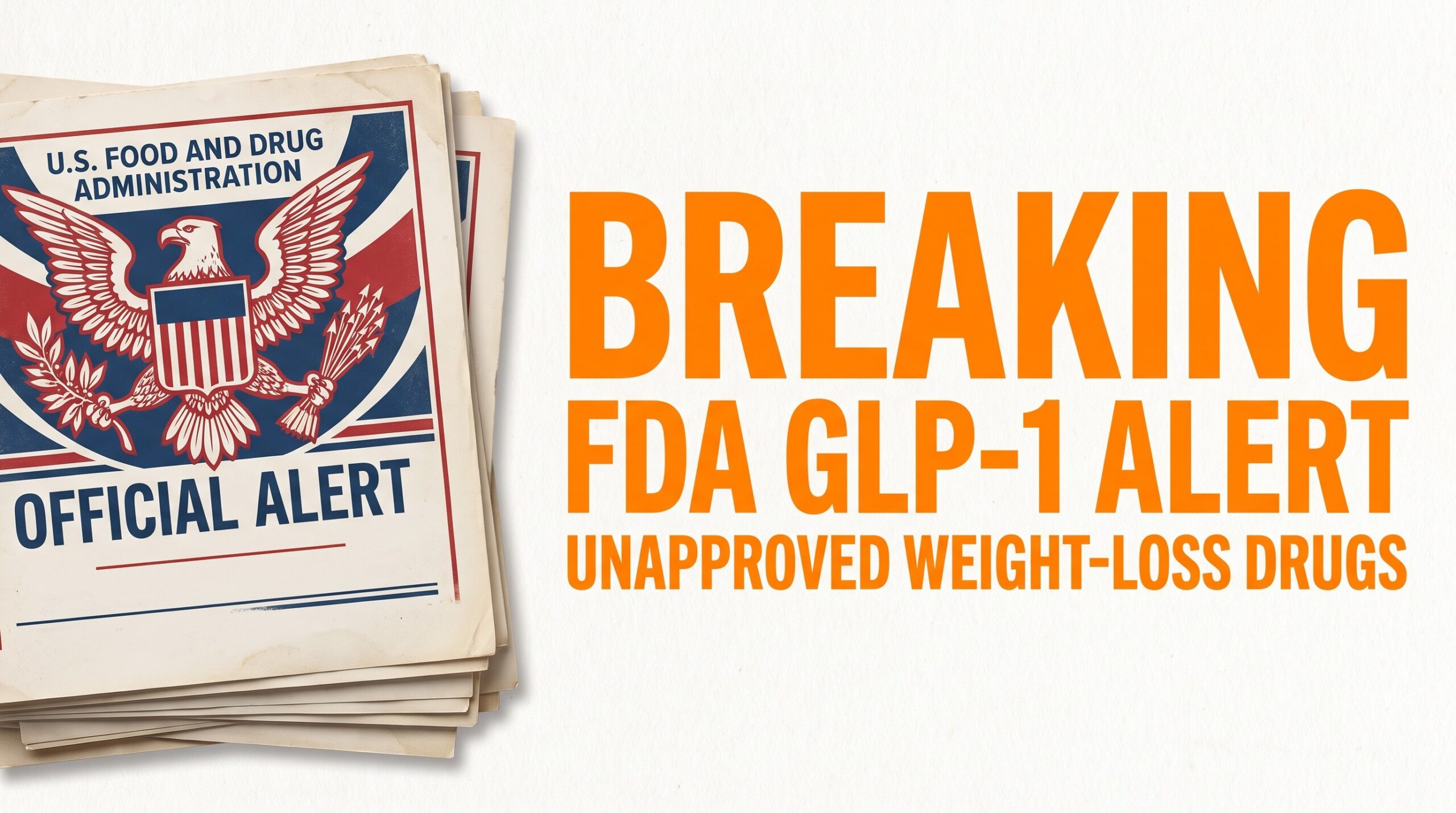
BREAKING: FDA Flags Risks of Unapproved GLP-1 Drugs for Weight Loss
Breaking · Silver Spring, Md. · Sept. 4, 2026
The FDA is warning patients and clinicians that unapproved GLP-1 drugs used for weight loss — including compounded and illegally marketed versions of semaglutide and tirzepatide — do not get the agency’s pre-market review for safety, effectiveness, or quality.
That is the core line on the agency’s live drug-alert page, FDA’s Concerns with Unapproved GLP-1 Drugs Used for Weight Loss. Content on that page is marked current as of Sept. 1, 2026. We are treating it as a primary source, not a rumor mill.
Key facts
- Unapproved ≠ reviewed. FDA says unapproved GLP-1 versions “do not undergo FDA’s review for safety, effectiveness and quality before they are marketed.”
- Compounding has a narrow lane. Compounded drugs “should only be used in patients whose medical needs cannot be met by an FDA-approved drug.”
- Retatrutide / cagrilintide: FDA states these “cannot be used in compounding under federal law” and “have not been found safe and effective for any condition.”
- Adverse-event counts (as of May 31, 2026): 990 reports tied to compounded semaglutide; more than 730 for compounded tirzepatide. Underreporting is likely for many state-licensed pharmacies.
- RUO / “not for human consumption” sales: FDA has warned companies selling unapproved semaglutide, tirzepatide, retatrutide, survodutide, or mazdutide under those labels when products ship to consumers with dosing instructions.
If you only skim one thing today: the agency is drawing a bright line between FDA-approved prescription products and everything else wearing a GLP-1 costume.
What the FDA is warning about
The page opens like a wire story, not a brochure. Patients and clinicians, it says, may look to unapproved versions of GLP-1 receptor agonists — “including semaglutide and tirzepatide” — for weight loss. Quote the risk language directly:
“This can be risky for patients, as unapproved versions do not undergo FDA’s review for safety, effectiveness and quality before they are marketed.”
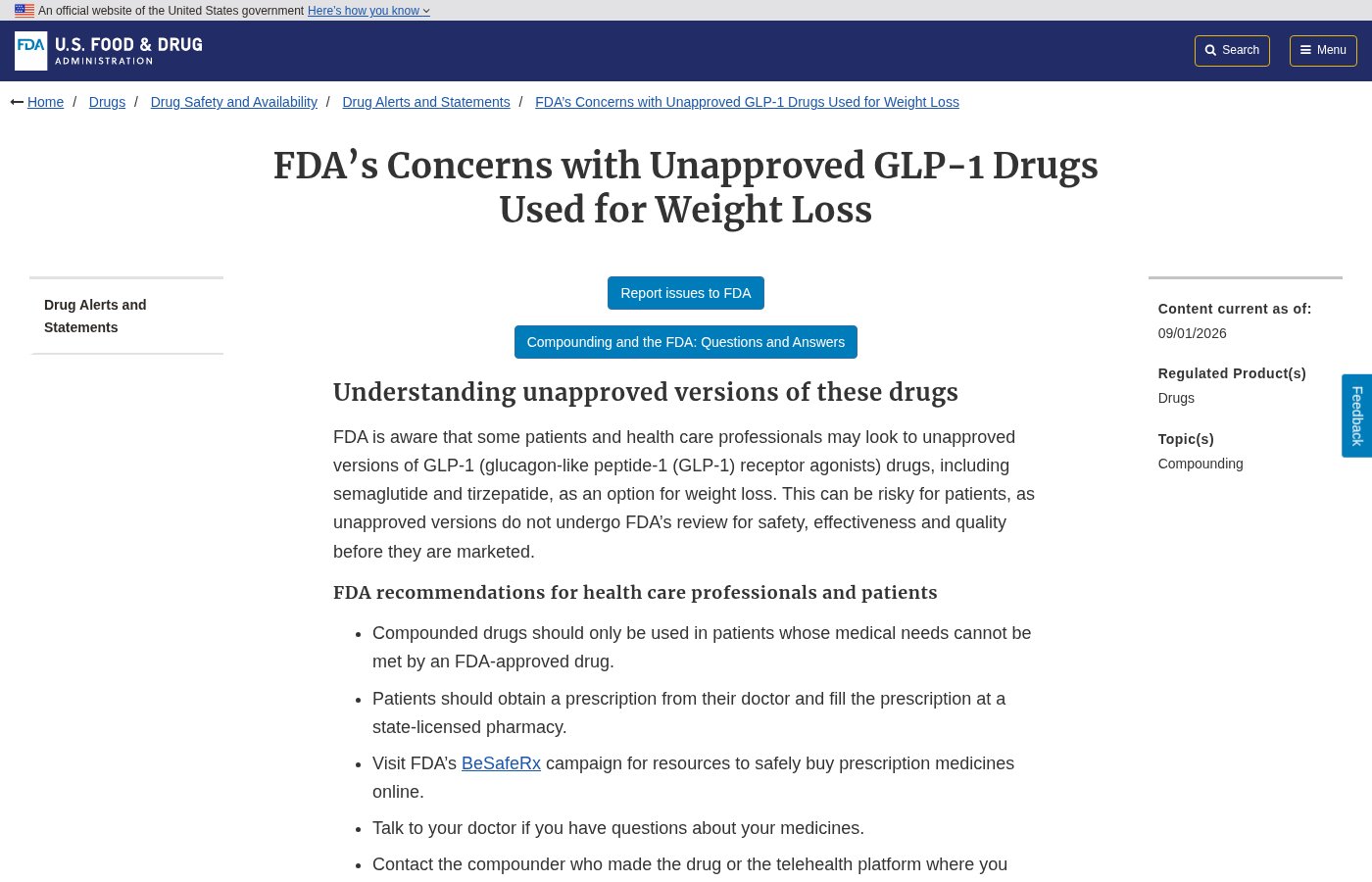
FDA’s own recommendations for professionals and patients are blunt:
- Use compounded drugs only when an FDA-approved drug cannot meet the medical need.
- Get a prescription from a doctor and fill it at a state-licensed pharmacy.
- Use the agency’s BeSafeRx resources before buying medicine online.
- Talk to your doctor. If label or use questions pop up, contact the compounder or telehealth platform.
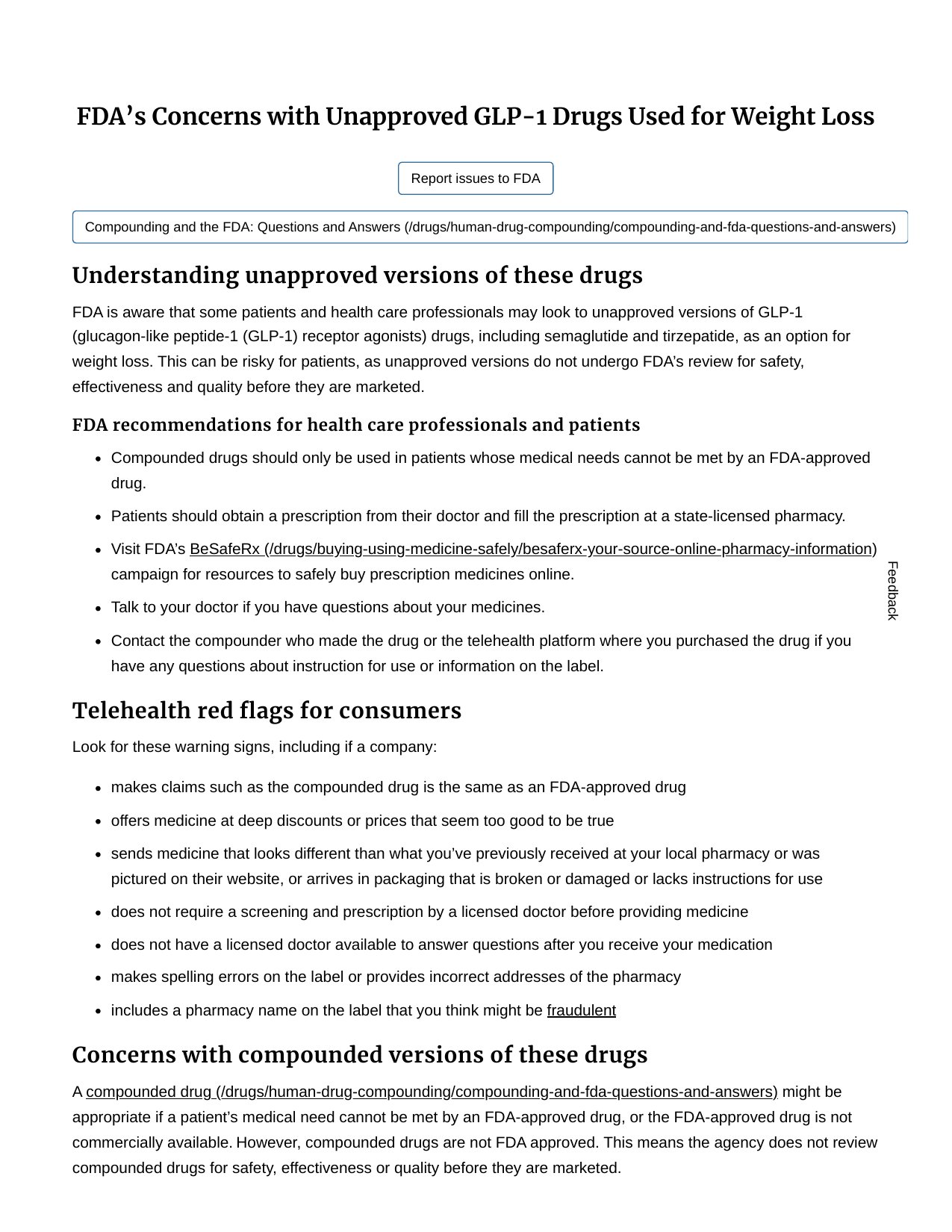
Telehealth red flags the agency wants you to spot
This section reads like a consumer crime blotter. FDA says watch for companies that:
- Claim the compounded drug is the same as an FDA-approved drug
- Push deep discounts that feel too good to be true
- Ship medicine that looks different than expected, or arrives damaged / without instructions
- Skip licensed-doctor screening and a real prescription
- Have no licensed doctor available after you get the medicine
- Botch spelling on the label or list shady pharmacy addresses
- Print a pharmacy name you suspect is fraudulent
Who’s affected: compounding vs approved products
FDA does not say compounding is imaginary. It says compounding is not FDA approval.
“A compounded drug might be appropriate if a patient’s medical need cannot be met by an FDA-approved drug, or the FDA-approved drug is not commercially available. However, compounded drugs are not FDA approved. This means the agency does not review compounded drugs for safety, effectiveness or quality before they are marketed.”
Then the agency walks the specific risk list it is working with state partners on:
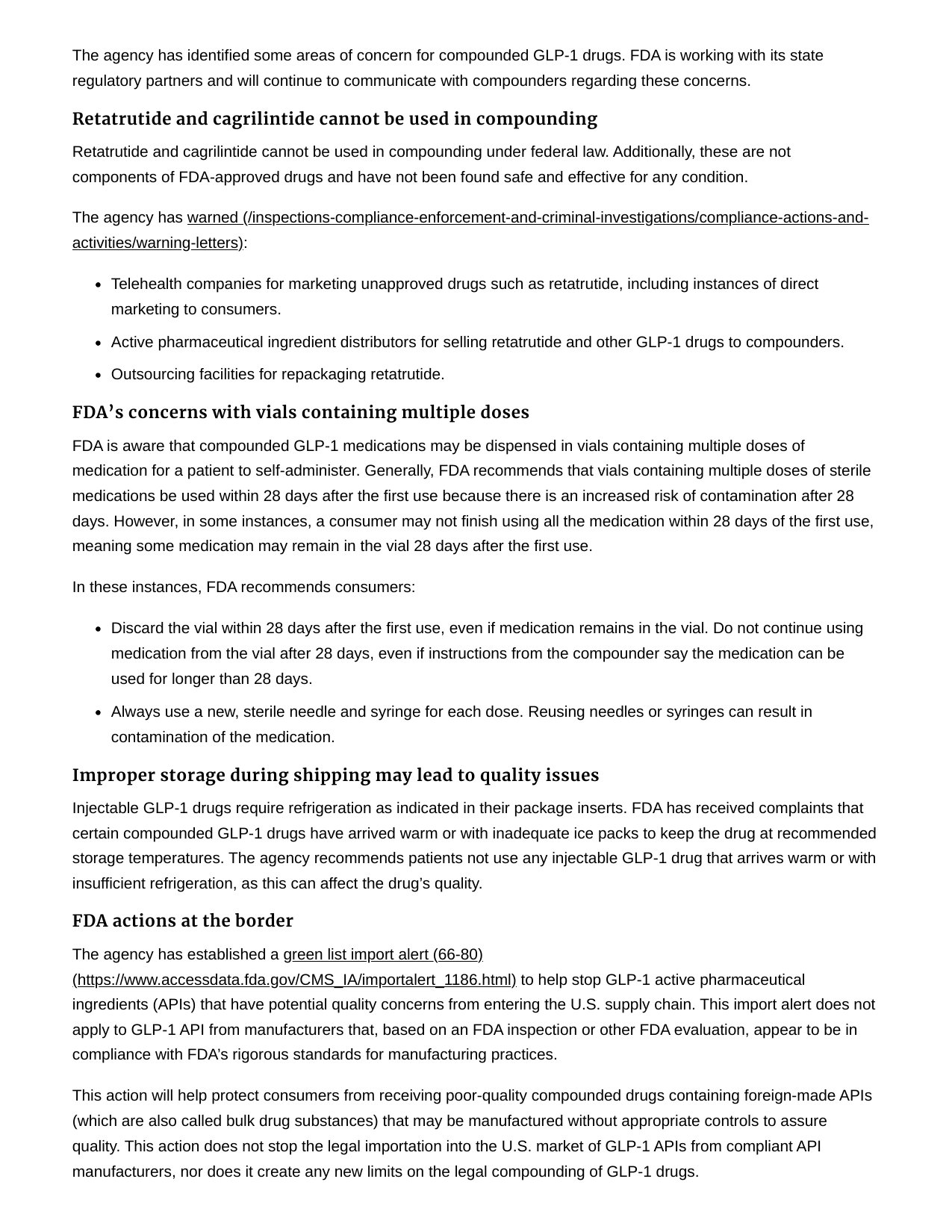
- Retatrutide and cagrilintide — cannot be used in compounding under federal law; not components of FDA-approved drugs; not found safe and effective for any condition. FDA says it has warned telehealth marketers, API distributors, and outsourcing facilities in this lane.
- Multi-dose vials — generally use within 28 days after first puncture; discard even if drug remains; new sterile needle/syringe each dose.
- Warm shipping — injectable GLP-1s need refrigeration; do not use product that arrives warm or under-iced.
- Border / API quality — green list import alert (66-80) aimed at GLP-1 APIs with potential quality concerns.
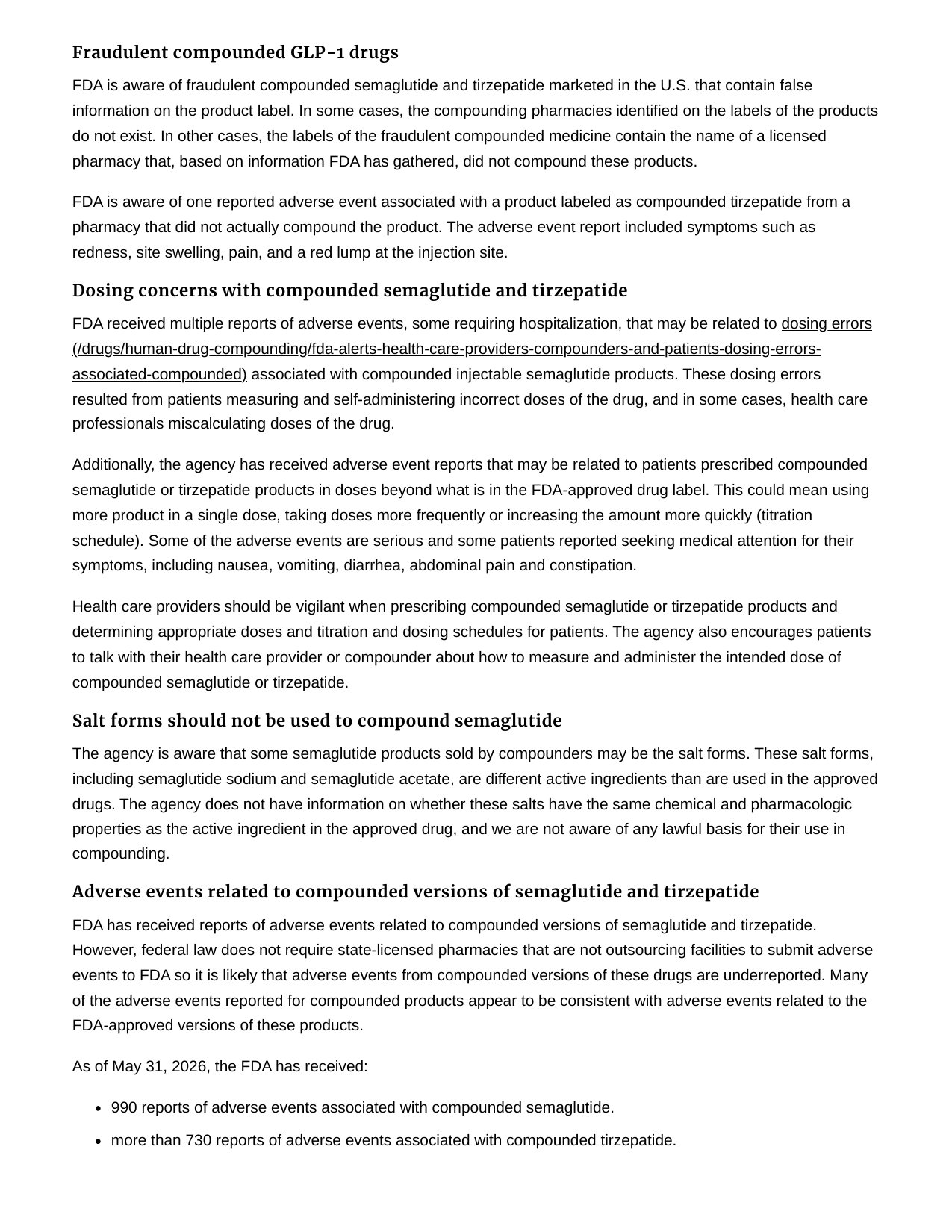
- Fraudulent labels — pharmacies on labels that do not exist, or licensed names that did not actually compound the product.
- Dosing errors — adverse events, some hospitalizations, tied to patients or clinicians mis-measuring compounded injectable semaglutide; also reports of doses beyond approved-label amounts or faster titration.
- Salt forms of semaglutide — sodium/acetate salts are different active ingredients; FDA says it is not aware of a lawful basis for using them in compounding.
What this does not change
Read the page carefully and the approved lane is still the approved lane.
- FDA-approved GLP-1 medicines prescribed by a clinician and dispensed through legitimate pharmacy channels are not what this alert is attacking.
- Legal compounding for a real individual medical need that an approved product cannot meet remains a regulated category — but it is still not the same as FDA approval.
- Compliant API imports are not blanket-banned by the green-list alert; FDA says the alert targets APIs with potential quality concerns and does not create new limits on legal compounding by itself.
In plain English: the agency is not canceling the science of GLP-1 receptor agonists. It is warning about products and marketing that skip the review gate patients assume when they hear a drug name on TikTok.
Illegally marketed versions, counterfeits, and fake “research” bottles
Separate from compounding, FDA flags:
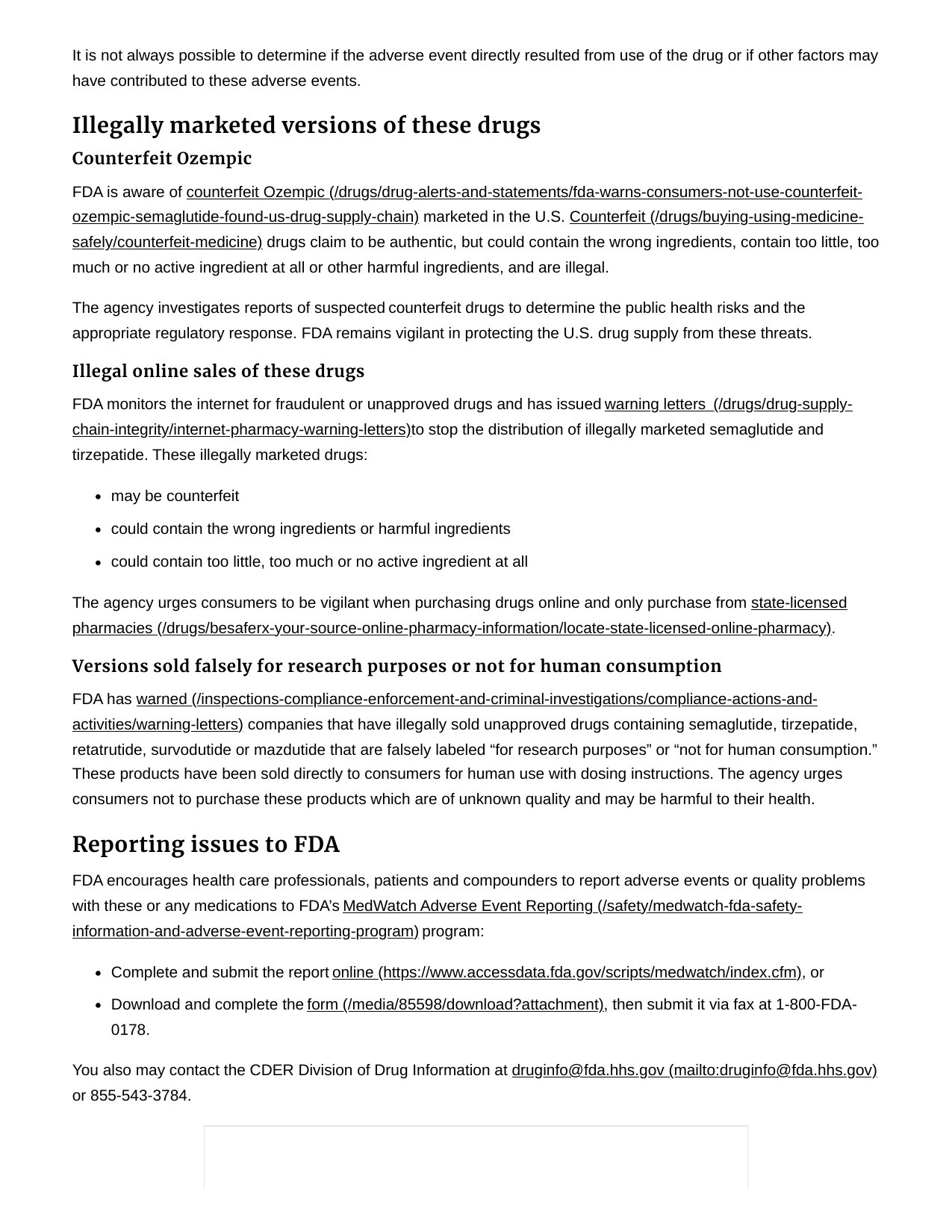
- Counterfeit Ozempic in the U.S. supply chain
- Illegal online sales of semaglutide and tirzepatide (wrong / missing / harmful ingredients possible)
- Products falsely labeled “for research purposes” or “not for human consumption” while sold to consumers with dosing instructions — naming semaglutide, tirzepatide, retatrutide, survodutide, or mazdutide
No official FDA video is embedded on that alert page (footer social links do not count). We are not inventing one. Primary source stays the written alert.
So what for peptide readers
If you read Peptides & Pump for maps — not miracle captions — this FDA page is a sorting hat:
- Approved Rx conversation belongs with a licensed clinician and a real pharmacy. Full stop.
- Compounded copies are a different regulatory object. FDA’s own words: not reviewed for safety, effectiveness, or quality before marketing.
- Research-catalog / RUO bottles are not a backdoor human therapy, and FDA says it has already warned companies blurring that line with dosing instructions.
- Name recognition is not approval. Retatrutide buzz does not equal a compounding green light. FDA says the opposite.
Use our evergreen maps if you want the mechanism story without turning a news alert into a shopping list:
- Tirzepatide vs semaglutide
- Retatrutide research map
- Peptides for weight loss
- Mazdutide vs retatrutide
Also useful on-ramps: Start Here, what are peptides, and how to reconstitute peptides for lab-math literacy — not for DIY drug play.
Bottom line for readers: treat the FDA URL as the primary source. Screenshot it. Bookmark it. Ask a clinician before you trust a telehealth caption that says “same as the brand.”
Sources
- Primary: U.S. Food and Drug Administration. FDA’s Concerns with Unapproved GLP-1 Drugs Used for Weight Loss. Content current as of Sept. 1, 2026. Accessed Sept. 4, 2026.
- U.S. Food and Drug Administration. FDA Intends to Take Action Against Non-FDA-Approved GLP-1 Drugs (press announcement, Feb. 6, 2026).
- FDA. BeSafeRx online pharmacy safety resources.
- FDA. Import Alert 66-80 (green list referenced on the alert page).
Report problems to FDA MedWatch online or via the form/fax pathway listed on the agency page. CDER Division of Drug Information: druginfo@fda.hhs.gov / 855-543-3784.
Free guide
Get The Peptide PlaybookEnter your email and we’ll send the research PDF. Education only — not medical advice.
I built Peptides & Pump so you can read the FDA page without a guru tax. If you want the protocol library and a place to think out loud before you spend money, that is Pro. If you are not ready to pay, use the free Knowledge Base first.
 Keep going on Peptides & Pump
Free is the peptide community. Pro is where you master it. Codes are the links. Click them so the discount fires.
Free
Knowledge Base
The peptide community · 2,500+
- 2,500+ member peptide community
- Sourcing questions before you buy anything random
- The basics, from people actually using peptides
Pro
Peptides & Pump Pro
$10/mo · 7-day trial
- Science-backed protocol library
- 1-on-1 support from Lee and Matt
- Step-by-step video, plus a monthly $500 drawing
LEE20 Limitless LEE15 BioLongevity LEE10 Paramount LEE Peptira LEE10 S1
Disclaimer. This article is educational news coverage of a public FDA drug alert. It is not medical advice. It is not a recommendation to buy, compound, skip, or substitute any medicine. FDA-approved drugs, compounded drugs, and research-labeled products are different legal and quality objects. Always talk with a licensed clinician about prescription medicines. Peptides & Pump does not sell peptides or prescription drugs.
Affiliate disclosure. Soft partner codes appear only in the site footer block (LEE15 / LEE20 / LEE / LEE10). This news page is not a product sell sheet. Some links may be affiliate links.