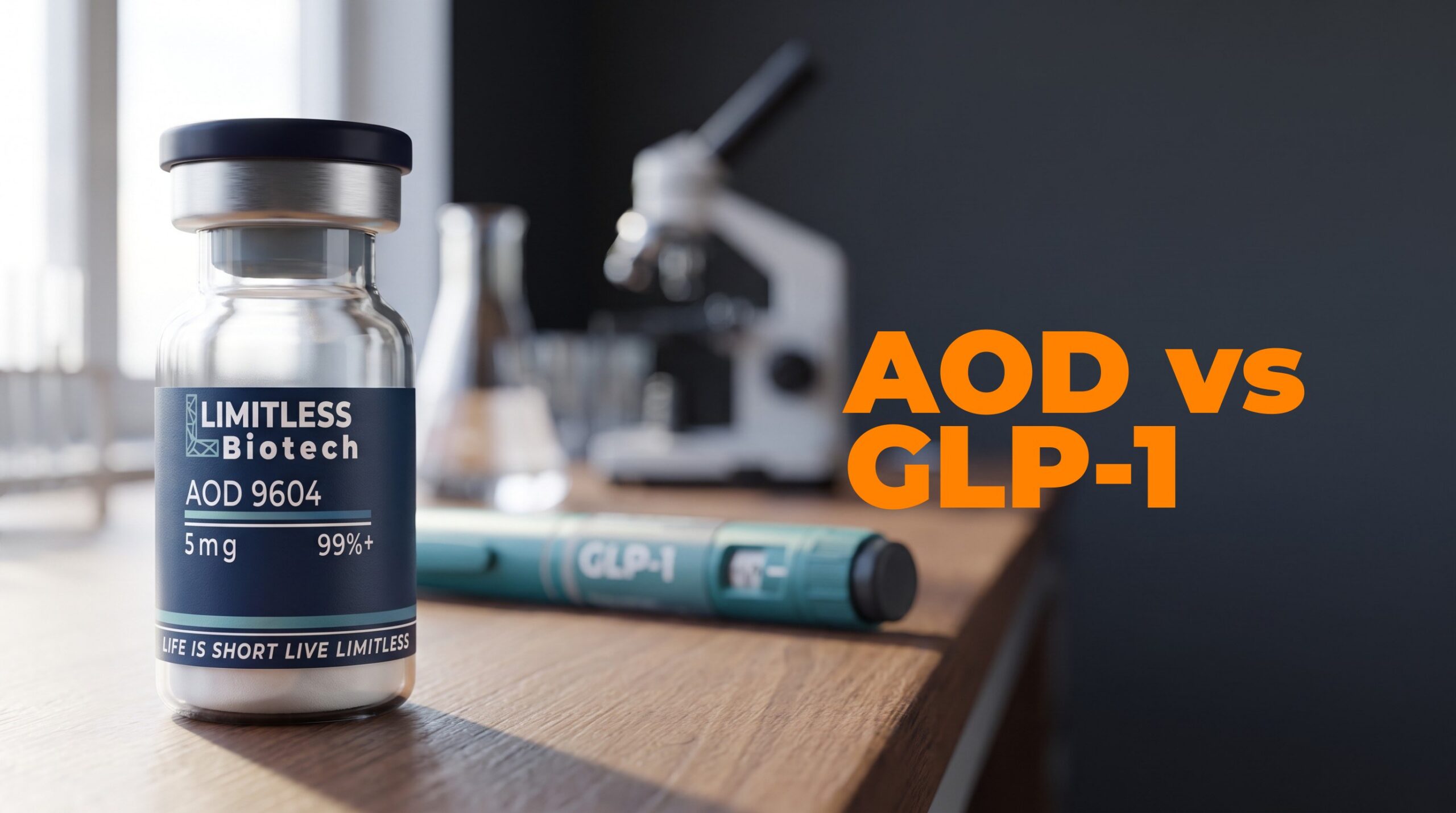
Peptides for Weight Loss: Research Compounds vs GLP-1s
Key Takeaways
- “Peptides for weight loss” is not one vial. It is at least three conversations: prescription GLP-1 drugs, research-catalog fragments like AOD-9604, and GHRH analogs like tesamorelin.
- Semaglutide, tirzepatide, and retatrutide are a pharmacy and clinician conversation. They are not a lyophilized research vial with a coupon code.
- AOD-9604 is a 16-amino-acid hGH fragment (176-191 / Tyr-hGH 177-191) built as a lipolytic piece of the hormone. Mouse lipid-metabolism data exists. Human weight-loss data is mixed. It is not an approved obesity drug.
- Tesamorelin is a 44-amino-acid GHRH analog. The visceral-fat evidence is Egrifta in HIV-associated lipodystrophy, not a research-vial hack for pinchable subcutaneous fat.
- Full protocols stay in Peptides & Pump Pro ($10/mo, 7-day trial). This public page answers the search question so you stop mixing lanes.
Peptides for weight loss names a goal, not a molecule. The goal gets sold as three lanes in one cart: prescription GLP-1 and dual GIP/GLP-1 pens, research-catalog fragments such as AOD-9604, and tesamorelin — a GHRH analog whose best human evidence is visceral adipose tissue in HIV-associated lipodystrophy.
A named sequence in a lyophilized vial is not a drug label. Mixing those lanes is how a cake gets ordered as if it were a pen.
One is a prescription-drug conversation. GLP-1 receptor agonists. Dual GIP/GLP-1 agonists. Triple agonists still in development. Pens. Pharmacies. Prior auth. A clinician who owns the risk.
Two is a research-catalog conversation. A named sequence in a lyophilized vial. A certificate of analysis if you are lucky. A forum thread that pretends those two things are the same as a drug label.
Three is a specific analog conversation. Tesamorelin as a GHRH analog whose best human evidence is visceral adipose tissue in HIV-associated lipodystrophy, sold online as “the fat-loss peptide.”
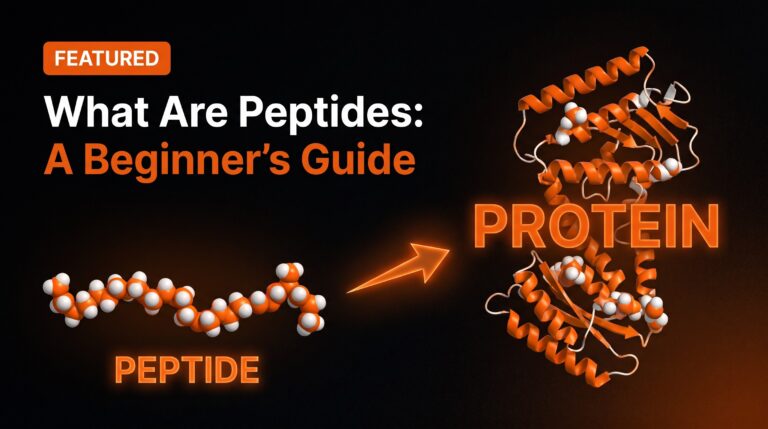
If you still need the map of what peptides even are, read that first. Then read this before you buy a vial because a reel said “AOD.”
What does “peptides for weight loss” actually mean?
A peptide is a short chain of amino acids. That is the category, not the job.
Insulin is a peptide. Semaglutide is a peptide. AOD-9604 is a peptide. Tesamorelin is a peptide. Your collagen powder is a pile of peptides if the marketer is being cute.
So “peptides for weight loss” is about as precise as “pills for blood pressure.” You named a format. You did not name a mechanism, a tissue, or a regulatory lane.
The search intent is honest. People want less fat. They heard peptides. They want the vial that does what the pen does, without the pen, the nausea, or the insurance call.
That is the trap.
Weight loss is not one vial. Fat is not one compartment. A GLP-1 analog that slows gastric emptying and drops appetite is not the same tool as a C-terminal hGH fragment studied for lipolysis. A GHRH analog that reduced visceral fat on CT scans in people with HIV-associated lipodystrophy is not a “cut” for love handles.
If you are brand new, start on the Start Here page. The GH-secretagogue lane is peptides for muscle growth, not this page. Do not run five compounds because a podcast guest stacked them on a whiteboard.
Are GLP-1 drugs the same thing as research peptides?
No.
Semaglutide, tirzepatide, and retatrutide are engineered gut-hormone receptor agonists. They work on appetite, gastric emptying, and glucose handling. That is a drug-development story. Phase programs. Labels for the approved products. A prescriber.
STEP 1 put once-weekly semaglutide 2.4 mg against placebo in adults with overweight or obesity. Mean weight change at 68 weeks lived in a different universe from a research fragment. Wilding and colleagues published it in the New England Journal of Medicine in 2021.
SURMOUNT-1 did the same kind of work for tirzepatide, a dual GIP and GLP-1 receptor agonist. Jastreboff and colleagues, NEJM, 2022. Double-digit percent body-weight change at 72 weeks at the studied doses. That is why your group chat will not shut up about it.
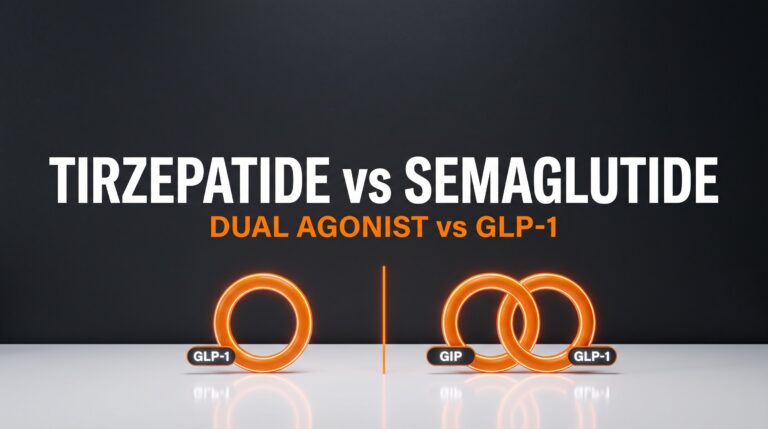
If the search was specifically tirzepatide vs semaglutide — dual agonist versus GLP-1 — that comparison now has its own page.
Retatrutide is a triple agonist at GIP, GLP-1, and glucagon receptors. Phase 2 obesity data from Jastreboff in NEJM, 2023 is the paper behind the hype. It is still a drug-development conversation. It is not a coupon-code vial.
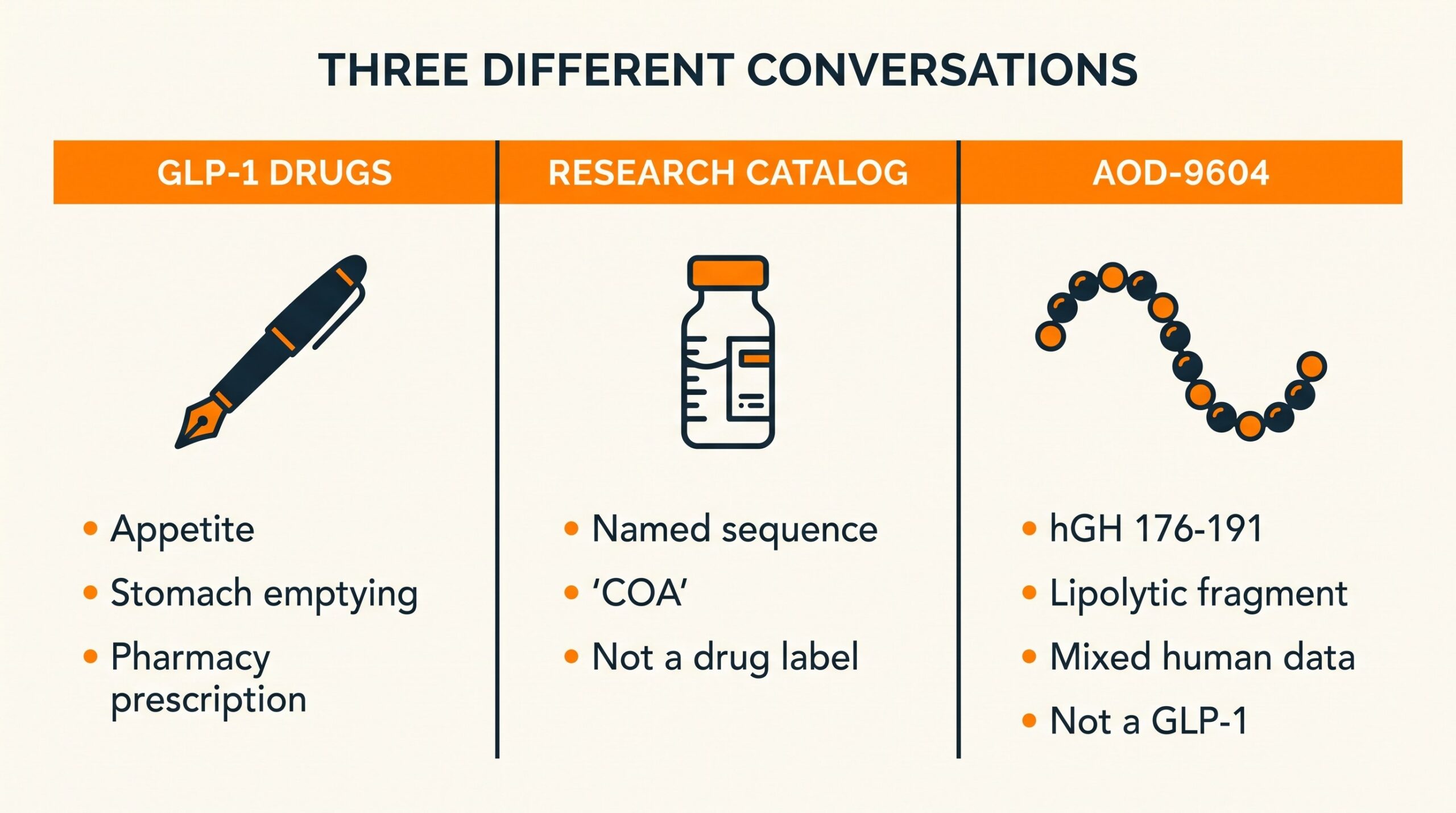
Steal this filter.
| Lane | What it actually is | What the evidence is | Who owns it |
|---|---|---|---|
| GLP-1 / GIP / glucagon agonists | Engineered gut-hormone receptor drugs (semaglutide, tirzepatide, retatrutide) | Large randomized obesity trials in NEJM | A clinician and a pharmacy |
| AOD-9604 | 16-aa lipolytic fragment of hGH (176-191) | Mouse lipid-metabolism papers; mixed human data; no obesity-drug approval | Research-catalog conversation, not a substitute pen |
| Tesamorelin | 44-aa GHRH analog | Visceral fat on CT in HIV lipodystrophy (Egrifta) | Approved-drug indication in a specific population; a research vial is not that label |
You can be interested in all three. You cannot mash them into one Reddit protocol and call it science.
A mitochondrially encoded 16-amino-acid research peptide such as MOTS-c is a different lane from those three — not a GLP-1 and not a GH fragment.
What is AOD-9604, and what does the human data actually say?
AOD-9604 is a 16-amino-acid peptide. The sequence is the C-terminal lipolytic region of human growth hormone, residues 176-191, with a tyrosine added at the N-terminus for stability. You will also see Tyr-hGH 177-191. Same idea.
The design intent was simple. Keep the fat-metabolism piece of hGH. Leave behind the growth-promoting and glucose-disrupting baggage of the full 191-residue hormone.
That is a clever hypothesis. Mouse data exists.
Ng and colleagues published metabolic studies of that synthetic lipolytic domain in Hormone Research in 2000. Heffernan and colleagues followed in Endocrinology in 2001 with chronic treatment in obese mice and beta-3 adrenergic receptor knockout mice. The fragment changed lipid metabolism in those models. It did not behave like a tiny copy of intact hGH on every axis.
Human weight-loss data is the part the sales page skips.
A 2013 paper by Stier, Vos, and Kenley in the Journal of Endocrinology and Metabolism reviewed the human clinical program. They described AOD9604 as generally well tolerated in the studies they covered, without the IGF-1 pattern you expect from intact hGH. That is a safety story. It is not a slam-dunk obesity-drug story. You can read the paper here.
Metabolic Pharmaceuticals ran the obesity program in the 2000s. AOD-9604 is not an FDA-approved weight-loss drug. WADA lists it as prohibited in sport. Mixed human data means mixed. It does not mean “secretly better than tirzepatide if you pin it right.”
If someone tells you AOD-9604 is “the peptide version of a GLP-1,” they are selling. GLP-1s hit gut-hormone receptors that change how hungry you are. AOD-9604 was built as an hGH fragment aimed at lipid metabolism. Different lock. Different key.
I am not going to drop a units-and-days protocol on a public page. That is what Peptides & Pump Pro is for. Ten dollars a month. Seven-day trial. This page is here so you understand the compound before you spend money.
If you ever reconstitute a lyophilized vial, learn how to reconstitute peptides before you waste 10% of it. That article is technique. It is not a fat-loss protocol.
Where do people actually get research-grade AOD-9604?
Education first. This block is the research-catalog SKUs I will put my name on, with the codes that fire. Not a treatment claim. Not “buy this to treat obesity.” GLP-1 drugs stay in the prescription lane with a clinician.
AOD-9604 research vials
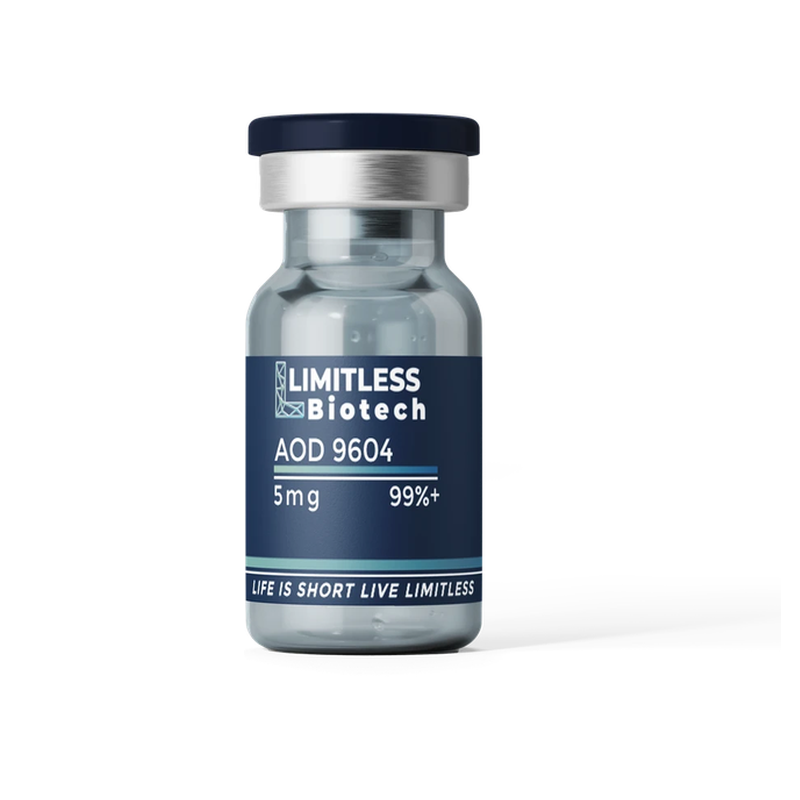
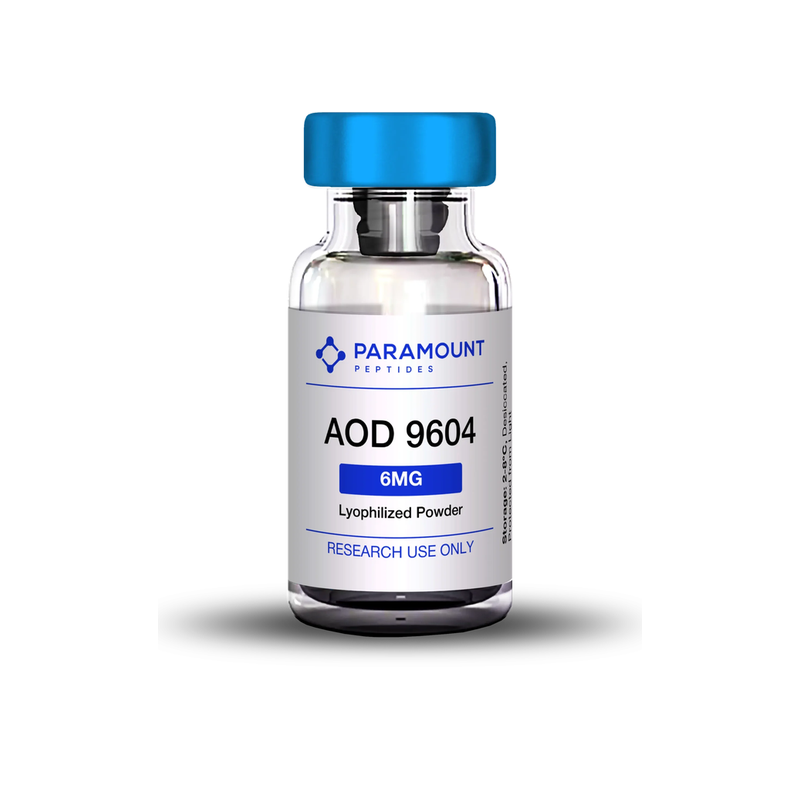
Limitless AOD-9604 · LEE20Paramount AOD-9604 6 mg · LEE10Peptira AOD-9604 5 mg · LEES1 shop · LEE10BioLongevity home · LEE15
Why is tesamorelin a visceral-fat story, not a pinchable-fat hack?
Tesamorelin is a 44-amino-acid analog of growth hormone-releasing hormone. GHRH analog. It signals the pituitary to release GH. That is a different mechanism from an hGH fragment, and it is a different mechanism from a GLP-1.
The human evidence that actually matters is not a forum cut. It is Egrifta.
Tesamorelin, as Egrifta, is FDA-approved to reduce excess abdominal visceral adipose tissue in adults with HIV-associated lipodystrophy. That sentence should slow you down. The indication is specific. The population is specific. The fat depot is specific.
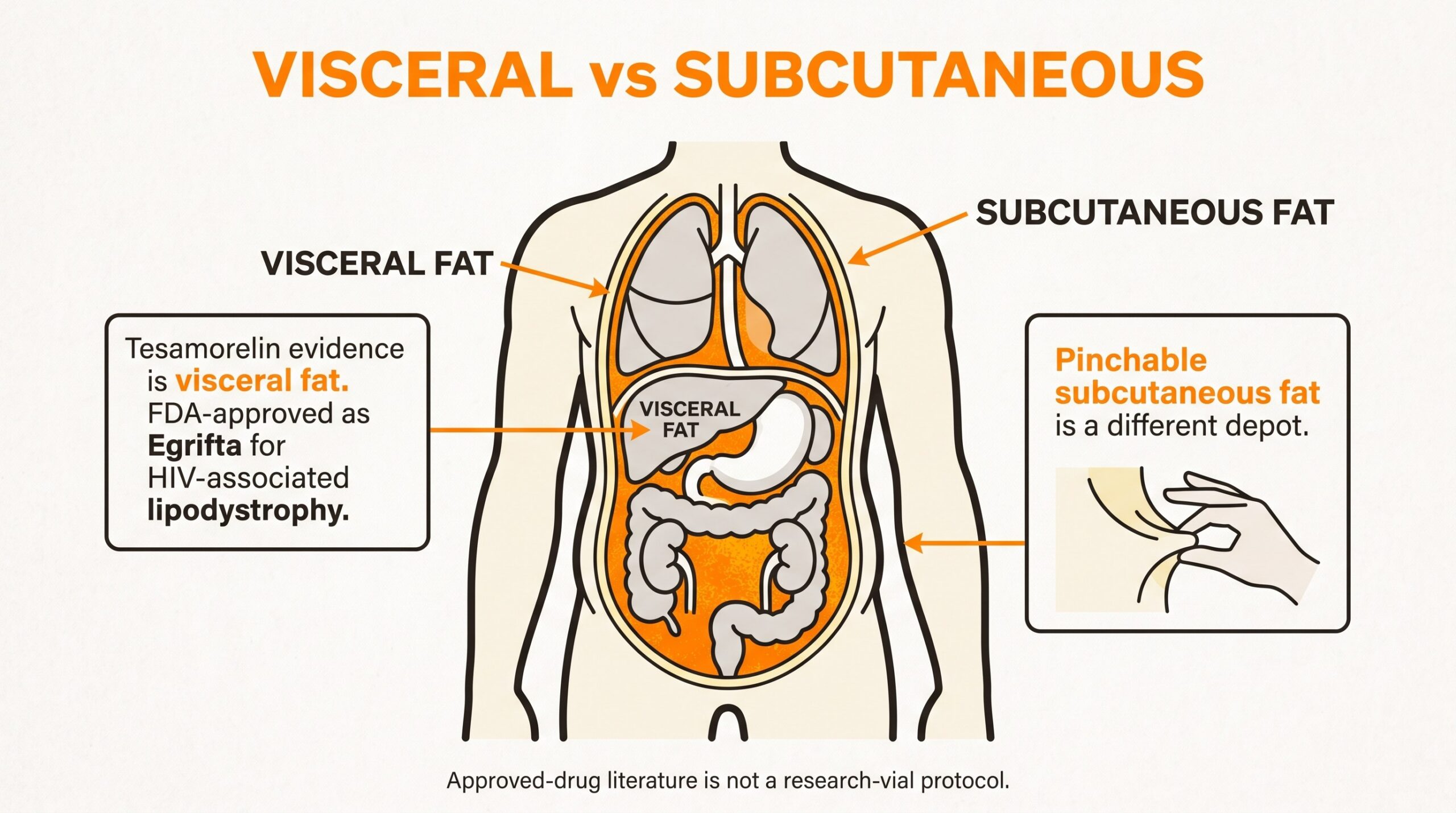
Visceral fat sits deep, around organs. Subcutaneous fat is the pinchable layer under the skin. Tesamorelin’s published effect is on the deep compartment on CT. It is not a magic eraser for the fat you grab at your hip.
Falutz, Grinspoon, and colleagues published a 2007 New England Journal of Medicine trial that randomized 412 people with HIV and abdominal fat accumulation to tesamorelin 2 mg daily or placebo for 26 weeks. Visceral fat on CT dropped on drug. Lipids moved. That is the paper that put the analog on the map as a visceral-fat tool in that population.
A 2010 pooled analysis of two phase 3 trials in the Journal of Clinical Endocrinology & Metabolism (Falutz et al.) reported about a 15% treatment effect on visceral adipose tissue versus placebo, with no meaningful reduction in abdominal subcutaneous fat. Read that again. Visceral down. Subcutaneous basically not the target.
The 52-week extension in AIDS (Falutz, 2008) is duration and safety follow-up, not a reason to run a research vial like a lifestyle drug. Stanley and colleagues in JAMA (2014) looked at visceral fat and liver fat in HIV-infected patients with abdominal fat accumulation. Same analog. Same neighborhood of patients. Still not “tesamorelin for dad-bod.”
A research-catalog tesamorelin 10 mg vial is not Egrifta. Approved-drug literature is not a research-vial protocol. If a vendor implies otherwise, they are counting on you not reading the indication.
Tesamorelin research vials (visceral / GHRH lane — not a pinchable-fat hack)
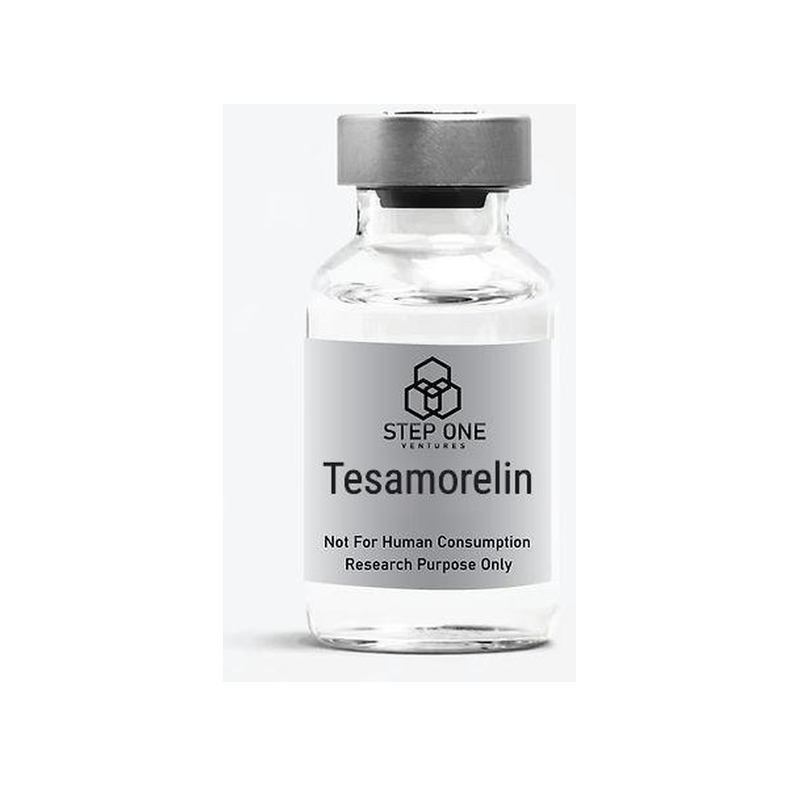
Paramount Tesamorelin 10 mg · LEE10Peptira Tesamorelin · LEES1 Tesamorelin · LEE10
How should a beginner start without copying a forum stack?
Start with the question, not the vial.
Are you trying to change appetite with a prescription incretin drug? That is a clinician visit. Not a reconstitution calculator.
Are you trying to understand a named research fragment because a podcast guest stacked it next to BPC-157? Read the sequence, the fat depot, and the actual papers. Then decide if it even maps to your goal. Oral BPC-157 is a gut-route conversation, by the way. Different job. Different article. Do not drag it into a fat-loss stack because the internet likes the letters BPC.
Are you trying to copy Egrifta because an ad said “visceral fat”? You are not in that trial population until a clinician says you are.
Here is the order I give beginners in my age band.
1. Read first. The Start Here page exists so you do not run five compounds on day one.
2. Name the molecule. If you cannot explain what a peptide is in one sentence, you are not ready to shop a catalog.
3. Separate the lanes. GLP-1s in the prescription bucket. AOD-9604 in the “fragment with mixed human data” bucket. Tesamorelin in the “GHRH analog, visceral evidence in HIV lipodystrophy” bucket.
4. Learn the mechanics if you ever mix a vial. How to reconstitute peptides is boring on purpose. Boring keeps you from wasting money.
5. Ask before you buy random. The free Peptides & Pump Knowledge Base is where sourcing questions belong. Pro is where the protocol library lives. Public pages like this one exist so Google stops lying to you.
Can AOD-9604 replace a GLP-1?
No.
Different receptors. Different jobs. Different evidence piles. A lipolytic hGH fragment is not an incretin agonist. If a GLP-1 is medically appropriate, that is a prescription conversation with a qualified professional. AOD-9604 is not a loophole around a drug label, a side-effect profile, or a diagnosis.
Is tesamorelin a weight-loss peptide?
It is a GHRH analog with a visceral-fat indication as Egrifta in HIV-associated lipodystrophy. Weight on the scale and pinchable subcutaneous fat are not the same endpoint as VAT on a CT scan. Do not borrow the brand indication and paste it onto a research vial. That is how people get hurt, broke, and confused.
Do “fat loss peptides” from a research catalog need a COA?
If you are even in the research-catalog lane, yes. A named sequence without a current certificate of analysis is a hope. Hope is not a method. I still want a clinician in the loop for anything that sounds like a drug, because some of these molecules are drugs in another bottle.
Where do full protocols live?
Peptides & Pump Pro. $10 a month. 7-day trial. Cancel anytime. This public page answers the search question. It is not a protocol. It is not medical advice. It is not a cure.
If you want the library, member discussions, and a place to think out loud before you spend money, join Peptides & Pump Pro. If you are not ready to pay, use the free Knowledge Base first. Then come back and argue with me when you have read more than a caption.
The bottom line
“Peptides for weight loss” is a search term, not a molecule.
GLP-1s are a prescription-drug conversation. AOD-9604 is an hGH 176-191 lipolytic fragment with mixed human data. Tesamorelin is a GHRH analog whose visceral-fat evidence is Egrifta in HIV lipodystrophy. Head-to-head incretin talk lives on tirzepatide vs semaglutide.
Keep the lanes. Read the papers. Do not buy a stack because a caption told you to.
Skin-search blends like GLOW are not a fat-loss lane. If that is the tab you meant, the map is glow peptide.
Read next: AOD-9604 for the hGH fragment lane, tirzepatide vs semaglutide for labeled incretins, and MOTS-c if the mitochondrial search is what brought you here.
I built Peptides & Pump so you can get this without a guru tax. More on the About page if you want the long version of who is writing this.
Free guide
Get The Peptide PlaybookEnter your email and we’ll send the research PDF. Education only — not medical advice.
 Keep going on Peptides & Pump
Free is the peptide community. Pro is where you master it.
Free
Knowledge Base
The peptide community · 2,500+
- 2,500+ member peptide community
- Sourcing questions before you buy anything random
- The basics, from people actually using peptides
Pro
Peptides & Pump Pro
$10/mo · 7-day trial
- Science-backed protocol library
- 1-on-1 support from Lee and Matt
- Step-by-step video, plus a monthly $500 drawing
LEE20 Limitless LEE15 BioLongevity Paramount LEE Peptira LEE10 S1
Next reads
Supplier footnote: Other research suppliers I mention when people ask: Paramount AOD-9604 6mg and Paramount Tesamorelin 10mg, Peptira AOD-9604 (code LEE), and S1 Research (code LEE10). Match the product to the job. Do not collect bottles.
Disclaimer. This article is for educational and research purposes only. It is not medical advice. It is not intended to diagnose, treat, cure, or prevent any disease. AOD-9604 and research-catalog tesamorelin are not FDA-approved weight-loss drugs. Tesamorelin as Egrifta is FDA-approved only to reduce excess abdominal visceral adipose tissue in adults with HIV-associated lipodystrophy. Semaglutide and tirzepatide products used for chronic weight management are prescription drugs; that is a clinician conversation, not a research-vial protocol. Most of the published evidence for research-lane fragments is preclinical or mixed in humans. Individual results vary. Always consult a qualified healthcare provider before starting any peptide, supplement, or protocol, especially if you have a medical condition or take prescription medication. Peptides & Pump does not sell peptides.
Affiliate disclosure. Some links on this page are affiliate links. If you buy through them, I may earn a commission at no extra cost to you. Codes LEE15, LEE20, LEE10, and LEE are the ones I actually use. That commission is how I keep publishing free education. I only link suppliers I am willing to put my name on.

7 Comments